A current application due for determination next week generated very few responses. Yet with Cambridge’s huge inequalities, a new unitary council could take control of the consultation processes and ensure schools have the administrative resources to respond, and that developers organise their timetables that synchronise with the academic year.
To be fair to South Cambridgeshire District Council, they established a Youth Engagement Service to be that bridge between developers and young people – and it has been highly successful. (Award-winning even – you can read more about it here.)
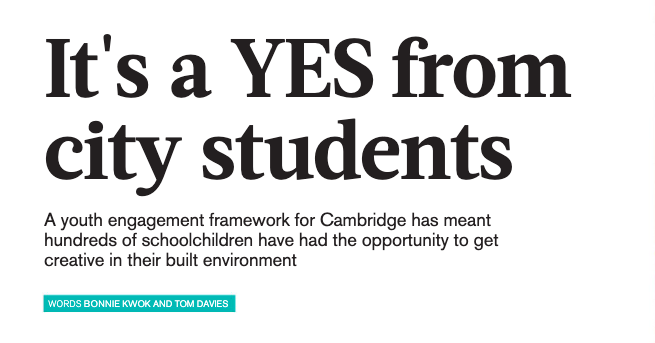
Above – South Cambridgeshire’s youth engagement framework was featured in Cambridge Architecture CA86 (Nov 2023) in an article by Bonnie Kwok and Tom Davies – do have a read.
As good as that service is, it’s not compulsory, and in this era of underfunded schools in our chronically unequal city, there are a host of opportunities we’re missing. At the same time both the curriculum review (which reported back recently) and the restructure of local government mean that the new unitary council could build on what is a successful setup.
The challenges
The current fragmented nature of local public service provision makes it all but impossible for ‘place-based co-ordination’ or what we might call Total Place 2.0. Instead we’ve got a system of academies and the growing Multi-Academy Trusts which were critiqued by Warwick Mansell for Prospect the Union here.
With so many large developments in the pipeline, schools inevitably get approached in the consultation phases where developers have to draft a community engagement strategy. This is what happened with the Trinity Hall Farm redevelopment that is up before councillors next week. I’ve also seen similar engagement with some of the recent sci-tech developments, in particular at the Land South of Coldham’s Lane site currently called Cherry Hinton Innovation. <<– Scroll down to see their video with GCSP.
“What does the Trinity Hall Farm proposal look like?”
Grim. The less said the better.
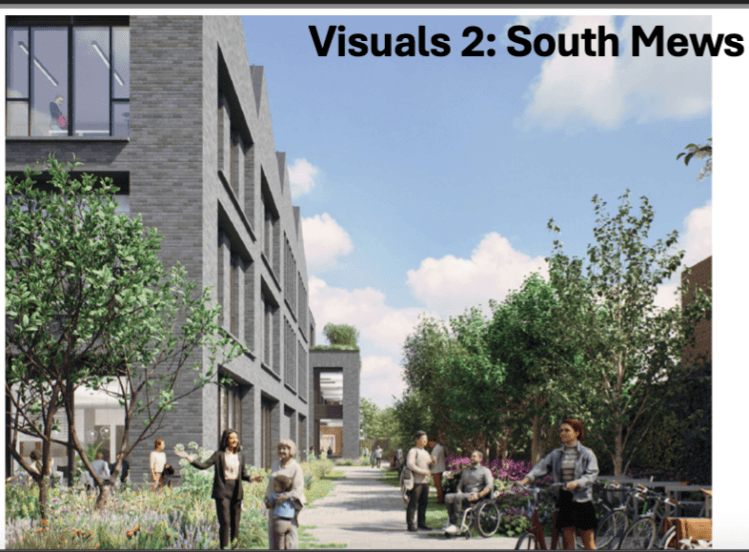
Above – Carbuncle-tastic designs with ***lots of grey***
You can see the documents at https://applications.greatercambridgeplanning.org/online-applications/ Ref 25/00016/FUL, and the developer’s website here.
Cambridge Past, Present and Future have opposed it
“Cambridge Past Present & Future object to this application because we do not consider that the development meets the requirements of Policy 57 in that the design, in terms of location on the site, height, scale and form, are inappropriate when viewed in the wider context.”
Above – CambridgePPF 2025 cases, scroll to Trinity Hall Farm,
“How good are the community engagement activities?”
At best it’s splendid. At worst it’s tick-box stuff done by London consultancies who know nothing about the city. In the case of Trinity Hall Farm:
“Brockton Everlast (the Applicant) appointed Marengo Communications, an independent specialist public consultation company, to undertake the pre-application community, and stakeholder consultation”
Above – Statement of Community Involvement (Dec 2024) Ref: 25/00016/FUL
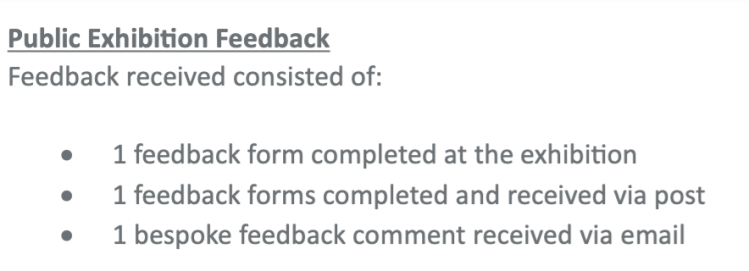
Above – results of the first consultation exhibitions (3 events) in 2022
This was followed by trios of events in March 2024, and July 2024
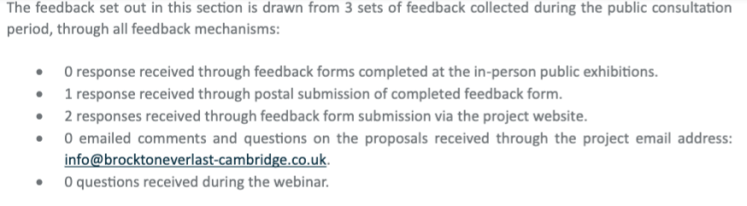
Above – from March 2024
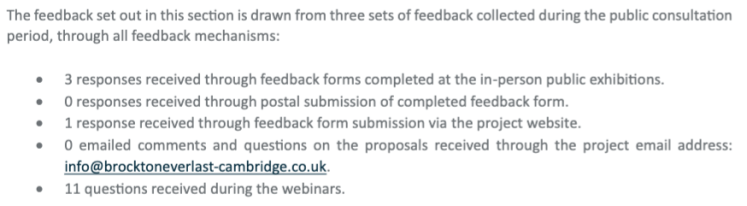
Above – from July 2024
“That’s embarrassing”
It ticked all the boxes though.
“Really?!?”
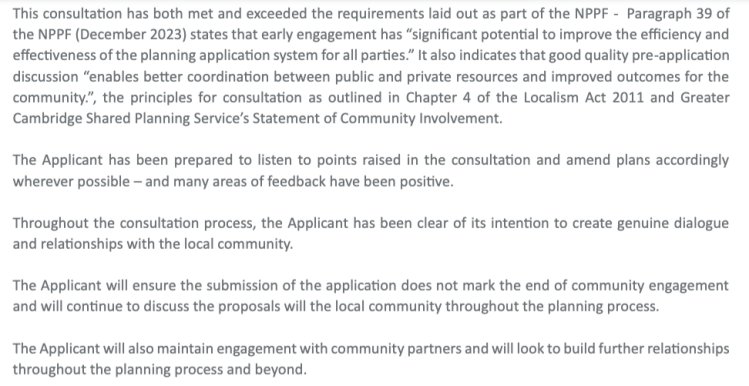
Above: “The consultation has both met and exceeded the requirements laid out as part of the National Planning Policy Framework”
I don’t really know who to be embarrassed for. But given the scale of the development something has gone wrong. At the same time we have to be mindful of a host of other major planning applications including:
- The Cambridge Science Park
- Cambridge Business Park (Crown Estates)
- The now frozen Hartree / Cambridge Waterworks
At the same time there’s also:
- The emerging Greater Cambridge Local Plan – which I have already organised new events for
- The North East Cambridge Area Action Plan
- North Cambridge Framework for Chance – now out to consultation
And that’s before we’ve considered:
- The CPCA Local Growth Plan with new concert hall for Cambridge
- The revamped Local Transport Plan with new light rail and Greater Cambridge Transport Strategy, which the CPCA Transport Committee will be discussing on 17 Nov 2025.
“That thing about consultation overload?”
Consolidate, co-ordinate, simplify
What I wrote back in March 2023 on overcoming Cambridgeshire’s consultation problems.
At the moment we’re nowhere near there. And as the Trinity Hall Farm case study shows, developers are not getting anything back either.
“Could AI be used to pick out some key findings from all of the statements of community engagement submitted to the GCSP Service?”
Now there’s an idea for Cambridge’s research students!
And in principle despite my huge reservations of the environmental impact amongst other things, this is the sort of task that AI was meant to be designed for: Analysing otherwise impossibly-large volumes of paperwork and text to pick out the important issues.
Given that planning services are digitised, it should be possible to download all of the document types for each and every planning application, and then instruct the AI to analyse them accordingly. I don’t claim it’s fool-proof. One of the key warnings that AI platforms seem to come with are on accuracy. What would the total figure be on the number of consultation responses from the public? What would the cumulative total of objections be for each different reason? (i.e. for each material consideration allowed for in planning law?)
To conclude?
Ideally there would be a unit within the new unitary council that would have an overall schedule of which schools and year groups would get the most out of responding to community engagement offers from developers. In particular anything that assisted the children’s learning and their familiarity with both local democracy and with how buildings and infrastructure get built.
But that also means transferring some of the huge profits that developers make and will make with the growth of Cambridge and transferring them to the schools and youth organisations for the benefit of children and young people.
This is something that civic-minded individuals within industry could start making the case for. And if not this, something better that achieved similar outcomes for the children and young people in terms of their knowledge and understanding of both local democracy, town planning, and urban development.
If you are interested in the longer term future of Cambridge, and on what happens at the local democracy meetings where decisions are made, feel free to:
- Follow me on BSky
- Spot me on LinkedIn
- Like my Facebook page
- Consider a small donation to help fund my continued research and reporting on local democracy in and around Cambridge


