
It remains to be seen whether the final plans will be an improvement to what were in the documents submitted by the RAILPEN who lobbied ministers heavily to get the application called in.
You can see:
- The GovUK Press Release here
- The BBC Cambridgeshire summary here
- See the press release from the Better Beehive Campaign whose actions led to an improved design
Personally I don’t think the application should have been called in for ministers to decide. That said, the current government has shown its willingness to call in applications and overturn refusals from local councils for large applications that look like they could create lots of new jobs. This one being one such case. The only reason I can see based on the long-established Caborn Principles for calling this in is that the application is so large that it will have an impact on long term economic growth beyond a single planning authority area.
Credit to the campaigners and local residents for their work in securing a series of improvements to the original application – irrespective of the decision (see the Better Beehive Campaign’s latest blogpost here)
This has been a very long time in the works – the first I heard of it was in June 2022 which I wrote about here. Three-and-a-half-years later and the amended application has been approved – although someone will have to compare what was originally proposed vs what’s in the ‘approved-by-ministers’ version.
Nearly 550 documents in the final folder for this application
To browse them, get to the planning portal at https://applications.greatercambridgeplanning.org/online-applications/ and type in the reference 23/03204/OUT into the simple search box.
Just over a year after we saw the first display boards the financiers RailPen submitted the planning application which had 164 documents. Not a small number for a group of residents to get their heads around. Which is one of the reasons why I encouraged as many people as possible to pick a small aspect of the scheme and focus on it in the hope that others would cover the rest.
I focused on public transport – in particular the lack of light/suburban rail transport. I remember giving RailPen’s property chief Matt Howard (no relation to the Green Party Councillor on Cambridge City Council with the same name) a hard time over transport access – to no avail.
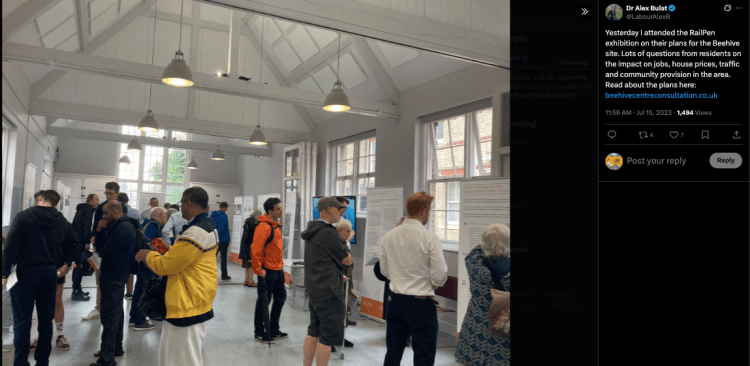
Above – By Cllr Dr Alex Bulat (Then Lab – Abbey Ward) at one of several public exhibitions. It was pouring with rain that day – hence many of us were in rain coats (me in the yellow) with Matt Howard of RailPen in the white shirt, in the old St Barnabas School Hall off Mill Road.
It’s not all bad news
Even very large applications can have positives and these have included:
- CamSkate
- The inclusion of Make Space for Girls in the public space design
- The bringing together of so many different groups and people at a time when consultations are being had on the future of our city
To give you some idea of how much detail I’ve gone into over the years, I’ve written the following on the application
- Redeveloping the Beehive Centre – 15 June 2022
- …and again a day later on 16 June 2022
- Make space for girls charity – getting the developers to meet with them, 21 June 2022
- First plans lacking usable green space – 31 December 2022
- Why the Beehive redevelopment plans need a railway station – 15 July 2023
- Scrutinising the application – 24 August 2023
- The most recent changes – 30 July 2024
…Hence why at the bottom of blogposts I point people to my Ko-fi page to support my research. Because at present there are no schemes for ordinary residents to be compensated for their time spent scrutinising these applications – and also just as importantly, there is no expert ‘public advocate’ to help represent local communities when it comes to such detailed applications. (Relying on local councillors is inevitably hit-and-miss because so much depends on the calibre of candidates that put themselves forward, and most places are not as fortunate as Cambridge is). One of the things I will be asking Mr Freeman to consider is appointing a new residents’ advisory committee on public transport and active travel – one that
- is made up of people whose household income is below the median
- has a critical mass of people from backgrounds seldom heard in planning and development quarters
- Includes a substantial element of education and training
- pays the participants a decent rate for their participation – including the education components
- is accredited for those that want it – whether CDP points or a mayoral certificate that younger participants can put on their CVs.
What would the results be like if you got participants who are or were regular bus users?
Scrutinise the Section 106 Agreement
- Employment & Skills Strategy
- Community Outreach Strategy
- Start-Up Space and Scale-Up Space Strategy
- Community Floorspace
- Public Realm & Public Realm Management Strategy
- Meanwhile Use Strategy
- Local Centre Strategy
- Biodiversity Net Gain
- Off-Site Leisure Contribution
- Travel Plan, Transport Contributions & Monitoring
- Public Art Strategy
All of these need scrutinising and you can read the S106 agreement in the original 2023 application in the planning portal (Ref 23/03204/OUT )
Peter Freeman must insist on a new suburban / metro station for Coldham’s Lane
Or rather whoever the new Chief Executive of the Cambridge Growth Company is, must do so. I wrote about it in July 2023 here.

The image looks southwards at the top, and northwards at the bottom. A rail station over the Coldham’s Lane Bridge could (in principle) provide for four exits. These are:
- North Romsey (residential area – top left of the photo)
- The Beehive Centre (sci-tech park proposals, around 5,000 employees anticipated plus any local residents and visitors using their facilities – top right of the photo)
- The Coral Park Trading Estate and Cambridge Retail Park – which we now know is being redeveloped
- The Centre for Computing History – which is one of Cambridge’s hidden gems, (bottom left of the photo)
Given the longstanding chronic traffic issues on Coldham’s Lane, and given that a critical mass of people working on the site will have to come in from outside of Cambridge, it makes sense either to have a metro stop at Coldham’s Lane Bridge by the Beehive Centre, or some sort of safe extended active travel path from where the proposed Cambridge East Station will be at the Barnwell Road Coldham’s Lane Junction.
Anyway, let’s see what the detail says when people more qualified than me have unpicked the 122 page document published today.
If you are interested in the longer term future of Cambridge, and on what happens at the local democracy meetings where decisions are made, feel free to:
- Follow me on BSky
- Spot me on LinkedIn
- Like my Facebook page
- Consider a small donation to help fund my continued research and reporting on local democracy in and around Cambridge

 The Cambridge Town Owl