I was sort of fortunate because I had one of my local city councillors and my local county councillor represented on the committees that formed the selection of councillors doing the cross examination.
Of the write-ups I’ve seen from councillors, you can see:
- The extended account from Cllr Karen Young (LibDems – Queen Edith’s)
- The short sharp summary from Cllr Dave Baigent (Your Party / Ind, Romsey)
Additionally I also expect we will see accounts from:
- Cambridge Labour – most likely Cllr Katie Thornburrow
- Cambridge Green Party – most likely from their group leader Cllr Naomi Bennett, or from Cllr Hugh Clough (Newnham) who was on the committee
The return of Hartree?
The application’s not dead?
It’s not dead yet. #SorryNotSorryForTheMusicalTheatreReference.
“That will come as an unpleasant surprise for the Save Honey Hill supporters”
They created a song too – sing along!
Actually, my take for some time has been that the scale of the Housing Minister’s ambitions for Cambridge are so great that an expanded Cambridge will need not just the relocated works, but at least one more *plus* the upgrades of all of the other smaller sewage processing sites.
“Why the smaller sites?”
Have a look at the emerging local plan assessment reports – in particular the Greater Cambridge Integrated Water Management Study – Detailed Water Cycle Study (2025) which Stantec were commissioned to carry out. (Do Ctrl+F or scroll down to just below ‘Third Party Docs’)
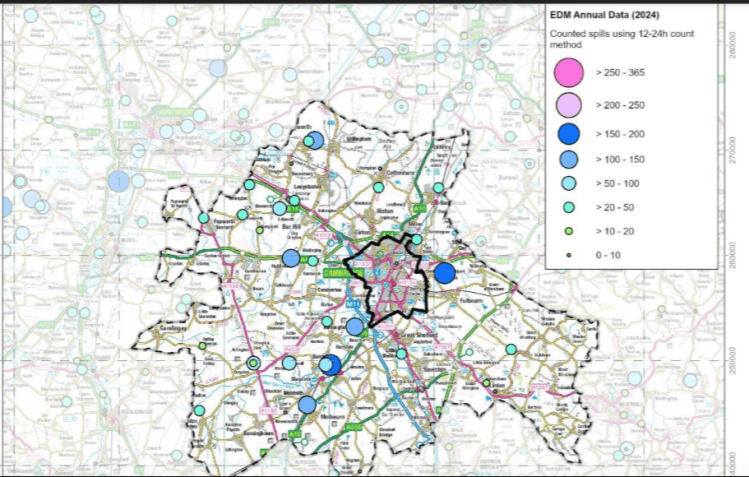
Above – Figure 4.3: Monitored Storm Overflow spills in Greater Cambridge in 2024
The larger the circle, the greater the number of storm overflow spills there were in 2024. (i.e. where the rainwater flowed into the drains, mixed with the sewage in the sewers, and spilled over into the water courses. Which is why I have never gone swimming in the River Cam).
“And the water supply?”
You can read the detail in the Cambridge Area Water Supply Evidence (2025) study by Atkins-Realis.

Above – I’ve not read this. I don’t dare! (It’s the first document in the climate change subsection in the list)
I’ve picked out a couple of diagrams instead.
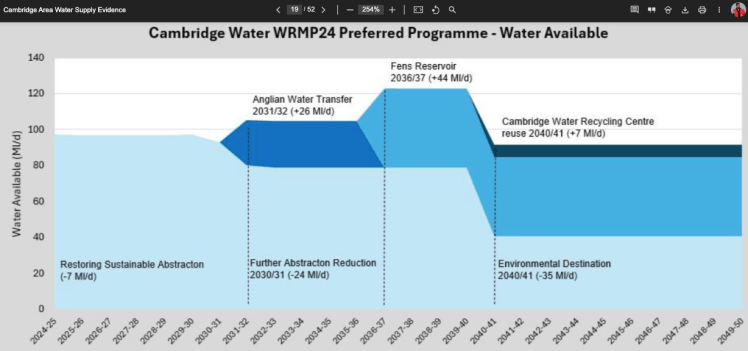
Above – Cambridge Area Water Supply Evidence (2025) p19 – proposals on reducing abstraction from nature
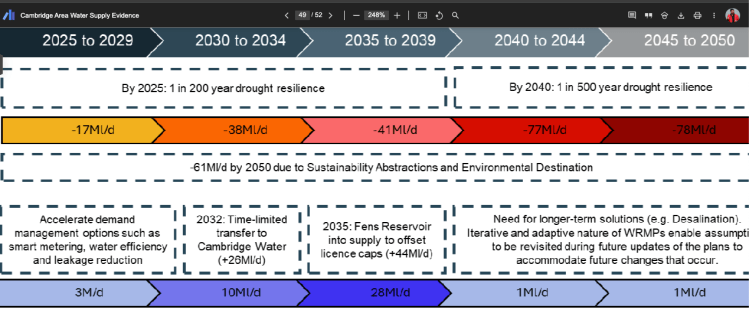
Above – Cambridge Area Water Supply Evidence (2025) p49 – what needs to happen by when to make the region more water-resilient.
I.e. that report needs someone with more expertise than me to look at it. Especially those assumptions.
Anglian Water as a significant risk
This goes with all of the utility companies. It seems that institutions are still in an era where ‘collaborative partnership working’ is meant to solve the problems. But in reality we’re now in an era of institutional turmoil made worse by what’s happening internationally.
The ultimate lever the Government could pull if Anglian Water does not ‘reappraise its programme of investments’ is to nationalise the company, change the leadership, and be done with it.
While I can’t see the current PM pulling off such a move, his successor (if a Labour PM) might not have such reservations, especially if they were more left-leaning, were committed to the growth plans, and decided that privatised utility firms could not be allowed to get in the way of the government achieving its objectives.
Working with the NHS
The problem here is the fragmentation between the NHS (and above that the Department for Health and Social Care) and the rest of government.
Back in my regional government office days I found it astonishing that the regional public health teams sat in their own section with their own systems in a building that was supposed to facilitate cross-departmental working. Although this was over 20 years ago, it reflected a mindset and a culture that for the cohort of young ambitious 20-somethings that made the majority of new recruits was completely…exactly. We could not understand the stubbornness.
So when I heard about this from Mr Freeman, I can’t say I was surprised.
“Urban and Civic have told me they have offered a free plot and money on five of their schemes but they have never been take up from the clinical commissioning group. We believe passionately that if you don’t provide those (healthcare) facilities you won’t get the community engagement or takeup”
Peter Freeman to Cambridge City Council 09 Dec 2025. 2h53m
Which is why I can understand why some political parties and politicians say that primary care should be taken out of the control of the NHS and placed under the oversight of an empowered tier of local government.
One other thing that struck me was how dependent Mr Freeman is on ministerial support and Treasury approval. As mentioned in my earlier post there does not seem to be any mechanism for:
- Taxing the excess wealth generated in the Cambridge economic sub-region – in particular from the creation of negative externalities from some activities (Eg buying up of properties for Air BnB use / very short term lets)
- Creating and implementing local solutions for chronic problems – such as the shortage of town planners or dentists which again using revenues raised locally could easily part-fund a new training schools at existing institutions.
At the moment the Combined Authority is consulting on its medium term budget – you currently get a pop up on their landing page asking you to fill it in. But where is the genuine flexibility in the proposals? I responded to their consultation and in the grand scheme of things it’s hard to see how the general public can provide a meaningful response. It’s a tick box exercise.
Total Place 2.0 – is the local government revamp/unitarisation an end or a stopping point?
One policy open to re-examination for the Minister for Housing is Total Place – brought in by the former Communities Secretary John Denham at the end of Gordon Brown’s Government (I wrote about it here). The lessons from the short-lived programmes was written up in a report by Re-State a few months ago which you can read here.
One of the things I think should be at the heart of what the Cambridge Growth Company does is having governance structures in mind. Once their work is done, will the governance institutions be able to maintain and sustain what they’ve built? And will they be able to evolve in the face of the challenges of future ages?
If you are interested in the longer term future of Cambridge, and on what happens at the local democracy meetings where decisions are made, feel free to:
- Follow me on BSky
- Spot me on LinkedIn
- Like my Facebook page
- Consider a small donation to help fund my continued research and reporting on local democracy in and around Cambridge

 The Cambridge Town Owl