This follows on from my previous post on the draft Infrastructure Delivery Plan – which is probably why it’s still a draft and why the consultants need the wider public to scrutinise it
TL/DR: Have a look at the tables on proposed new sports pitches, then ask about provision by things like gender, age, mobility and more.
HAVE YOUR SAY
The Greater Cambridge Shared Planning Service of the City and District councils says: “Please contact us at LocalPlan [@] greatercambridgeplanning [.] org should you have any questions”. So if you want to have a discussion about this or any other issues raised in the consultation document and/or something in the huge accompanying document library, email them ***Or***… get in touch with one of your local elected councillors and *ask them to make representations on your behalf to the responsible council officers on your behalf* via https://www.writetothem.com/
For those of you who have never responded to a consultation before, going via your local councillor can be a more useful way as they will be more familiar with your local context, and even visit your school/college/community group if it is something that several of you would like to talk about.
On infrastructure delivery – sports facilities (outdoor ones)
I concede that both my analysis and opinions here are *very limited* when compared with life experience on this front (being a generally grumpy middle-aged bloke who moans a lot and doesn’t get out as much as I’d like!) so I’m writing this more as a plea for others to have a look at it and/or anyone who can get a new generation of young women and girls interested not just in sports provision but shaping the future of their city and county as well.
The issue? This table in the section on proposed outdoor sports facilities in the recently-published Greater Cambridge Infrastructure Delivery Strategy.
These are six of twelve rows below. The previous five above are all football pitch-related items (fortunately the girls are catching up – no thanks to the Football Association which should be compensating their game due to the 50 year ban) and the final row is for tennis courts.

Above – Priority Projects – summary of outdoor facilities, p104
The only field of view I have of secondary school is what I lived through. In the context of sports, in that table it was the boys that played cricket and rugby, while the girls played hockey. Even assuming that were still the case, the first thing that strikes me in that table is how under-provided for the girls and women’s sports are.
Going back to my early 1990s growing up in South Cambridge, the Conservatives had so badly under-funded education that a number of sports pitches at a number of schools could no longer be maintained and were abandoned as wasteland.
This was from a county council document published in the 1980s that I bought in one of the periodic Cambridgeshire Collection sales that referred to ‘a typical secondary school’ in the county.

Above – ‘A typical Cambridgeshire Secondary School’ in the early-mid 1980s’
If the building style looks familiar, it’s because many schools were built in the post-war era using similar materials with similar pattern books. In this case, none of these buildings exist anymore, and the land to the bottom of the picture (can you see the goal posts?) was sold off for housing.
Therefore the provision of sports facilities matters. And it matters more that they can have some sort of permanence that makes it harder for politicians to take them away in the short-medium term. (In the long term, things like demographic change inevitably mean public service provision has to adapt, just as it has to in our ageing society – something GCSE and A-level geography warned us about at the end of the last Millennium).
Obviously this isn’t the 1990s anymore, and sports facilities have to be much more accessible and equitable
There was a big round of sports pavilion building and upgrading in and just after the Year 2000 as ministers made a big effort to upgrade community facilities with the support of national lottery funding. So it’s not as simple as assuming that one plot of grass will be allocated to Rugby Union for men and men only all year around. That’s not how the sporting seasons work. Which then brings us into that other elephant in the room: Governance structures. That will be outside of the remit of the local plan *and* the Cambridge Growth Company, but someone somewhere is going to have to figure out what the best groupings are likely to be to enable as many to participate and enjoy the facilities as possible. That also means having some sort of pipeline/structure for adults and volunteers as well – mindful that the Saturday morning football sessions I used to enjoy as a child came to an end because there were no available adult volunteers to take over my age cohort.
I hope the Make Space for Girls Charity can encourage their local supporters to pick up on this
See https://www.makespaceforgirls.co.uk/ for more on their work. They were involved in the design of some of the social areas in the recently-approved-by-ministers Beehive Redevelopment application – see the quotation from the charity here. Their involvement I think started with some social media exchanges such as this one in June 2022, and giving them a mention in a webinar facilitated by the developers and their consultants and leaving them to it. Now that the outline permission has been granted, I hope that they can bring their ideas through to completion and set a new high standard for others to aspire towards.
The point being that they’ve done it before, so can they now bring that learning to bear on the future of the city and district?
I hope so – and this is also where the likes of the Cambridge Growth Company should be tapping into the expertise of the Association for Teaching Citizenship and the Youth Engagement Service more locally to get that infrastructure report refreshed.
Trying to plan for the future – current demand vs induced demand
There are so many things that make all but impossible to get right.
- A snapshot of sporting activities today won’t be the same as in ten years time – even if population turnover was zero. In what shape will you be in ten years time? Exactly.
- Planning for ten/twenty/thirty years time also means having to plan for the increases in population that the new homes will be occupied by. (And that’s assuming we won’t be facing catastrophic consequences of climate change – which will bring its own urban design challenges including unexpected things like the need for shade from a hot sun).
- What will sporting and exercise fashions be like over the next few decades? Will the changing urban design – eg the greater presence of cycleways and active travel routes encourage higher rates of participation per capita than at present?
Which is why I think that table on outdoor facilities – and also indoor ones too, need scrutinising.
Talking of which, the non-swimming-related facilities included squash, padel, and indoor bowling.
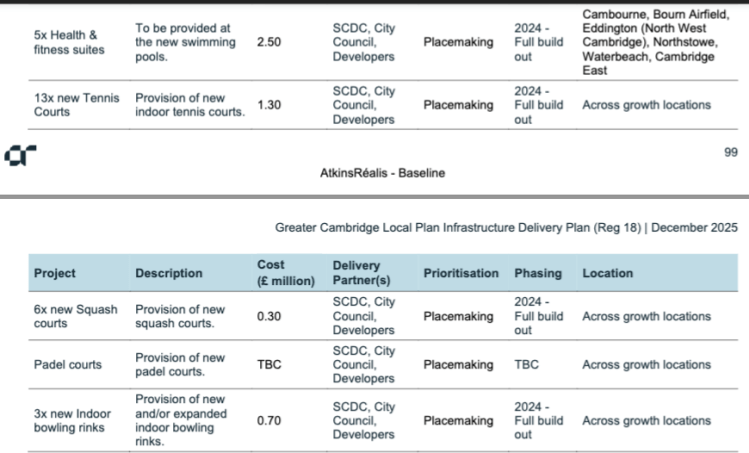
Above – Priority Projects – summary of indoor facilities, p99-100
Are there other sports and leisure activities (noting how popular Darts and Snooker are these days) that could be incorporated into new social amenities?
Now…what’s next? The Cultural Infrastructure Study you say? Part one of three?
If you are interested in the longer term future of Cambridge, and on what happens at the local democracy meetings where decisions are made, feel free to:
- Follow me on BSky
- Spot me on LinkedIn
- Like my Facebook page
- Consider a small donation to help fund my continued research and reporting on local democracy in and around Cambridge

 The Cambridge Town Owl