
I went to the afternoon session of the launch event at Anglia Ruskin University earlier – mainly to plead the case for lifelong learning. Fortunately one of the speakers (Mark Wakeford of Ovo Energy) on the panel made the case for me.
You can read the report here (scroll to the end for the PDF)
To summarise on the headline:
- No single governance organisation is responsible for co-ordinating (and ultimately empowered to pull rank on) policies and actions in a region that has multiple different councils and histories spanning it – businesses and investors like to know who is in charge
- No single assembly is responsible for oversight and scrutiny in a high profile manner
- The one opportunity to provide that much-needed in-depth overhaul of the governance of England was spurned by the Conservatives in Government even though a select committee which they made the majority of MPs on in the last Parliament said they should table the legislation to enable such a commission to start work.
And so our governance structures remain a mess
At the afternoon session, Mark Wakeford said lots of sensible things about lifelong learning – not least the need to familiarise the public so that they can give informed consent about the changes that we will have to see in the retrofitting of our towns and cities. But given the scale of the changes needed, I still don’t get the sense we have any idea of what will soon be asked of all of us – especially now that we are beyond the stage of prevention.
Mr Wakeford stated how there had not been a substantial lifelong learning policy in England for some time – and this was holding back the skills agenda as well as the response to the climate emergency. In the grand scheme of things I agree with him – you only have to look at the tiny skills budgets of the CPCA combined with the lack of a firm policy on adult education and lifelong learning more generally. What there currently is has been summarised in this useful briefing from the House of Lords Library. But at a local ‘day-to-day’ level there’s not much out there. (Some of you may be interested in the old NIACE publications on adult education in England). Current campaigns for lifelong learning include:
Being the local historian (formerly of ARU over 20 years ago!) I reminded the audience of what the university used to have, and asked the panel if we could have it back please!
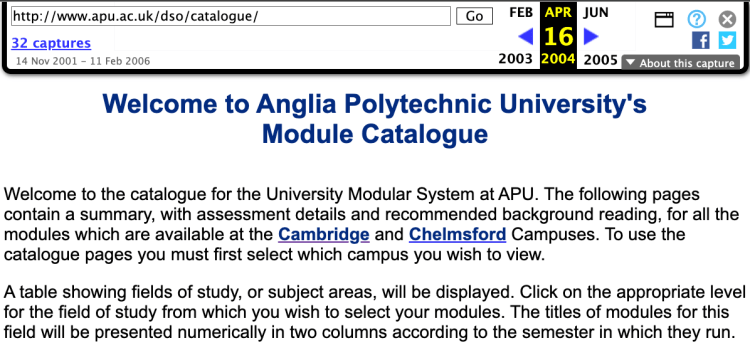
Above – detail from the Cambridge APU module catalogue – the Comic Sans font gives the date away, even if the text above it does not!
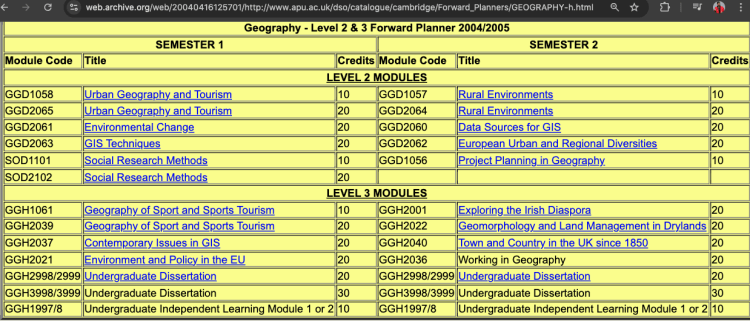
Above – some of the modules from the Geography options from 2004/05
I can’t speak for the morning session, but the afternoon session did not fill me with much hope for the future on skills policy
Not for the fault of the speakers or the participants – similar themes from other conferences, events, and speeches are now cropping up that it’s hard to ignore them.
The biggest barrier to progress? HM Treasury
It’s like this huge Black Hole (in the astronomy sense) where any decent policy idea that passes anywhere near it gets drawn into it by its sheer gravitational force…and is then never heard of again. (Yeah – why were we not allowed to study Space at secondary school in the 1990s? Or the Dinosaurs?!? You can see why I want this new lifelong learning college, right?)
Last month I wrote a piece about how Whitehall controls skills policy, and how for Cambridgeshire and Peterborough at least, the Combined Authority is little more than a local delivery or commissioning agent. Which is why I find CPCA Skills Committee meetings ever so dull and frustrating. It can’t be much better for the councillors on that committee because in the grand scheme of things all they are there to do is to agree local interpretations of national targets, and to approve procurement/commissioning exercises.
“What would an alternative be like?”
A local or regional tier of the state would be able to raise revenues from within their own geographical areas through a much wider range of tax-raising powers than what they currently have (and HMT can ‘top slice’ the totals raised to redistribute to those areas unable to raise them locally) to pay for a much more comprehensive system of adult skills and lifelong learning. The Politics involved would be which tax levers to pull and by how much. And as for local priorities in addition to whatever central government had for its ones, the local/regional tiers could add their own ones and fund them accordingly.
In fact, that’s similar to what things used to be like a hundred years ago – when culture and communications technology made over-centralisation much harder to pull off. Take Leicester City Council in 1939 below and compare their responsibilities with any local council today. (Note the presence of the utilities – and air raid wardens!)
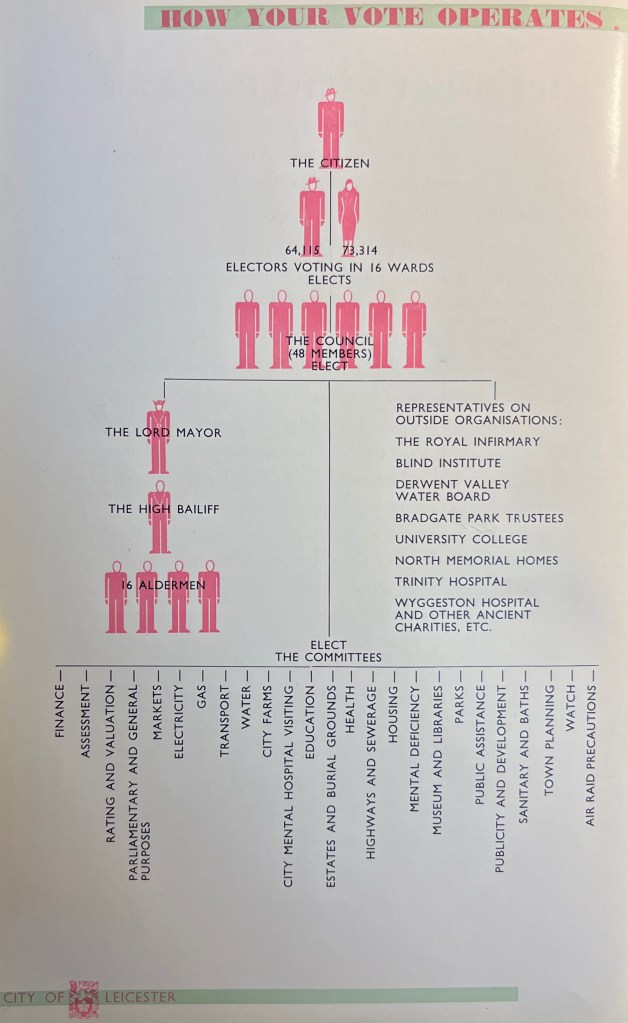
Above – Civic Affairs, the City of Leicester (1939) p5 – note the huge range of public services that the City of Leicester under the oversight of its councillors were responsible for. Furthermore note the Board presence of the council on the old University College – now the University of Leicester
It’s worth browsing through the full document Civic Affairs, the City of Leicester (1939) because it was published to help educate and inform its citizens – noting that equal suffrage for adults was only achieved just over a decade before. (And this 1983 guide tells me civics for adults is something we should bring back!)

Above – Political Education for Adults – something that should help form the essential competencies of anyone working in a public-policy-facing field
The history of the rise and fall of municipal local government in England is told by Tristram Hunt in his epic Building Jerusalem. If you want to see a reflection of his conclusion of the fall of the status of local government he says compare the architecture and location of Victorian town halls (eg Leeds Town Hall – grand and at the heart of the city) to the miserable anonymous box stuck out of the edge of a business park that is South Cambridgeshire Hall. Hunt said one is a place where people meet and where collective decisions are debated and made, while the other is an administrative building there to process the decisions taken elsewhere.
**The Politicians…**
This was the theme that kept on coming back time and again. So much so that I almost wanted to defend them. The closest I got in my public question was asking the audience to get in touch with their local MP or councillors about the issues we debated that afternoon because there’s no point in complaining about politicians not doing things you want them to do if you don’t ask them in the first instance. And that has to start locally.
It’s not just the politicians that the pro-growth skills advocates need to engage with – it’s the general public. And on that we’re all failing. (Me included).
One of the participants who asked a question said she was from Wisbech, and spoke of the longstanding poor infrastructure problem that North Cambridgeshire has had for decades – something their local MPs even when ministers did not push for that infrastructure to be built and/or upgraded. Fast forward to 2025 and nearly all of the county-level seats of that Fenland District (which the town of Wisbech is in) voted for TeamNigel candidates. (See the map here – the sky blue seats in the north of Cambridgeshire). With 25 percent of the seats within Cambridge City going to The Green Party, the growth of the Cambridge economic sub-region is not something that growth supporters can take for granted. The negative externalities are now so great (along with other concerns in national and international politics) that they are showing up at the ballot box.
That’s also one of the reasons why more people in public-policy-facing workplaces need to familiarise ourselves with policy-making processes. Not what the textbooks say, but how it works in practice. That said if you want some festive reading, have a look at
- The Politico’s guide to Lobbying,
- How to be a minister
- How to be a parliamentary researcher
- How to be a civil servant (Like I was back in the day)
- How to be an MP (The late-author of which was the first MP to follow Puffles on Birdsite – one for those of you who remember the early 2010s)
(Actually – as a quick aside, this conference was noticeable for not having a live social media presence. Certainly not in the afternoon – no hashtag, no live blogs etc. Which for me reflects how much damage past and current owners of the global SocMed brands have done to something that could have been beneficial to so many.)
**The Government has got to provide funding…**
…was another theme that kept on coming up – especially on infrastructure spending. Time and again I wanted to shout:
***No! The Government instead has to table the legislation in Parliament to free up local and regional tiers of government from Whitehall micromanagement and empower councils with far greater, wider, and deeper tax/revenue-raising powers so that they don’t have to lobby government all of the time!***
But I thought better of it. (The result of reading up more on neurodiversity and nipping the urge to interrupt in the bud)
The woman from Wisbech who asked what I thought was a very good public question – one that none of the panellists really had an answer for (Ideally it would have been nice for it to have been put to Daniel Zeichner MP at his morning panel session) brought the focus to legitimacy. i.e. the assumption that the public wold go on accepting the headlines of more money being spent on Oxford-Cambridge things while others went without.
Land value uplift levies, and land value taxes to fund local government
This for me is one of the reasons why ministers really need to get a move on with a comprehensive policy on all things land value – from annual taxes to co-fund local services through to taxing the paper-increase of land as an asset when it moves from agricultural land (low value because you can’t build on it) to when it is designated in a new local plan for development (raised value because you can build on it).
If we can get to a system where in ministerial statements that information can be made public, the public concern that ‘rich Cambridge is getting all the nice stuff (we’re not), that might go some way to alleviating the concerns. Especially if it means less affluent parts of the country benefit from redirected central funds. The last I heard from ministers when they were asked if local government funding systems would be overhauled was
Why more people at such local/regional public policy conferences need to follow up event attendance with correspondence with their MPs
Have a read of Dr Catherine Howe’s blogpost here on broken feedback loops in Whitehall. Melanie Collins of Skills England (who took a fair amount of heat as one of the few civil servants on the afternoon panels) underlined the need for evidence bases to support requests for more funding or policy changes. Lots of correspondence from local constituents going via MPs is an evidence base for local support. (https://www.writetothem.com/ for those of you willing to do so)
Is a refreshed version of Total Place an answer?
If you are interested in the longer term future of Cambridge, and on what happens at the local democracy meetings where decisions are made, feel free to:
- Follow me on BSky
- Spot me on LinkedIn
- Like my Facebook page
- Consider a small donation to help fund my continued research and reporting on local democracy in and around Cambridge

“It’s time for Total Place 2.0”: John Denham in conversation with Jessica Studdert
 The Cambridge Town Owl