
The Oxford-Cambridge Supercluster Board published a report called The Economic Power of the Oxford-Cambridge Growth Corridor. The report calls an overhauled, simplified governance structure
The top-three recommendations are:
- Fast-track East West Rail approvals, with an accelerated examination timetable, adequate resourcing of the Planning Inspectorate and phased delivery starting this parliament.
- Create a single Oxford–Cambridge Growth Corridor governance structure, covering the whole region and led by a figurehead empowered to align government, industry and universities.
- Publish a supercluster-wide strategy and spatial plan, clearly prioritising sites for homes, labs and workspace alongside supporting infrastructure.
I wrote about the lack of governance structures and institutions a month ago
I wrote this following the recent skills conference at Anglia Ruskin University, describing the challenge as a ‘governance-shaped gap’. Expanding on this, I wrote that the problems the OxCamArc / Growth Corridor faced were:
- No single governance organisation is responsible for co-ordinating (and ultimately empowered to pull rank on) policies and actions in a region that has multiple different councils and histories spanning it – businesses and investors like to know who is in charge
- No single assembly is responsible for oversight and scrutiny in a high profile manner
- The one opportunity to provide that much-needed in-depth overhaul of the governance of England was spurned by the Conservatives in Government even though a select committee which they made the majority of MPs on in the last Parliament said they should table the legislation to enable such a commission to start work.
No combined authority/strategic authority for the OxCamArc area
In July 2025 the Government published a series of fact sheets on the areas of England that had already established combined authorities or which were work in progress.
The problem at the moment is that Cambridgeshire and Peterborough aside, none of the component councils on the growth corridor/OxCamArc have completed devolution negotiations.
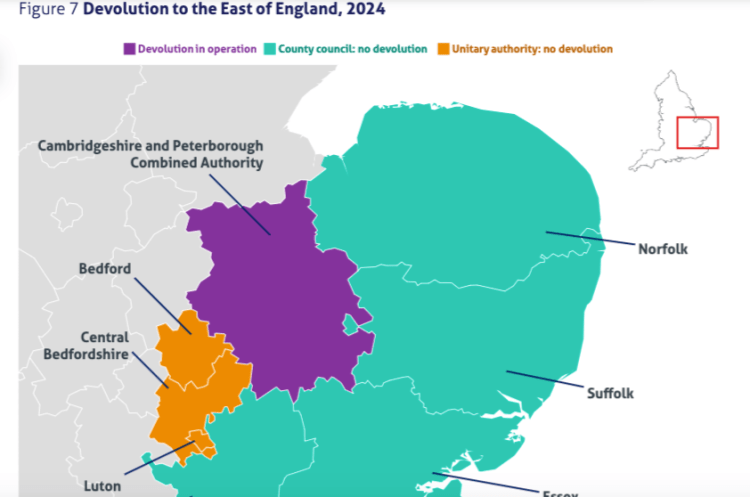

Above – Institute for Govt (2024) Completing the English Devolution Map – pp31 and 47
At present, everything west of Cambridgeshire is a mess of quangos and partnerships that give the impression they were invented on the back of the ministerial envelope
Over recent times the councils in Oxfordshire and Berkshire have got together to submit an expression of interest in forming a ‘Thames Valley Strategy Authority’
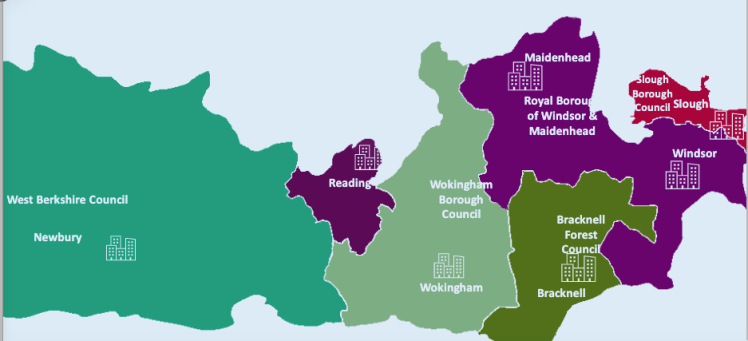
Above – from the Berkshire Prosperity Board 16 Dec 2024.
The problem is that other parts of the government have different definitions of what area the Thames Valley covers. For example:
- Department for Education in 2016 had Buckinghamshire and Milton Keynes in their ‘Thames Valley‘
- Department for Transport’s subregional transport planning body covering the OxCamArc/corridor doesn’t include Berkshire but does include Hertfordshire

Above – EEH next to the other English sub-regional transport areas

Above – the detailed map (various sources) of the local government areas that are in the Oxford-Cambridge Growth Corridor that was outlined in The Chancellor’s comment in the recent investment prospectus.
And that does not match things like the Varsity Active Travel Corridor
Between 1994-2010 there was a network of Government Offices ‘for the regions’, the brainchild of Michael Heseltine when he was John Major’s Deputy Prime Minister
The advantage they had was that these geographical areas matched the old Regional Development Agencies that were designed to match the criteria for European Union regional development funding.

Above – from the ERDF Report by the Commons Select Committee for Communities & Local Government
Because of the UK’s huge inequalities, a number of English regions received substantial investment from EU funds (which had to be evidence-based, not based on party political preferences) – and those areas were hard-hit by the UK leaving the EU because the Pro-leave governments that followed did not match the lost revenue pound-for-pound. On top of that, wider investment funding from the European Investment Bank has also not been marched by the new UK equivalent.
Had they remained in place, the regional offices for the South East, and for the East of England might have been able to cover the governance gap. Gordon Brown wanted to create stronger regional structures and began with proposed ‘regional select committees’ along with a named minister for each government office area. These didn’t get off the ground because both the Conservatives and Liberal Democrats in the 2005-10 Parliament boycotted them.
The Tories scrapped the old Regional Spatial Strategies – and the Government Office Network too
Or you could say the Liberal Democrats in the Coalition enabled them to do so, but the decision was primarily Eric Pickles’ call.

Above – You can read the draft East of England Plan of March 2010 here.
I wrote about the old RSS in the context of not needing everything located in Cambridge, saying that the county towns of Bedford and Northampton should become designated ‘landing sites’ for Cambridge’ based startups that become too big for the city eg because land prices are too high. (I expanded on that theme in this recent post). I also make the case for the eastward upgrades of railway lines in particular making the case for regenerating the old east-coast resorts through tourism from a growing Cambridge.
Why there needs to be a strategy and spatial plan
The graph in the Supercluster report reveals that London, Oxford, and Cambridge together received more venture capital funding than the rest of England put together. Which speaks volumes.
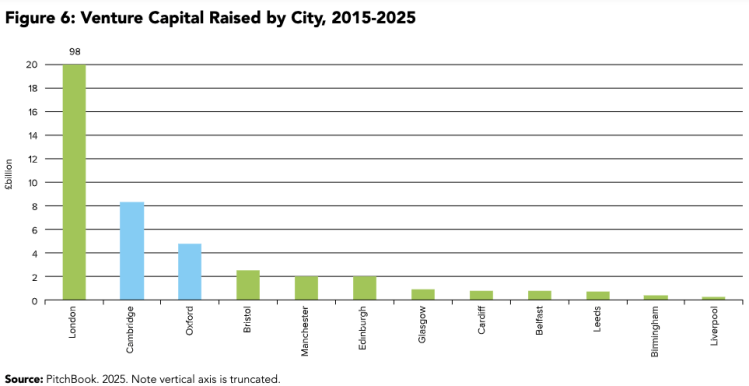
Above – Supercluster Report p14
This is why transport funding and construction are ever so important. But the problem remains that everything gets micromanaged by The Treasury. Hence there’s a growing case for a percentage of tax revenue from sources like income tax to be allocated by formula grant to local and/or regional tiers of government that then are the responsibility of those local areas. The challenge is then ensuring there are sound structures and systems of accountability and fraud prevention. The lack of directly-elected assemblies and/or high profile scrutiny committees (in part because of a collapsed local media ecosystem and non-existent democracy education for adults) means that building this up is a task-and-a-half.
For those wealthy and powerful interests calling for that single governance structure, one interesting question to put to them is this:
Would they we willing to be scrutinised by directly-elected representatives of that single governance institution to ensure propriety and transparency of policy and spending decisions?
Comments on the metaphorical postcard please.
If you are interested in the longer term future of Cambridge, and on what happens at the local democracy meetings where decisions are made, feel free to:
- Follow me on BSky
- Spot me on LinkedIn
- Like my Facebook page
- Consider a small donation to help fund my continued research and reporting on local democracy in and around Cambridge

 The Cambridge Town Owl