TL/DR? We’re doomed – give up now. Or is there hope we can turn things around?
Nature security assessment on global biodiversity loss, ecosystem collapse and national security
It’s also worth seeing these in the context of the wider UK National Risk Register produced by the Government which indicates what the state has made preparations for, and which of the catastrophes it thinks are more likely to happen and what impact they are likely to have. Civil contingencies has been in the public eye because of the collective experience of the pandemic which still has not gone away.
“So all of this is on top of the existing risk register?”
Yes – and these findings are grim. But we cannot say we were not warned. Some of us are old enough to remember the Blue Peter Green Book from 35 years ago.
“Global ecosystem degradation and collapse threaten UK national security and prosperity. The world is already experiencing impacts including crop failures, intensified natural disasters and infectious disease outbreaks. Threats will increase with degradation and intensify with collapse. Without major intervention to reverse the current trend, this is highly likely to continue to 2050 and beyond.”
Above – UKGov Biodiversity Loss Assessment 2026 p2
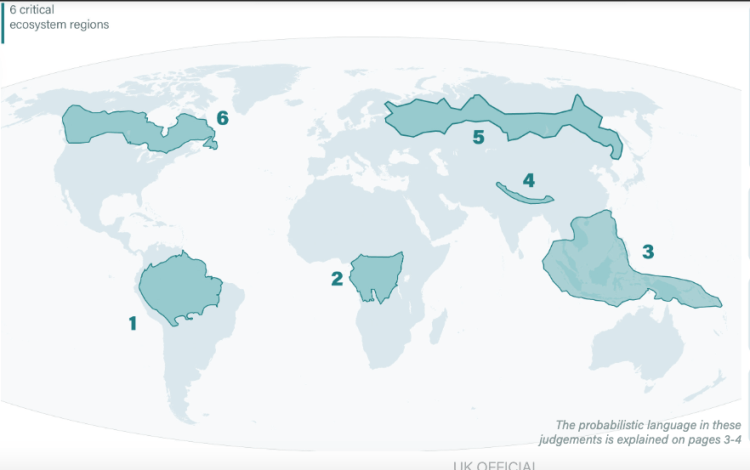
Above – the six critical ecosystems, p8
The tropical rainforests of The Amazon, Central Africa, the coral reefs and mangroves of South-East Asia, along with the Himalayan glaciers, and the boreal forests of North America and Russia are all highlighted as critical ecosystem regions. Or ‘Biomes’ as we were taught in GCSE Geography in the 1990s.
- Migration will rise as development gains begin to reverse and more people are pushed into poverty, food and water insecurity. A one percentage increase in food insecurity in a population compels 1.9 percent more people to migrate.
- Serious and Organised Crime will look to exploit and gain control over scarce resources. More people pushed into poverty will mean more opportunities for SOC to exploit (e.g. people trafficking and black markets in scarce food, pharmaceuticals, critical minerals).
- Non-state actors including terrorist groups will have more opportunities resulting from political instability – e.g. acting as mercenaries or pseudo-governments. They may gain control over scarce resources.State threats become more severe as some states become more exposed than others to food and water insecurity risks.
- Pandemic risk will increase as biodiversity degrades, people move between countries and transfer of novel diseases between species becomes more likely.
- Economic insecurity becomes more likely. Nature is a finite asset which underpins the global economy. It would take resources of 1.6 Earths to sustain the world’s current levels of consumption. The total annual value of ecosystem services to the UK was £87 billion in 2022 (3% of GDP).
- Geopolitical competition will increase as countries compete for scarce resources including arable land, productive waters, safe transit routes, critical minerals.
- Political polarisation and instability will grow in food and water insecure areas and as populations become more vulnerable to natural disasters. Disinformation will increase.
- Conflict and military escalation will become more likely, both within and between states, as groups compete for arable land and food and water resources. Existing conflicts will be exacerbated.“
Above – The national security risks if we carry on as normal, p9
“And the UK-specific challenges?”
It’s not good. The headlines on p10 are:
- The UK relies on global markets for its food and for fertiliser.
- The UK is unable to be food self-sufficient at present, based on current diets and prices.
- UK food production is vulnerable to ecosystem degradation and collapse.
- UK food production is vulnerable to ecosystem degradation and collapse.
- Ecosystem degradation or collapse affecting major food producing regions would increase resource scarcity and drive up global food prices.
- Significant disruption to international markets as a result of ecosystem degradation or collapse will put UK food security at risk
- Some technologies exist that could help, but need significant research, development and investment to have achance of working at scale. Protecting and restoring ecosystems is easier, cheaper and more reliable.
Above – Impact on food security in the UK, p10
“So, what is to be done?”
Interestingly, ***there are no specific policy recommendations***
Which indicates that:
- We’re doomed
- We already know what they are – it’s that we don’t have the party political consensus to do what we need to do to implement the policies and undertake the actions.
It’s not just the ‘Be more green / recycle more / consume fewer meat pies’ lifestyle slogans and exhortations that matter here. If anything they have been tested to their limits.
“Where’s the ministerial press release?”
There isn’t one – which is why environmentalists and Green Party figures are calling it out.
Above – former Green Party Leader and Brighton Pavilion MP Caroline Lucas on Bluesky.
It will be interesting to see if the Energy Secretary volunteers a statement – normally Ed Miliband is on top of things like this. I’d be surprised if it required an Urgent Question in the Commons to get a formal response out of ministers
Failing that, expect Prime Minister’s Questions to force the PM to respond.
All of this puts the growth of Cambridge into perspective – something that Prof Romola Davenport of the Faculty of Geography asked me about earlier at the CRASSH Urban Histories evening.
I wasn’t nearly as clear as I would like to have been because #NeurodiversityBurnout + CFS/ME kicking in with a vengeance.
Prof Davenport asked what my view was on the rapid growth of Cambridge. In terms of the very big picture, I’m extremely uncomfortable with what I still call the OxCamArc. I am more sympathetic to the establishment of a devolved English Parliament and executive mirroring what Scotland has, and located in one of the great northern cities. Or rather anywhere between Birmingham and Leeds inclusive. That way those institutions that like or need to be close to where big decision-making functions take place would have to move out of London – rebalancing not just the economy but society too.
Additionally I gave the example of Redcliffe-Maud’s Royal Commission report on the Governance of England 1966-69 with his proposals for powerful unitary councils and a new regional tier of provinces for England as the framework to build more powerful locally and regionally accountable institutions as something to work from.
The previous Conservative Government started the policy of the hyper-rapid growth of Cambridge under Michael Gove, and that has been continued by the present government
Mindful of the earlier paragraphs, I’m also of the view that we had the general election, ministers have made their policy statements to Parliament, and the rapid growth of Cambridge (and the wider Oxford-Cambridge Growth Corridor (can you see why I’m sticking with OxCamArc?)) are now going ahead. The only way to stop this politically/peacefully from an ordinary resident’s perspective is to get involved either in party politics – joining a party opposing the growth (Eg The Green Party), or joining a campaign group opposing the growth. (Alternatively the climate emergency and/or global economic collapse might end up having a similar impact.
Therefore, the task for people like me now is how to ensure the whole thing doesn’t leave my home town looking like a disaster zone. Or at least trying anyway!
Prof Davenport questioned me on the options other than the proposed new towns that were available to ministers. This reminded me of the debates on how Cambridge should grow in the late 1990s.
“What were the options back then?”
It was all about the Cambridge Futures programme which I wrote about in my Lost Cambridge blog here.

Above – The Seven Futures for Cambridge (Nov 1999) from the Wayback Machine
The options were:
- Minimum Growth
- Densification
- Necklace villages
- Green Swap
- Better transport links
- Virtual highway
- New Towns
Such was the scale of growth that followed that with the exception of continuing with Holford and Wright’s vision of keeping Cambridge as a compact university town, one way or another we got all of the above. (Give or take the better transport links if you look at the state of bus services and the number of pot holes in the roads!)
With the present water crisis and sewage capacity crisis (note we were here half a century ago during the planning embargo of 1974-78 from the old Anglian Water Authority) we may well find out in the next decade or so what the environmental limits to growth are. (Hence my take that ministers should look at neighbouring county towns that have old industrial and riverside locations potentially available for investment – especially where existing land uses such as big warehouse retail are declining). Because not everything needs to be in Cambridge, does it?
If you are interested in the longer term future of Cambridge, and on what happens at the local democracy meetings where decisions are made, feel free to:
- Follow me on BSky
- Spot me on LinkedIn
- Like my Facebook page
- Consider a small donation to help fund my continued research and reporting on local democracy in and around Cambridge.

 The Cambridge Town Owl