An old map arrived in the post a week ago which shows how extensive the east-west rail links from Cambridge used to be. Plus some recent findings in the world of old magazines and past research reports
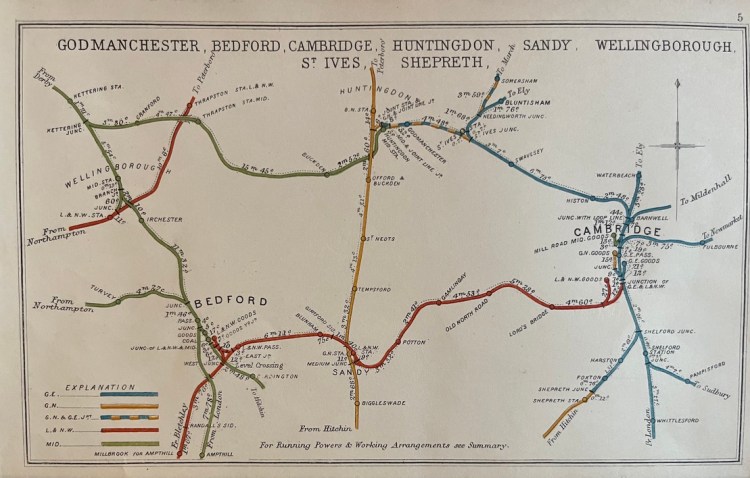
Above – the old Cambridge – Huntingdon – Kettering route.
There are lots of photos on the Railway Correspondence Travel Society (RCTS) here which also reminds us of the old Histon to Hunstanton rail service that connected the district to the seaside. (Today, the only direct seaside rail link is to Brighton!)
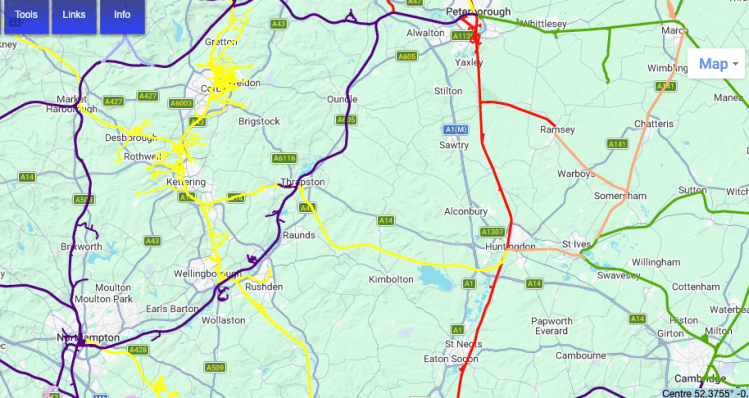
Above – It looks more interesting when you can play about with it as on RailMapOnline
I had a look at the options of reconnecting Cambridge with western county towns in a previous blogpost here, wondering if having Bedford as a ‘landing spot’ for growing firms in Cambridge that got too big for the city to relocate in a co-ordinated manner, and then further onto Northampton.
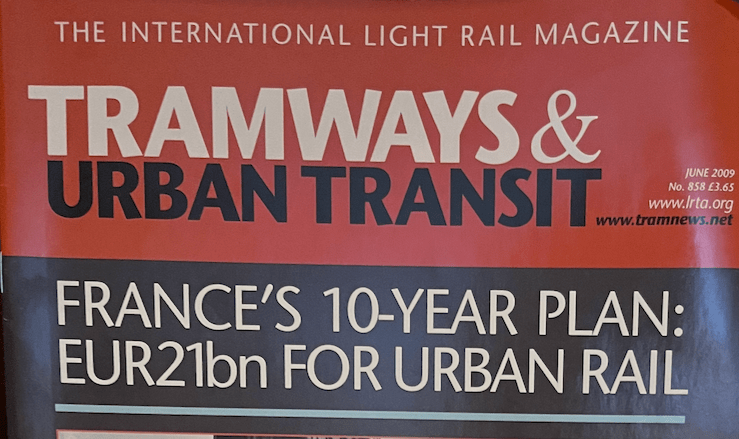
Also, I’m reminded that over a decade ago, France was already making great strides in its expansion of trams and light rail in its cities
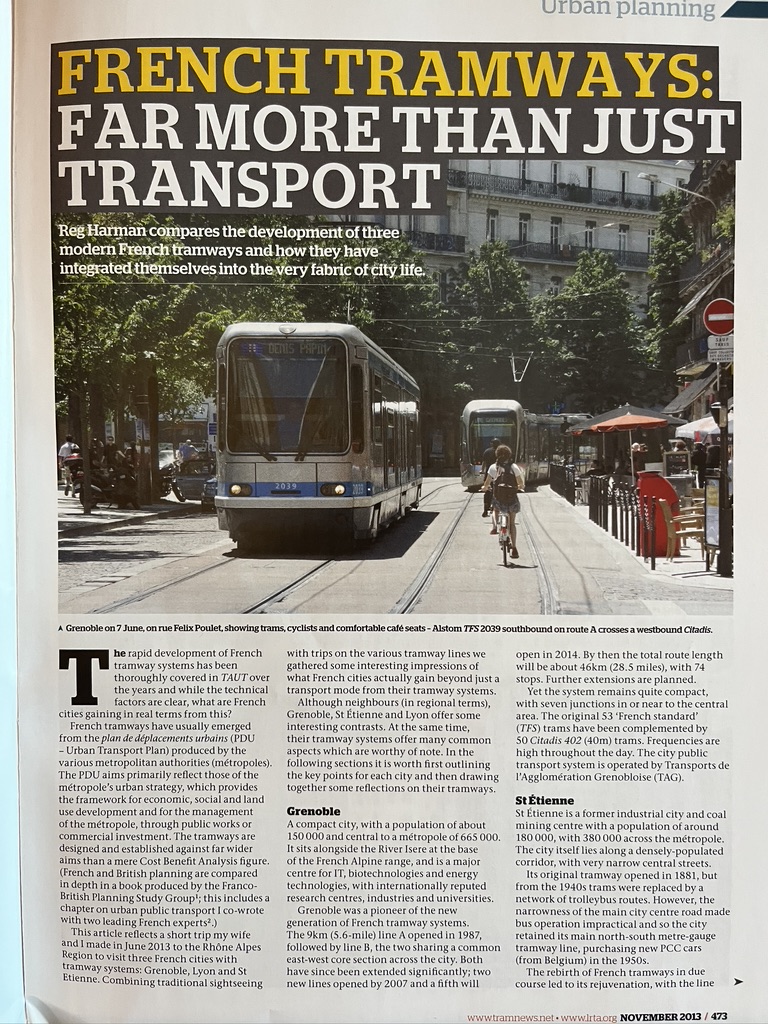
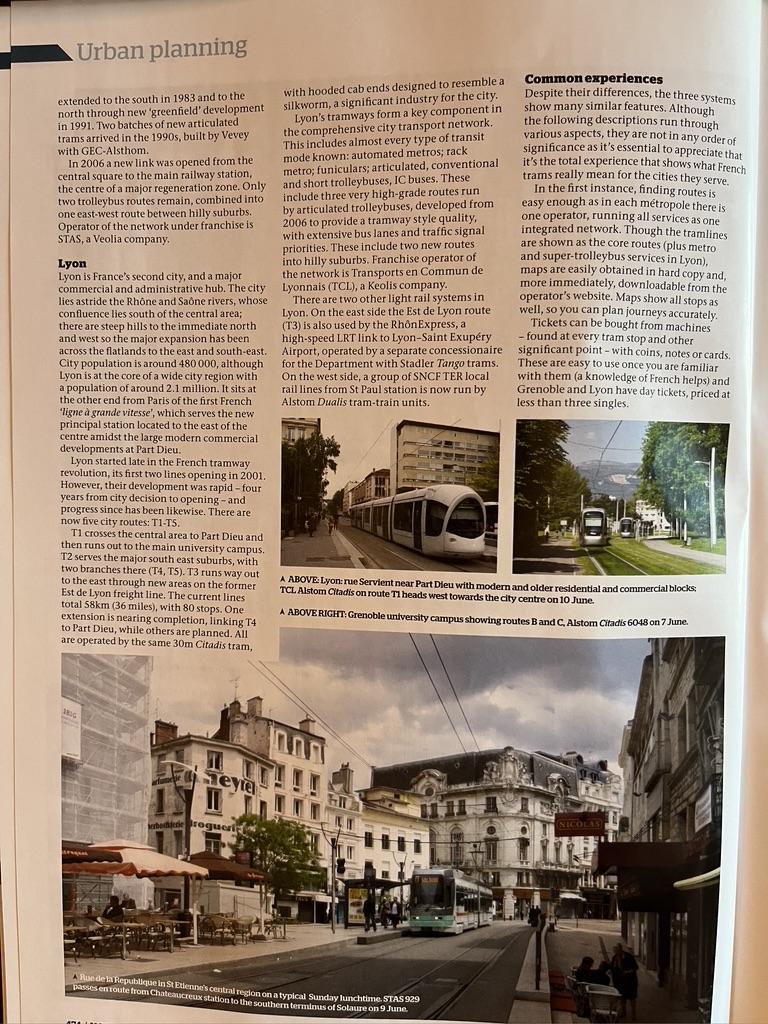
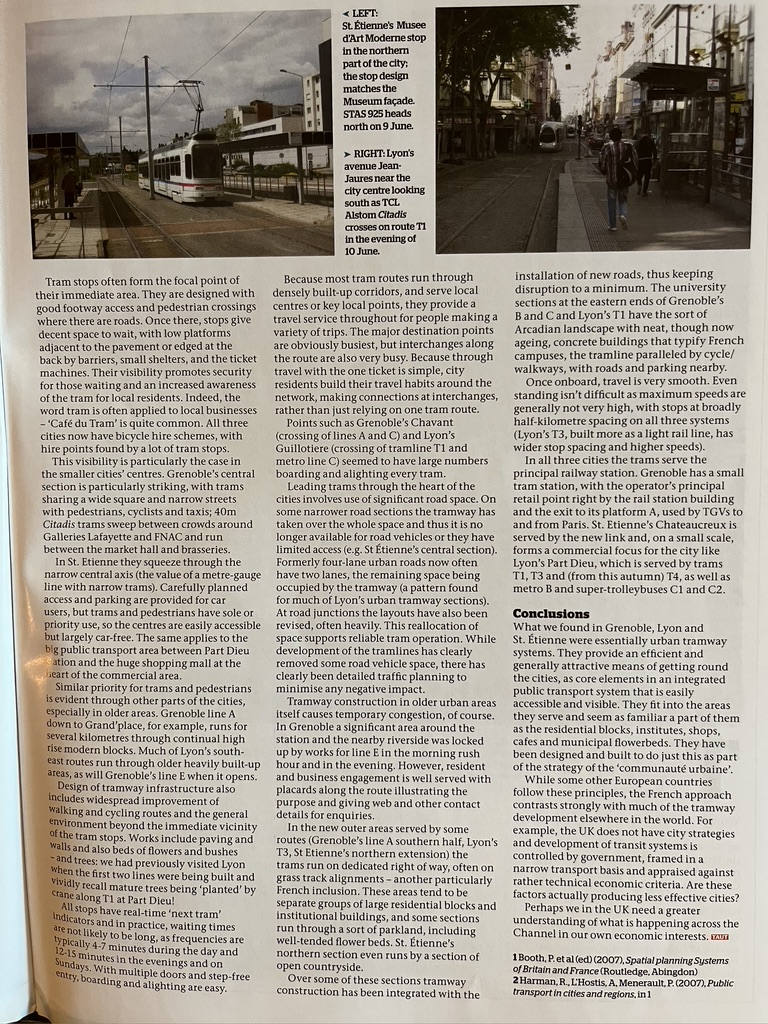
Above Light Rail and Urban Transit No 911 Nov 2013, published by the LRTA which you can join here, the magazine being part of the membership package. (I bought this one off of an auction site that you may have heard of – they’ve got more here)
Which reminds me – I still don’t know why we didn’t get the Cambridge Futures proposal that the Cambridge Evening News in May 1999 told us all about.
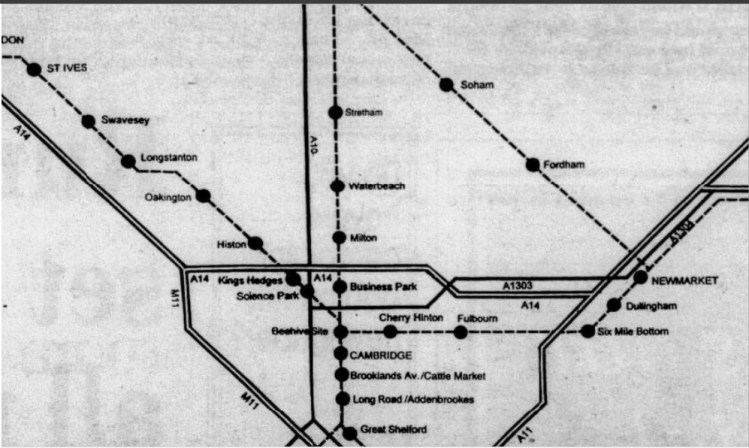
Above – detail from the Cambridge Evening News
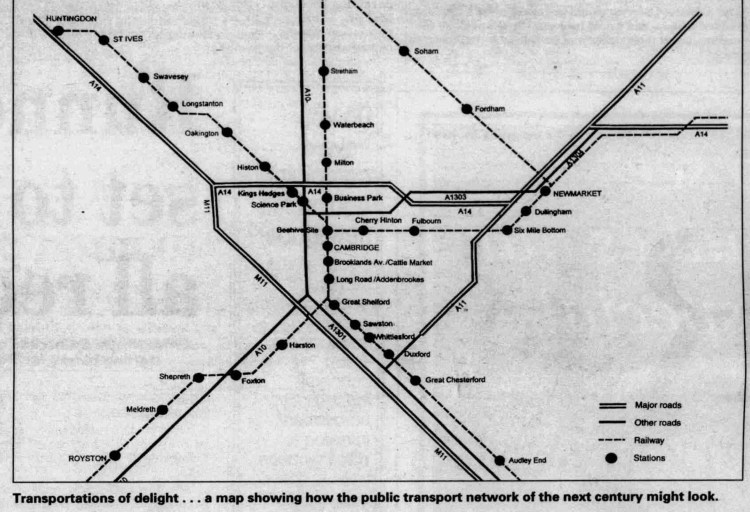
…and the larger version via the British Newspaper Archive here – some of the suggestions have been things that Rail Future East Anglia have been campaigning on for decades.
One of the reasons we got this far was because former County Transport Director Brian Oldridge pushed for it.
Furthermore, he pushed for building a light rail network that could be part-funded by congestion charging.
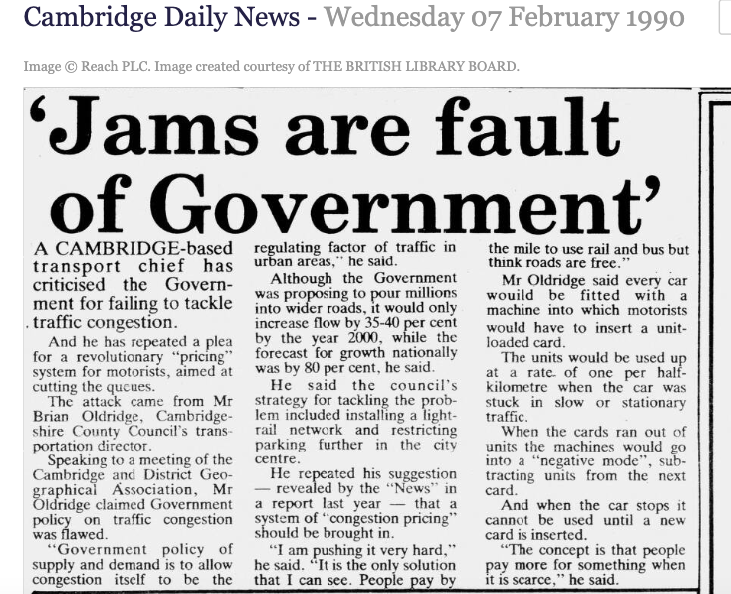
Above – Brian Oldridge quoted in the Cambridge Evening News when I was still at primary school, 07 Feb 1990 in the British Newspaper Archive. I think I got my cycling proficiency certificate from the county council 18 months or so later.
“He said the council’s strategy for tackling the problem included installing a light rail network and restricting parking further in the city centre. He repeated his suggestion – revealed by the “News” in a report last year – that a system of “congestion pricing” should be brought in”
Above – Brian Oldridge, Transport Director of Cambridgeshire County Council in the Cambridge Evening News, 07 Feb 1990 in the British Newspaper Archive.
Which makes me wonder if he squared that one with his Shire Hall executive councillors.
As it turns out he was addressing a publication on congestion on roads published by the Institution of Civil Engineers in 1989 – which he was a Vice President of in that era.
“The citizen can claim that he should be able to travel freely and conveniently between home and work, and to exploit his leisure without impediment. In practice he is faced with a narrowing choice of means to do this, and with delay, discomfort, and sometimes unreasonable hazard in his travel. Industry is faced with similar uncertainties which inhibit development and increase costs. The worsening of this situation will increase in pace unless immediate steps are taken”
Above – Congestion (1989) Institution for Civil Engineers, para 1.1
“What are its policy recommendations?”
Co-ordination.
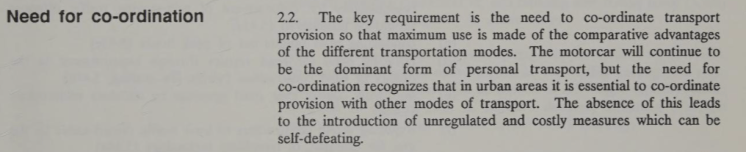
Above – Congestion (1989) Para 2.2.
Status update?”
Work in progress. They also called for:
- Modifying demand
- Flexi-time working
- staggering of school hours and holidays
- four say weeks for the same hours (compressed hours)
- replace national bank holidays with local bank holidays (as in Scotland)
- new employment centres in residential areas
- out of hours retail delivery
- boost differential between peak and off-peak fares
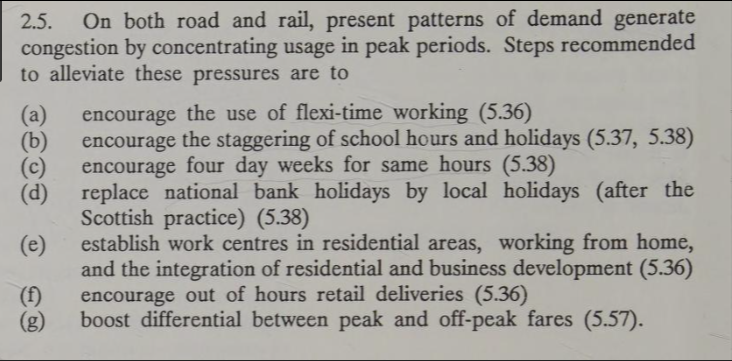
Above – Radical Moves – para 2.5 in Congestion (1989) by ICE (no, not that one).
They also had more radical things including:
- Road repairs outside peak hours
- Reduce need for road repairs through improvement in quality of road construction (i.e. whole life consting)
- Improved control over road openings by statutory undertakers (gas, electricity, water, sewage etc)
And for reducing demand for motor travel…
- shifting demand from private to public transport (which few politicians would advocate the reverse
- consider road pricing (what if they say ‘We’ve considered it, and *no*? Back to square one?’)
- restrict central parking / implement park and ride systems
- pedestrianisation of urban centres
On public transport the report also calls for better bus services…
…which is ironic given that the Conservative Governments of the era delivered the opposite through privatisation…
- increase frequency
- introduce bus stops with lead time indicators (i.e. information for passengers which in principle we now have with electronic boards)
- travel cards on key routes
- collective taxis on scheduled routes (doesn’t deal with the costs of drivers)
- Improve off-peak services for flexible working
- review of bus deregulation (para 2.10).
“So back in 1989 the Institution for Civil Engineers was saying the Tories’ policy of bus deregulation and privatisation was not working, and…it still hasn’t been reversed?”
Sounds about right.
“And on rail and light rail?”
At the time railways were still a nationalised industry, although the Thatcher Government was running it down in the run-up to privatisation – which was quickly followed by big state subsidies because…exactly.
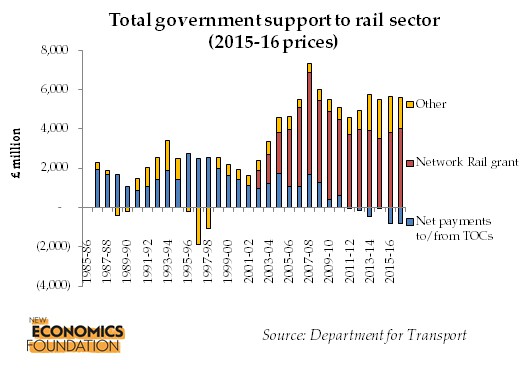
Above – New Economics Foundation (2017) “Our railways have failed – what next?”
‘Rich people won’t use buses but they will use light rail and trams’
“Car users are notably reluctant to transfer to other modes of transport, however LRT (Light Rail Transit] with its attractive, modern image, high reliability, and frequency of service has proved effective in attracting car drivers. In the UK the longest established LRT system is the Tyne and Wear Metro on which passenger journeys have increased from 14.1 million in 1981 to 44.9 million in 1987/88.”
Above – Para 5.76 Congestion (1989) ICE
A much more recent study of the Tyne and Wear Metro was published last year which you can read here – it’s taking it to the next level with machine and deep-learning analysing surveys of passengers.
“Data from 850 passengers were collected through a structured questionnaire and analysed using advanced machine learning (ML) and deep learning (DL) techniques, including Random Forest, Gradient Boosting, and Neural Networks.”
Huseyin et al, (2025) Using machine learning to investigate user behaviour of Tyne and Wear Metro, in Intl Journal of Transportation Science and Technology
Note the section at 4.2.1. on correlation between service quality and user perception.
“Enhancing service reliability and comfort, particularly during peak hours, is likely to yield significant gains in user satisfaction. Additionally, promoting the Metro’s environmental benefits—such as energy-efficient rolling stock and clean air zone access—could strengthen public perception and align transport strategies with the UK’s Net Zero objectives.”
Which is something that can be done potentially within existing repair and maintenance budgets – or rather without the need for huge additional capital investment. What’s also notable is the team included local academics in Newcastle working with a number of academics in the Republic of Türkiye (to give the country’s redesignated name in English).
On Congestion Charging – 1994
The University of Leeds submitted a paper to the Transport Select Committee in 1994 which summarised the now familiar issues with congestion charging for motorists. It’s main call was for a pilot scheme to test its feasibility – which is what the First Mayor of Greater London did. But given how much larger London is to the rest of the UK (its population is greater than that of Scotland and Wales put together) the more interesting and applicable trials and schemes such as the one for Oxford, will be more applicable to other towns and cities. Recall the past paper on congestion charging in Cambridge that I featured in Lost Cambridge here, which looked at the attempts to bring in such a change in the late 2000s. A summary history is provided by the Cambs Sustainable Travel Alliance here.
Cambridgeshire County Council’s business case – why today’s decision-makers need to look at it again
“Public Transport: The challenge is to make public transport the motorised mode of choice by delivering a network of services that offers fast, reliable journeys and gives people a viable alternative along major inter-urban corridors and at Park & Ride gateways to Cambridge, as well as enhancing the existing network of services within the city. This will be accomplished by developing a High Quality Public Transport (HQPT) network across Cambridge, serving the major new development areas and the expanded Park & Ride gateways (11,000 additional spaces by 2021), via a network of segregated busways.”
“This network will build on the Cambridgeshire Guided Busway (CGB) currently under construction, and will be complemented by strengthening of the inter-urban and city bus services. The network will be operated by new ‘hybrid’ vehicles which could run emission-free through the city centre and at other locations with air quality problems”
Above – Cambridgeshire County Council (2011) application for funding, p11, via the Internet Archive here
“I’ve seen that HQPT acronym again! I don’t like it! Make it go away!!!”
Neither did the public by the sounds of 2023! Anything that is an acronym which does not make crystal clear what the mode of transport is for the ordinary resident who does not follow local democracy/politics closely, will not get the public’s consent. Even more so in an age of organised disinformation.
And that is the challenge that confronts the decision-makers in our present time. The past decade alone has set back the public’s disposition, just as it has those campaigners who back in 2014 were willing to be critical friends of the then City Deal. Are there any historical case studies of infrastructure building that has overcome setbacks of previous generations and the understandable scepticism of the local public, and succeeded?
If you are interested in the longer term future of Cambridge, and on what happens at the local democracy meetings where decisions are made, feel free to:
- Follow me on BSky
- Spot me on LinkedIn
- Like my Facebook page
- Consider a small donation to help fund my continued research and reporting on local democracy in and around Cambridge

 The Cambridge Town Owl