
BBC Cambridgeshire published a headline in response to the Board of Governors meeting
It followed the meeting earlier – you can read the papers here. Also, if you want to help support Addenbrooke’s and The Rosie Hospitals you can join as a member of the trust (I have) via https://www.cuh.nhs.uk/about-us/foundation-trust-membership/. You can do the same for mental health services with the CPFT at https://www.cpft.nhs.uk/become-a-member/. For those of you interested in Politics but who don’t want to stand for election or take on a heavy burden, this is one area where you can show your support for local public services. (See also some background here)
“Where are we with the long term solution – the ‘New’ “new Addenbrooke’s?”
Some of you may recall what I wrote this time last year here when pressure from local MPs and the now Greater Cambridge Development Corporation (previously the Cambridge Growth Company) persuaded ministers to commission and fund the early work for a new general hospital for Cambridge.
AKA Addenbrooke’s 3…which rest on a series of pillars outside of the control and maintenance of the CUH NHS Trust. You can find out more on Addenbrooke’s 3 here
I also wrote about the CUH NHS Annual Public Meeting for 2025 here
Cambridge Biomedical Campus – Open Forum – 21 Sept 2026
The contact details are here for anyone wanting to find out about the future of this huge site on the southern edge of Cambridge.
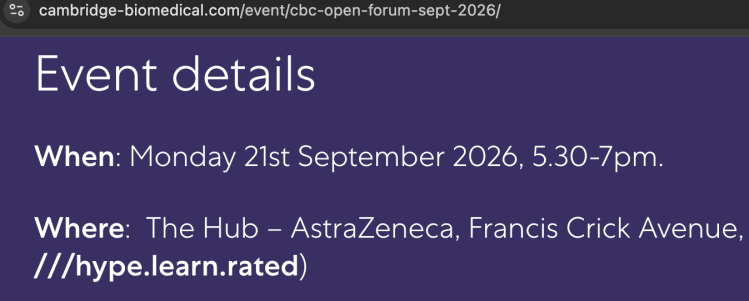
Slides from the previous meetings (bar the most recent one which needs updating!!!) are here – scroll to the foot of the page. The venue is three blocks south of the new Cambridge South Railway Station (See the map here)
Annual Public Meeting for Addenbrooke’s and the Rosie – 23 Sept 2026
If you want to attend online, you need to register here.
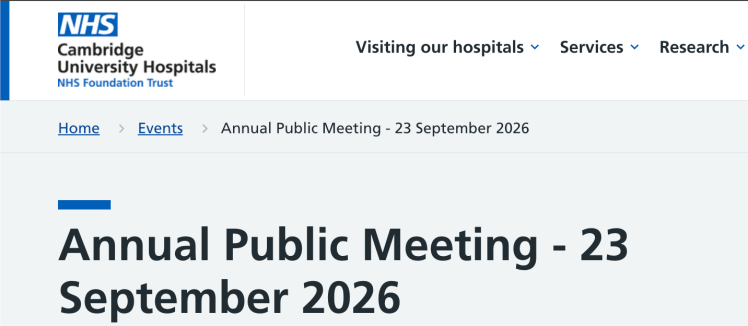
“Questions can also be submitted in advance by emailing cuh[.]nhsfoundation [@] nhs [dot] net by 12:00 on Monday 21 September 2026.“ (See the link here).
Expanding the A&E at Addenbrooke’s has been a long term problem – as I have found out the hard way on too many occasions. The most recent being these:
- 19 September 2024 – “Addenbrooke’s Accident and Emergency under strain as new report assesses Cambridge’s sci-tech bubble”
- 03 December 2024 – “Addenbrooke’s Accident and Emergency deals with 4 times the volume of people it was designed for”
- 14 January 2025 – “Why has the total number of beds at Addenbrooke’s stayed static over the past quarter of a century?”
- 25 July 2025 – “The failure to fund Addenbrooke’s A&E service – the buck stops at the Chancellor’s desk”
- 26 September 2025 – Addenbrooke’s alarming risk register – and their limited ability to respond
I don’t intend on repeating what I said in them. Given the recent news on the CSET Busway from the A11 to Addenbrooke’s, there’s new information that needs scrutinising.

Above – you can browse through the extensive core documents here
“Anything in the Board of Governor’s Papers from earlier?”
There are 181 pages of meeting papers so I generally advise people to look for the images/diagrams or tables of information. Especially if the subject includes risk assessments.
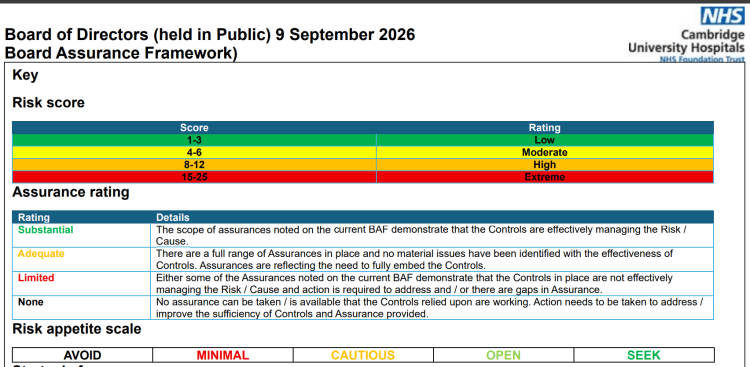
Above – the assurance framework. In this case ‘substantial’ does not mean bad, but rather they have received ‘substantial assurances’ that a risk can be managed and that controls are in place to manage it.
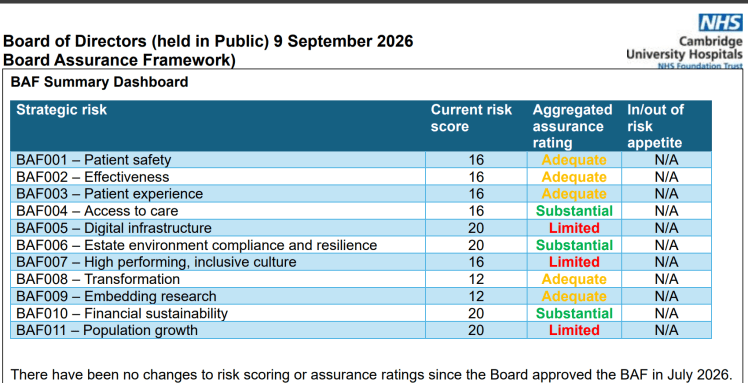
Above – Table on Strategic Risks faced by the CUH NHS Trust. Population growth is one of the top risks with limited information/assurances that the Trust can deal with it.
“That one on population growth looks alarming – what went wrong?”
Let’s have a look – scroll down to p75 in the papers here.
The tables state:
Causes
- “Inaccurate demographic and demand forecasting and poor access to data
- “Failure to understand and influence the implications of the Greater Cambridge Growth Plan, and plans for regional growth in the East of England
- “Failure to transform the model of care with system partners so that demand for emergency and planned care grows at an unsustainable and unmanageable rate.“
Consequences
- “Inability to meet the needs of a larger population
- “Deterioration in patient outcomes and experience
- “Increased regulatory intervention
- “Reputational damage
- “Impact on the aims of the Greater Cambridge Growth Plan
- “Inadequate articulation of the case for a new acute hospital, further impacting our ability to sustainably operate.”
The above reflect a picture of failures at board level not just in CUH NHS but across the cohort of public service executives at board level.
Furthermore, in my view it further reflects policy and structural failures at central government level – especially when the Members of Parliament for South Cambridgeshire were either government backbench MPs or worse, ministers in government or more catastrophically, the Secretary of State for Health and Social Care. This is because of the big institutional barriers between local government and the NHS as institutions.
“How are they managing the risk associated with population growth?”
The paper states:
“It is the government’s stated position that the population of Cambridge should double by 2050 and it is taking action to make this possible, for example through the creation of the Cambridge Growth Company which has recently progressed to incorporation as the Greater Cambridge Development Corporation. In this context, there is significant risk to sustainable healthcare services: if new models of care are not implemented, alongside fit-for-purpose clinical facilities, the consequence is the inability to sustainably provide patients with access to excellent timely care.
“Population growth across the East of England and in Greater Cambridge in recent years has already been above national averages, and sustained growth is increasingly certain. This risk seeks to address the impact on healthcare services if we fail to anticipate and implement changes in the model of care in advance of population growth.”
Above – CUH NHS 09 September 2026 Board of Governors Meeting Papers p75
The update from Claire Stoneham (Chief Strategy and Transformation
Officer) on p7 states:
“The announcement of the Greater Cambridge Development Corporation, and the response published the previous week, was noted. This was welcomed as a positive development, with a focus on growth, maximising the impact of life sciences, and recognising the need for supporting
infrastructure across housing, transport, primary care, community services and the Cambridge Biomedical Campus.”
I’m surprised the text wasn’t a little more positive of the influence that the GCDC has had in being able to bring forward the work for Addenbrooke’s 3, and securing Government funding for the preparatory work.
“Shouldn’t CUH NHS ask #Localgov people to have a look at those population risks?”
They could do – especially those council officers who are working on planning, transport, and anything influencing or impacted by population growth. A simple word search in the corporate risk registers of those institutions would provide that high-level scoping of who needs to talk to whom.
There are a host of other in-depth risks that are assessed – including financial (which my brain is too tired to crunch through ) and staffing numbers (see the latter from p140).
The one thing I noticed that’s a challenge for The Rosie was the shortage of Maternity Support Workers.
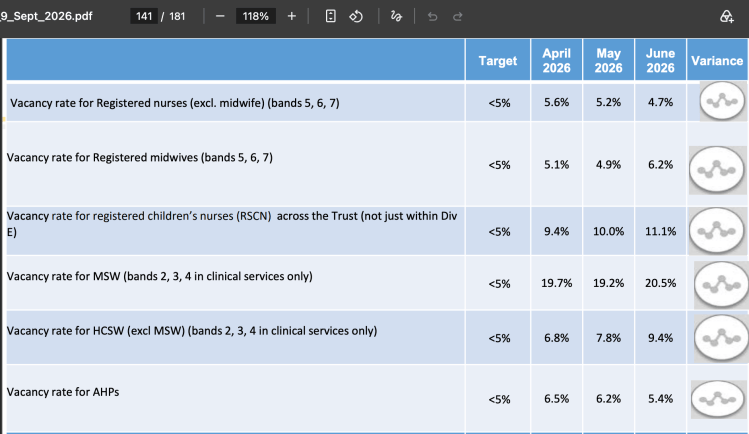
Above – Vacancy rate for different staff grades – MSW = Maternity Support Workers
The commentary states:
“Vacancy for maternity support workers has increased this month and remains an area of concern, recruitment remains ongoing with a good pipeline. Turnover has increased to 17.5%”
Above – CUH NHS 09 September 2026 Board of Governors Meeting Papers p141
If you are interested in the longer term future of Cambridge, and on what happens at the local democracy meetings where decisions are made, feel free to:
- Follow me on BSky
- Spot me on LinkedIn
- Like my Facebook page
- Consider a small donation to help fund my continued research and reporting on local democracy in and around Cambridge


