
The existing systems of local development plan making, and county transport planning inhibit rather than enable this process – along with the weak, feeble, and over-complicated mess of governance structures created by successive governments.
This is why we can’t have nice things in and around our city
I was in Together Culture on Fitzroy Street earlier talking to a couple of people about three speculative bids to get land on the southern and eastern edges of Cambridge taken out of the Green Belt to enable development – and some chaps to make their fortunes too.
The problem is things move about all over the place and hyperlinks get easily broken. Which is why ages ago I downloaded some of the larger files supporting the bids from big landowners and speculators so I could return to them easily.
The sites in the printed out reports I looked at today (these ones) pretty much cover the areas highlighted in purple in the map below of what landowners and developers offered up as undeveloped land that could be built upon.
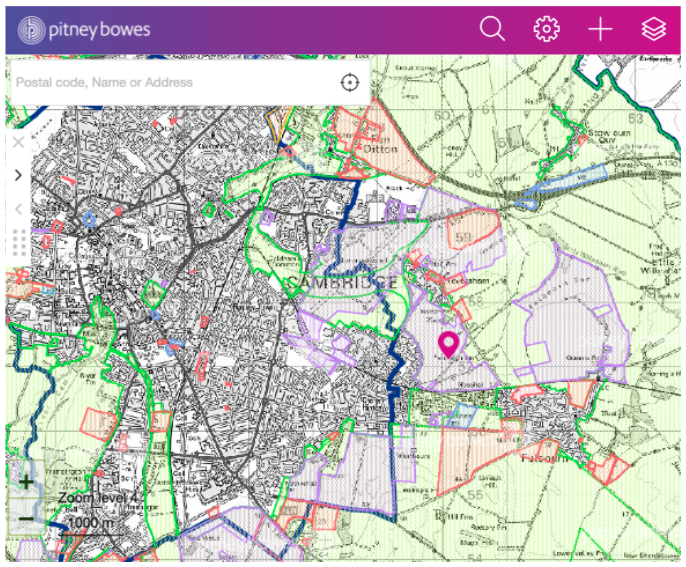
Above – from GCSP via CTO 05 Sept 2021 – additionally I looked at the speculative submission from the colleges of St Johns, & Jesus, Cambridge for two huge swathes of land south of the Cambridge Biomedical Campus
Just don’t ask me where the water will come from. Or where the builders building the site will live. Or anything about transport. Or how to build them without so much as a molecule of CO2 being released during construction.
A sort of fallacy of composition – the assumption that letting each developer/landowner do their own thing site-by-site will meet the needs of the wider city, county, and region.
The University of Cambridge’s development at Eddington should be a textbook case study of this (in my opinion anyway!)
“Eddington is a new sustainable, long-lasting and ambitious community in Cambridge designed to offer a high quality of life to enhance the City, surrounding area and University of Cambridge.”
https://eddington-cambridge.co.uk/about-us
There are two specific problems I have with the above sentence.
- If Eddington is to enhance our city *and* the surrounding area, then the facilities built on the site need to be large enough to serve the city *and* the surrounding villages
- If Eddington is to enhance our city *and* the surrounding area, then those facilities need to be easily accessible both by public transport *and* through active travel routes.
The University of Cambridge and their consultants have (so far, and in my opinion only) failed on both of those.
Public Transport
Their website states:
“The most convenient bus service for Eddington is the Universal (U) service, which links Eddington with West Cambridge, the City Centre, Cambridge Station and Addenbrooke’s.”
The problem is the University’s U-service is separate to Stagecoach’s services. Which means people have to buy two sets of tickets because the Tories in the 1980s said this would be more efficient, cheaper, and offer a better service for passengers when they deregulated the buses. That’s what happens when your policies on public services have minimal input from those that depend on the services and those that provide them – instead leaving it to ideologues.
Storey’s Field Centre – despite the awards, it is too small as a centre to serve a community larger than Eddington itself
Personally speaking I utterly despise the architectural style of the centre and the built environment of Eddington more generally. The emotions of rage and fury such things generate in me are not good for my health. But I accept that there are those that like that style. As I don’t live there and as it’s on the other side of town, I try not to lose sleep over it.
The issue of capacity however, is an issue. That’s not to say there isn’t much going on in Eddington – there clearly is. However, it was designed as an exclusive university enclave, not as an inclusive part of a city that seems to have different values to those in influential decision-making posts in the University of Cambridge and its member colleges and institutes. If the University of Cambridge wanted to create a truly inclusive social and civic centre for Eddington, they’d have paid more attention to The Junction in Cambridge – which has multiple bus routes running past it and is also large enough to hold a greater variety of events. Furthermore, when you look at the postcode data of The Junction’s customer base, the distances people are prepared to travel to see shows there are far further than many might expect.
Cambridge & South Cambridgeshire Indoor Sports Facilities Strategy 2015-31
Above – The strategy as adopted in June 2016 Appendix C the 14 MB document which you can read here
“It’s nearly 500 pages long. No. I won’t read it!”
Lightweight.
“The vision is to enable opportunities for increased and more regular physical activity, particularly from those in areas of deprivation, and in new settlements, to improve community health and well-being, by facilitating provision of, and access to, a range of quality, accessible and sustainable facilities in Cambridge and South Cambridgeshire District’.”
Cambridge City Council (2016) p7/494
We are over halfway through the timeframe of that strategy. Progress update?
In July 2021 I tabled a public question asking for an update – see the video here.
One thing to note is that South Cambridgeshire District does not have its own municipal swimming pool – something that the 2009-13 strategy noted.

“The existing pools will also age significantly and will not necessarily be in a condition to suit the needs of 2021. For these latter reasons, the increased population and demand arising from new growth areas in particular would justify the provision of additional swimming pool water space in appropriate locations, particularly in areas of new housing and in South Cambridgeshire.”
Cambridge Sports Strategy 2009-13
I could go on and list stuff such as this from the defunct Cambridgeshire Horizons in the mid-2000s

Above – from Cambridgeshire Horizons (undated)
We got the ice rink – courtesy of a University-linked donor who left a substantial amount of money for the rink. In the last millennium. It took that long to find a site and get it built and open…before CV19 struck in 2020. Cambridge City FC were ultimately forced out to Sawston – which has a suburban or light rail opportunity on the old Cambridge-Haverhill line to service it, but at the moment nothing.
We’re still waiting for the University to deliver on the swimming pool that was a planning condition of Eddington’s planning approval, and the rowing lake seems to be in a permanent state of suspended animation. Furthermore, as the Open Space and Recreation Paper for North East Cambridge states on p41 here, they don’t have enough to cover the full cost of a new swimming pool that would otherwise serve some of the most economically deprived communities in Cambridge – and yet councils are unable to tax the wealth our city apparently generates to fill that funding gap. (Despite my suggestions here)
Local government in England does not have the powers to designate what sort of facilities should go where in a co-ordinated manner that results in them getting built and serving the wider needs of the settlement (town/city) first – ahead of private profit
Cambridge: A globally-recognised city run like a market town
- No powers to raise revenues independently from the wealth generated by the local economy
- No powers to use taxation to limit the economic activities that now have a disproportionately negative impact on the welfare of the city – from Air BnB (See also Barcelona) and aparthotels (see here) to private cram colleges, over-large language schools, and unmanageably large groups of tourists (See also Venice)
- No resources for enforcement on private rental housing let out in breach of health and safety and lettings laws
- No resources for enforcing unlawful and anti-social car parking
- Feeble penalties that do not act as a deterrent where laws put in place to protect the public realm and the collective wellbeing of the city are broken
The fragmented nature of local public services means that those responsible for administering and governing our city on a day-to-day basis, and those responsible for the detailed longterm planning, have too much outside of their control. There is no means locally, for example to:
- Expand Accident and Emergency at Addenbrooke’s to meet our rapidly-growing population – the last extension being in 2001
- Ensure that new housing developments have fully-staffed GP surgeries and NHS dentists for new residents (ditto for those neighbourhoods facing densification of housing with detached homes replaced by multiple flats – normal for an expanding city with high land values)
- Establish new community centres or youth clubs within existing communities (because lack of funding and an over-reliance on contracting out – all too often to religious-linked groups as providers)
- Establish new adult education colleges or centres of lifelong learning – that requires ministerial approval. Which is crazy.
Combined Authorities are not the answer
Not least because the public policy world has not examined the philosophical case for combined authorities with a critical eye. Rather, too many policy and academic institutions seem to have gone along with it because it seems that’s what ministers want and/or that’s the route towards achieving whatever other goals they might have. I remain astonished how few have picked up on the lack of local democratic legitimacy of many of the combined authorities. Only in London does the London Assembly provide for directly-elected scrutiny and oversight. But even then, the powers of the Mayor of London and of the Assembly are much smaller than their counterparts in the capital cities of other countries.
Ironically, one of the few sceptical takes on Combined Authorities – one that picks up on the weaknesses of policies on the governance of England, is former Secretary of State John Denham, along with Janice Morphet in this recently-published paper.
One of the most useful things that paper does is provide a historical summary of the past half-century of policy-making on local and regional government in England. Obviously I’m interested because it’s part of my own working and living history – I started my old civil service career in the Government Office for the East of England in Cambridge. I was please to see him confirm that the GO-Network was created by Michael Heseltine and John Gummer amongst others so as to align with developing EU development fund structures which, unlike Levelling Up funding, bypassed ministers and Political patronage. The idea being that each English region had the population of a lower-to-mid-size EU country. Which makes you think. (Scotland, Wales, and Northern Ireland IIRC were standalone units).
Can the Deputy Prime Minister face down The Treasury to give cities more freedoms to raise revenue from their economic base to spend on infrastructure for the common good?
Prof Mia Gray, Professor of Economic Geography at the University of Cambridge pointed me to a publication that identified the UK’s over-centralised structures as being a bar on the wider economic and social development of English towns and cities – in particular The Treasury.
“Collier lays the blame for widening inequality on stale economic orthodoxies that prioritise market forces to revive left behind regions, and on the arrogant, hands-off and one-size fits all approach of centralised bureaucracies like the UK Treasury. As a result, Collier argues, the UK has become the most unequal and unfair society in the western world.”
New Economics for Neglected Places, Collier (2024)
It’s also just as much the handful of powerful and influential senior ministers that are responsible – in particular the post-holders of Chancellor of the Exchequer who could have driven through some big changes if they wanted to. In a different policy area, David Blunkett gives a good account of how as Education Secretary he drove through a new Citizenship GCSE onto the English Curriculum. Shame about the book price though.
Cambridge 2065 – so few of the contributors assessed governance structures
I wrote about the report here – only former civil servant Julian Bowrey raised the issue of governance structures, but even then refused to elaborate on what the governance of ‘Cambridge’ however defined, would look like. (You can see the original report published in 2015 here).
Returning to local development plans and local transport plans, one huge difference between the earliest ones for Cambridge (Davidge 1934, Holford & Wright 1950) and the 21st Century reports, is that the former were written to be read, while the current reports are written to be referenced to.
Until a suitably competent and empowered (and all the other policy buzz-words you can think of and list) council is established by Parliament to govern Cambridge (Parliament is Sovereign etc…) our city will never be greater than the sum of its parts. Which is so sad given the potential it has. But while fortunes stand to be made for others in this extractive economic system we have, it’s hard to see things changing in the short-medium term without something arriving from leftfield.
If you are interested in the longer term future of Cambridge, and on what happens at the local democracy meetings where decisions are made, feel free to:
- Follow me on Twitter
- Like my Facebook page
- Consider a small donation to help fund my continued research and reporting on local democracy in and around Cambridge.
Anyway, the Combined Authority wants your ideas for its shared ambition. Click here and scroll down to the box titled: “Place based – what makes us stand out?”
 The Cambridge Town Owl