The Local Government Information Unit published a report on the future of local government in England – looking into the longer term over the next quarter of a century.
See:
- The LGIU Report Looking to 2050 here
- The LGIU Report 2025 State of Local Government Finance in England
Ministers cannot have a meaningful conversation about local government without having a comprehensive overhaul of the taxation and spending powers of local councils and any regional tiers of government in England. Or even a fully-devolved English Parliament similar to the Scottish Parliament for that matter.
I’m not going to go into the debate about a devolved English Parliament in this blogpost. It does however need to be considered on its merits as part of any review/Royal Commission along the lines that the last Parliament recommended via the previous Commons Public Administration and Constitutional Affairs Committee. For those of you interested in the case for an English Parliament, read the extensive paper from the UCL Constitutional Unit from 2018 here.
A separately elected English Parliament would be accompanied by a separate English government, likely headed by a First Minister. The English First Minister and government would be powerful and high-profile. Whitehall departments like Health and Education would effectively transfer wholesale, creating a large English civil service. It is the prospect of such bodies that makes some fear instability, caused by an over-dominant England.”
Above – Russell/Sheldon (2018) UCL Constitutional Unit
Overhauling the finances of local government in England
Six months ago MPs on the Commons Local Government Select Committee told ministers that local government funding structures are broken. As is often the case, the select committee recommendations were broadly ignored. In that blogpost I linked to over a decade’s-worth of select committee reports which were ignored by successive governments, which makes you wonder what the point of having MPs in the first place is if they can be whipped to ignore the select committee reports their colleagues prepared and voted through when it comes to big things like The Budget.
“The [2025 LGIU survey] found that effective bankruptcies are likely in 6% of councils in the next financial year and 35% of councils over the next five years.“
“Fewer than 1 in 10 senior council officials are confident in the sustainability of local
government finance.“
Above – LGIU Finance (2025) p5
That’s where the crisis currently is. The LGIU finance report highlighted some of the options that ministers could consider, and the likelihood with those surveyed on the positive impact each one could have on their institutions’ finances.

Above – LGIU Finance (2025) p30
I won’t quote any further on the detail. Feel free to go into it in the report.
The big picture recommendations from the LGIU’s report on the future of local government in England set out ten recommendations.

Above – Future of local government in England (2025) LGIU p7
The Governance of Cambridge in 2050
I’ve had a couple of goes at pondering what Cambridge might be like in 2050, and those were before Michael Gove’s supersize plans which were summarised in his Case for Cambridge in March 2024. A few months later and he was gone. Today he can be found editing a pro-Conservative political magazine. His proposals for Cambridge were not without significance. The biggest one was appointing Peter Freeman as Chair of the Cambridge Growth Company – with the Deputy Prime Minister and the Minister for Housing both continuing with the policy growing Cambridge rapidly, the action of forming a development corporation, and the decision to keep on Mr Freeman as Chair of the Growth Company.
The history of Peterborough is the reason a growing Cambridge has to think about governance. Being a 3rd generation new town designated by Harold Wilson’s Labour Government in 1967/68, both Cambridge and Peterborough had similar populations at the time. Fast forward to the 1990s and Peterborough ended up with a population almost double that of Cambridge, at over 200,000 people. As a result of Michael Heseltine’s review of local government, Peterborough became a new unitary council in 1998. Prior to that, Peterborough was (like Cambridge) a lower tier level council within Cambridgeshire County Council. (You can read the story of the growth in The Peterborough Effect 1988 online, or buy one of the cheap second hand copies online – the book being published by the long-defunct development corporation that Peterborough had throughout that time period).
Splitting Cambridgeshire and Peterborough into two unitary councils
Or maybe three? At the moment we don’t know what ministers will decide both in the principle or in the geographical boundaries. Given the pace and restrictions on options, I struggle to see how the options emerging will be in place for any meaningful length of time. We may experience a significant level of turbulence similar to the 15 year period between 1960-75 when local councils in England went through significant restructures – with many rural districts and small urban districts being merged into much larger district councils, and small county councils being merged into much larger county councils – the intention from ministers being that these would function as some sort of ‘strategic tier’. Although as things turned out, the geographical areas and the financial resources made available in the longer tern turned out to be far too small. In the end it was still Whitehall that was in control.
Successive ministers have had no plans or visions for sharing Cambridge’s economic wealth beyond funnelling business rates into the Treasury
Which is why ministers find themselves criticised repeatedly for being seen to spend money on Cambridge while other parts of the country struggle. Part of that is because ministers never explain how the redistribution of business rates revenues actually happen. (i.e. the business rates are collected locally – giving the public and firms the impression that the revenues are spent locally, when in really the Treasury collects it all and redistributes it nationally as it does with other national taxes). It remains to be seen how the new mansion tax tier of council tax will function.
A geographically regional plan for Cambridge’s economic sub-region
I’ve written about this before in the context of connecting Cambridge via electrified and upgraded rail links with:
- Peterborough (currently an unreliable Cross Country diesel chuggington service that starts at Birmingham and ends at Stansted Airport
- Bedford (the old varsity line should never have been allowed to decline)
- Northampton (given the lobbying from Oxford nearly 800 years ago squished their young university) which would make a suitable ‘landing site’ for growing Cambridge spin-outs that become too big to stay, given the Northampton’s industrial decline.
- Luton (geographically less than 15 miles from Hitchin station that is already on the Cambridge-King’s Cross line.
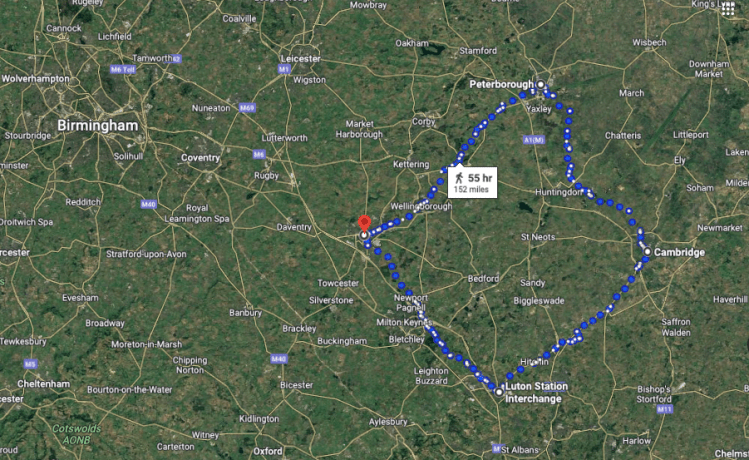
Above – from G-Maps where Northampton, Peterborough, Cambridge, and Luton make for a nice ‘quad’ – with potential extensions westward towards Rugby, Coventry, and Birmingham.
Cambridge-Northampton by rail via Bedford
I had a look at this in more detail in 2023
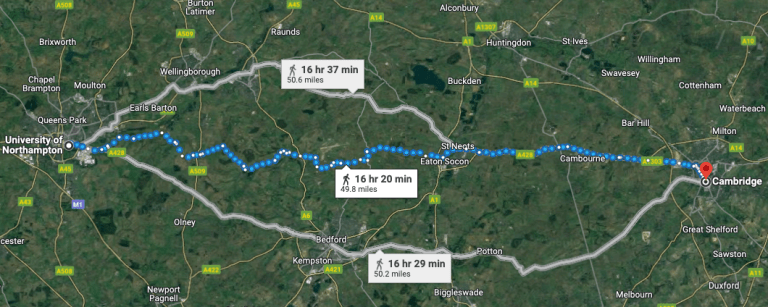
“[East West Rail] could take 35 minutes between Bedford and Cambridge.”
Given that Bedford-Cambridge is already being built, the geographical distance ‘as the crow flies’ from Bedford to Northampton is around 20 miles, and much of the old Bedford-Northampton railway line is still there. (Have a browse of the old rail network in England here). Interestingly, the are ongoing calls for the reconnection of the two historic county towns by rail. While the impacts may not be massive, the indirect impact of such a rail link would enable a small number of workers in the Cambridge bubble to commute in from the villages between the two county towns by rail, while at the same time boosting passenger numbers at the existing stations.
One of the biggest challenges has been Network Rail – and as their Passenger Rail Study Phase One report for England’s Economic Heartland partnership in 2020, only the north-south links from Cambridge counted.
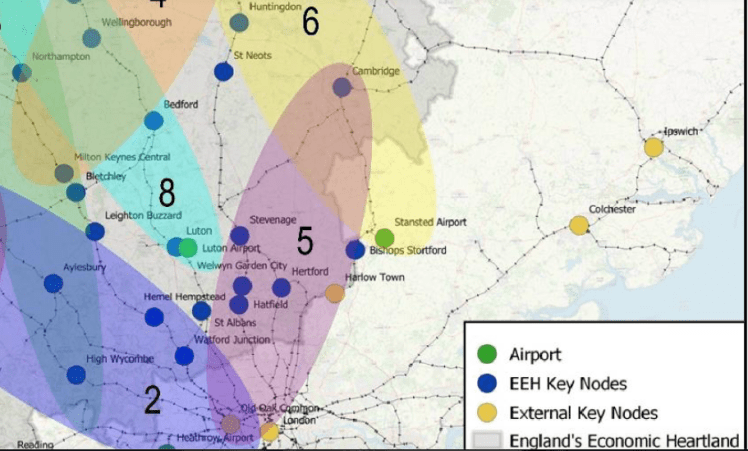
Above – EEH/Network Rail (2020) p9
Since then, the EEH Partnership has spent *lots* of money on commissioned reports (see here) which sadly have not had much publicity. These need reviewing and if necessary submitting as part of the evidence bases for both the emerging Greater Cambridge Local Plan and the Mayor’s Local Transport Plan.
East of Cambridge matters too
See the 2023 State of Rail Report from Transport East (like EEH but for the east of England!) here
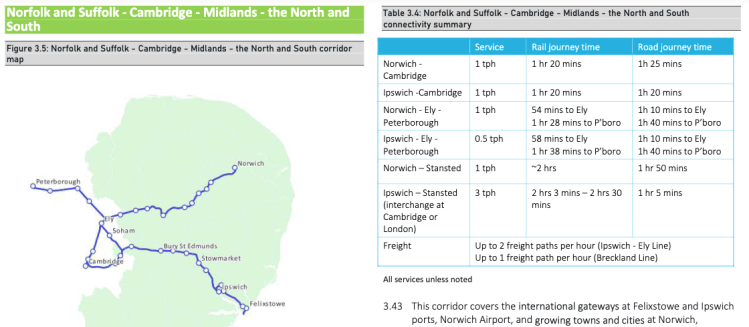
Above – Transport East (2023) p30
The challenge for local government organisations serving Cambridge is they do not have the administrative or policy capacity to cover both. If ministers enabled local government to raise more funds through a much wider range of taxes and levies – especially on more speculative activities like higher end properties through to building a light rail to transfer day-trippers and coach passengers onto light rail systems outside of the city, Cambridge could raise the revenues necessary to fund that much-needed policy capacity locally and not have to rely on other institutions to do it for us – such as Cambridge Ahead (see their reports here). Useful as I find their reports, they are ultimately there to represent the interests of their members. It’s striking that under a Labour-run city council and a Labour Government, there is no counter-representation at meetings from trade unions. I think there’s a role for trade union officer representation on the committees. Furthermore, it forces the hand of trade unions at regional tiers to recruit and train a new generation of local/regional policy specialists – something that higher education institutions could help provide for.
As for public services?
The principles of Total Place under Gordon Brown’s Government could apply here
But that is something for a public event on how our city and county should be governed. Anyone interested?
If you are interested in the longer term future of Cambridge, and on what happens at the local democracy meetings where decisions are made, feel free to:
- Follow me on BSky
- Spot me on LinkedIn
- Like my Facebook page
- Consider a small donation to help fund my continued research and reporting on local democracy in and around Cambridge

 The Cambridge Town Owl