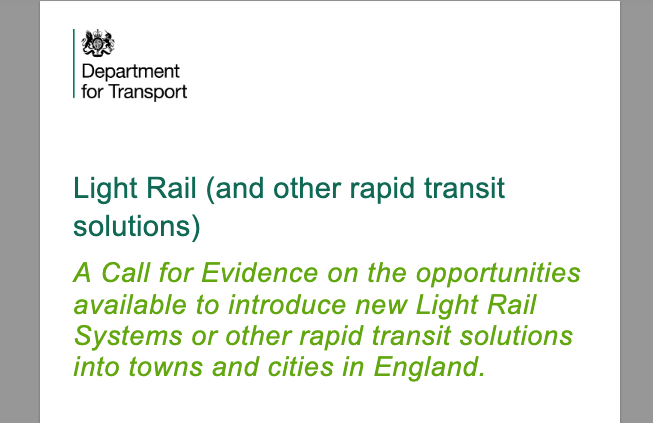
Strange what you stumble across when doom scrolling with a frazzled out brain (You can access the consultation document at the foot of this link)
I couldn’t even do basic admin tasks today such was my abnormally-fatigued state, spending most of the time between Wednesday afternoon and Friday evening tucked up and wondering why my brain won’t switch off when all my dry eyes wanted was *some restful sleep*. (If you want to know what CFS/ME and the impact of Post-Exertional Malaise looks like, I made a short video on it back in 2023 here)
So I spent part of the time doom-scrolling through old newspapers instead, trying to work out what I had stumbled across last month.
Above – the theme of the old Cambridge Evening News’ coverage in 1990 of our city’s traffic problems. I was still at primary school at the time.
This was the result of new findings on the history of Cambridge’s local transport debates, the results of which involved Cambridgeshire County Council launching a consultation in partnership with local Cambridge newspapers (The Weekly News delivered free to residents at the time, and the Cambridge Evening News) about how to solve the city’s transport issues. Given the much higher circulation in those days, around 10,000 people responded.
Huge support for a Cambridge Light Rail – February 1990
The areas surveyed were Cambridge City, South Cambridgeshire District, and about half of the old East Cambridgeshire District. I looked at the details in LostCambridge here.
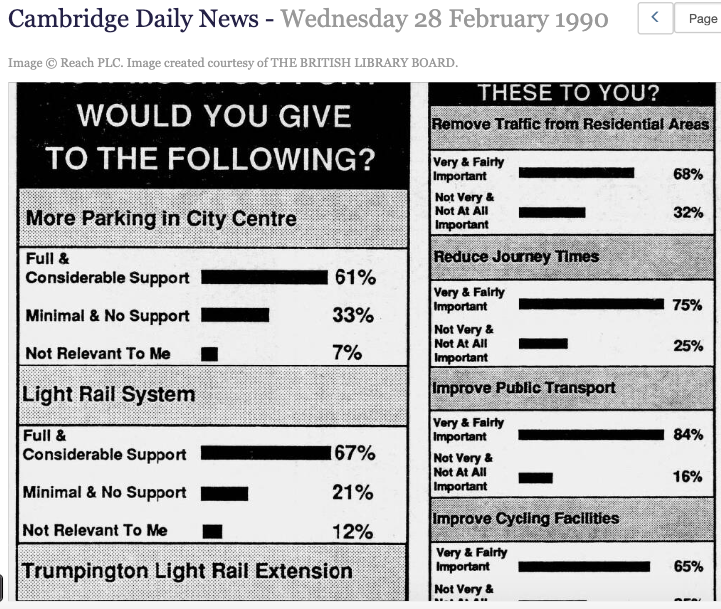
Above – Cambridge Evening News 28 Feb 1990, BNA.
Progress updated anyone? (Other than Colin Ward’s description of trams being ‘The Gondolas of the People’ in 1996 in the Town and Country Planning Association’s Journal!)
“What happened to the results of Theresa May’s Consultation?”
It kept on ticking over through the periods in office of the following two Prime Ministers before Transport Ministers in Rishi Sunak’s Government put it out of it’s misery.
“18 October 2023 – The outcome has been published.”
But then with a general election due within the following 12 months of that point, I can sort of understand why it got kicked into the long grass.
Which is a shame, because the then Minister for Local Transport Jesse Norman was quoted in New Civil Engineer as saying:
“light rail schemes [are] the “future” of the UK’s urban travel.”
Above – New Civil Engineer 08 Feb 2019 (They have a few back issues of their magazine going for sale on that auction site – I’d love to do an intro course in civil engineering but we don’t have an adult education college in Cambridge that does such things so I can’t).
“Did anyone publish any responses?”
They did. The questions in the consultation were:
- Q1 What is the potential scale of the opportunity for further light rail (or other rapid transit) systems to be introduced in England?
- Q2 Is there an appetite for new systems to be introduced in our cities and towns?
- Q3 Is there evidence to support this appetite?
- Q4 What would the environmental, economic and congestion benefits be?
- Q5 What impact would it have on jobs?
- Q6 Does light rail open up new housing or business developments or improve the urban fabric of the area?
- Q7 What can we learn from the experience of other countries in adopting new systems?
- Q8 What issues have helped progress light rail schemes or acted as barriers to their development?
- Q9 What and where are the future opportunities here in England for new light rail systems or alternatives?
- Q10 What are the key issues that are preventing light rail schemes from being delivered?
- Q11 How can we deliver systems within a budget as has happened?
- Q12 What are the key lessons from Europe in progressing light rail and in what way are these different to the U.K.?
- Q13 What does the future of light rail look like with new generation transport schemes coming forward?
- Q14 How do you see light rail aligning with new initiatives such as autonomous vehicles; cycling and walking; and wider Mobility As A Service initiatives?
- Q15 How can promoters leverage funding from sources beyond central Government?
The most significant specialist response was from the LRTA – the Light Rail Transit Association.
You can read their responses via the Bristol and Bath Area Trams Association dated 19 May 2019 here.
Other notable responses include:
The LRTA also has a more up-to-date view in TramForward News here
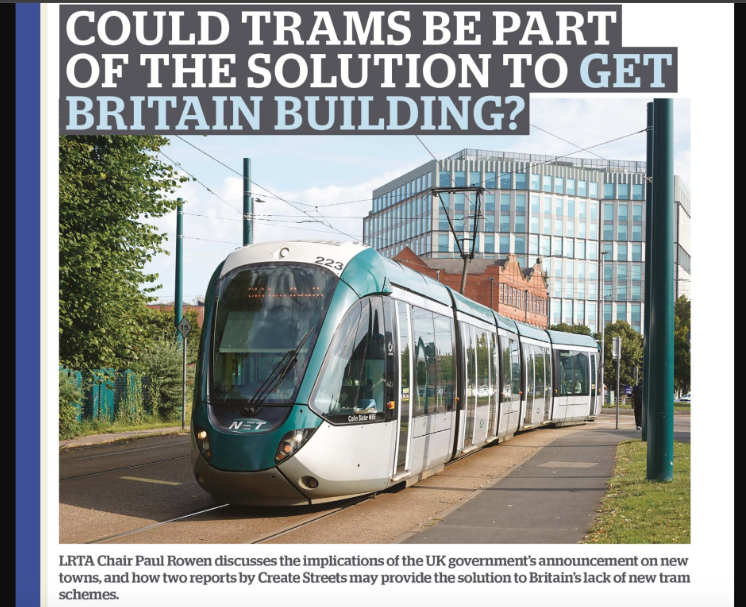
Above – from TramForward News April 2026 produced by the LRTA
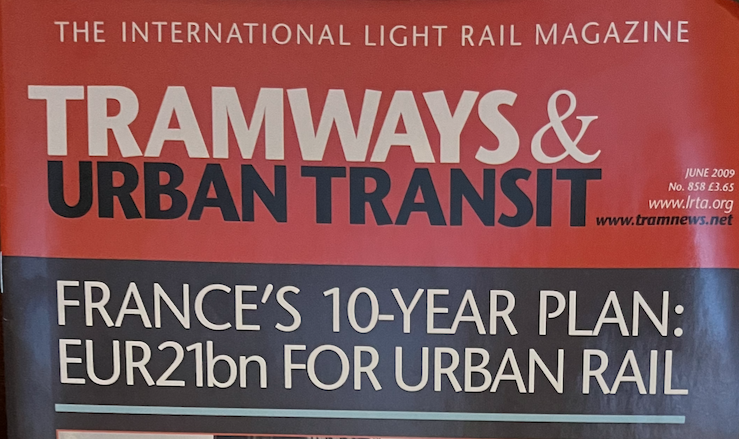
Above – the LRTA also publishes Tramways and Urban Transit Magazine.
It’s not just the Tories that struggled with Light Rail plans – Labour did as well
John Prescott’s ten year transport plan
You can browse through a copy of the White Paper archived by National Archives here
The big bold claim was that the Government was going to deliver:
“…up to 25 new rapid transit lines in major cities and conurbations, more than doubling light rail use.”
Above – Transport Ten Year Plan (2000) HMSO, p6
Which was a bold move. Gwyneth Dunwoody’s Transport Select Committee was damning.
“The Department has underestimated the time required to design and implement light rail schemes. It has further compounded the difficulties faced by authorities in bringing such schemes forward by failing to allow local transport plan funds to be used for scheme development and by failing to address regulatory barriers adequately. While we recognise that the increase in light rail schemes is a success story for the Department, it must continue to maximise their potential impact”
Above – Conclusion (y) of the Select Committee on Transport, Local Government and the Regions Eighth Report. 21 May 2002.
The most damning bit was that ministers under-estimated how long it had taken existing schemes to get from concept to completion.
“…the Light Rapid Transit extension to Manchester airport will have taken 12 years from public consultation to completion. The Confederation for Passenger Transport estimated that schemes would have to be approved by 2004 to be built by 2010”
Above – Implementing the Plan, paragraph 99 on Light Rail, HoC 21 May 2002.
In a nutshell ministers need a comprehensive industrial plan to align supply chains and send clear, timely signals to industry about what they need to invest in so that skilled workers, component manufacturers, and inventories of parts and machinery are there ready to go – and that the work for each city / urban region can be sequenced so that the workforces can move seamlessly from one project to another. Especially the tunnelling teams.
Then there’s also the separate issue of ensuring the corporate memory stays within the public sector and is not frittered away on private sector consultancies. Because the amount of money spent on feasibility studies and business cases – the ones I’ve seen commissioned by the likes of the Greater Cambridge Partnership and the Combined Authority, are incredible.
A lesson in public transport from Cambridge’s Hungarian Twin City, Szeged
The twinning dates back to the mid-1980s before the fall of the Berlin Wall. One of the reasons for considering (and later choosing) the Hungarian city was that it was a similar size to Cambridge with a prominent university. And a river too.
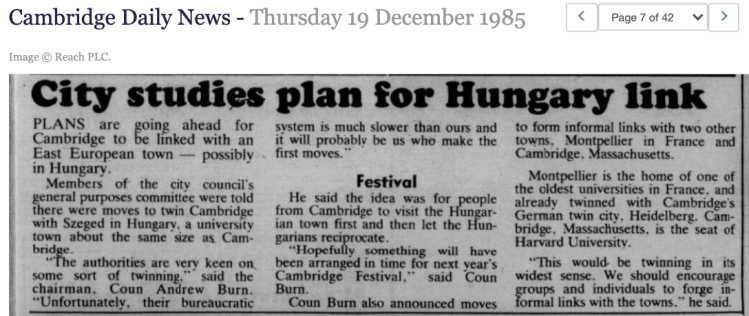
Above – Cambridge Evening News 19 December 1985 p7 via the British Newspaper Archive
It was completely fortuitous that the once huge Cambridge Festival (The music and performing arts one that wound up in the 1990s) had the theme of Hungarian Music in 1986, the year the Twinning agreement was signed.
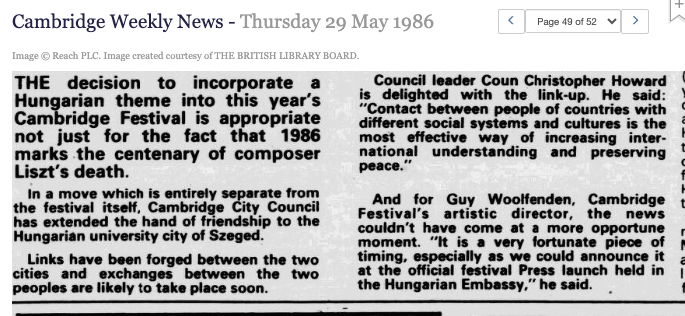
Above – Cambridge Weekly News 29 May 1986 p49
The links between the two cities are maintained by the Cambridge-Szeged Society.
The Railway Networks YT page features their main railway station which has a tram stop outside the main entrance.
Above – Szeged Railway Station by Railway Networks – and a textbook example of integrated public transport. Why couldn’t we have this for Cambridge Station’s revamp?
As I wrote back in 2024, Cambridge is beyond the stage where it needs a second urban centre. Not least one that can incorporate late night entertainments without disturbing college masters and local residents – and one that can be purpose-built to disperse large numbers of people via public transport back to surrounding towns and villages on Friday and Saturday nights.
Twin towers
In that same piece I also mentioned the theme of twin towers – ornamental ones as architectural pieces to break the bulky skyline that has emerged from recent property developments. After all, many of our ancient college buildings have twin towers.

Above – Kings College Cows, and Trinity, by Maureen Mace which you can purchase here
(I particularly like here trees collection too!)
I picked up the above in an article on the emerging draft local plan which for me helps make the case for a new large civic square with a quartet of civic buildings to anchor them
- Cambridge East Station (make it bigger and much more grand than the dull grey Cambridge North, and the limited capacity of Cambridge South which will cause problems in a couple of decades)
- A new large concert hall large enough to host top tier musicians and performances (so minimum capacity 3,000 for the main auditorium, and with a separate opera house in the same complex)
- A new large lifelong learning college (which I’ve said should be named after the late Sir Michael Marshall – noting the site is owned by the company the late civic figure was head of)
- A new large city hall for local and regional government institutions and public services so that their executive management functions are within walking distance of each other
That way, Cambridge East Station and the northern end of the airport site by Newmarket Road become their own bus and light rail transport hubs.
“Which reminds me – what happened to the CAM Metro again?”
It got scrapped following the 2021 Mayoral Election.
The Strategic Outline Business Case was published in the CPCA Papers of 27 March 2019. I recall some work was done by the Combined Authority when Dr Nik Johnson became Mayor, refocusing the CPCA’s work on bus improvements (see the Tiger Bus scheme that has proved popular with younger passengers) that they carried out work to keep hold of the studies commissioned as part of the CAM Metro work.
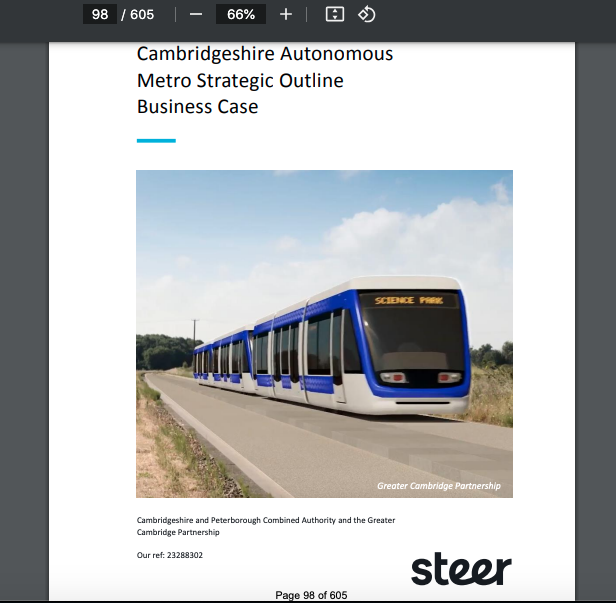
Above – from p98 of the CPCA Board Meeting Papers 27 March 2019, the SOBC By consultants Steer.
What I also spotted in the CPCA Board Meeting of 25 November 2020 that included a CPCA Prospectus – one which contained this photo below that contrasts with what was on the front of the Steer report!
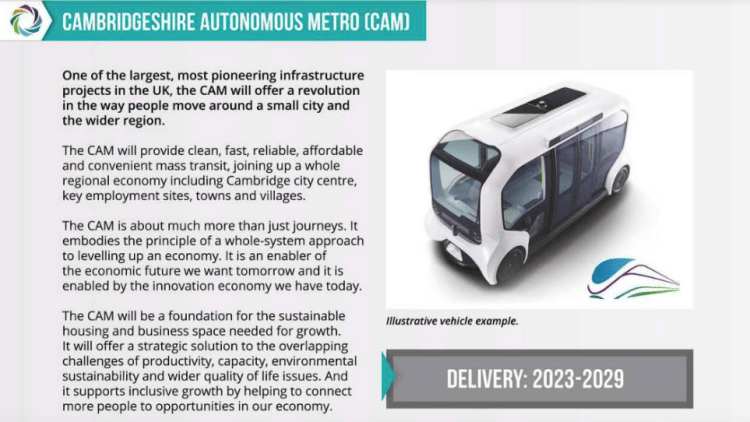
Above – item 35 (at the bottom), 4.6 Appendix 3, p21 – Combined Authority Prospectus
There’s also another paper on the national significance of the CAM Metro.
Above – Item 32, 3.2, Appendix 1 – The National Significance of the CAM.
Given the proposed growth plans that followed in the mid-2020s, even the CAM Metro proposals now feel obsolete. Especially if they were banking on the smaller autonomous vehicles!
If you are interested in the longer term future of Cambridge, and on what happens at the local democracy meetings where decisions are made, feel free to:
- Follow me on BSky
- Spot me on LinkedIn
- Like my Facebook page
- Consider a small donation to help fund my continued research and reporting on local democracy in and around Cambridge


