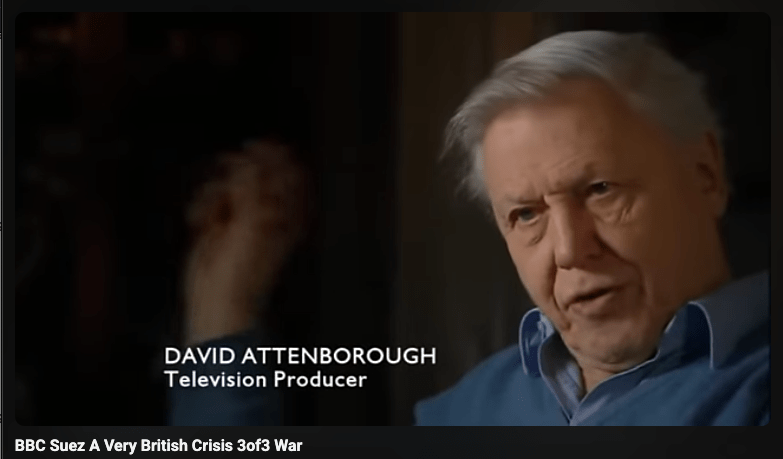
It’s one of the most astonishing scenes in the UK’s early post-war political and military history. And as TV producer in his late 20s, David Attenborough found himself summoned to Downing Street for a live broadcast to the nation.
So off he went. When he arrived, this was the scene that he saw.
We’ve had quite a few prime ministerial addresses to the nation since then. I’m trying to picture what political storm would have broken out if any recent prime minister was in such a situation.
Broadcast in 2006 it’s one of the most compelling historical documentaries of modern times.
- Part 1 is the historical background
- Part 2 on conversations between UK, France, and Israel – featuring future Foreign Secretary Douglas Hurd.
- Part 3 on the crisis and aftermath – and a very revealing clip into the institutional mindset of the violence unleashed. Marine Ray Turley’s recorded interview is essential viewing on the UK’s legacy in the Middle East.
“In those days…in the Marines in 1956… ….and we’d freely use that expression. We had no qualms about shooting them. We were carrying out the aims of the British Government. The Government says we shall take the Canal. So ‘Take the Canal’ we would.”
Marine Ray Turley in the 2006 documentary
The politician who put an end to the war? President Eisenhower.
The exchanges over the resolutions at the United Nations were debated when Mr Speaker granted the Leader of the Opposition, Hugh Gaitskell of Labour, what we now know as an Urgent Question. You can read the transcript here. This set things up for a clash between the Prime Minister and the Leader of the Opposition.
“United Nations Resolution (United Kingdom Reply) – HC Deb 03 November 1956”
The text of the motion? “Motion made, and Question proposed, That this House do now adjourn.—[Mr. Heath.]” <<– Future PM Sir Edward Heath?
Somehow I recall similar happened in the run up to the catastrophic Iraq war of 2003
Turns out former Conservative Foreign Office Minister of State Douglas Hogg made that very point.
“…in a democracy no Government should commit forces to war without the authority of this House expressed on a substantive motion, so that those who oppose war can seek to change the policy by their vote. To commit Britain to war relying on the royal prerogative and without the explicit authority of this House seems to be an affront to democracy.”
Above – Douglas Hogg MP (24 Sept 2003).
Turns out the father of Douglas Hogg – Quintin, was First Lord of the Admiralty (the Minister of the Crown in charge of the Royal Navy prior to the creation of a single Ministry of Defence in 1964) in the run up to, and during the Suez crisis of 1956.

