In an historic night for a host of reasons, Cambridge Labour’s hold on political power at the Guildhall evaporates in the face of:
- A Green electoral tidal wave
- Non-stop negative headlines in the face of a host of unforced errors by national party figures.
Above – delete/amend as appropriate
The balance of power at Cambridge Guildhall
- Labour: 17 councillors
- Green: 12 councillors
- Liberal Democrats: 11 councillors
- Your Party: 1 councillor (Dave Baigent)
- Conservatives: 1 councillor (Delowar Hossain)
My vaguely-confident predictions from yesterday (more vague than confident – the only thing strengthening on my side is this persistent lurgy!)
Abbey: – GREEN (hold) – ✓
Arbury: – LABOUR (hold) – X – ARBURY was a Green Gain
Castle: – LIB DEMS (gain from Lab) – X – CASTLE was a Green Gain
Cherry Hinton: – LABOUR (hold) – ✓
Coleridge: GREEN (gain from Lab) – ✓ (only eighty votes in it!)
East Chesterton: – LIB DEMS – X – EAST CHESTERTON was a Labour Hold
King’s Hedges: – LABOUR (hold) – ✓
Market: – LIB DEMS (hold) – ✓
Newnham: – GREEN (gain from Lab) – ✓
Petersfield: – GREEN (gain from Lab) – ✓
Queen Edith’s: – LIB DEMS (hold) – ✓
Romsey: – GREEN (gain from Lab) – ✓
Trumpington (2 seats): – LIB DEMS x 2 (hold) – ✓
West Chesterton: – LIB DEMS (gain from Lab) – X – WEST CHESTERTON was a Labour Hold
Credit to those who re-stood for election in Cambridge – even in the face of certain defeat. While winning is fun, one of the most important events in elections is the voting public visibly watching and witnessing political power and public office *being removed from a once powerful political figure* with objects little more menacing or threatening than a few secure black boxes containing untampered ballots cast by secret ballot. Yet its power is immense.
As Phil said:
- Labour hold four:
- Cherry Hinton,
- East Chesterton,
- West Chesterton,
- King’s Hedges.
- Labour lose six to the Greens:
- Arbury,
- Castle,
- Coleridge,
- Newnham,
- Petersfield and
- Romsey.
- Greens hold Abbey.
- Lib Dems hold Four:
- Market,
- Queen Edith’s and
- two in Trumpington… [but make no gains within Cambridge City]
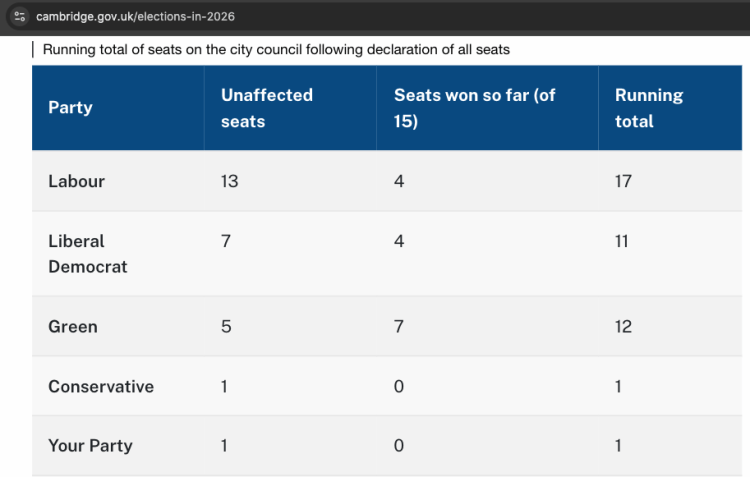
Above – Cambridge City Council’s 2026 elections page. The Greens leapfrog over the LibDems into second
The great news for The Greens
They have broken through into double figures at The Guildhall for the first time ever.
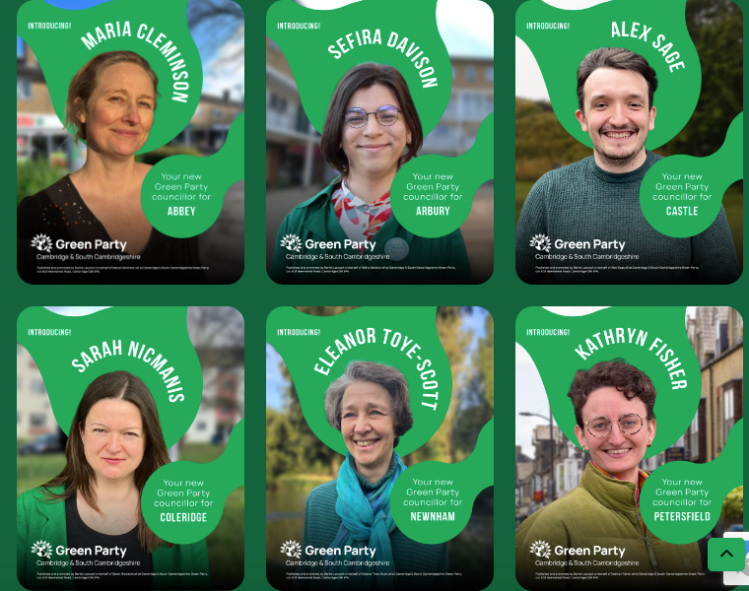
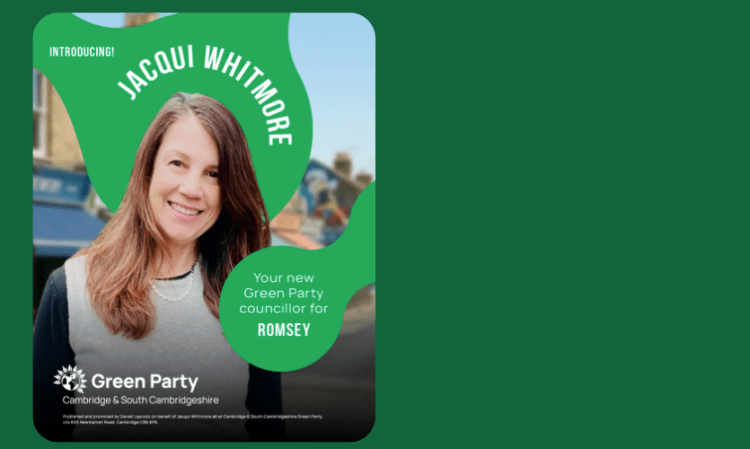
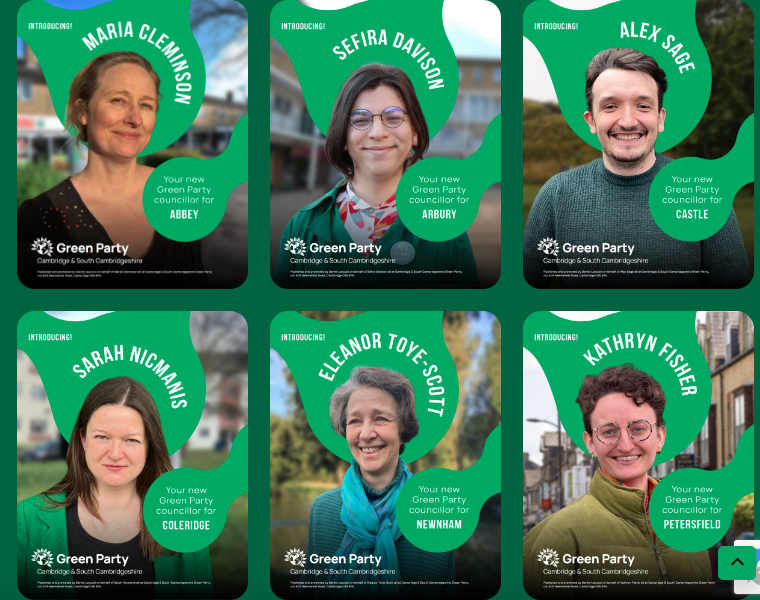
Above – from Cambridge & South Cambs Green Party’s website – the above seven join their existing five councillors (Cllr Cleminson selected to replace the retiring Cllr Howard in Abbey Ward).
The challenge this good news brings for the Greens
Five incumbent ward councillors joined by seven new councillors. The group dynamics will be interesting to watch given the challenges of co-ordinating and organising a larger group of councillors. (Note the Green Party has no ‘party whip’ system, which is different to the other parties).
The good news for Labour
They held onto the two Chesterton seats – which historically are swing seats and are hotly contested between Labour and Liberal Democrats. Prior to that they were safe Conservative seats until the Liberals ejected them in the early 1980s. They remain the largest party so have the first go at proposing a new council leader figure. While the Liberal Democrats are their opponents inside the Guildhall, the South Cambridgeshire Liberal Democrats are their shared service partners for a range of council services. With the transition to a unitary council, it may be in the interests to work constructively with Labour. But at what [local political] price? eg will some minor local policies change? David Blunkett the former Education Secretary said on Newsnight that Labour should take a collective step back to process what for thousands of their members and supporters were a difficult set of verdicts to take from the electorate. (But that’s the way it should be in a strong democracy when any political party in power comes up short in the eyes of the electorate).
The bad news for Labour
They lost Coleridge and Arbury, two normally rock-solid Labour seats with the exception of the post-Iraq-War occupation by the Liberal Democrats which proved extremely difficult to remove until Nick Clegg did the hard work for them. Over the past 40 years, the voters of Coleridge had only returned a non-Labour candidate on *two* occasions – and this in a system that has city council elections in three of every four years (The fourth being county council elections). Frederick Burling (1980s) and Chris Howell (2009) for the Conservatives. Coleridge was *that safe* for Labour. Hence it needed a series of national political events/catastrophes plus a multi-year targeted campaign by an opposing party to break that pattern.
Additionally, the defeats experienced by:
- Simon Smith (Castle),
- Anna Smith (Coleridge – no relation), and
- Cameron Holloway (Petersfield) – one a former executive councillor who did a huge amount of work on town planning and budgets amongst other things, plus the loss of two now former council leaders, will be felt.
Cambridge being Cambridge generally isn’t the city where political parties can win seats with paper candidates. Which in good political times for a party means contests for prime seats. As a result, there can be a greater pool of higher calibre candidates who can manage the physical (campaigning) and intellectual (the draft local plan is over 500 pages – not including annexes) demands from which to select from.
The good news for the Liberal Democrats
In the ring around the city, their colleagues in South Cambridgeshire didn’t leave much behind as they all-but-completed the comprehensive destruction of the once mighty South Cambridgeshire Conservative Association’s councillor cohort. Just over a decade ago there were nearly 40 Conservative councillors in South Cambridgeshire District Council. Today? two. More locally, Returning to politics in Queen Edith’s is Cllr Amanda Taylor who started her electoral life when I was doing a paper round in the same neighbourhood in the mid-1990s. But she’s still mobile and active enough to cover the ward, well-known (you don’t get 1,500 votes in a council ward by being a paper candidate). You can only compete against the candidates opposing parties put in front of you.
The bad news for the Liberal Democrats
The Green Party gatecrashed the carefully-prepared plans for the Liberal Democrats to retake Castle Ward from Labour, snatching the ward by 24 votes from under their noses – while failing to overcome Labour hit by negative national headlines and internal issues including the loss of some activists to movements such as Your Party – which has one councillor (Cllr Dave Baigent in Romsey) on the city council. As a result, there isn’t the wealth of new energy that comes with a critical mass of new councillors. With no new net gains, only one new figure, Cllr John Grimwood in Trumpington comes in as a new replacement candidate who won his contest. The LibDems have the same issues in Queen Edith’s that Labour has in Coleridge: No record of frequent high profile challenges at election time. The people of Queen Edith’s have only ever returned a non-LibDem city councillor on three occasions over a thirty year period. The last time the ward was regularly contested was in Euro 1996. The only defeats were in 2012 when ironically Cllr Taylor lost to Sue Birtles of Labour – again in the face of national political catastrophes. The next was Sam Davies MBE.
No Communist Revolution at the ballot box
There were what the broadcast media might label as ‘far left’ candidates standing in Cambridge:
[Updated to add:]
For the record, Khalid Abu-Tayyem in Castle* has asked me to correct and update this part with what he experienced and went through following the general election 2024 – see his post on X here.
My apologies for not having kept up with the post-general-election developments.
Three further independents (unaffiliated – Eleanor Cooke, Nick Picton, and David Carmona) also stood. Having hyper-local neighbourhood-based independent candidates means that at hustings at least, there’s a greater chance of issues being discussed that political parties might not want raised eg because it puts them in a bad light, or was a controversial decision. Eg a planning application.
“Was it worth the smaller party candidates / independent candidates standing?”
Unless they are spreading violence and hatred, my general view for ward-level local elections is to let people get on with it. It’s hard enough at the best of times to make local elections seem even vaguely interesting to the majority of the population. If accounting for all registered voters, the biggest cohort were the voters that stayed at home and did not participate. In the case of one of the independent candidates – Nick Picton,


Above – Nick Picton’s election address to the voters of East Chesterton for the Cambridge City Council Elections 2026. Eye-catching enough to be picked up by Mark Pack in the House of Lords here.
Tories all but destroyed in Southern Cambridgeshire
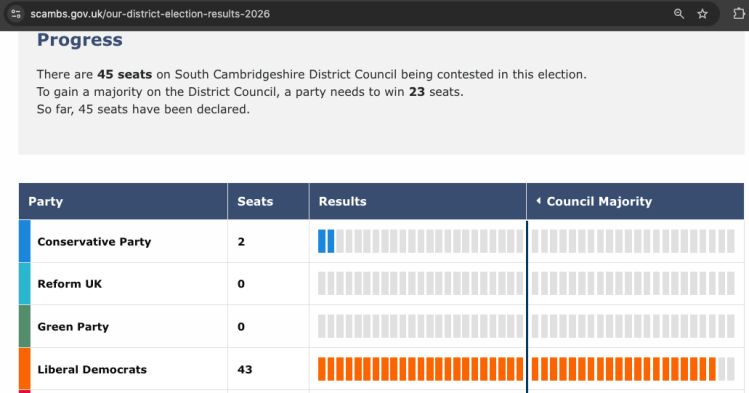
Above – by the time the Liberal Democrats had won enough seats to retain control of South Cambridgeshire Hall in Cambourne, only one Conservative councillor – the group leader Heather Williams – had been re-elected
Small mercies that the restructure of local government means she’ll only have 12 months of meetings to endure with another Cllr Williams who retained his seat. No sign of TeamNigel, little sign of Labour. Just the excruciatingly narrow gap between the Greens and their first district councillors here.
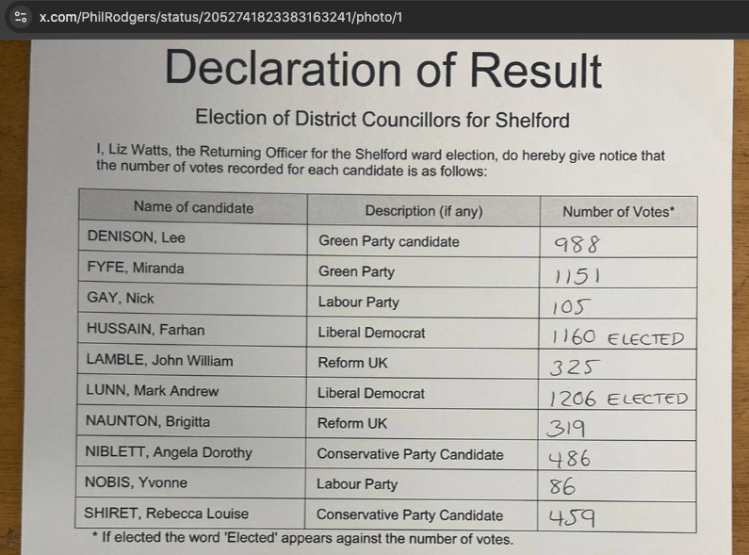
Above – Via Phil Rodgers, just nine votes separating one of the two Liberal Democrat winners and The Greens’ Miranda Fyfe. Every vote counts.
*(Declaration of interest – I have been commissioned in the past by Miranda Fyfe to film events and campaign intro videos. Because transparency).
As for Tories and TeamNigel…
No concerted effort in Cambridge – but then with national results perhaps they didn’t need to? A reminder to Cambridge and Southern Cambridgeshire residents that we cannot insulate ourselves in a bubble from what’s happening in the rest of the country politically.
There’s a new challenge for institutions in and around Cambridge
Especially those promoting the continued growth in the face of unsolved environmental constraints and issues. Just as TeamNigel has caused huge shocks for institutions that now have to deal with councils led by that party, Cambridge City Council currently has no leader – Cllr Holloway having been defeated by Cllr Fisher of The Greens. That means two weeks of intense negotiations before we find out what Political shape the new city council will take for what will be the final independent year of its existence. We find out formally when the new civic mayor is elevated at the opening of the new council year/AGM on 21 May 2026 at The Guildhall.
“What’s the challenge?”
While the short-term fix is for Labour and the Liberal Democrats to agree a year-long confidence-and-supply agreement so as to limit the influence of their Green Party opponents, The Green Party in this snapshot in time is not like a standard local political party: It is growing into a movement, which amongst other things involves organising events that are open to the public that are not simply about politics and/or environmental doom. You only have to see:
- Their packed events calendar (when was the last time you saw a political party with one of those that was publicly accessible?)
- The visits of high profile campaigners combined with very visible symbols of inequality in and around the city – and more of their national level figures have that hard-to-find screen presence, such as Rachel Millward (deputy leader of the national party here)
- The 2,000+ Green Party members in the Cambridge & South Cambridgeshire Green Party …which inevitably has a different impact for a fast-growing and rapidly-evolving political party vs Cambridge Labour when it had similar numbers, but in their case had a 100 year history and longstanding systems, structures, cultures and conventions.
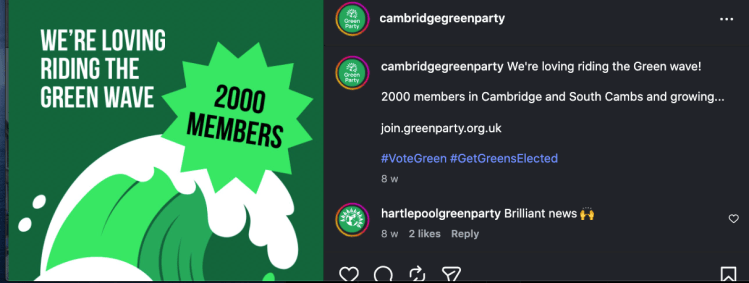
Above – Cambridge & SC Greens on IG 10 March 2026.
“Couldn’t this all end in tears?”
That’s the risk people take when getting involved in party politics. I remember discussing this with former national party leader Natalie Bennett, now in the House of Lords, in this interview back in 2016 – ten years ago and just before the EUReferendum. The interview below covers the Green Surge of the mid-2010s, the new media scrutiny, and the party having to adapt and improve its institutional systems and structures as a result.
Above – Natalie Bennett of The Green Party, 26 May 2016 (ten years ago) outside the Cambridge Union (interviewed by me, very much not the trained, polished interviewer!)
Time will tell how the local and national party institutions for The Greens evolves. Because given the huge growth pressures and the very visible environmental pressures, there is a lot at stake. And not just for the political parties.
If you are interested in the longer term future of Cambridge, and on what happens at the local democracy meetings where decisions are made, feel free to:
- Consider a small donation to help fund my continued research and reporting on local democracy in and around Cambridge
- Follow me on BSky
- Spot me on LinkedIn
- Like my Facebook page


