“The Fund will support practical, locally led approaches that can build trust, remove barriers to participation and deepen people’s connection to democratic life.” Says the written statement to Parliament
You can read the full statement from Democracy Minister Samantha Dixon MP here
Long-time readers of this blog will be familiar with my workshops over the recent years where I’ve booked community venues and run sessions covering:
- Central government and the civil service
- Local government
- The town planning system
- How decisions by central and local government have influenced Cambridge’s history
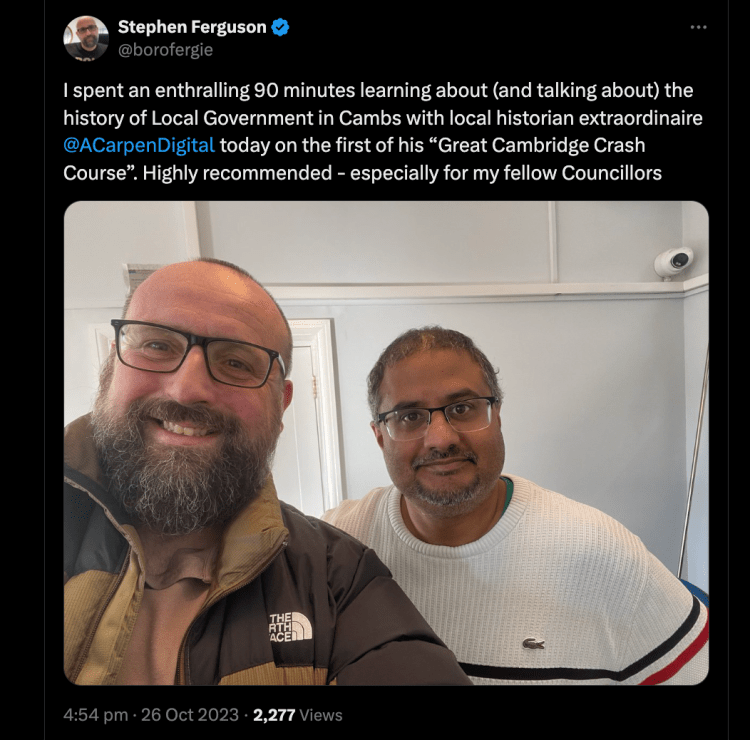
Above – Cllr Ferguson (left) and myself (right) at Rock Road Library’s community room on 26 Oct 2023
The reason why I like booking local community rooms – in particular libraries, is that the funding gets recycled back into library services. Also, library services are measured on the number of room bookings they get.
I also ran a workshop on the draft local plan, which the new leader of Cambridge City Council attended along with councillors from the two other large parties on Cambridge City Council.
“The event was well attended including three councillors and representatives from three political parties. It was very well chaired and a positive meeting, as we have all come to expect from Antony, who has always shown great skill at bringing people together around even the most contentious issues.”
Above – Cllr Katie Thornburrow (Lab – Petersfield) 16 Nov 2025
Note the eligibility criteria
Applicants must be civil society organisations – individuals and sole traders such as me have been specifically excluded. If anyone is wondering whether I’m going to apply for it.
What that means is that if people are interested in future workshops funded by the Government’s fund, a constituted local community group that meets the eligibility criteria would need to apply for the funding and be successful, then commission me to run the workshops on their behalf. I could not do this alone.
Even if I were eligible, my neurodiverse mindset finds application processes to be a *huge barrier*. Like wading or swimming through treacle. As Jon Tickle demonstrated in Brainiac Science Abuse many moons ago.
Above: Real life scientific experiment!
It’s a Cambridge thing – where scientists test out popular phrases such as the uselessness of chocolate teapots.
Which provides two imaginative examples of how to engage the public with science
The democractic engagement fund is looking to tease out imaginative ways of engaging the public – and in particular groups of people who are disproportionately less likely to participate
The themes the Government has listed are:
- Outreach
- Informing
- Widening Opportunities
In the grand scheme of things, the examples provided in the guidance could apply to any of them
The ones listed include:
- Democracy days – where citizens can learn about democratic institutions, voting, register, and engage in Q&A sessions.
- Providing democratic information at existing touchpoints e.g. youth clubs, sports teams etc.
- Fund democracy ambassadors/community champions/Young Mayors.
- Language-accessible sessions (including BSL where appropriate) for ethnic minority communities.
- Creative competitions on what democracy means to the citizen.
- Art Installations & Street Theatre: Using creative mediums to spark conversations about democracy.
- Storytelling Projects: Collecting and sharing citizen voices to highlight why participation matters.
- Drama and Theatre: Plays or performances that explore themes like fairness, representation, and why voting matters.
- Deliberative forums – creating safe, structured spaces for dialogue where citizens can discuss issues and share perspectives and engage place‑based decision‑makers on community perspectives. This may include the use of digital deliberative democracy tools where appropriate. (Cambridge University is experimenting with some here)
- Mock elections. Enabling provision for participants to input into decisions affecting them.
- Facilitated debate forums or deliberative workshops where participants explore democratic concepts, rights, and responsibilities.
- Mock decision‑making exercises or role‑play simulations that help people experience how democratic processes work.
The point being that there are many other options available than me running a workshop and facilitating discussions.
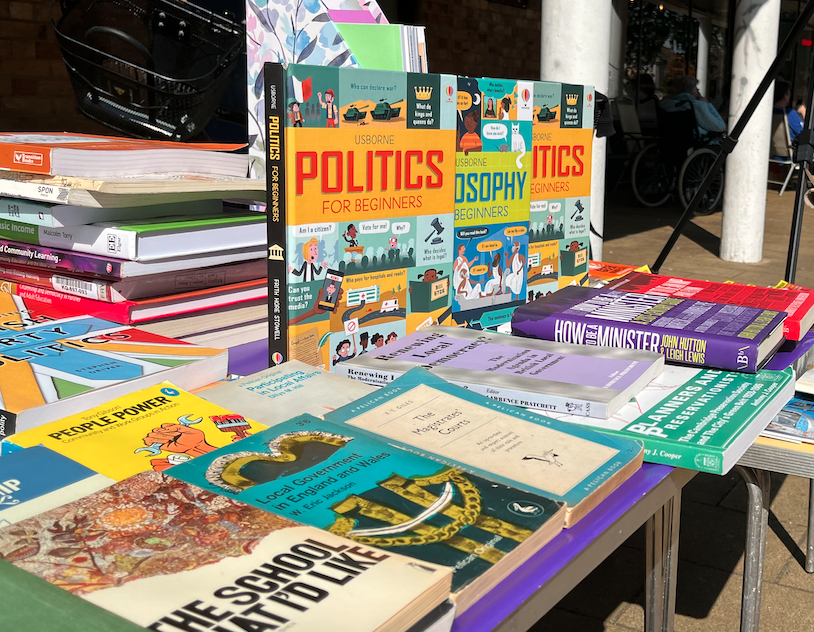
Above – a community book sale from 2023 that I ran – acquiring very low-priced second hand stock gathering dust in warehouses and bringing them out to new audiences
I also blogged about individual titles that caught my eye, and also digitised some of the oldest books dating back to the interwar era which introduced democracy and politics to a general public that had only recently won the right to vote.
Interestingly it was the books written and published during war time – especially the discussion guides, that were the most interesting. I’ll leave you to judge as to why. (The civics topics in the old church-based Adult School Union syllabuses are particularly interesting because they approach democracy and politics in its broadest sense rather than as narrow academic topics).
I would love to see (and even help write) a musical about Cambridge’s local history for local secondary schools to perform – commissioning local musicians and songwriters to write the songs.
Local history is one way of engaging people in local democracy, because it helps explain how Cambridge got to the state of where it is today.
Which also reminds me, the Cambridgeshire Association for Local History is on the lookout for new members and new volunteers to help keep the society going. They produce an annual publication and online bulletins which welcome contributions from anyone (Subject to their inclusion criteria). You can read back copies here. This is also where a new generation of local historians – especially further education students working on extended projects, could make a huge difference. Even and especially where it involves recording the changes happening to Cambridge for future generations.
For those of you who want to get out and about, see the walking tours that the Mill Road History Group has lined up here in partnership with a number of other local organisations including Living Streets Cambridge.
Video production on all things democracy
This is ***really difficult to do*** – and is even harder if you are doing it on your own! I found out the hard way when I experimented with video summaries of up-coming local council meetings.
Above – Cambridge Local Democracy – preview of meetings from 17 Jan 2022
Several years ago when I was invited to stand as an independent candidate in Queen Edith’s ward for the city council elections, I made some short video-explainers to give viewers the essential info on regularly-occurring issues, such as potholes!
Above – Who is responsible for potholes? 15 April 2023
Both of those videos at the time of writing had fewer than 25 views each.
Given how algorithms are gamed, getting any online traffic/interest would need to include paid advertising. Having been filming and uploading videos featuring various local content from meetings to marches to vlogposts, only one local-democracy-related video has exceeded 1,000 views – and that was the voxpops on rebooting the controversial Greater Cambridge City Deal in 2016 – a decade ago!
That said, the importance of the video record – especially pre-lockdown when most local councils did not have their own inhouse provision, is being able to use content recorded at the time to hold future decision-makers accountable. For example in 2017 I highlighted in this video how the Greater Cambridge Partnership had not provided a substantive answer to what happens to the buses proposed for the Cambourne-Cambridge Busway ***when the buses hit Grange Road***
A decade later and they still have not responded – they are assuming that the buses would ‘join the existing bus network’ even though they have not had substantive conversations with Stagecoach – the majority bus provider – about the plans. (Note the CPCA Mayor Paul Bristow opposes the project and gave evidence at the Public Inquiry stating that as Mayor in control of bus franchising he is under no obligation to use the busway once built).
So if you are applying for the democratic engagement fund, the big question you will need to answer is how you intend to get people to watch your content
…and furthermore, act upon what they have learnt.
If you are interested in the longer term future of Cambridge, and on what happens at the local democracy meetings where decisions are made, feel free to:
- Follow me on BSky or on LinkedIn
- Like my Facebook page
- Consider a small donation to help fund my continued research and reporting on local democracy in and around Cambridge.

 The Cambridge Town Owl