Also on supporting community projects, and coming up with something that does not mention the word ‘school’
Not least because one of the biggest barriers to people taking part in anything involving education and learning are their negative experiences at school during childhood.
Cambridgeshire has a new Local Democracy Reporter
Hence my surprise at seeing my blogpost on lifelong learning questions to the Combined Authority Skills Committee making the news.
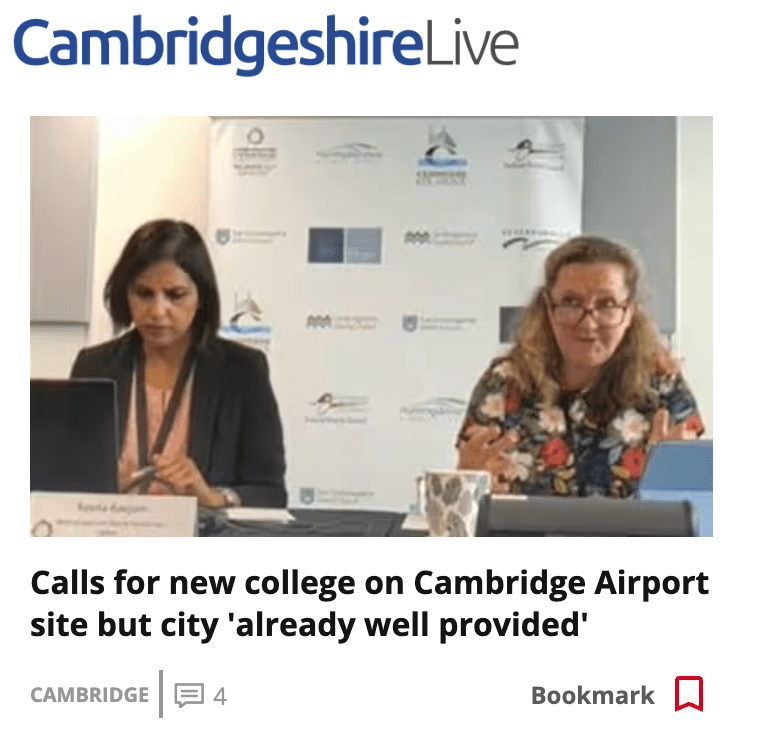
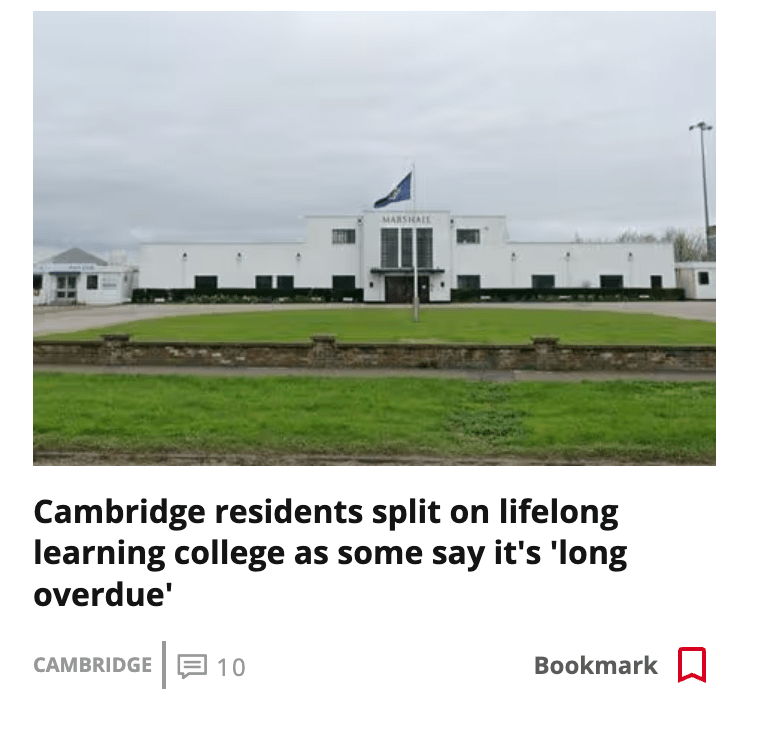
Above-left, by new reporter Eoin McCaul, and the follow-up piece by one of ReachPLC’s freelance contractors quoting responses by readers.
“Eoin is a local democracy reporter covering Cambridgeshire County Council, Cambridge City Council, South Cambridgeshire District Council, Huntingdonshire District Council, Fenland District Council, and East Cambridgeshire District Council. He has previously worked for The Belfast Telegraph and The Bolton News after studying a master’s in news journalism at Cardiff University.”
Above – Mr McCaul’s profile on CL, and also on LI.
The problem of disconnection in society
More than a few studies have been published on disconnection in/isolation from society and the symptoms such as loneliness, and vulnerability to disinformation online. Go back further and you’ll find a large number of academic reports going back decades.
- Strengthening community cohesion – Commons Library March 2026
- This place matters – Jo Cox Commission, August 2025
- A tinderbox of disconnection and division threatens our democracy – Independent Commission on Community Cohesion, June 2025
- Half of all Britons feel socially disconnected from society – University College London, May 2025
One of the Government’s responses has been the Pride in Place strategy – and the funding schemes for dozens of neighbourhoods dotted across England.
“This Government was elected to deliver a decade of national renewal. The measures of success cannot just be shifts in national statistics but must include change that people see and feel in their local community.“
Above – Pride in Place Strategy, September 2025
The problem with the areas getting the funding is other areas in similar need inevitably ask: ‘why not us?’ Peterborough has two neighbourhoods that were selected for funding. One of the challenges that they will have is that other neighbourhoods will inevitably ask why their part of the city is not receiving similar investment. I remember during my civil service days visiting areas receiving funding via the New Deal for Communities Programme 2000-2010. One of the things local councillors said to me was trying to ensure equitable treatment across the city – noting the huge perception risks that one group in society is seen to ‘get more’ than others. Social policy is far more complex than the newspaper headlines make out. And it’s impossible to do well from an office in/around Whitehall!
Commons Education Select Committee calls for community learning centres in every town – November 2020
The report was published in November 2020 and was debated in the Commons early the following year. I wrote about it here.
“A month before the report from the Education Committee, I wrote a blogpost on colleges for adults. There are already examples of this, such as CityLit in London. But why do such centres have to be ‘towerblock-based’? CityLit in Central London between Holborn and Covent Garden tube stations lacks the open spaces.”
At the end of the blogpost I wrote that decision-makers should…
‘Make them places where people want to be’
Which is why I said that whatever any new facility in Cambridge looks like, it must not look like ‘school’. Which is why I found the paper from Derby’s WEA on an ideal adult education college to be very interesting reading – not least because they asked the question about the learning facilities that adults need. What they missed out on were the wider facilities that adults would find convenient – such as things like health clinics, pharmacies, creches, and places to rest, on site.

Above – An ideal adult education centre – An example from Derby 1968
Breaking the stereotypes on lifelong learning
I wrote about this in a previous blogpost, quoting the late Frank Dobson MP.
“Generally, part-time students at Birkbeck are not doing flower arranging. They are studying serious subjects I find it hard to believe that this is being done by good and decent people such as my right hon. Friend the Secretary of State for Innovation, Universities and Skills. He is my friend and he is honourable, but he is not right; he is wrong on this occasion. I cannot believe that Ministers have seriously considered the impact of this change on individual institutions.”
In times gone by, Anglia Ruskin University and predecessor institutions used to carry out the function that Birkbeck did. One of the things that also disappeared was any opportunity to learn about civics/citizenship education – something I continue to point people to Qasir Shah’s paper from UCL in 202 about.
“A decade of austerity has resulted in adult education being severely underfunded, which it is argued has affected the most marginalized and vulnerable in society: those who need education the most as their only route to social mobility and social contact”
An example from American inter-war history
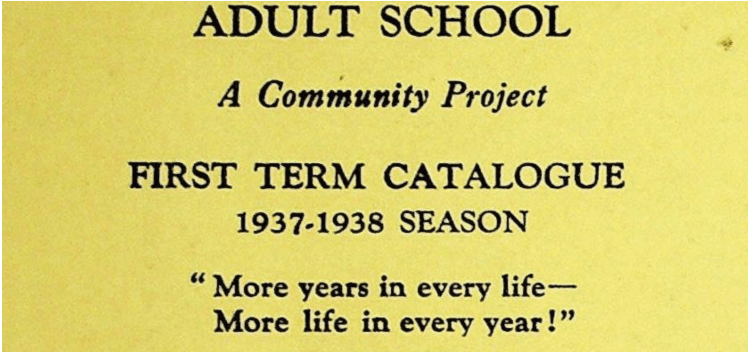
This course catalogue from South Orange Maplewood Adult School – their First Term Catalogue 1937-38, arrived recently and is digitised here. One of the things the course summary shows is the sheer variety for what is an evening class series.
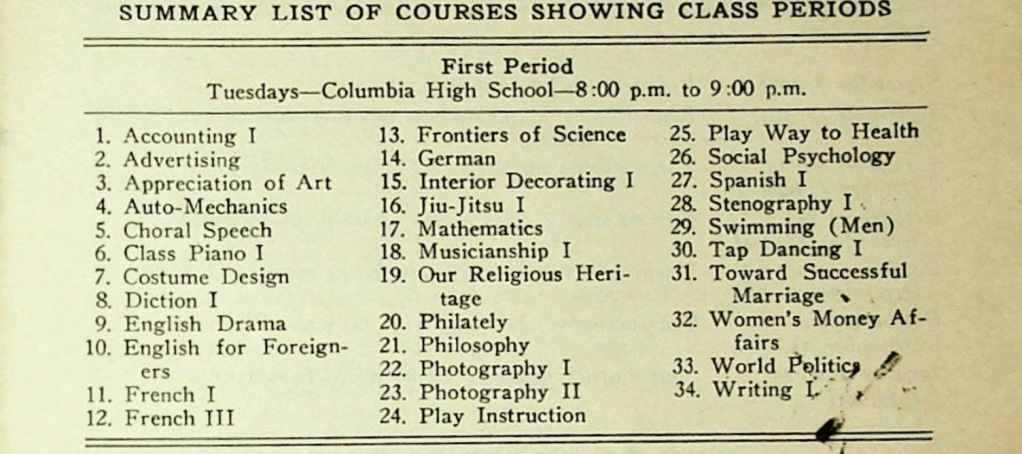
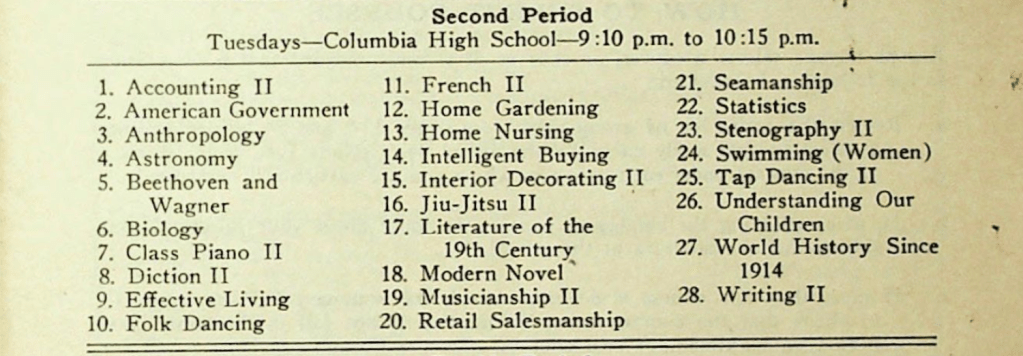
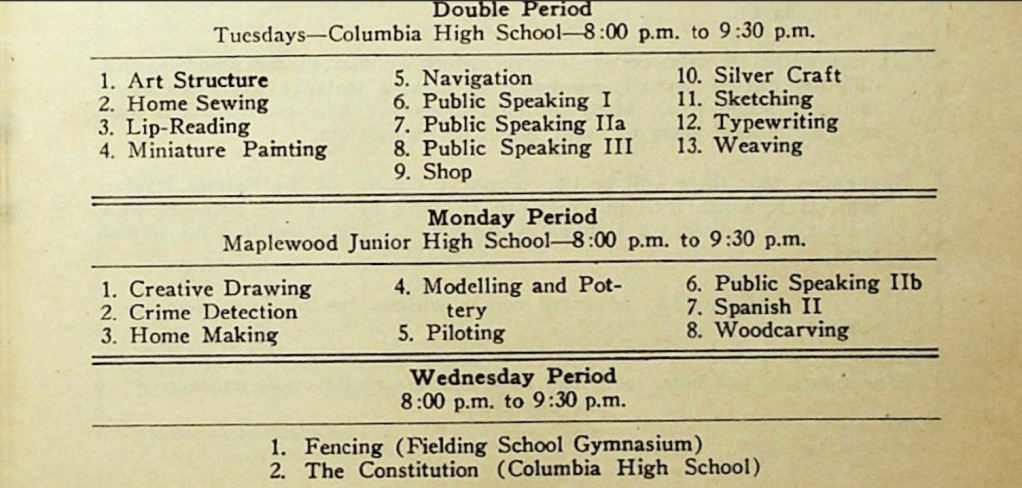
Above – South Orange Maplewood Adult School First Term Catalogue 1937-38, p2
Classes and activities are also grouped into different themes.
One of the things Cambridge lacks are opportunities for adults to learn/re-learn musical instruments in group/social settings **as beginners**
The two that I am aware off are community orchestras for both adults and children together.
I briefly went to the former for a number of sessions after my civil service years until CFS/ME took hold, and went to see the latter in a local concert last year. Both are splendid should you wish to try them out.
What the South Orange Maplewood catalogue offered, and what the East London Late Starters’ Orchestra offer, are for adults only.
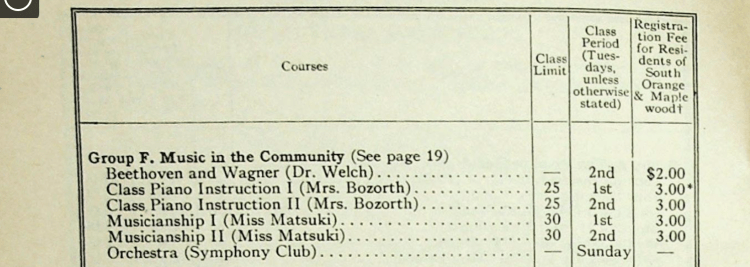
Other themes include civics/democracy education, and finances
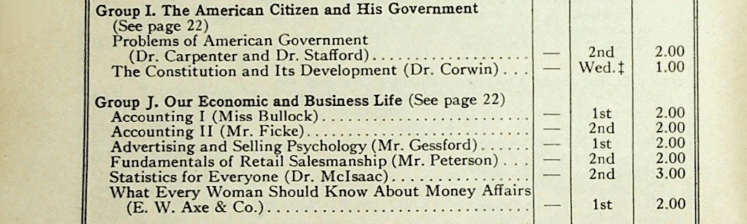
Science is also on the list – as are foreign languages which Cambridge is well-provided for in evening classes
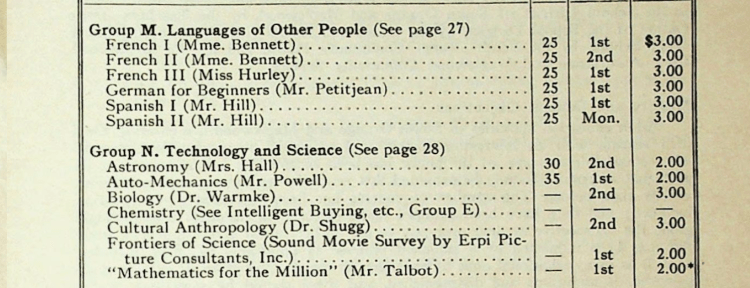
Above – what would lifelong learning classes for beginner adults be like in a science lab?
After all, it’s not like there’s a shortage of laboratories in the city!
The interdisciplinary approach in higher education
This is the approach from the London Interdisciplinary School here
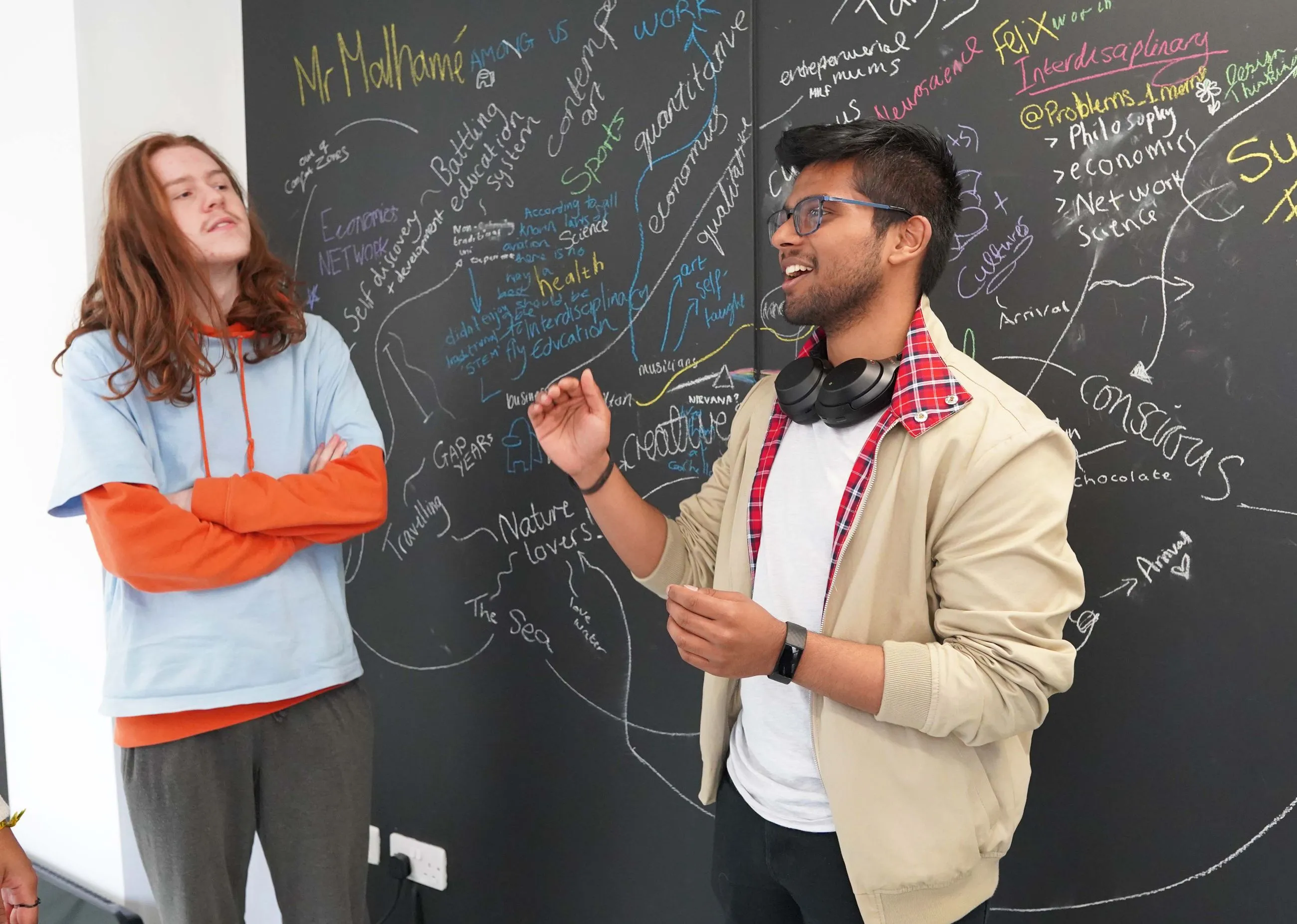
Above – the chap on the right is not me in younger years! (See https://www.lis.ac.uk/about)
What’s striking is the different mindset between this approach and what some in civil service circles are saying.
“The future is interdisciplinary (ID). You will be at the forefront of the ID movement—challenging what is possible, being able to cut across disciplinary boundaries, make new connections, and find new solutions.”
Above – London Interdisciplinary School
“It is time to call time on the old conception of the generalist“
Teodor Grama and Alex Thomas, Institute for Government, 06 March 2025
The offer from the LIS makes me wonder if my university experience would have been more fulfilling intellectually had there been far more variety. But the concept in the late 1990s of ‘Combined Studies’ degrees wasn’t even on the radar – something offered by the Open University. (I think ARU used to offer it with their old module catalogue. The closest they have is their Liberal Arts degree).
The Combined Authority’s structure does not allow for it to support something like ARU’s old module catalogue.
I wrote more about it in this blogpost. Essentially you could pick and choose between modules which if I recall correctly were offered in both daytime and evenings.
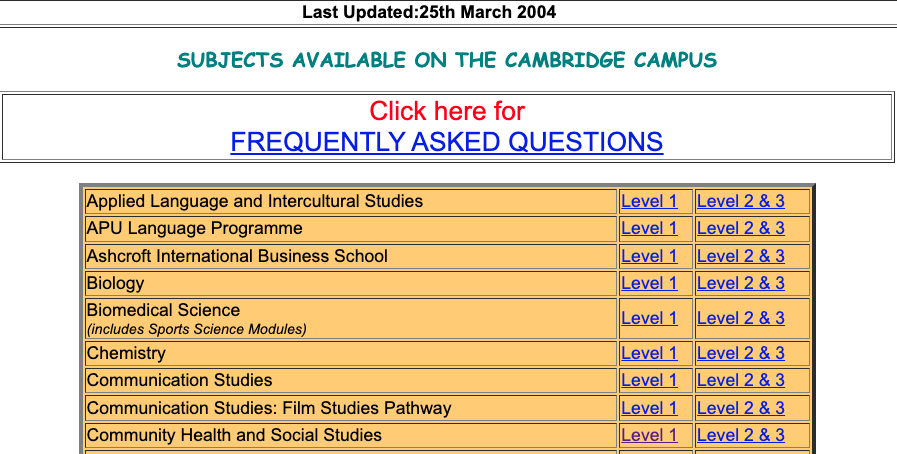
Above – detail from the Cambridge APU module catalogue – the Comic Sans font gives the date away, even if the text above it does not!
What might a civic equivalent of the above be like to help communities reconnect with each other through activities and learning?
If you are interested in the longer term future of Cambridge, and on what happens at the local democracy meetings where decisions are made, feel free to:
- Follow me on BSky
- Spot me on LinkedIn
- Like my Facebook page
- Consider a small donation to help fund my continued research and reporting on local democracy in and around Cambridge.


