
Cambridge City Council announces on social media it is bringing in its Red Severe Weather Emergency Protocol (they need also to put this on their website landing page as at the time of posting, there isn’t anything informing local residents about the extreme weather conditions).
#IAgreeWithPuffles – and everyone else who thinks something should be done
A couple of days ago I responded to a post by the national party leader for The Greens, Zac Polanski about the state’s responses to the heat alerts.
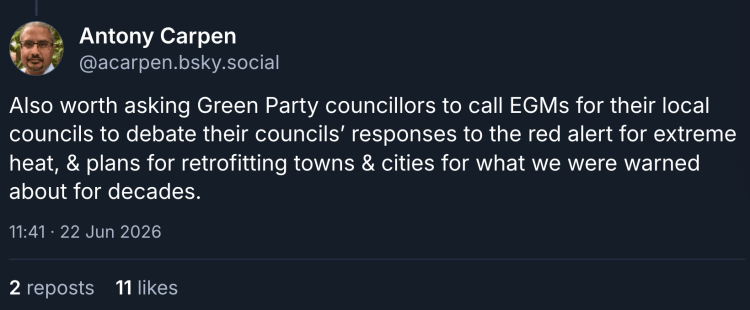
Above – from Bluesky above, 22 June 2026
Since then The Greens in Cambridge have followed through on that request.
“This is why our Green councillors are calling for an extraordinary meeting to discuss what urgent action we can take now, and what adaptations we can put in place for future heatwaves.”
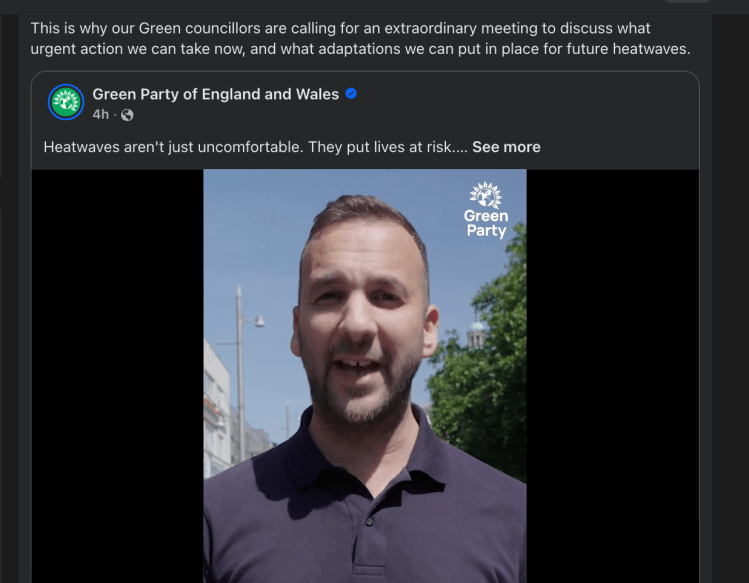
Above – Cambridge Greens on FB, 24 June 2026
Because at this stage, I don’t really care about who makes the requests so long as it gets done. I assume it’s a similar case for other residents too. On a wider note, I also think it’s good for residents to see a political party responding positively to a relatively straight-forward request and following it up. Because it increases the likelihood of other residents doing similar, and thus gets more people involved in local democracy.
“Greens are calling for urgent measures… including]… A full extraordinary council meeting to ensure accountability and a coordinated response.”
You can also see Cllr Thornburrow’s previous blogs on local Cambridge issues here
“Isn’t it a bit late to have a meeting now? We’re already in crisis mode”
Not at all. The big challenge with national resilience and civil contingencies planning is no one really knows how they will respond to a scenario until they are actually in it. We can train and prepare for it, but until you’ve been through the real deal there is only so far you can engage people with ‘what if?’ scenarios. With extreme heat how having gone beyond what was being predicted in past scenarios in decades gone by, we are at the ‘here and now’ for mitigation. i.e. we are beyond the point of ‘how do we prevent bad stuff from happening in the future?’ to ‘The future is here, bad stuff has happened, and we didn’t prepare well enough for it.’
“Is it not obvious to all of us that we were unprepared and that the Government’s judgment was faulty?”
Above – Major Milner MP to Neville Chamberlain MP, Col 1161, House of Commons Hansard, 07 May 1940
This was the so-called ‘Norway debate’ that led to the fall of Prime Minister Neville Chamberlain. Timely given the fall yesterday of the current Prime Minister Keir Starmer (who remains in office until Labour have been through the motions of selecting a new party leader who can command the confidence of a majority of the House of Commons, most likely to be Andy Burnham MP).
The current heatwave is due to end at the weekend. Do we know what any ‘lessons learnt’ are?
Some of the actions will involve redirecting people to groups that can already provide advice and support – such as Cambridge Carbon Footprint here.
Additionally, for the evening classes in Cambridge, it’s the practical ones that book out the fastest, eg carpentry. Why are providers not expanding capacity? Why are funders not providing additional funding for that expansion?
Cambridge Regional College also has a ‘change it yourself’ course as an introduction to all things DIY, but again there’s only so much they can do without the funding. And the focus of that funding as I’ve mentioned before is on basic and adult skills.
‘The Skills shortage from a different viewpoint – Christopher Shirley’
I picked out this extended post via Anne Bailey of Form the Future on LI here
Mr Shirley deals with the chronic skills shortages *and* the continued underinvestment in education and training from employers – in an era where the financial burden of training and education now seems to fall on individuals rather than on the firms or the state. (How did we get to here again?!?)
The costs of training – including the costs of living *while* training, are explored further in the post. And this is something ministers need to consider, and Combined Authorities need to make the case for when it comes to the sectors with the most chronic shortages and which those continued shortages become a strategic risk to growth. (i.e. so great they justify Politically the intervention of the state.)
With that in mind, I hope councillors read Mr Shirley’s post, and then debate the issues he raises in the context of green skills and wider resilience. Some will involve working out how to retrain people into the new green economy. Some of it will involve getting people to take part in learning some of the practical skills and knowledge if/when there is no one around to help them in the case of an emergency because demand outstrips supply. Also, the people on the latter may find themselves interested and inspired to go on the former courses. But as with how to deal with heatwaves, it’s hard to know how people will respond until the challenge or opportunities are there upfront staring them in the face. And as for the heatwave and extreme heat (Which really should not be illustrated by people going to the beach in media articles!) that time is now.
If you are interested in the longer term future of Cambridge, and on what happens at the local democracy meetings where decisions are made, feel free to:
- Follow me on BSky
- Spot me on LinkedIn
- Like my Facebook page
- Consider a small donation to help fund my continued research and reporting on local democracy in and around Cambridge.

Above – Blue Peter Green Book 1990. How on earth did we get to here?

