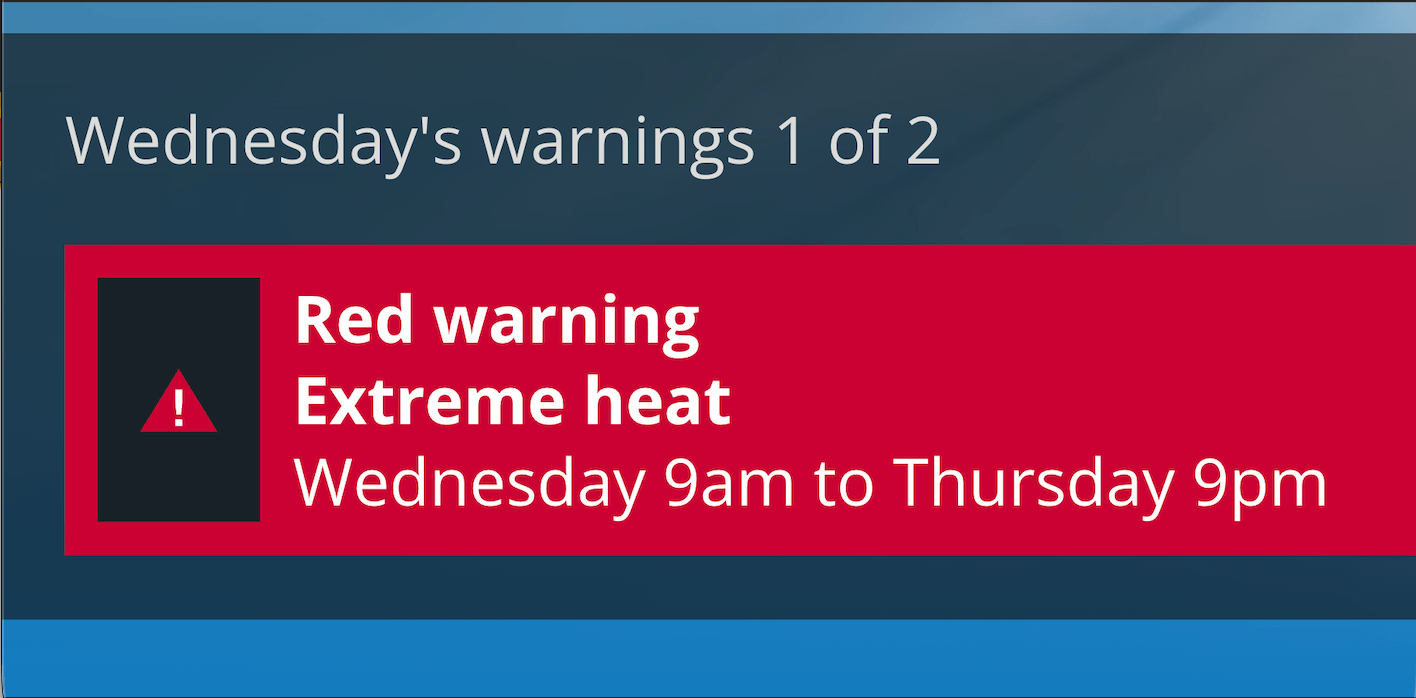
Suddenly 1999 seems a very long time ago, and the extreme heat that we were warned about is now here. So why are we so badly prepared? Interesting day to ask such a question given the Prime Minister resigned earlier this morning following Andy Burnham’s election to Parliament with a huge majority last Thursday.
If you asked teenager or young adult who followed pop music what ‘red alert’ was, they might have responded to the Basement Jaxx track of the same name.
Above – not written about extreme weather events
“The UK Health Security Agency (UKHSA) has issued a red heat-health alert (HHA) for 6 regions of England.”
And Cambridgeshire sits within one of them. And while the boundary of the red alert area just misses Cambridge itself, I don’t expect things to be noticeably cooler as a result. It’s still going to be a very hot one!
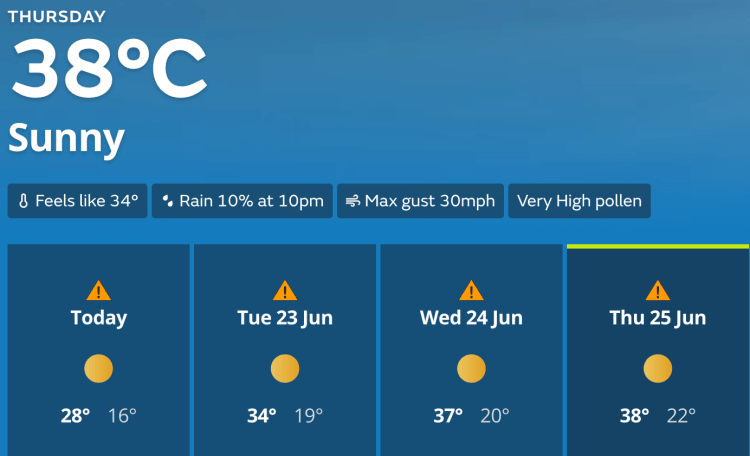
Above – Cambridge’s forecast for this week from the Met Office. Our 38 degrees on Thursday is outside the Red zone but London’s 38 degrees the day before is within the red zone. Which is why I hope the CPCA Mayoral Question Time on Thursday is postponed. I don’t want to be getting on a bus on the hottest part of the day given my health! (I have submitted a PQ).
Advice on staying cool in very hot weather was updated last month (May 2026) here, but so far there hasn’t been anything at the time of typing on the webpages/landing pages of local councils:
“What does the National Risk Register say?”
“The reasonable worst-case scenario is based on an extended period of high temperatures and would affect 50-70% of the UK population. This would take place over 5 consecutive days, with maximum temperatures exceeding 35°C.”
Above – National Risk Register 2025, p141
“What advice does it have?”
It says refer to the ‘adverse weather and health plan”
Above – AWHP 2026-27
“What does that say?”
It has some guidance at Appendix 2 on p69 which is essentially a set of links to more guidance. Eg on keeping cool at home. It also has a poster.
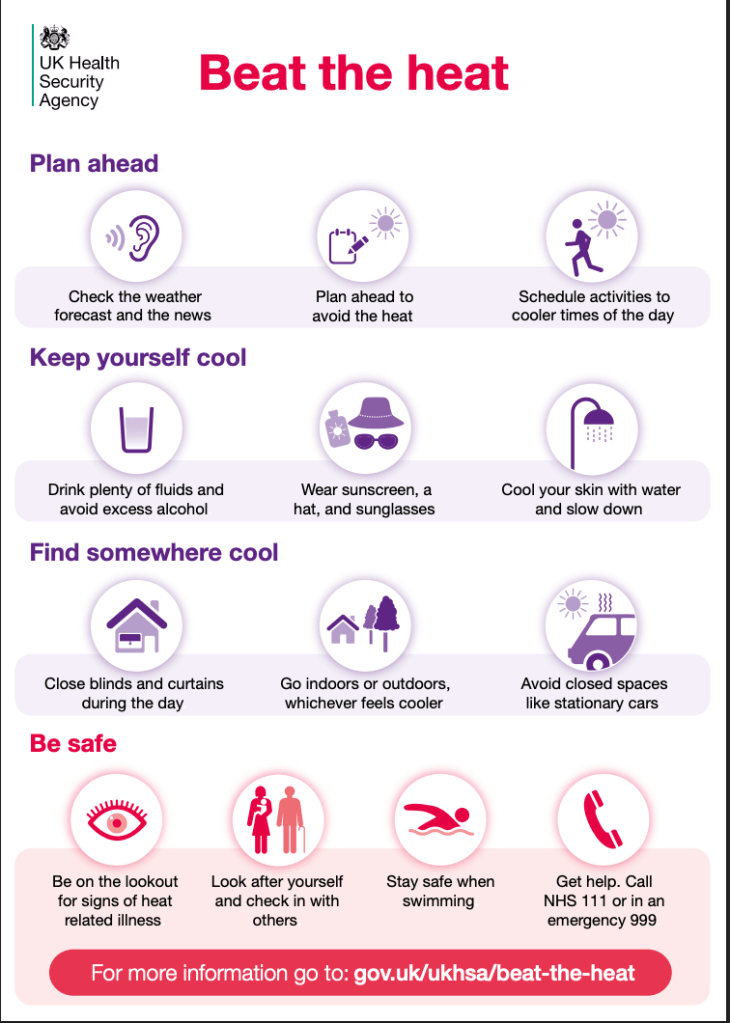
Above – Beat the Heat by UKHSA 2026
London ran a heat emergency exercise – Operation Helios, in 2025. You can see the results in the post-exercise report here
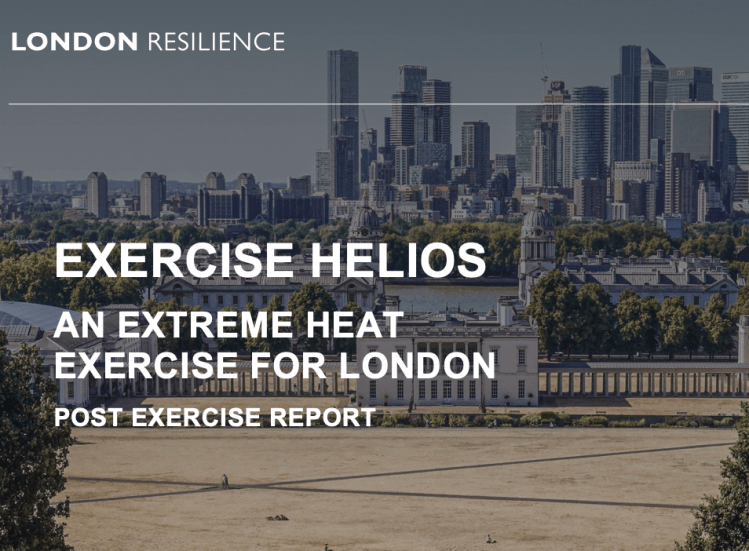
Above – Post exercise report for Operation Helios, London Assemby (2025)
“How can we adapt our buildings to climate change?”
“Failure to recognise and incorporate climate-related physical risks into decision-making is considered a threat to socioeconomic security.”
They have a monitoring framework and report for those of you responsible for non-domestic buildings
“Why are so few of us talking about retrofitting towns and cities?”
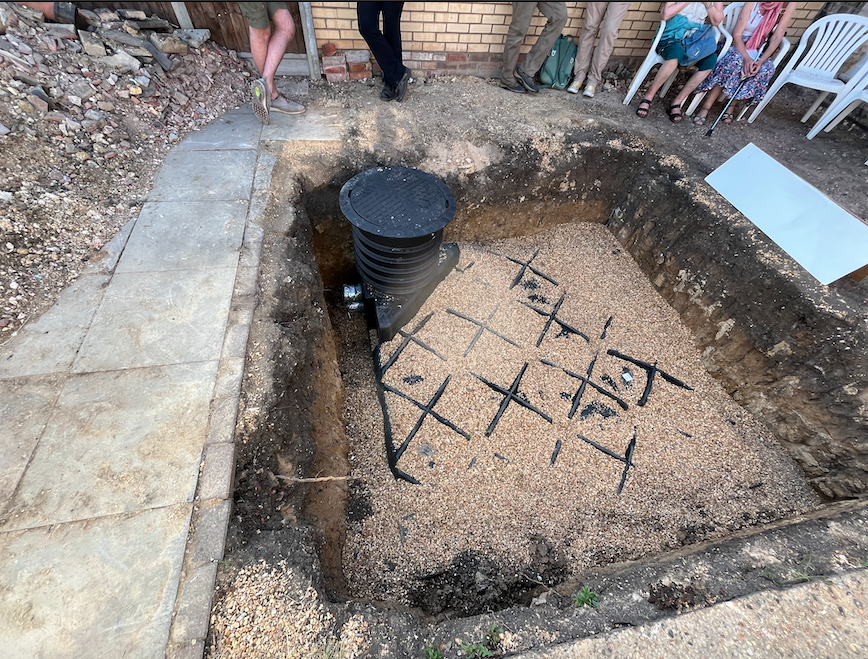
Above – the top of the fitted reservoir in the Cambridge exemplar house which in this case is a 1,000 litre tank if I recall correctly, with the filter on top of it. The plastic top is designed to enable inspection.
This was part of Cambridge Carbon Footprint’s retrofitting exemplar programme if I recall correctly. The amount of work involved just to retrofit one interwar semi-detached house was sobering given the number of properties needing similar treatment.
Other things in politics have taken priority I guess. It will be interesting to see what the party political response is this time next week. Not least because the EU is more likely to take an even more firm response given what is happening in France where temperatures are above 40 degrees in many parts to the extent that schools have been closing and alcohol sales banned.
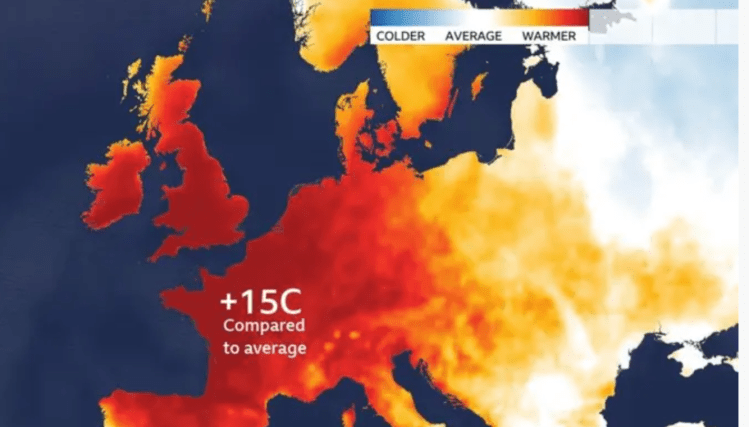
Above – not normal. BBC Weather
In November 2007 Brenda Boardman of the University of Oxford’s Environmental Change Institute wrote a research report for The Co-operative Bank and Friends of the Earth

Above – Home Truths, ECI Report 34, University of Oxford
Go to p41 of the above report to see what it says about retrofitting existing buildings. The distribution of housing by Energy Performance Certificate rating for 2007 is striking.
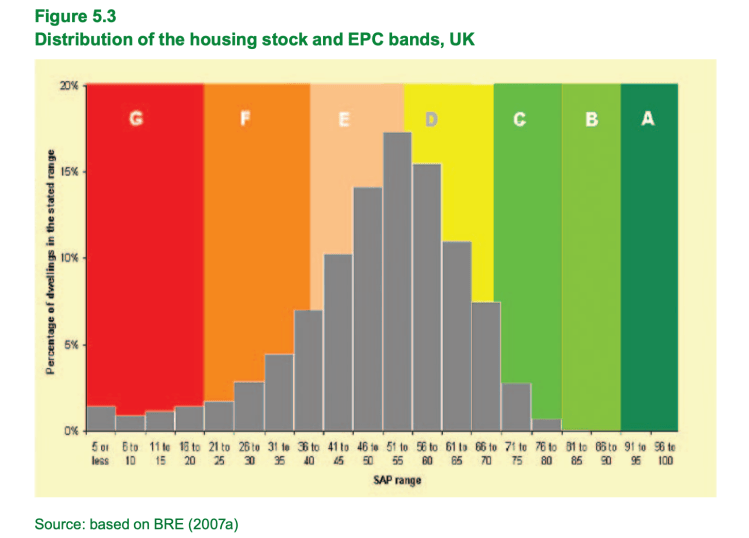
Above – Boardman (2007) p45/46
Now compare it to 2024’s figures. What difference 17 years?
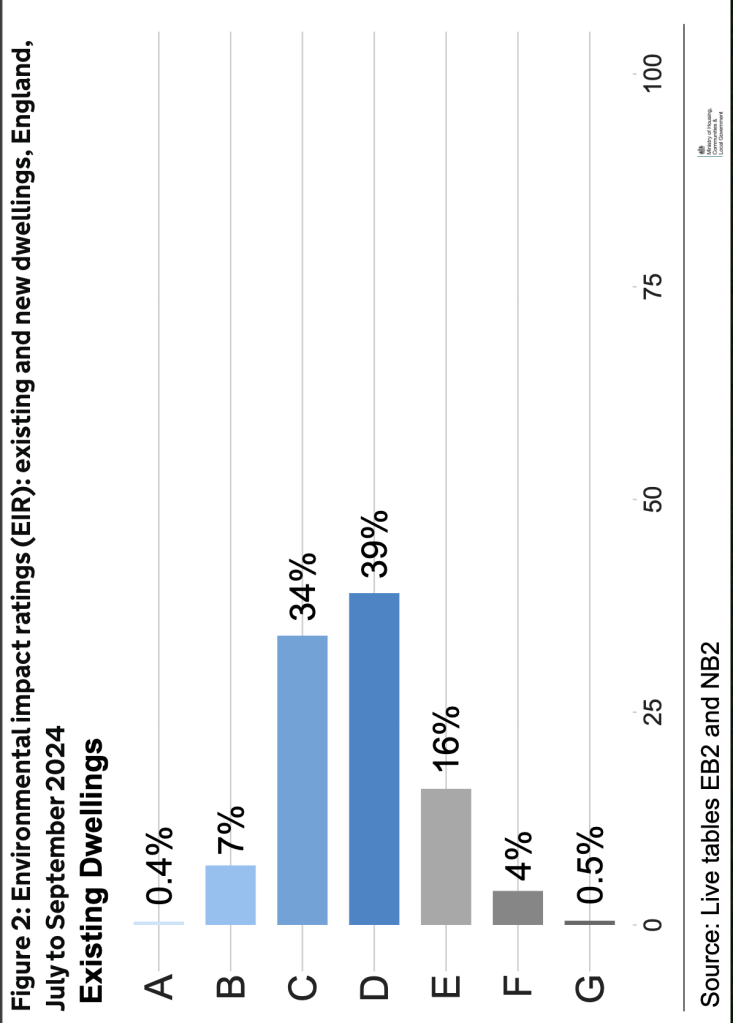
Above – EPC figures for existing dwellings from GovUK, 24 Oct 2024
Note the limitation with the above-mentioned graph: it only applies to properties rented or sold. There are lots of people living in owner-occupied housing or long term rented who may not have any idea of how energy efficient their home is, or what improvements are needed to make them more energy efficient and also resistant to extremes of heat and cold.
‘What would “Retrofitting your town/city” courses and workshops be like in practice?’
If only we had a large lifelong learning college in Cambridge that could deliver something like this ***at scale***
I asked the question back in July 2022 following the heatwave of that year. It got so hot that weather charts had to invent new colours.
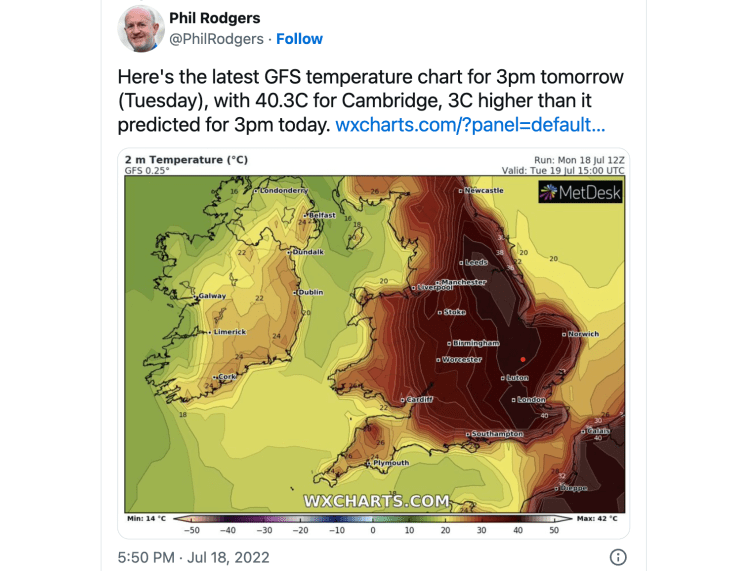
Above – Phil’s chart inventing new colours to show how ‘orrible it was in that heatwave
At the end of that blogpost of 2022 I referenced to Frank Hardie’s wartime pamphlet.
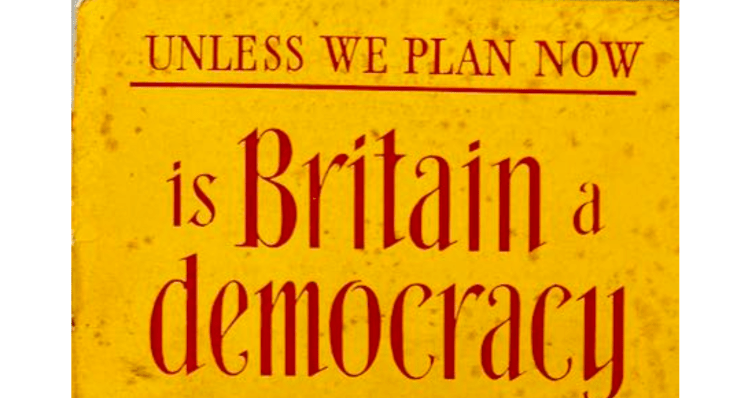
Above – strengthening our democracy, also an urgent task. The discussion questions put by Frank Hardie on the final few pages here are also still relevant to today.
And on the environment, my generation was warned about the Greenhouse Effect on Blue Peter in the late 1980s/early 1990s.

Above – Blue Peter Green Book 1990. How on earth did we get to here?
And how do we deal with it?
If you are interested in the longer term future of Cambridge, and on what happens at the local democracy meetings where decisions are made, feel free to:
- Follow me on BSky
- Spot me on LinkedIn
- Like my Facebook page
- Consider a small donation to help fund my continued research and reporting on local democracy in and around Cambridge.


