
Two sets of question-and-answer sessions for CPCA Mayor Paul Bristow in the continuing heatwave
I’ve not yet listened to the above, but one thing journalists are able to do that most councillors don’t get the chance to do is to ask extended follow-up questions. Veteran journalist and broadcaster Chris Mann has done many of these types of interviews, so do have a listen.
Later that day Paul Bristow faced residents from across the county at The Guildhall in Cambridge – this wasn’t by any means a ‘Cambridge’ audience.
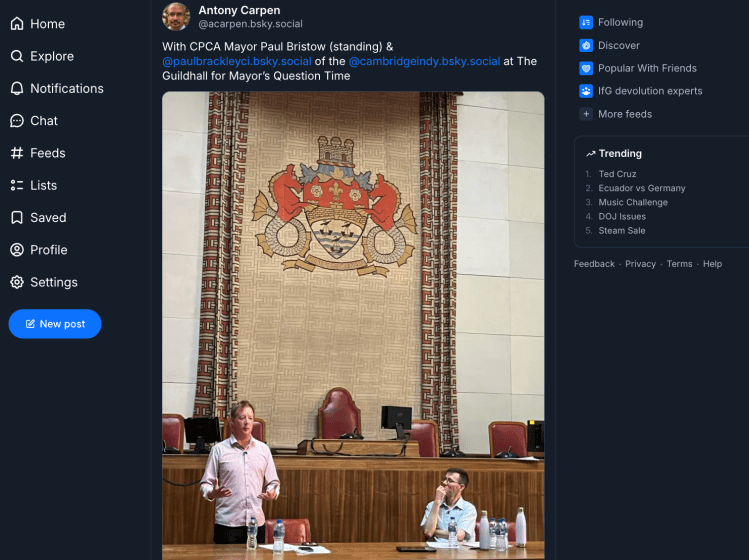
Above – Paul Bristow (standing) with Paul Brackley of the Cambridge Independent chairing
An audio recording of the meeting will be available from the Combined Authority, and the Cambridge Independent will have a full feature in next week’s edition. (Alternatively you can subscribe to read it online when it’s up).
With the meeting open to the public and of interest to people beyond the city of Cambridge, many of the people tabling questions were residents from outside of the city. Furthermore, the geographical range of topics covered the EU/single market status at one end, to the detailed designs of Mill Road in Cambridge.
Inevitably the heatwave had an impact on numbers – it was over 30 degrees C outside as the bus trundled into Cambridge. Most of the seats in the council chamber where councillors normally sit were filled, although after the formal tabled questions had been asked in the first half, a number of people left – the council chamber being stuffy despite its high ceilings.
“What did the CPCA Mayor say?”
For people not familiar with the issues or the office of the Mayoralty, on the face of it it was a competent performance by the Mayor. For those who were familiar with the history and the detail, there were more than a few points you could have picked him up on and criticised him over.
My overall impression was one that *the office of the mayoralty* does not have the powers or the funding to do what successive governments have said they want metro mayors to do. This was reflected in the Mayor’s response to my question about lifelong learning and the issues I raised in this blogpost. He said one of the frustrating problems of adult skills is that the Government ties lots of conditions to funding awarded to combined authorities. As I’ve mentioned before, this means that the policy decisions are taken in Whitehall and the combined authorities are reduced to being little more than county level delivery agents for central government. That sort of work can be done without a tier of politicians because it’s just a procurement and contract management exercise. It’s not devolution in any meaningful sense.
Doubling down on light rail
The CPCA Mayor acknowledged the issue with a mass transit for Cambridge and the tension between the pro-busway lobby and the pro-lightrail lobby. The Urban Transport Group that is carrying out the work of the Mass Transit Taskforce that I wrote about in this blogpost, has put out a new call for evidence.
Above – Mass Transit Taskforce Call For Evidence, 22 June 2026
A lot of the evidence they are asking for is technical, but the top issue is on understanding the benefits of mass transit. (I’d also say that this includes the drawbacks too). The deadline is 31 August 2026
Agreement to disagree on Mill Road
The mess that is the governance structure of institutions that have state responsibilities in Cambridge is reflected by the disagreement over the status of Mill Road between the CPCA Mayor and the Liberal Democrat majority administration that runs Cambridgeshire County Council. The issue is the existence of the ‘Bus Gate’ that prohibits general motor vehicle traffic with the exceptions of buses over Mill Road Bridge. The idea is to persuade motorists that use the road as a through-route to use alternative routes, and thus to make the road safer and more pleasant for pedestrians and cyclists.
The CPCA Mayor included in his manifesto a pledge to scrap the Bus Gate. At present he has no powers to do this – the legal authority rests with the county council, for which the Liberal Democrats who won a majority of council seats *at the same time* that the CPCA Mayor won the mayoralty (two elections on the same day) support it as they were the leading party that brought it in during the previous GCP & County Council administration.
That said, the powers are due to transfer from the County Council to the Combined Authority in the not-too-distant future.
So at the moment it’s a big mess, although nominally the restructure of local government is meant to resolve some of the over-complicated things associated with the current structure and system.
A world of expensive consultants, documents, reports, and strategies.
Former Conservative councillor for Coleridge, Chris Howell – also one of the founders of the cross-party Cambs Unitary Campaign. gave a damning monologue of big infrastructure projects that cost far, far too much and challenged the Mayor to put pressure on the systems and processes that result in such huge infrastructure costs. I think some of this is due to the model of outsourcing and consultancy used which amongst other things means paying a lot of money for consultants for things that could otherwise be done in-house – as used to be the case until Thatcher’s Government forced local government to move from direct provision to commissioning of third parties.
Paul Bristow was also scathing of the Greater Cambridge Partnership, saying it should be wound up and the funding transferred either to the Combined Authority (which is what his predecessor-but-one James Palmer also wanted), or to the Cambridge Growth Company/Development Corporation. For those of you who follow the GCP, the next board meeting is on 09 July 2026 in Cambourne.
East West Rail also came up
This was in part due to the objection by Cambridge University’s astronomers whose telescopes might be disturbed by the proposed southern route. It remains to be seen what the outcome will be, but what it shows is that the University of Cambridge and its institutions are now so large that the diseconomies of scale are now hard to ignore. I.e. different parts of the globally-famous institution have differing opinions on the same thing.
“Chancellor Jeremy Hunt backed the East-West Rail link in his Autumn Statement after cuts to the scheme had been suggested in recent weeks.”
Above – BBC News 17 November 2022
The southern entrance into Cambridge was also taken by the previous government.
“Today it announced its preferred route alignment for the third section of the railway between Bedford and Cambridge, including a direct link to the Cambridge Biomedical Campus, marking a significant step towards delivering the scheme.”
GovUK Press Release 25 May 2023
The route was confirmed by the Conservative Government and re-confirmed by the then incoming Labour Government.
The Cambridge Biomedical Campus has a number of University of Cambridge assets and institutions on site. Their Estates Division responded to the 2021 consultation here which highlighted both the support of East West Rail overall, as well as concerns about the Mullard Radio Astronomy Observatory – ironically built on the railway tracks of the old Varsity Line linking Oxford and Cambridge.
It remains to be seen what impact the University of Cambridge sustaining its objection has on the Bedford-Cambridge section (or more specifically, the Cambourne-Cambridge sub-section) of the East West Railway line.
If you are interested in the longer term future of Cambridge, and on what happens at the local democracy meetings where decisions are made, feel free to:
- Follow me on BSky
- Spot me on LinkedIn
- Like my Facebook page
- Consider a small donation to help fund my continued research and reporting on local democracy in and around Cambridge.


