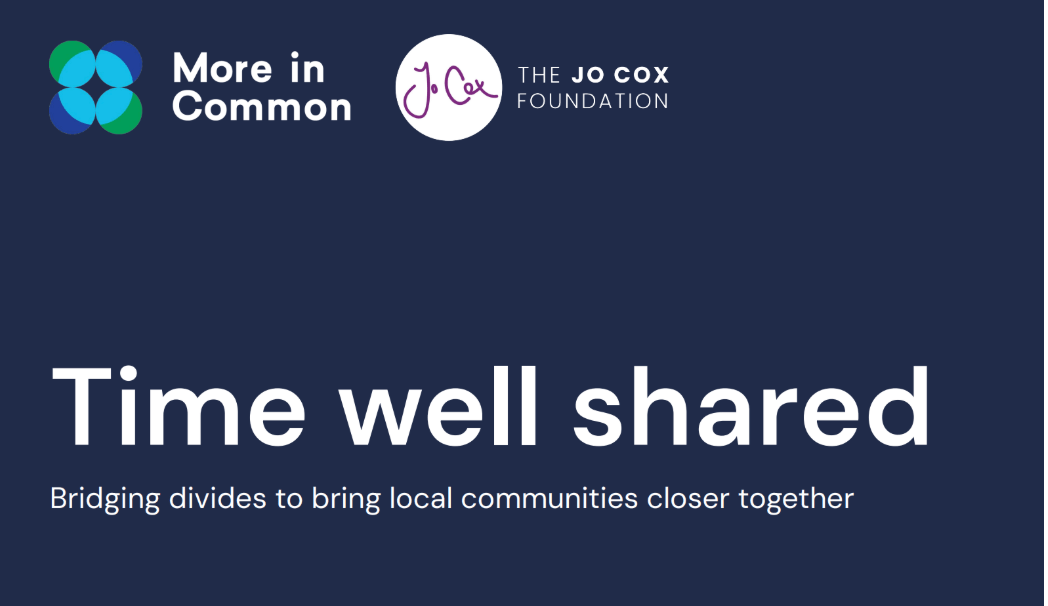
The Cambridgeshire and Peterborough Combined Authority Skills Committee doubled-down on their remit from central government, sticking within the skills remit and refusing to be drawn into the wider lifelong learning policy area
Image: The latest report from the Jo Cox Foundation which deals with loneliness in society
I tabled a public question for the Skills Committee meeting (scroll to 5 mins on on the webcast video via the meeting papers here). Make what you will of the question and answers.
I have written ***lots*** on lifelong learning over the past decade or so, and on loneliness as a public policy issue – this blogpost dating from March 2017. (See also the Government’s 2023 evidence review here)
I’m also on public record as having called for the abolition of the Greater Cambridge Partnership *and* the Combined Authority as part of a call for a new unitary council that covers the Cambridge economic sub-region. And with substantially more powers. There wasn’t anything in the responses that convinced me to change my mind on that principle.
Essentially the CPCA still feels more like a delivery agency for central government rather than an institution that creates and shapes its policies through interaction with local people and organisations. (The minimal discretionary funding and lack of independent revenue-raising powers reinforces this point – the solution to which is not local as it involves changing the law).
My main reasons for tabling the questions included:
- The Government’s confirmation it will create a development corporation for Cambridge
- The Government’s purchase of the airport site via Homes England in partnership with Hill
- Loneliness in society as a policy area not going away anytime soon – see the latest report from the Jo Cox Foundation – her finding on ‘micromoments’ is one I’ll come back to. Building a new lifelong learning college as part of the Cambridge growth plans is for me essential in dealing with loneliness, providing new large activity spaces (positive physical and mental health), and places for adults to retrain in those sectors with chronic skills shortages – which the latest CPCA report says it has issues with.
On the substantive issues:
- The Combined Authority restated its priorities on adult skills
- The Combined Authority’s Skills Committee Chair, Cllr Lucy Nethsingha (LibDems – Cambourne), Leader of Cambridgeshire County Council, confirmed her view that the City of Cambridge is very well provided for facilities for adult skills, and that other parts of the county had greater need.
Which is fair enough. The CPCA was provided with so few powers and hardly any discretionary funding that it can only work on what ministers provide it funding for. And that funding always comes with strings attached due to accountability of public funding rules. Combined Authorities have no directly elected assemblies that executive office holders are accountable to, nor do they have their own ‘independent of central government’ powers of raising revenue.
Both ‘local councils’ and ‘learning providers’ were mentioned in the response from the CPCA. It’s a shame they were not specific as to which local councils had the competencies to spend money (and how much) on adult education and lifelong learning. The County Council’s page is here. They use the brand name Cambridgeshire Skills – which is something I have a huge issue with because it narrows down the broad sector of lifelong learning down to a much smaller policy area.
The overall picture at present is there appears to be no Political Champion for adult education and lifelong learning beyond the narrow skills policy area
Any elected councillor/s willing and able to stand up and be counted on this one?
“Why the long term decline in funding and presence of adult education? I thought there was a long history dating back to mechanics institutes and schools of art?”
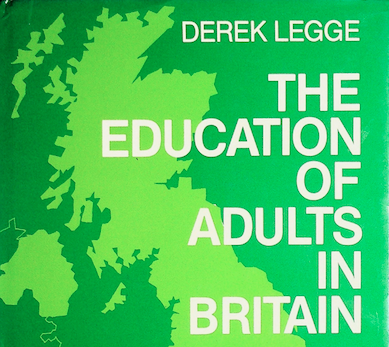
Above – Have a browse: The Education of Adults in Britain by Derek Legge from 1982
“If the road to the education of all adults is to be a long one, then it is important to make haste. It is also important to keep the ideal in mind for it is our only chance of securing the just society and the better life for all which democracy demands.”
Above – Legge (1982) p221 / 231pdf
Sadly he was ignored. The sector never really recovered from the cuts made by the Thatcher Government. The old Advisory Council for Adult and Continuing Education published: Protecting the future for adult education in 1981. Spoiler. They were unsuccessful – the committee being wound up in 1983.
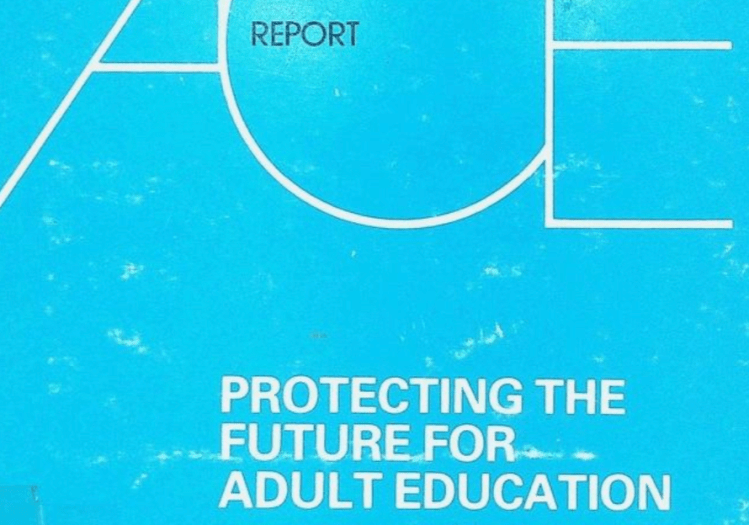
Above – Protecting the future for adult education (1981) by the old ACACE.
The publications that still read well today (click on the links to read) include:
What would one of these look like on the Cambridge Airport site?
National adult education institutions – reduction of funds and the retreat of policy areas
The old National Institute for Adult and Continuing Education was rebranded as the Learning and Work Institute – the latter having very different vibes. Lots of old NIACE publications can be found on sale second hand online. That tradition of print reports seems to have disappeared, with the L&W Institute focusing on evidence-and-policy reports for a much narrower audience – mainly a London-based policy/politics audience. For example the NIACE published Taking Part?: Active Learning for Active Citizenship, and Beyond in 2010. The L&W Institute website barely mentions citizenship.
This matters because adult education and lifelong learning has to be one of the policy areas to deal with the challenge of state-sponsored disinformation in society.
At the moment there’s next to nothing for adults in community education for things like citizenship and democracy education, media literacy, and central and local government. Successive governments have ignored if not actively defunded such provision. I’ve not seen much movement from politicians on reversing the cuts that really kicked in at the start of the Thatcher Government.
Previous generations explored civics and democracy education for adults in a depth and breadth that today’s readers might be surprised to see
The old Adult School Union – a churches-based organisation that produced annual schemes of work for adults’ discussion and learning groups has almost a century of publications before it wound up in the 1980s. Years ago I collected a number of these and put together the civics-related topics into a single publication here for people to browse through.
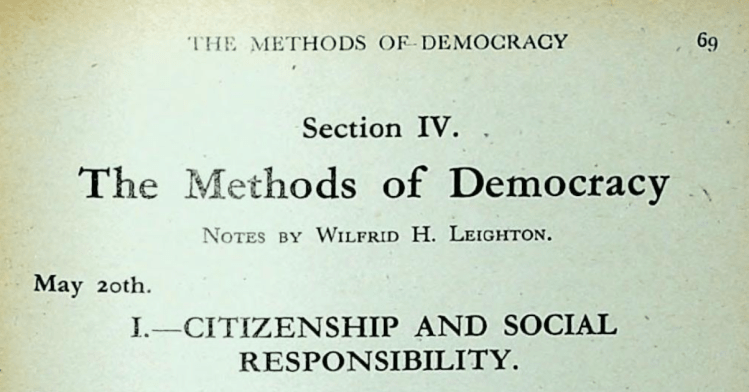
Above – the Methods of Democracy section digitised here covers:
- Citizenship and social responsibility
- Community and the state
- Town and country planning
- An Act of Parliament
- Central and Local Government
Again, they are written for discussion groups, with the texts providing useful introduction summaries to each topic. I’ve not seen anything similar aimed at a lifelong learning audience for discussion groups in recent times.
If we are talking about reconnecting people, rebuilding and strengthening communities, then see People Matter from 1961
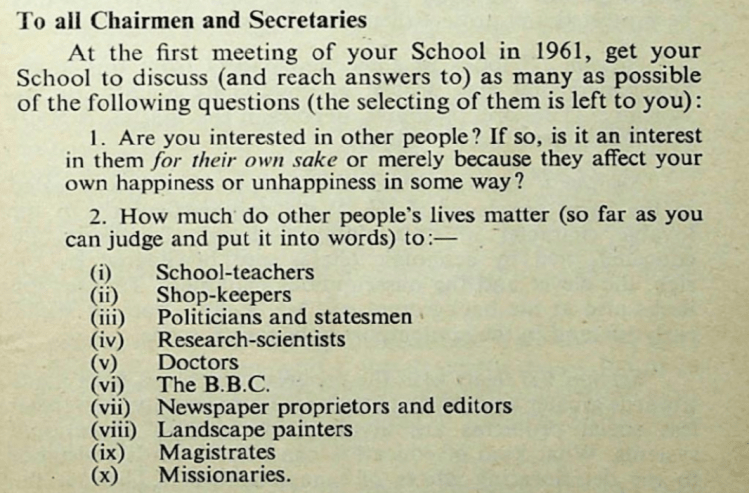
Above – People Matter
- People and their interests
- You and your interests
- What do you do at home?
- An evening out
- Leisure in a mass society
- Education and Living
- Equality in Education
- Social Purpose in Education
- Education for Mass Culture
Oh – and there’s a very topical discussion subject: Water supplies!
That’s not to say L&W Institute publications have no value – they do
See their 2026 report on training needs. Their headline statistic is damning on industry and employers.
“According to the 2024 Employer Skills Survey, employer investment in training per
employee in the whole economy has declined by 13% in real terms since 2022, and
29% since 2011. Previous analysis by L&W (based on 2015 data) found that employers
in the UK invested only half the EU average in training.”
Above – L&W Training & Skills (2026) p28
How many people see this as a local issue, and how many see this as a national issue? (How many people see this as something they can have an influence on? How many see this as something ‘for politicians to deal with’?)
What impact have CPCA skills policies and programmes had on the skills shortages since its creation in 2017?
To what extent has the Combined Authority alleviated the skills shortages in the CPCA area? How much more funding would it need and over what period of time to alleviate the skills shortages in the key sectors of the local economy? (Mindful that Fenland has different needs to those in and around Cambridge – the book Fenwomen by Mary Chamberlain is still a sobering read given how little transport infrastructure has improved since it was published in 1977).
I don’t know what the longer term picture is over the lifetime of the institution. Something for someone to go through the old skills committee meetings?
Only it’s nearly 1am and the only thing keeping me occupied is the Uruguay vs Saudi Arabia match (Uruguay have just equalised), and I don’t think my eyes will thank me for staying up to listen in on the Iran vs New Zealand match!
If you are interested in the longer term future of Cambridge, and on what happens at the local democracy meetings where decisions are made, feel free to:
- Consider a small donation to help fund my continued research and reporting on local democracy in and around Cambridge
- Follow me on BSky
- Spot me on LinkedIn
- Like my Facebook page


