
Sir Geoff Mulgan, the former Director of the Prime Minister’s Strategy Unit in Tony Blair’s Labour Government suggested to one unnamed Cambridge academic:
“…that they and their students might occasionally visit Luton to talk about politics… [they] looked horrified”
Above – Sir Geoff Mulgan, Rethinking universities’ social contracts, 11 June 2026
(Image: The old Trials of Democracy Cambridge project)
They don’t even need to go as far as Luton. They just need to cross town to Abbey Ward, or head to the south side of Cambridge Science Park in King’s Hedges Ward.
“The 2019 Indices of Deprivation showed that there were 3 Lower Super Output Areas (LSOAs) in Cambridge which were ranked in 20% most deprived areas in England. These [three] neighbourhoods were in Abbey and Kings Hedges wards.”
Above – Wellbeing and Social Inclusion Paper for the Cambridge Draft Local Plan, p53/54\
For the future of King’s Hedges ward, the acid test for Cambridge Science Park is what impact its densification programme will have on local residents – a part of Cambridge with a large percentage of council and social housing. Which means doing the hard work of investing in people rather than passively allowing north Cambridge to become gentrified and having a less affluent population priced out by a more affluent population as we have already seen in too many parts of Cambridge already. (I’ve spent the past 16 years living in South Cambridge and observing it as successive governments enfeebled both city and county councils, with little protest in high academic or business circles). The result of the growing pressure from across the city and from within students’ and research communities has been to persuade the University of Cambridge to commission a new civic listening project which you can read about here. One of the first actions from that work was the announcement of funding for a series of projects supported by the Community Knowledge Incubator Fund. (*Declaration of interest – I was on the panel of judges for this).
There will always be a tension between those with a financial interest to promote the ‘exclusive’ Cambridge brand, and those like me as long term residents who want the city to become much more inclusive.
“What were once secluded ivory towers now reshape whole cities with their building projects.”
Above – Mulgan (2026)
Which is what has happened in Cambridge. In my previous blogpost I looked at some of the housing data published by the University of Cambridge that former councillor Sam Davies MBE had highlighted. During her time as an independent councillor for Queen Edith’s ward – which includes the Cambridge Biomedical Campus (I will always call the site ‘Addenbrooke’s because I remember when most of the site was countryside), she posted frequent blogposts on the many issues arising from such fast growth.
“The relationship between the ambitions and deep pockets of big business; the quality of life of residents; and the ability of local government to mediate between interests where these are in conflict, is a topic I have returned to time and again in the last year.”
Above – Sam Davies (2022) Big Business, Little People
Ms Davies put a series of questions to Emma Goodford, a partner in the Life Sciences division of property consultancy Knight Frank at an online seminar mentioned in the above-linked blogpost she wrote. Ms Goodford referred to ‘Kendall Square, an innovation district in Boston (in the USA) promoted by MIT and others’.
Misguided comparisons between Cambridge UK & Cambridge MA
One of the things Ms Davies and I have discussed over the past decade is the inequality in powers and funding between Cambridge UK and Cambridge’s elsewhere. How many times have you heard Cambridge UK compared with Cambridge, MA? At some recent conferences when this comparison has been made, my neurodiverse-inability-to-keep-quiet has meant I’ve called out repeatedly the enfeebled Cambridge City Council and the tiny budget and few powers it has compared to its namesakes. For example in the USA local government and state government are protected by the US Constitution. The United Kingdom Does Not Have A Written and Codified Constitution. We have a system of Parliamentary Sovereignty. A Parliament can legislate on whatever it likes within the Realm. It cannot be bound by the decisions of previous Parliaments, nor can they bind future ones. (Even on Brexit). That’s not to say decisions are consequence-free.
In the case of the Cambridge Biomedical Campus vs Kendal Square, Ms Davies picked out the community benefits for the latter

How much revenue does Cambridge City Council get from the firms operating within its boundaries? Here’s a quick reminder.
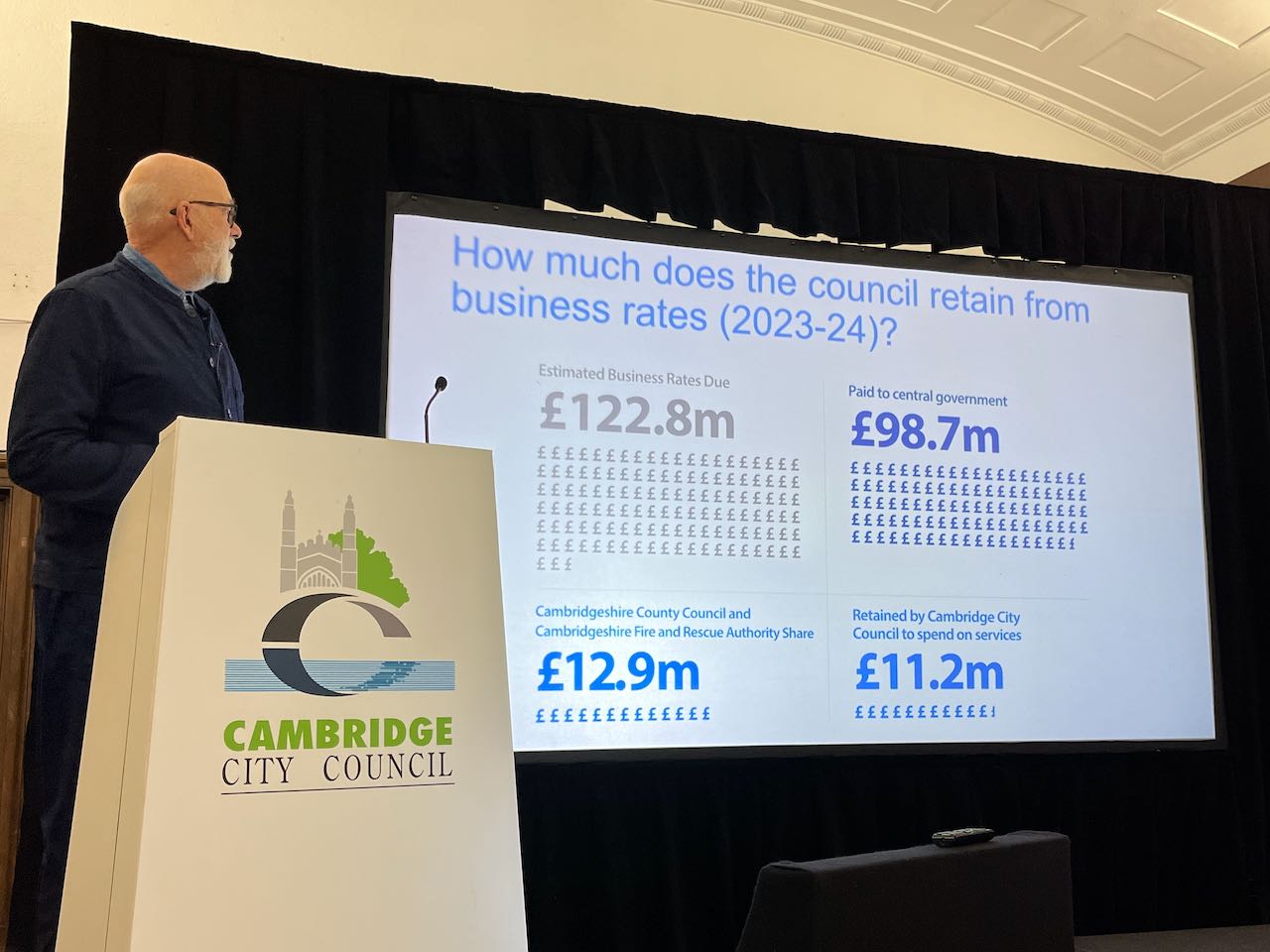
Above – Cllr Mike Davey at Cambridge Guildhall, 06 Dec 2023
While the simple response might involve wondering what Cambridge could do with £120m+ per year in business rates revenue, the regime of business rates is not progressive. Since the Poll Tax debacle, the temporary solution brought in by John Major’s Government (If I recall correctly) broke the local link between business rates revenues and individual local councils. The revenues all go into a big pot and get shared out nationwide – understandable given the negative impact on economically-deprived areas of the country. What’s not clear is there isn’t a single, high profile site/page that shows which councils are net contributors / net recipients and by how much. (You need to be a public finance accountant to make sense of the tables here!)

Above – I can’t find the bit that highlights the revenues received from the redistribution of the total business rates revenue.
Also, note that Cambridge and South Cambridgeshire are lower tier districts, while Peterborough is a unitary area, as is Brighton and Hove (where I lived during my uni days) – and both have larger populations than Cambridge.
The last monster-sized research commission on local government finance and the funding of council-provided public services was done by the Layfield Committee in 1976. And the final report and appendices are not for the faint hearted.
- Layfield Committee – Conclusions (35 pages)
- Layfield Committee – Local Income Tax (appendix 8)
- Layfield Committee – Full Report (over 500 pages if you’re brave enough!)
That gives you an idea why in the grand scheme of things it would not be acceptable to HM Treasury for Cambridge to be a ‘special case’. It’s just that overhauling Local Government Finance is in the ‘too difficult pile’. And given the precarious position of the Prime Minister Sir Keir Starmer, don’t expect any big changes this side of his premiership.
“That’s all well and good, but what does all that have to do with academics staying in their comfort zone?”
- We’re not seeing academia within Cambridge leading the following:
- The conversations on what the future governance structures should be for:
- the city of Cambridge,
- the county of Cambridgeshire, and
- the Cambridge economic sub-region (despite the existence of at least two institutions in Cambridge that are more than capable of doing so)
- The wider conversations with the rest of the city about the future governance and public service provision – especially when their concerns about the lack of GP surgeries and NHS dental places go unmet
- The conversations on what the future governance structures should be for:
- We’re not seeing any movement from academia to press ministers on establishing new civic lifelong learning institutions that could provide the space for town and gown to interact not just on the future of our city, but also on things like leisure, and also learning about things discovered since we left school or were prevented from studying at school, in my case things like:
- The dinosaurs (and Pleistoecene Megafauna)
- Astronomy and space exploration
- Politics, law, current affairs, and the media
- Much as I like the museums we have, I always come away from them feeling that the experience was incomplete because it was a discrete, one-off event. For example it wasn’t part of a terms-worth of workshops, meetings, or discussions. Hence there is no means of building on knowledge from a previous session, no means of discussing things with other participants, or questioning and following up things with the experts without coming across as an intense over-eager individual. (AKA a freak or a weido).
Why is there not a movement within university cities by those learned in politics, democracy, and public policy to engage with the people their institutions share their cities with to create the shared spaces to debate strengthening democracy, combatting disinformation, and working together to improve the places that we share?
“[Universities] need at least some answers to the question of what they are for, beyond the narrowly instrumental (just serving the economy or labour markets), or self-referential (seeing learning as good in itself), and hopefully encompassing broader goals of human growth and development and collective needs.”
Above – Mulgan (2026)
For me, this is the acute challenge the University of Cambridge faces. I’ll leave it for the residents of other university cities to speak for them.
“We celebrate Nobel Prizes, unicorn counts, spin-out numbers and research output per capita. Don’t get me wrong, these are real and brilliant achievements. But they measure the creation of innovation value, not its retention or distribution. A city can score brilliantly on every one of those metrics and still be failing the people who live there.”
Above – Faye Holland (LI, 11 June 2026)
It’s no good for local residents to be told about the above if they see the homes in their residential neighbourhoods being bought out by predatory property investors and converted into poorly-maintained HMOs that the local council cannot afford to regulate properly due to central government austerity. And as I mentioned in my previous blogpost, one way Cambridge’s residents have been responding to the chronic inequalities in our city has been at the ballot box – Labour no longer in majority control having lost six seats to The Cambridge Green Party last month. The Greens have leap-frogged over the Liberal Democrats (12 council seats to 11) to become the official opposition at The Guildhall.
I still have not seen any institutional acknowledgement of the message that the electorate sent to the prominent institutions in our city. And as I also mentioned, it could be worse for Cambridge – as the University of Durham (a unitary council) are finding out the hard way with TeamNigel in majority control of their local authority.
What’s it to be? Stay within a shrinking comfort zone while the storms rage outside the ancient college walls? Or taking the first steps into doing something that you might not have done before – something that makes you more than a little bit uncomfortable?
If you are interested in the longer term future of Cambridge, and on what happens at the local democracy meetings where decisions are made, feel free to:
- Follow me on BSky
- Spot me on LinkedIn
- Like my Facebook page
- Consider a small donation to help fund my continued research and reporting on local democracy in and around Cambridge


