
Has the growth of student enrolments at the University of Cambridge – in particular international postgraduate student numbers exacerbated the city’s housing crisis and the chronic skills shortage within the economic sub-region? (Also, highlights from meetings in Parliament that you might not have known existed)
Controversial statement or simply responding to the data on housing and student numbers cited by former Queen Edith’s councillor Sam Davies MBE – herself a graduate of Cambridge University many moons ago.
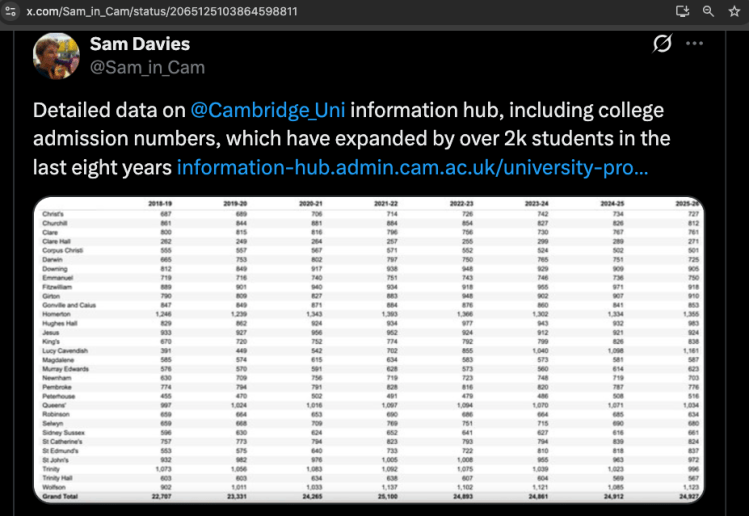
Above – Sam Davies on Birdsite. (There are about five people who still use the site and who have not migrated over to Bluesky who I don’t want to lose touch with. Other than that, my acct has long been locked and generally only used for posting links to my blogpost and finding out what they’ve found out about the future of Cambridge)
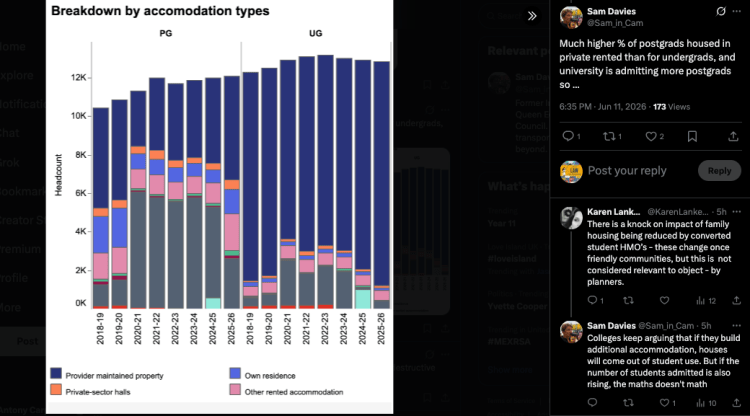
Above – the grey sections of the bars above denotes ‘unknown’ – which presumably means a fair amount of that will be private rented HMOs or similar accommodation
As others have stated many times over the years, when a house in a residential area designed for long term residence is converted into a HMO, it results in the a higher population turnover for that property. When it happens at scale, it risks destabilising communities. Facilities that rely on long term residents become less sustainable, and facilities targeting the short term/annual residences take their place. The shops by The Rock Pub on Cherry Hinton Road are textbook examples of this – I’m old enough to remember the places that were there in the 1980s. Some of the people that ran the businesses there in those days had been there for decades – their names or those of their husbands or fathers being in the Cambridge directories from WWII.
“But the City of Cambridge isn’t a museum or a theme park. Cities change and evolve with time”
The root cause here is about the governance structures of local and regional government – something that is missed in the inflammatory media content on immigration.
A rise from just over 10,000 post-graduate students to almost 12,000 postgraduate students in four years is not a small rise for a city like Cambridge
Which has created its own housing crisis within the University of Cambridge – something its own students have been calling out their institution on in the student press.
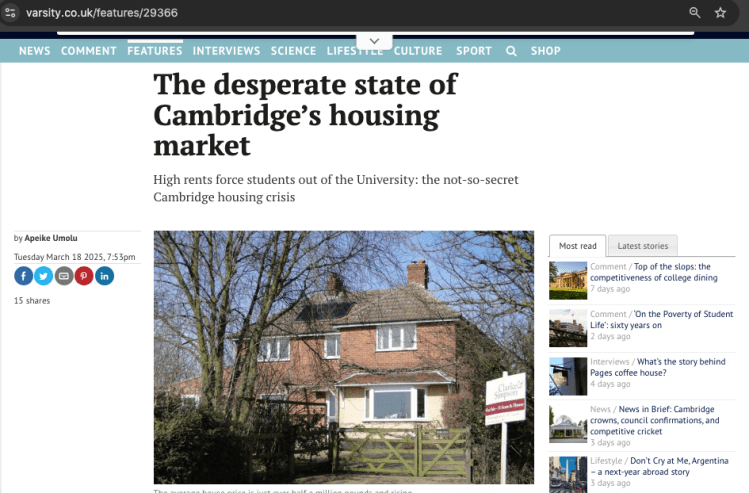
Furthermore, the new official opposition party on Cambridge City Council, The Green Party, called out the then ruling Labour Group on the housing crisis in 2025. See Cllr Elliot Tong (Greens – Abbey) on 23 March 2025 to Cambridge City Council.
Six weeks later The Greens won three seats on Cambridgeshire County Council – one off of the Liberal Democrats, and two off of Labour. Fast forward to the most recent elections and the Greens won six seats off of Labour – including the previously safe seats of Arbury and Coleridge for the first time in their history. Furthermore they won one of the LibDems target seats of Castle off of Labour, with the LibDems only holding on to their own seats and gaining none. The net result was Labour losing their majority and the LibDems being relegated to the status of the third party.
The challenge for the University of Cambridge and its member colleges is whether it can afford to carry on along such a trajectory.
What impact does post-graduate occupancy of otherwise residential housing have on Cambridge’s chronic skills shortages?
The large number of ‘unknowns’ in the greyed out section of the bars indicates that neither the University of Cambridge nor Cambridge City Council knows which parts of the city are the ones experiencing the growth in accommodation being converted for postgraduate use. This creates two challenges:
- Are the post-graduates receiving the support they need living in the private rented sector? (Especially if they are in a part of town far from their place of research/study, and far from where the colleges they are affiliated to are located)
- What impact is the change of housing tenure having on the local community and community relations? For example is there a risk that two different communities end up living completely separate lives even though they are geographically on the same road or even neighbours?
That then puts a moral responsibility on the University of Cambridge, its post-graduate institutions, and its wealthier colleges to explore how they can contribute towards alleviating any of the negative externalities that arise from their initial corporate decisions to expand student numbers
Similar issues arise with other types of rental and non-University/ARU student groups:
- Air BnB / short term lets
- Private language schools, private university foundation years aimed at the international market, and ‘cram colleges’ (which I think should fall under the Cambridge BID system if not be subject to additional levies to pay for shared youth facilities and programmes)
- Second homes
The short term/holiday lets came up earlier this week when the Local Government Minister Alison McGovern MP was cross-examined by the Housing, Communities and Local Government Committee
Have a listen to the Minister’s response to Chris Curtis MP (Lab – Milton Keynes North)
At the end of his sustained questioning on the proposed tourism levy powers being granted to Combined Authorities – a controversial point in Cambridgeshire’s fragmented politics, the Minister did not have an answer to Mr Curtis’s question about whether AirBnB would be covered or not.
“What is the Government’s policy on AirBnB levies?”
They have not decided yet – they are still looking at the consultation responses from earlier this year. That said, if we find Andy Burnham gets elected to Parliament this time next week, and then becomes Prime Minister not long afterwards, I can imagine he would be more than happy to have AirBnB fall under the scope – just as the Scottish Parliament legislated for and which the City of Edinburgh has made use of the new powers.
“Hosts are obliged to collect the levy on all bookings made for overnight accommodation in the city, and to remit the money collected to the Council on a regular basis with the first payment being due in October 2026. The amount of the tourist tax is determined by the Council, and is calculated on a percentage basis of the charge to the guest for the accommodation.”
Talking of consultations – remember to respond to the Punt Tout restrictions one for Cambridge
A decade ago complaints reached a peak with touts harassing residents who they thought were tourists, resulting in Cambridge City Council bringing in a new Public Space Protection Order using powers under the Anti-social Behaviour, Crime and Policing Act 2014. The current order expires later this year and The Council want to renew it. (Personally I think the city council should have the powers to tax the revenues of the punting firms too but the costs and paperwork and HM Treasury…exactly)
This all brings us back to the root issue of what powers local government should have to manage the areas they are responsible for
Should a local council or a regional tier of government be able to put conditions on the expansion of universities and private colleges? Should they be able to tell them that they have to build their own accommodation for a set percentage of their students before they can expand student numbers? Or is there a better way to achieve that balance?
One policy option from Siân Berry MP (Greens – Brighton Pavilion)
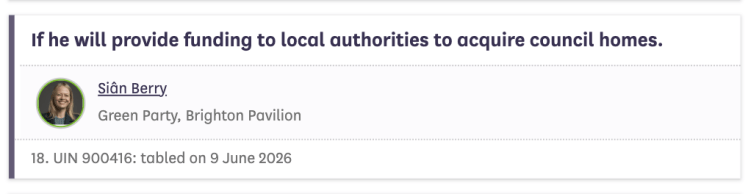
Above – will ministers provide the funding?
I hope Ms Berry asks if The Treasury would be willing to provide additional independent revenue-raising powers for local councils hit by huge inequalities but who are prevented from taxing the excess wealth generated in, or flowing into their areas eg Cambridge! Given Cambridge’s housing crisis, think of the positive impact such powers could have if some of the revenues could go for a new programme of housing purchases whether for renovation for new council housing, or as part of site acquisitions for new higher density council housing developments similar to the ones we’ve seen in recent years here.
This also feeds into the metrics and variables that state institutions are measuring – especially ‘success’ variables
It might be that the University of Cambridge has not accounted for the local impact of its corporate policies. For example their page Towards an International Strategy for the University of Cambridge makes no mention of the local impact on the city, nor the risks associated with that.
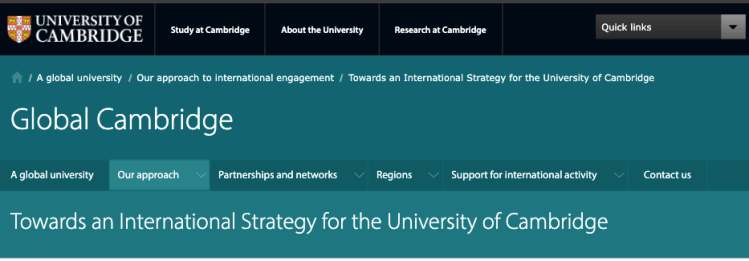
Above – Towards an International Strategy for the University of Cambridge
As I mentioned earlier, one of the impacts of the chronic inequalities in our city has been party-political – the rise of The Green Party whose councillor numbers are in double figures for the first time in their history in Cambridge. Furthermore, the ruling Labour group lost three very experienced councillors in those elections, including a former council leader. What impact will that have on the future direction at The Guildhall?
Other university cities have got even greater problems, finding themselves with a county council or city council run by TeamNigel. Such as in Durham which is a unitary council and also a prominent university city. Earlier this month councillors raised questions on student housing developments. What impact have the local elections had on town-gown relations in other towns and cities?
Which brings me finally to the article Faye Holland (of the Cambridge x Manchester Partnership) wrote ‘on city and region roles in the future of innovation-led growth.’
“We celebrate Nobel Prizes, unicorn counts, spin-out numbers and research output per capita. Don’t get me wrong, these are real and brilliant achievements. But they measure the creation of innovation value, not its retention or distribution. A city can score brilliantly on every one of those metrics and still be failing the people who live there.”
Which is exactly what has been happening in Cambridge for far too long. I refer to a quotation I’ve referred to repeatedly since the document was published in 2014 (and referred to in the second half of this blogpost from 2025)
“Cambridge will be one of the key venues to come and be seen, and to rub shoulders with the global intellectual elite. If it sounds like an exclusive conference venue, then that may be about right.”
Sanders, J (2014) in Cambridge 2065, p48
Which made it sound like: “The City of Cambridge as a Monaco-style settlement for the super-wealthy to meet the super-scientists”
‘Nobel Prizes, unicorn counts, spin-out numbers and research output per capita,’ these metrics mean nothing to local residents. Why should they? The town/gown divide and the huge wealth inequalities mean many of us live separate lives.
Furthermore, the policies that drive those numbers also seem to be the ones that are pricing people out of the city. That point about wealthy property investors buying up houses in residential areas to covert into HMOs targeting students (who don’t pay council tax – something that landlords and developers have targeted over the decades).
Faye Holland makes three clear points:
- No single UK city is large enough to win the global competition for R&D and FDI investment alone. I agree – hence calling for ministers to designate specific towns such as Bedford and Northampton as ‘designated landing spots’ for Cambridge spin-out firms that become too big for the city and also need affordable premises. (That requires massive rail investment).
- Not many ‘innovation leaders’ see the big picture – one that goes beyond their sectors or the geographical area of their innovation district (see the impact of the University of Cambridge on the city of Cambridge above)
- From short-term visibility to long-term accountability. This is a persistent problem with UK PLC and with central government which for decades has struggled with the concept of long term thinking. The culture of fast, short term gains still pervades.
I’d add to 3), the broken governance structures imposed by successive ministers – such as on bus franchising. It took Dr Nik Johnson the whole of his mayoralty (four years) just to get the essential consultations through. Today John Elworthy of the CambsNews highlights the Transport Committee papers of the Combined Authority indicate it may not be until 2030 that a fully franchised bus network is up and running.
You can’t blame me – I called for the abolition of the Combined Authority and the GCP back in 2023, and put it in a manifesto for the city council elections that year after several residents in Queen Edith’s ward asked me to stand. (I got 9% of the vote which for an Independent is astonishingly high).
And yet the one big issue that our city of bright minds and innovators seems unwilling or unable to address:
What should the democratically-accountable governance structures of our city be?
Food for thought?
If you are interested in the longer term future of Cambridge, and on what happens at the local democracy meetings where decisions are made, feel free to:
- Follow me on BSky
- Spot me on LinkedIn
- Like my Facebook page
- Consider a small donation to help fund my continued research and reporting on local democracy in and around Cambridge


