Two-and-a-half years after former Conservative Cabinet Minister Michael Gove announced his Government’s intention of establishing a development corporation for ‘Cambridge’, Chancellor Rachel Reeves confirms the policy following wide consultation.
Before I start, I have to declare an interest having recently completed a local history research commission for the Cambridge Growth Company which was a desk-based exercise researching the past 30-50 years of public consultations on large developments in Cambridge. (Which in part explains why I published so few blogposts in April 2026!)
The intention for a centrally-led development corporation should come as no surprise – ministers announced it last October.
That the Chancellor of the Exchequer provided the longest quotation from Government figures speaks volumes:
“The Greater Cambridge Development Corporation will be a joint national and local body, with the powers and long-term leadership to turn ambition into delivery.“
Above – Chancellor Rachel Reeves MP – press release 02 June 2026
That means it’s a major government priority. Chancellors generally don’t make big announcements like this about individual cities. Note that the Chancellor also put out a press release in support of the densification of the Cambridge Science Park. While that does not pre-determine the planning application, it sends a signal that ministers are willing to pull out all of the stops (similar to the Hartree development before the sharp rising costs were too much for even HMT to tolerate) to get permission approved. The tallest of the proposed towers is 45 metres.
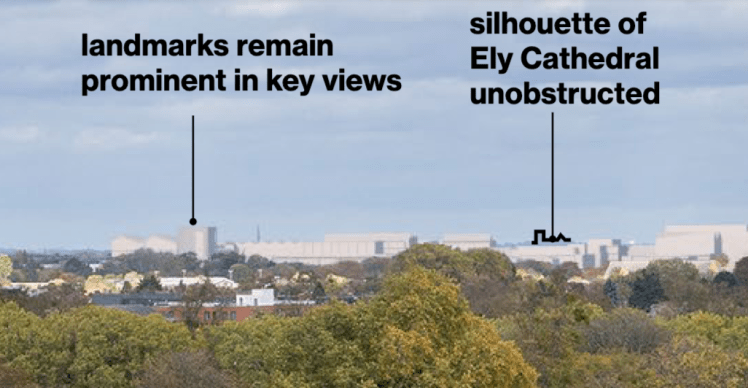
Above – A detail of a CGI from Great St Mary’s, from my later blogpost on the planning application documents published by Greater Cambridge Planning a few days later. Someone advised me to use building storeys rather than metres as the unit of measurement. i.e. the public can visualise 15 storeys more easily than a 45m building
I have been working on the assumption that ministers will make this happen
…so therefore my most useful role is to help residents make the proposals the best they can be for the many, not the few. Mindful of what we lost at Cambridge Railway Station including the proposed county heritage centre which should have housed the county archives. Instead Cambridge’s municipal archives are stored down the railway line at Ely. Not a good look for a place that ministers and business people want to become the most innovative city in Europe.
That’s not to say opposition in principle isn’t worth it. Quite the opposite.
If people feel passionately about the policies and the planning applications, it’s their right in a democracy to campaign on them. Which is exactly what happened in the Cambridge City Council elections a month ago when the voters of Cambridge made The Green Party the new official opposition with 12 councillors.
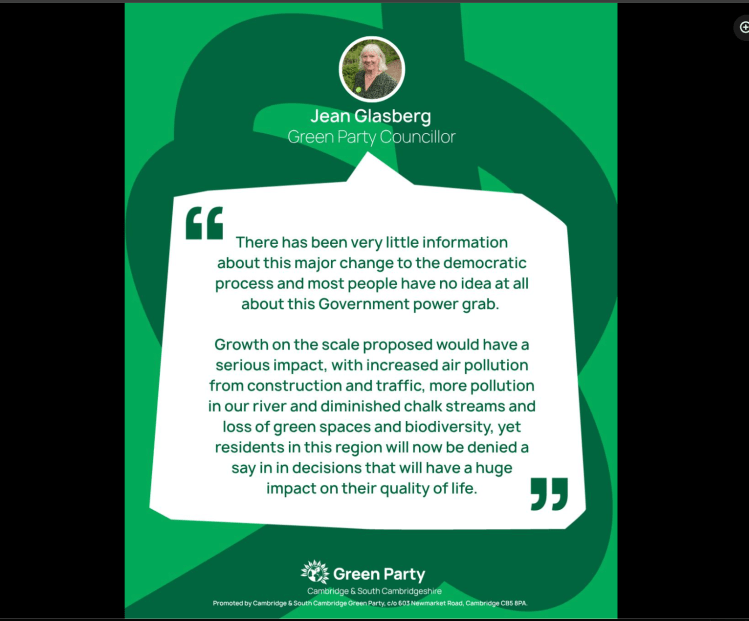
Above – statement on FB by Cllr Jean Glasberg (Greens – Newnham) on Cambridge City Council in response to the CamDevCo announcement
That signal alone from the electorate tells ministers that they need to strengthen their policies on the environment. And by that I’m not just talking ‘greenery’ but things that are far, far more substantial.
- Radical infrastructure policies to provide alternatives to the motor car so that the alternatives are the easier and more convenient choice. (Any congestion charging should not come before this in my opinion)
- Significant investment in reskilling for adults (esp on cost-of-living maintenance) as well as properly-funded and targeted training and education opportunities for young adults. What would the impact be if young people *got paid* to train in those areas where the skills shortages are the most acute? And to deal with the criticism of a tick-box approach on enrolments, payments at significant stages (or ‘milestones’) such as completing an exam/coursework/module, on securing employment, and completing 1/2 years in post?
- Retrofitting the existing built environment on things like rainwater harvesting and storage, to installing solar panels on big warehouses and over car parks
The onus is then on those backing the ‘dash for growth’ to demonstrate that they can do the basics when it comes to reducing the city’s environmental impact. At present I’ve not seen nearly enough evidence of this from the wealthy institutions and land/property owners. You only have to look at the car parks that lack solar panels above them, or the warehouses and sci-tech buildings that don’t have solar panels on them.
Fortunately Cambridge City Council agreed on a new leader and committee structures 24 hours ago.
Otherwise things could have gotten messy. The state of infrastructure is already in a woeful state that it is a resilience risk.
What this also means is that the planning committees of local councillors on the current and proposed unitary councils will lose many of their planning competencies – these will transfer over to the Greater Cambridge Development Corporation.
“Who will be on the development corporation’s planning committee?”
Some of the councillors will be, but not all of the members listed on the two planning committees or the joint development planning committee as it stands. What now needs to happen is publication of the policy detail – or at least a timeline of when we can expect to find out some important details such as who will be on the planning committees. While the boundaries are likely to be the external South Cambridgeshire District, incorporating everything inside the boundaries, I think that the development corporation could make the case for bringing in the surrounding market towns for the purposes of new rail-based transport infrastructure. Royston (Herts), Saffron Walden (Essex), Haverhill and Newmarket (Suffolk) are all reasonable cases for inclusion given commuting patterns.

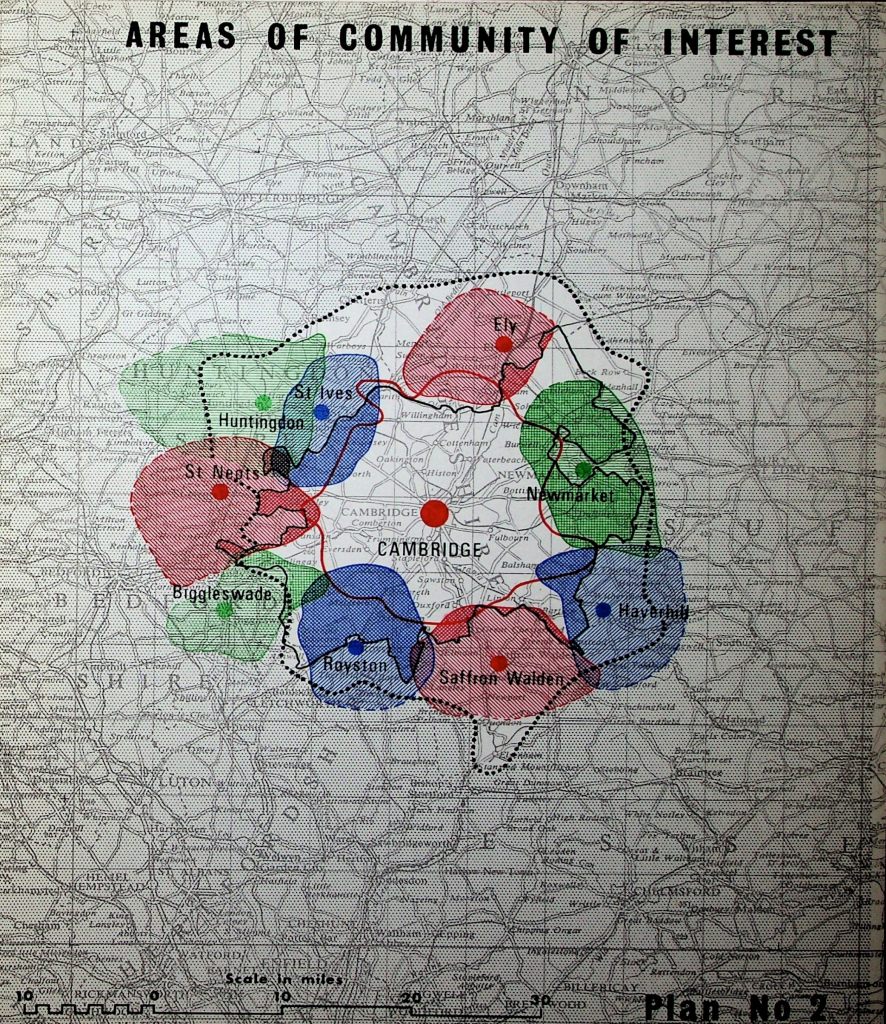
Above – left: Detail of Redcliffe-Maud (1969), and above-right, detail of the Cambridge Sub-region, Lichfield (1965). A circular suburban or light rail line and network sells itself
A reminder about our infrastructure wish lists
Back in January 2025 Peter Freeman, the Chair of the Cambridge Growth Company (which will evolve into the development corporation when Parliament approves the legislation tabled by ministers) invited the public to send in their wish lists.
Back in 2021 I wrote an extended wish list:
- “Florence Hall” – a new, large concert hall for Cambridge, named after the Mother of Modern Cambridge.
- An expanded Museum of Cambridge – to tell the story of our city
- Connect Cambridge Light Rail with an underground under the town centre.
- A lifelong learning college designed for over-18s – and one that does not resemble a school
- A revamped Guildhall front based on John Belcher’s design that was sunk by ratepayer’s revolts in 1898 7 1913, one that would create a new lecture theatre, raise the council chamber two levels up, and create a new rooftop cafe.
- A town athletics track (on the opposite side of town to where the Cambridge University one is)
- A large leisure centre with Olympic-sized swimming pool (or two half-sized ones to make it easier to manage different groups – I’m not fussed).
- A new stadium for Cambridge United Football Club – with massively improved transport connections by public transport and cycleway. (and a light-rail link to Cambridge City Football Club’s new stadium at Sawston).
- A new evening / nightclub/ night life quarter, possibly at The Grafton or between Cambridge United and The Beehive Centre – with a standalone levy to fund the inevitable extra policing costs associated with such quarters. Because let’s get real.
- A new arts centre for North East Cambridge by North Cambridge Station.
- Cambridge Great Park in the South – and an equivalent in the North.
It also included rail links to:
- Wisbech (a town with huge potential that could do with some of the excess wealth Cambridge seems to have, redirected there)
- Haverhill (ditto)
- Hunstanton (direct rail to the seaside)
- Great Yarmouth (ditto as Hunstanton, plus it potentially creates a proper rail-based Tech Corridor that ministers/consultants only talk of, making the coastal resort a place to live in and invest in). Also, the rail route can circle Norwich going underground at and serving the University of East Anglia, and Norwich Airport)
- Chelmsford via Haverhill & Colchester – creating a direct rail link between Anglia Ruskin Universities three campuses. Such a route could be extended up the North East to improve transport links with Lincoln and terminate at either Hull or York.
- East-West Rail extending to Bristol and Wales in the west, and to Ipswich & Norwich/Gt Yarmouth in the east – which would take some of the road traffic that otherwise heads to the M25 off the roads.
And that was all before Michael Gove announced his ‘Supersize Cambridge’ plans in 2023
East Cambridge / Cambridge Airport site as a second urban centre
The site of a new East Cambridge railway station is still up for debate, but in 2024 I made the case for it to be a new large transport hub for a second urban centre incorporating:
- A new City Hall for a new unitary council
- A new large concert hall and opera house (assuming the University of Cambridge won’t co-operate with the Hills Road site I have long proposed that they own)
- A new purpose-built adult education and lifelong learning centre (that doesn’t look like ‘school’!) that’s co-designed by the people going to use it. (See this example from Derby in 1968)
I’ve also suggested a theme of ornate/decorated ‘twin towers’ for each building so as to break the bland bulky skyline that the Great North East Wall of Cambridge (as described by Cambridge Past Present and Future) and the proposals for densifying the Science Park will create.
Cambridge’s twin cities setting a good example on public transport
Cambridge East Railway Station could be a start, and our Hungarian Twin City of Szeged has a practical example of what it could be like. Note the tram stop outside of the station and the ornate but not ostentatious twin towers at the front. Cambridge North Station looks miserable in comparison.
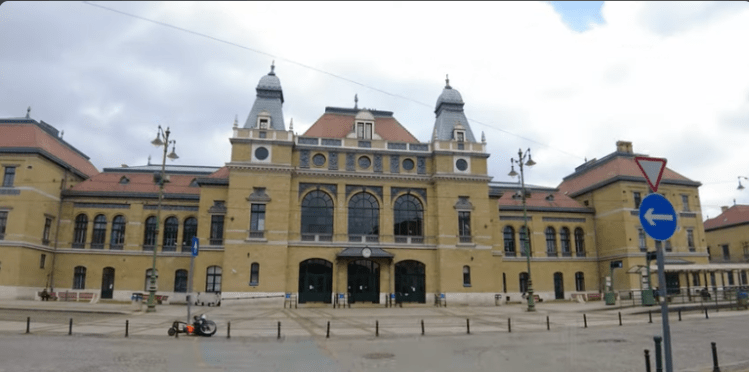
Above – Szeged Railway Station by Railway Networks – and a textbook example of integrated public transport. Why couldn’t we have this for Cambridge Station’s revamp?
As for Heidelberg, our German twin, it’s in a different league. Which is why I think more Cambridge residents and business people should go there and experience German public transport and then figure out what governance structures and taxation regime Cambridge needs to build something of a similar standard.
Given the proposed growth, I’m not talking small boxy administrative buildings. I’m talking grand and beautiful
Because the minimalists and contemporary designers have *the whole of North West Cambridge* to play with and Eddington is what they have built. And if that wasn’t enough, they also have *the whole of the Cambridge Biomedical Campus*, and if they get their way, the whole of the Cambridge Science Park as well. And that’s before we look at Cambridge Railway Station and Cambridge North. No, I’m not a fan.
Maybe they need to learn to share – lest the expanded Cambridge ends up with a monoculture of building designs.
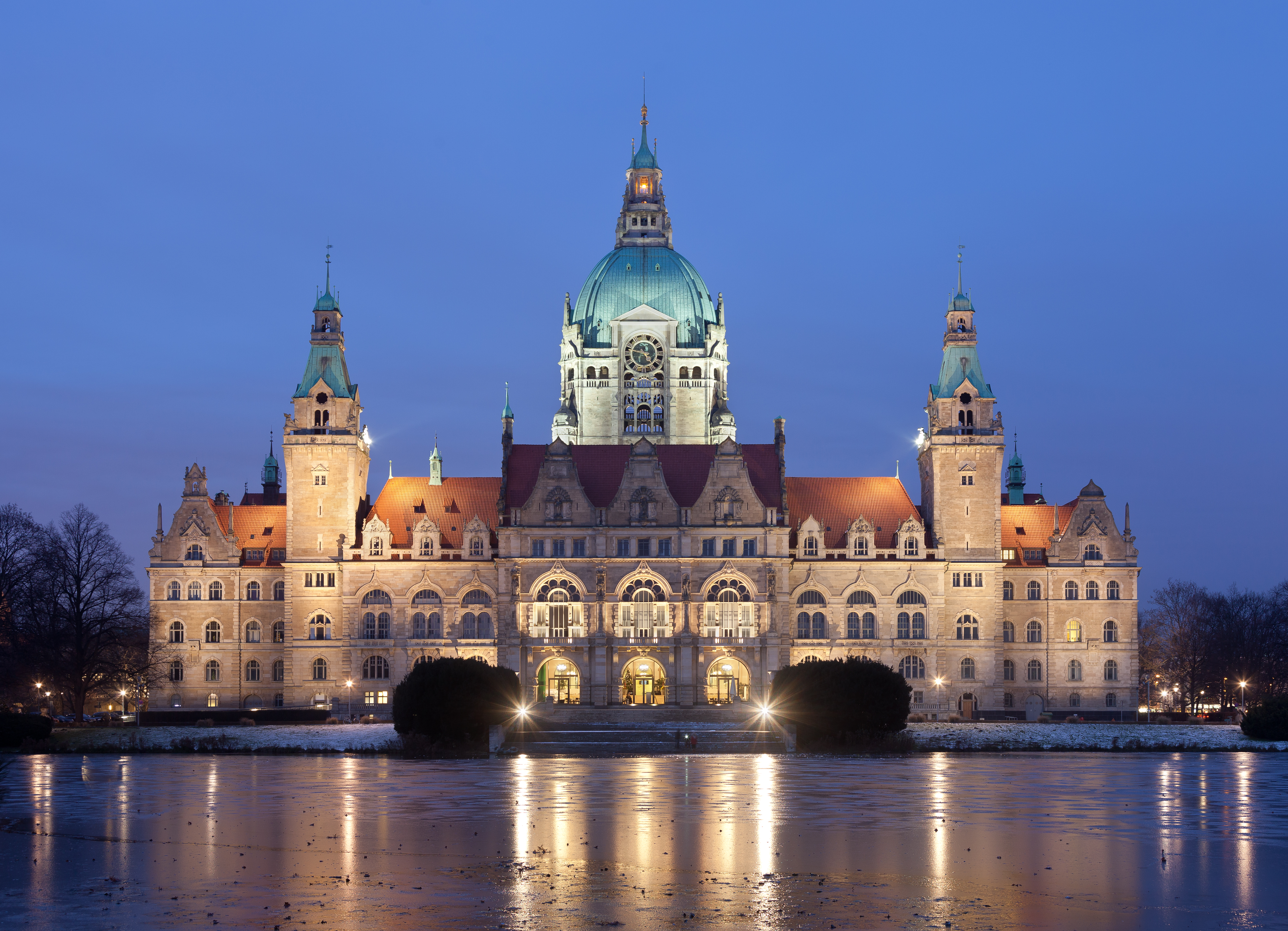
Above – Hanover New Town Hall (built circa 1913) – something similar to this would work for me – imagine stepping out of a railway station onto the equivalent of Parker’s Piece with a building like this on the opposite side, and with a lifelong learning college on the left side and a new large concert hall on the right hand side.
The problem is contemporary building design hands out awards to carbuncles like South Cambridgeshire Hall – which is located in the least accessible of places if you have mobility limitations like me.

Above – the miserable South Cambridgeshire Hall – even the Pride flag nor the lovely blue sky can hide the utterly depressing grey and beige awfulness that houses what’s left of post-austerity South Cambridgeshire District Council.
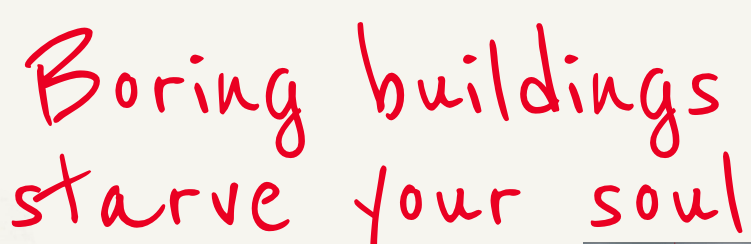
Above – from the Humanise campaign – maybe Cambridge needs to form its own chapter of this campaign given what lies ahead.
As for South Cambridgeshire Hall, I hope the unitary council hands back the lease and forgets that they ever occupied such a building that, rather than being the buzzing centre of a new town where important local decision are made, where communities gather together and meet, and where concerts are held, is an anonymous box that serves as an administrative function in an over-centralised state. I just hope the local residents campaign for something better than this for their new railway station at Cambourne and the new large extension that will be Cambourne North.
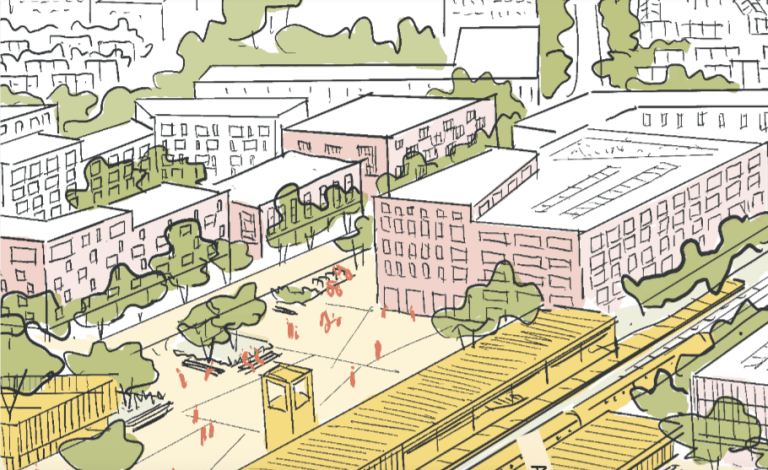
Above: “The residents of Cambourne deserve far better than this” I wrote in Oct 2025
Nothing’s changed on that front.
If you are interested in the longer term future of Cambridge, and on what happens at the local democracy meetings where decisions are made, feel free to:
- Consider a small donation to help fund my continued research and reporting on local democracy in and around Cambridge
- Follow me on BSky
- Spot me on LinkedIn
- Like my Facebook page


