
Can someone make a high profile case for re-connecting a fast-growing Cambridge to the seaside by train like in the olden days?
Image – The draft East of England Plan of March 2010 which you can read here.

Above – from the New Adlestrop Map
You can have a look at the old railway maps vs today from the National Library of Scotland
You can see below where the now closed loop used to run. You can zoom in further here

Above – from the National Library of Scotland Maps
As I set out in the 2022 blogpost, upgrading the railway infrastructure around Norwich Station is something that could have a huge positive impact on Great Yarmouth. However, it’s not something that any grant for Great Yarmouth alone could spend money on.
The thinking in the Whitehall bubble traditionally goes something like this:
**Town X is suffering from bad stuff. Bad stuff is the policy responsibility of the Ministry of Y. Therefore the answer is for The Treasury to approve a new spending programme from the Ministry of Y called the Z-Regeneration Fund and we will invite Town X and others like it to bid for funding to spend only on things that fall within the remit of the Ministry of Y.**
The Pride in Place programme is a classic case – see the list of recipient areas that received Pride in Place Impact Fund grants in September 2025 at the end of this note – one of the areas listed is Great Yarmouth. The JRF had a look at the data and looked at ‘double deprivation. Furthermore, they looked at parliamentary constituencies too.
“When considering parliamentary constituencies, rather than local authorities, some stand out as urgently needing investment and support. These include Clacton in Tendring, where 91% of its neighbourhoods (10 of 11) can be categorised as doubly disadvantaged, followed by Hartlepool (73%), Great Yarmouth (69%), Liverpool Walton (67%), Birmingham Hodge Hill and Solihull North (67%), and Knowsley (64%).”
Of the seven constituencies listed, in the 2024 General Election two elected TeamNigel MPs (one since splitting away) and another – Hartlepool, only returned a Labour MP due to a split pro-Leave vote, as happened in 2019.
With Local Government Finance reform being in the Too Difficult to Deal With Box since the 1990s, successive governments have relied on bypassing local councils and establishing centrally-administered regeneration programmes to deal with poverty and multiple deprivation. What it also means is that ministers are able to take the Political credit for any successes. Which can also mean a day away from Westminster as well, along with positive local media coverage if a visit involves opening a brand new facility such as a community centre.
Visiting Great Yarmouth in 2005 with the civil service
While I got a lot out of visiting different towns as part of my duties as a civil servant in the 2000s, I also picked up a lot of things between the lines – one of which occurred when I visited Great Yarmouth while still based in Cambridge. What’s really sad is that the facility seems to have closed with the firm running it being liquidated in late 2025.

Above – the old St James Church on the corner of Admiralty Road / Queens Road, also as shown here by the architects at the time
This was after being taken on a tour by a senior councillor who pointed out the various properties the council was acquiring for regeneration, such was the lack of demand from private investors. What’s hard to find out online is what is happening to the building that looking at G-Maps was last photographed being covered in scaffolding.
The appallingly poor transport access – responsibility residing with central government?
I remember being struck by how there was only one road into the city – a single carriageway of the A47.

Above – from G-Maps here, the red bubble being at the railway station, the beach and North Sea on the right, and the main road out being at the top-left.
And not surprisingly, with only a single carriageway into town…

Above – from G-Maps Sept 2024, traffic jams into Great Yarmouth
When you look at the industrial heritage of the town from Britain From Above in these aerial photos, and then consider the decline of the railways not matched by investment in a new road into the town…exactly. Although plotting a route for a new major roadis easier said than done with the Norfolk Broads and the River Yare forming massive natural barriers to the west, and the rows of densely-packed working class housing that occupies large areas.
There used to be a tram network, but such was the scale of the River Yare that it was built in two, unconnected sections
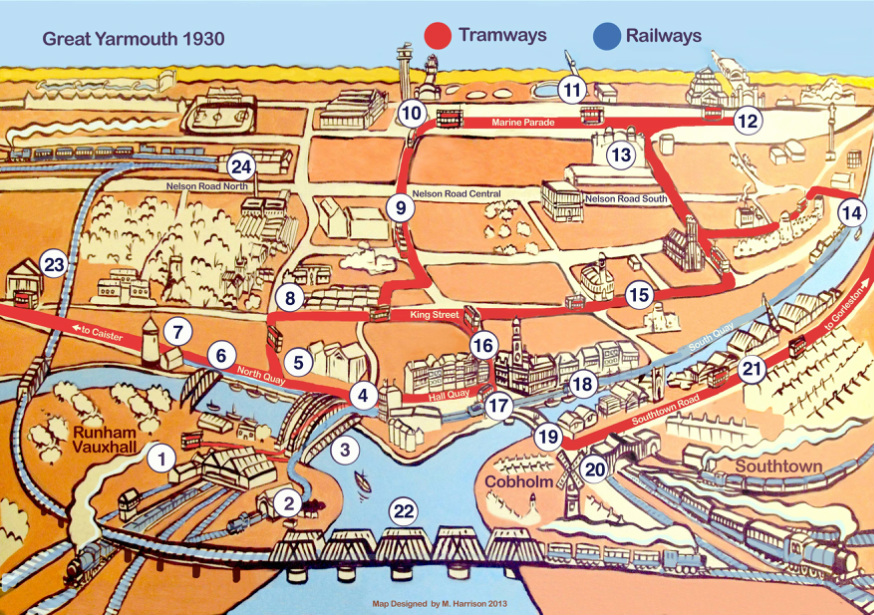
Above – the Great Yarmouth Tram Network by the Great Yarmouth Tram Trail 2012
Simply upgrading the railway alone would not solve Great Yarmouth’s challenges
Not least because what do potential tourists do when they get to the railway station?
This is where big infrastructure projects gets complicated – as HS2 more than demonstrates. The repeated disappointments of section cancellations and cost escalations inevitably undermine trust between people and politicians. Hence we’re at the stage of asking why the UK can’t build things anymore.
In the case of Great Yarmouth, as well as working with local residents of the town and county to come up with suitable proposals for future transport in and around the town, there is also the regional planning (East Anglia-scale) challenge of the rail links. Such are the inequalities that it is unrealistic to expect Great Yarmouth to raise the revenues locally.
The problem I have with the existing network of combined/strategic authorities – especially for Cambridge and Peterborough is that the geographical area is too small for anything genuinely ‘regional’.

Above – English regions 1994-2011, taken from a select committee report from 2007 in which the Government’s case for having such regions is quoted just above the map in this section here.
Transport East’s Strategy 2023-50
It’s a strategy that needs refreshing following the general election of 2024 and significant changes in government policy.

Above – Transport East Strategy 2023-50 p40
Back in 2021 I suggested exploring the concept of a new rail line to bypass Norwich City Centre and connect both Norwich Airport and the University of East Anglia campus to Great Yarmoth
It was ‘pie-in-the-sky thinking that tried to make use of the disused railway line to Mildenhall, then providing a sort-of-parallel railway line to the troubled A47 road.

Above – this was part of a broader post about Transport East back in 2021 where I looked at getting the old seaside resorts reconnected to the national railway network.

Above – The Hunstanton Rail Campaign want their station and track back. With new services.
The heatwaves that have followed since I wrote the above-mentioned blogpost help make the case for the new generation of railway lines beyond economic regeneration and more visitors to the seaside towns:
- Restored/new rail links would reduce the motor traffic to the coast for those wanting to escape the daytime heat inland
- With extended heatwaves more likely and more frequent, the ability for more vulnerable people to spend a few days on the coasts becomes more accessible for those that don’t have cars.
On the second point, this is not a case of: *Well now that we’ve got sub-tropical temperatures, here’s an economic opportunity!* It’s the opposite – it’s mitigation. And some of those in need won’t necessarily have the means to book the hotel rooms, guest house rooms, holiday homes/park units to stay in. But if you are looking at it from a *preventative healthcare* perspective, it may end up being more cost-effective for the taxpayer to subsidise stays away – possibly even in state-funded accommodation. Because hospitals have done this before.
The Addenbrooke’s Home in Hunstanton
Addenbrooke’s used to have a convalescence facility at the seaside town. It was acquired long before the NHS was established – hence the appeal for subscriptions for the affluent.

Above – Cambridge Daily News 16 March 1920 in the British Newspaper Archive
It was sold off under Thatcher’s Government at the start of austerity in the early 1980s

Above – The Lynn Advertiser 10 November 1981 in the British Newspaper Archive
That postcards were produced of the home in the 20th Century (some of which are still on sale second hand) also shines a light on the culture of the era – mindful that the air quality in urban Cambridge was poor due to a combination of coal-fired domestic fires, steam trains, and the Cambridge Gas Works, the brick works along Newmarket Road, and the cement works in East Cambridge.

Above – postcards of Addenbrooke’s Recovery Home on sale online
If you are interested in the longer term future of Cambridge, and on what happens at the local democracy meetings where decisions are made, feel free to:
- Follow me on BSky
- Spot me on LinkedIn
- Like my Facebook page
- Consider a small donation to help fund my continued research and reporting on local democracy in and around Cambridge.


