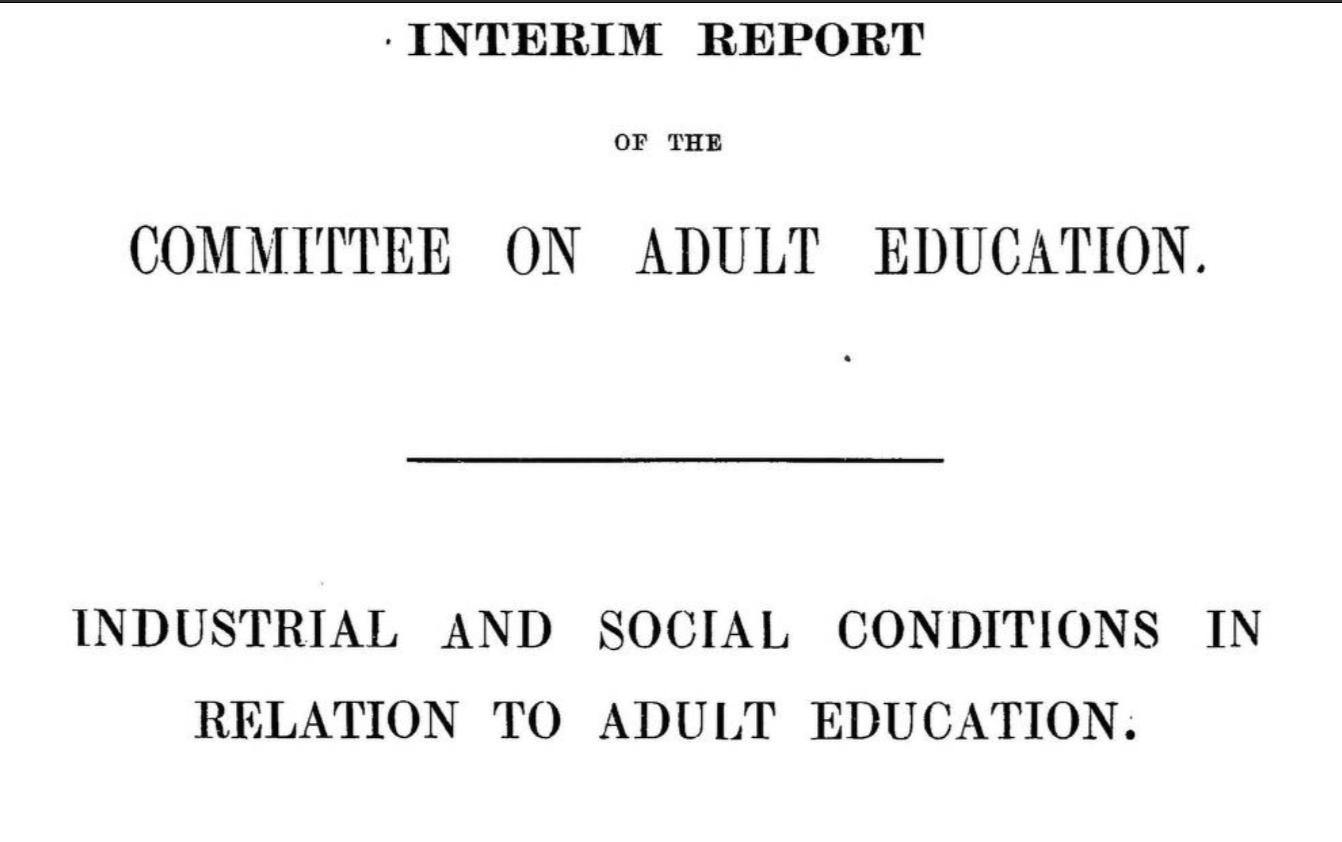
Titled ‘Industrial and social conditions in relation to adult education’, the document was published in 1919 as a one of a series of interim reports, and yet it resonates far more than any corporate report of recent times.
This is what it said about local government in paragraph 18 of the report
“The general environment is none the less powerful in shaping habits and customs, and in subtly affecting the mental outlook and aesthetic standards, because its influence works unconsciously.
“The streets along which men and women walk daily, the buildings they pass in their goings to and fro, the polluted atmosphere, all insensibly influence the inhabitants of every town.
“Long familiarity with the dreariness and dirtiness of town life must generally tend to weaken the desire of the majority of the inhabitants for more wholesome and more inspiring surroundings, and the old order is perpetuated. Thus a vicious circle is created.
“It is often said that it is the fault of the body of citizens if the towns in which they live are depressing and destructive of the foundations of good citizenship. In a sense this is true, but the fault is the offspring of the conditions of city life.
“If the circle is to be broken, it must be broken by the pressure of public opinion, both upon Parliament and upon local authorities, who will undoubtedly respond to the expressed wishes of citizens.
“If all towns cannot be made beautiful in the space of a few years, they can at any rate be made clean and healthy; they can be well supplied with such amenities as open spaces, public parks and recreation grounds.
“It is not necessary for us to do more than refer in this Report to the need for the adequate provision of:
- Public libraries,
- Art galleries,
- Museums, and
- Municipal music.
“We may, however, point out the need for a new and higher civic patriotism, and for a more deliberate policy on the part of local authorities for the progressive improvement of social conditions and for the provision of opportunities for a fuller social life.
“An inspiring environment is a strong educational influence necessary alike for the development of personality and for the growth of the social spirit”
What the report summarised at the end
“We have approached the matters dealt with in our present Report from the human rather than the economic point of view.”
“If the individual is to make the most of his powers, if the citizen is to be worthy of the responsibilities thrown upon him by the ever-increasing -complexity of life in a modern community, in other words if education in any broad meaning of the term is to’become a reality, certain definite conditions of life are indispensable. The paramount consideration is that of the individual as a member of society.
“Material progress is of value only in so far as it assists towards the realisation of human possibilities. Industry And commerce and the social conditions which are in a large degree dependent upon them must in our opinion be regarded from this point of view, and if they cramp the life of the individual, no amount of economic argument will suffice to justify them.
In considering industrial and social conditions in relation to adult education, we have not ignored economic considerations, but we have taken our stand on moral grounds. We do not think, however, that there is of necessity a fundamental antagonism between ethics and economics.
- Adequate pay,
- Reasonable hours of labour,
- The supersession of heavy, degrading, and monotonous forms of manual labour by machinery and improved processes,
- The provision of holidays,
- The introduction of human relations and of the social motive into industry,
- Healthy homes and a cheerful environment
…these are the indispensable conditions of economic efficiency; they are also amongst the elementary rights to which the citizen, as such, and in virtue of his responsibilities, is entitled“
What the report recommended
“We recommend on educational grounds:
- (a) That there should be a general shortening by law of the normal working day and that, subject to the qualifications already suggested in the case of certain industries such as agriculture, it should not be more than eight hours (Paragraph 9).
- (b) That in heavy and exhausting kinds of work, and work accompanied by special disabilities, the maximum legal working day should be shorter than the normal (paragraph d); and that heavy and exhausting occupations should be specially regulated, and wherever possible mechanical devices introduced (paragraph 10).
- (c) That overtime should be more closely regulated by law and reduced to a minimum (paragraph 9).
- {d) That where ” shift” work continues, the hours should be reduced below those of the normal working-day; and that, except where it is absolutely essential, regular night-work, whether periodical or continuous, should be prohibited by law (paragraph 9).
- (e) That efforts should be made to meet the evil effects of monotonous labour by alternating forms of employment, by creating opportunities for the exercise of initiative; and by establishing works committees for the consideration of matters affecting workshop life (paragraph 10).
- (f) That steps should be taken to guarantee to the worker some reasonable security of livelihood, either by such a reorganisation of industry as may prevent or minimise fluctuations in the volume of production, or, where that is impossible, by some extension of the principle of insurance, which would protect the wageearner against the ruinous effects of such fluctuations as cannot be prevented (paragraph 12).
- (g) That wage-earners should be entitled by law to an annual holiday, with pay; and that the weekly half-holiday should be extended by law to the worker in agriculture (paragraph 13).
- (h) That the preparation of schemes of housing and town-planning should be accelerated ; that such schemes should be drawn up in consultation with the beat expert advice available, and in co-operation with representatives of the people for whom such schemes are intended ; and that, particularly, representatives of women, who are the persons most concerned, should be included in the Housing and Town Planning, Public Health and other Committees dealing with this question (paragraph 15).
- (i) That adequate washing facilities should be required to be provided in all places of employment where the nature of the work makes it desirable (paragraph 15).
- (j) That special consideration should be given to the peculiar problems of rural housing (paragraph 16).
- (k) That a Village institute, or at least a hall, should be established in every village under public control
The impact of the First World War
“The nation ardently desires to order its life in accordance with those principles of freedom and justice, which, led so many of its best sons to the field of battle. The proposals we have made, incomplete and inadequate though they may be, are designed to contribute to this end.”
“But while it cannot be expected that a generation which boldly attacks the defects in its social and industrial structure, and opens up possibilities of new opportunities, will itself enjoy the full results of its labours, nevertheless the work which has been done in the past justifies the hope that the men and women of to-day will increasingly utilize the enlarged opportunities for equipping themselves by education for the development of life and the duties of citizenship.
“So…why didn’t we get all of that nice stuff?”
The membership of the committee that produced the report provides a number of insights.
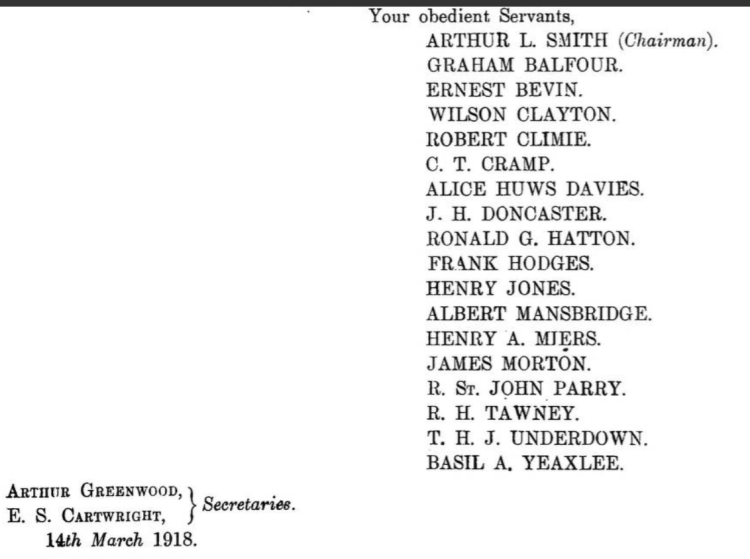
Above – the Committee that produced the interim report, mindful that at the time of submission the First World War was still raging.
Names that stand out:
- Arthur Greenwood – later Minister of Health in Ramsay Macdonald’s second minority Labour Government (1929-31)
- Richard Henry Tawney – Academic, pioneer of Christian Socialism, and later President of the Workers’ Educational Association
- Ernest Bevin – a senior figure in the Transport and General Workers’ Union of which he became General Secretary (1922-40) before Churchill – his staunch political opponent, brought him into his wartime Cabinet as Minister for Labour and National Service. Foreign Secretary until his death. (Do read his biography by Andrew Adonis)
Ones I looked up include:
- Alice Huws Davies – pioneering figure in the Labour Women’s Movement, becoming Secretary of Central London Labour Women’s League, and later an adviser to the Ministry of Labour (later the Dept for Employment, now DWP) on the training of women. Wrote ‘Women and Adult Education’ for the Cambridge Essays on Adult Education, published in 1920 and digitised here
- Sir Graham Balfour – Educationalist and local government administrator
- Robert Climie – later a Labour MP in both Ramsay MacDonald’s minority Labour Governments.
- Charlie Cramp – trade unionist
- James Henry Doncaster – Industrialist and philanthropist, owner of family steel works in Sheffield.
- Reginald St. John Parry – Cambridge academic who edited the Cambridge Essays on Adult Education (See also here in LostCambridge).
- Basil Alfred Yeaxlee – Author and Non-conformist preacher. YMCA newspaper editor
- Thomas Henry Johnson Underdown – later Lord Mayor of Bristol during the Battle of Britain.
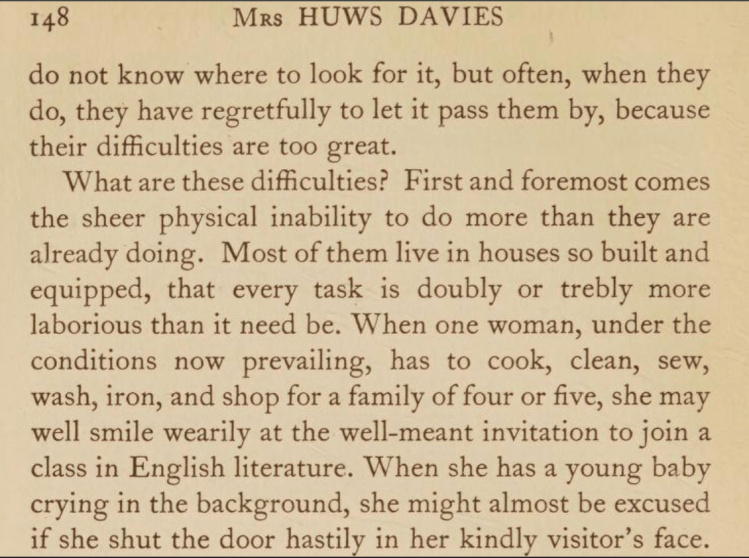
Above – Alice Huws Davies on the challenges of encouraging women into adult education, in Women and Adult Education’ for the Cambridge Essays on Adult Education, (1920) p148
Her contribution still reads well today – there’s still a long way to go.
“Sounds very left-wing and idealistic for the time”
Which explains the policy recommendations. Although there is little on adult education policy in the Labour Speakers Handbook published in 1923 here, you can get a feel for the politics of the era in left wing circles and how they contrasted with the Conservatives who dominated the latter part of the 1920s as the Liberal Party imploded.
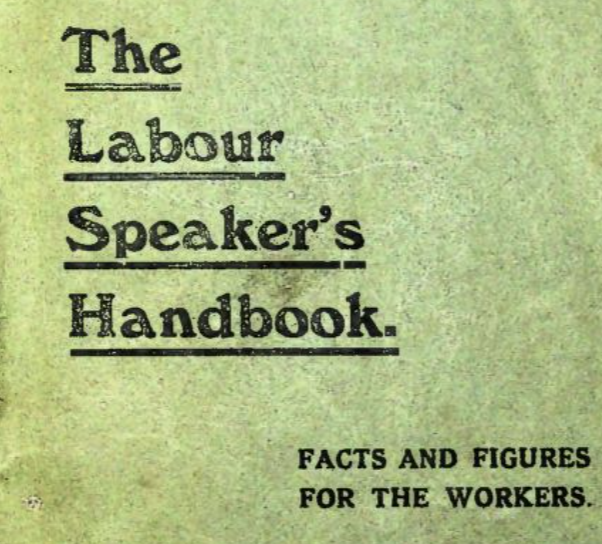
Above – Labour Speaker’s Handbook (1923)
It’s worth browsing through the foreign policies and compare how different they are with the Conservatives of the era and also with what happened in the 1930s.
The Central Labour College
One of the institutions emerging in the 1900s was the Central Labour College (1909-29) – founded by The Plebs League, itself incorporated the National Council of Labour Colleges, and the NCLC then incorporated into the Trade Union Congress’s educational structures.
One of the publications of the Plebs League in 1919 was a pamphlet on industrial history from the perspective of the worker – digitised here.
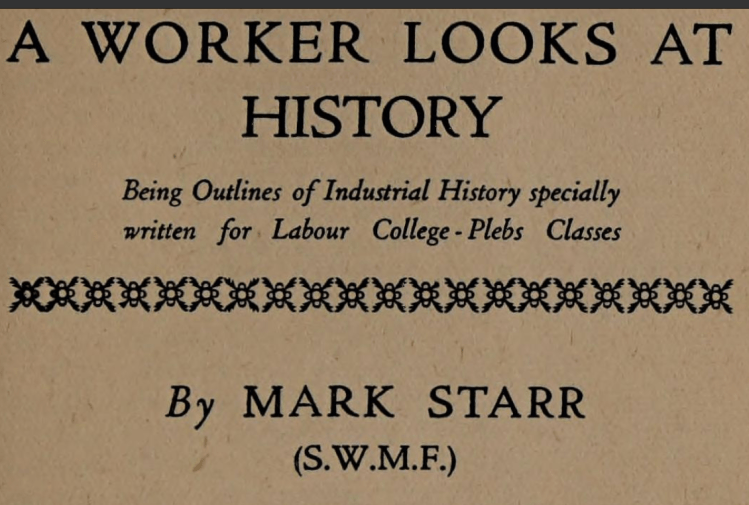
Above – A Worker Looks At History (1919) Mark Starr, in the Internet Archive
I have a particular interest in old books that look to the future. Or ‘Past Futures’ if you will. The conclusion by Starr in his epilogue is moving on the challenges historians and wider society faced in those unstable years.
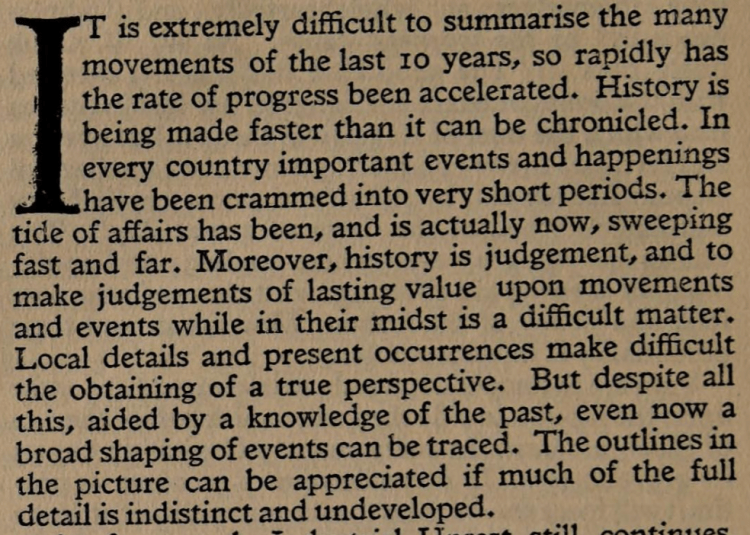
“It is extremely difficult to summarise the many movements of the last 10 years, so rapidly has the rage of progress been accelerated. History is being made faster than it can be chronicled. In every country important events and happenings have been crammed into very short periods. The tide of affairs has been, and is actually now, sweeping far and fast.
Above – A Worker Looks At History (1919) Mark Starr, Epilogue, p176 in the Internet Archive
‘History is being made faster than it can be chronicled’
Feels like our present age, doesn’t it?
If you are interested in the longer term future of Cambridge, and on what happens at the local democracy meetings where decisions are made, feel free to:
- Follow me on BSky
- Spot me on LinkedIn
- Like my Facebook page
- Consider a small donation to help fund my continued research and reporting on local democracy in and around Cambridge.


