What the report in 1924 on The Guildhouse Co-operative Centre for Adult Education can teach today’s politicians and policy-makers
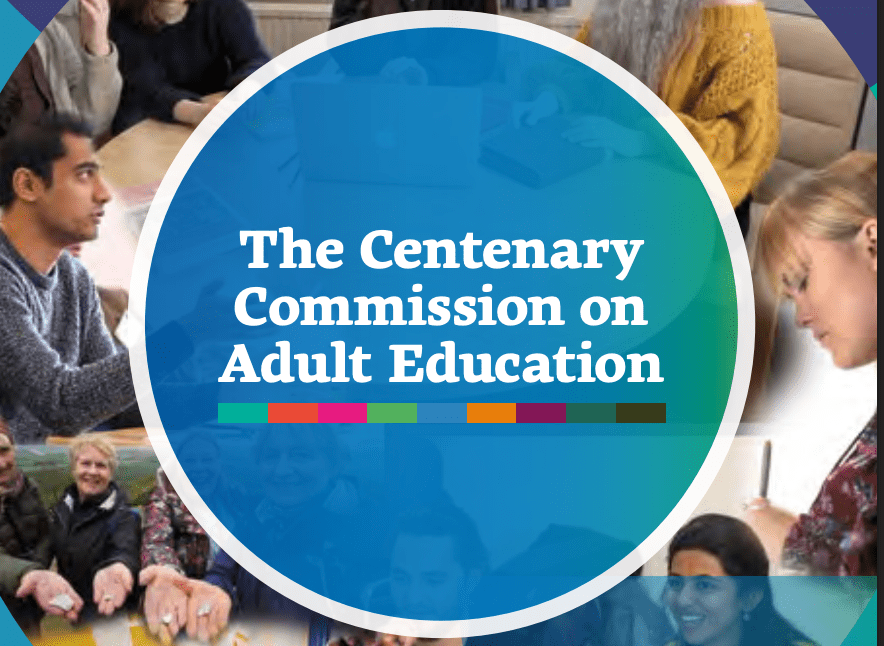
Image: The Centenary Commission on Adult Education Report 2019 (Which needs looking at again as it was drowned out by the Brexit noise in the general election).
You can browse through the guide that arrived this morning (and the time of typing) here. It may also be of interest to those of you in the Co-operative Party, which is a sister party of The Labour Party, of which Andy Burnham MP is a Co-op Party member along with 42 other Labour and Co-op MPs. (Which is the most ever in the party’s history)

Above – the Co-operative Party (bees and beehives being symbols of the movement, hence also The Beehive Centre in Cambridge before the Cambridge and District Co-op imploded in 1990)
Have you heard about the Co-op Party as a political party before? Or do you associate ‘The Co-op’ as a brand with the food shops?
Researching these topics for blogposts also involves a riot of tabs of reports and websites some of which follow through and some which don’t. How my neurodiverse brain organises/manages all of this I have no idea. The ones that seem to have carried through on adult education for this blogpost and some recent second hand purchases include:
- Adult Education – by the Association of Colleges on the Opportunity England report – see the Opportunity England report on Adult Education from April 2024 here (note the timing expecting a general election by the end of that year)
- Further and Adult Education – by the British Educational Research Association
- New bite-sized learning for adults – press release from the UK Govt 15 May 2026
- House of Lords debate on Lifelong Learning – by the House of Lords Library, 29 Jan 2025
- Adult learning and education and European & international policies – by the European Association for Education of Adults.
- Lifelong learning in the UK: the need for adult citizenship education – Qasir Shah for University College London’s Institute of Education (2020) – still reads well.
- The Story of British Architecture – adult education class – by Imperial College London. Cambridge, can we have this please?
- Adult Skills and Lifelong Learning – House of Commons debate 15 May 2021 which covered the Commons Education Select Committee’s report on adult skills and lifelong learning, published in November 2020. Its key recommendation being a lifelong learning centre in every town.
- The Centenary Commission on Adult Education 1919-2019 – you can read the reports via here (scroll down).
- Volunteer Cambs – appeal by the Workers’ Educational Association/WEA for volunteers. Only it’s a much smaller operation compared to what it used to be like. – see Lost Cambridge here.
“What does the Co-operative Colleges report of 1924 say?”
Lots of things.
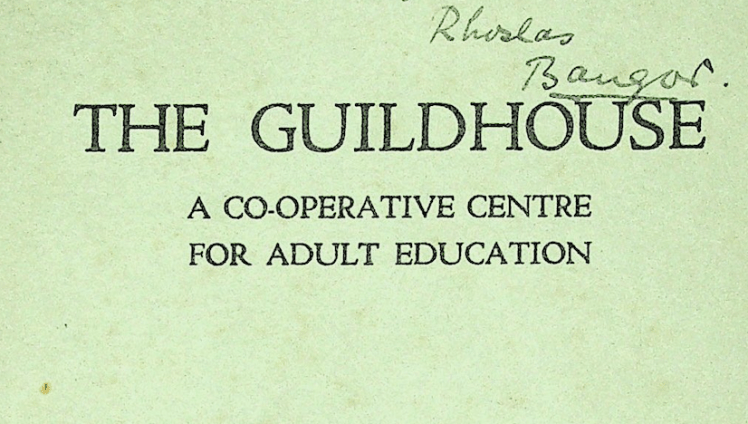
Above – The Guildhouse: A co-operative centre for adult education (1924) BIAE
The chapters include:
Introduction – Preface, Settlements and their functions
- The meaning and purpose of adult education
- Recent developments in adult education
- The immediate problem
- Community Spirit
- The Guildhouse – General Plan
- GH Organisation and Finance
- GH in Rural Areas
- Conclusion
- Appendix 1 – The special needs of women
- Appendix 2 – Brief list of relevant publications
Above – Chapter headings for The Guildhouse: A co-operative centre for adult education (1924) BIAE
Adult education centres in every town?
The parallels between what this report recommended in 1924 and what the House of Commons Education Select Committee recommended in 2020 are striking.
“Every town to-day needs an educational centre. The form in which such a centre can be established must vary in different places.”
Above – The Guildhouse Co-operative Centre For Adult Education (1924) p11 foreword by Lord Eustace Percy MP, a former Parliamentary Secretary to the Board of Education – equivalent today of a junior minister at the Department for Education
“A community learning centre in every town
“There has been a 32% decline in participation in community learning between 2008–9 and 2018–19.
“The report finds that the Department for Education (DfE) does not fully grasp the value and purpose of community learning and calls for an ambitious plan for a community learning centre in every town.
“These do not need to be new buildings or organisations: existing organisations and assets, such as colleges, church halls and libraries, could be used.“
Above – UK Parliament Press Release, 18 December 2020
Following through on the recommendation would mean:
- The Department for Education and allied departments allocating substantial capital funding for metro mayors and combined/strategic authorities to acquire and upgrade existing buildings, or build new ones
- The Treasury authorising new borrowing for metro mayors and combined/strategic authorities because realistically HM Treasury won’t hand over the sums of cash needed
- The Treasury authorising new taxation powers for metro mayors and combined/strategic authorities to impose on larger businesses (ie not small firms) and holders of extreme wealth
“Taxing the rich? That sounds like communism, honey!”
We’re no longer in an era where locally wealthy people re-invested their wealth and expertise back into local communities that they had strong personal connections to. When was the last time a figure like Sir David Robinson funded a major public service building/facility for the people – in his case The Rosie Hospital in Cambridge?

“What about extreme wealth and inequalities?”
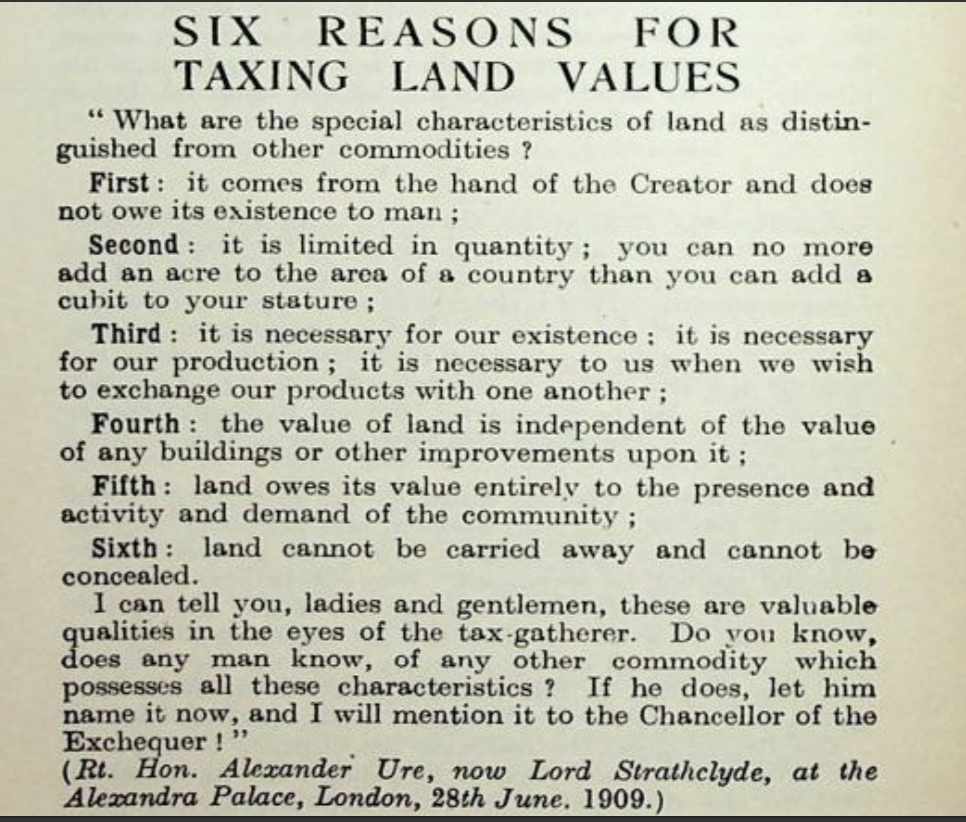
They are separate issues – ones that also need analysis and discussions on *how* wealth is accumulated and *who* sets the terms of trade. Think of the low fees paid to musicians by big streaming app corporations or even the AI-firms that rip off copyright-protected artists to ‘train’ their AI programs that require premium paid subscriptions. At the other end think of how wages vs capital gains are taxed. Think of the regressive regime of property vs the nearly 150-year-long campaign for a land value tax.
This means that unless/until local and regional tiers of government get their own independent means of spending monies allocated to them (eg a percentage of income tax receipts distributed via formula grant (which is a bit like a massive algorithm taking into account lots of things like poverty, multiple deprivation, inequalities, demographics etc) if not new wider powers of local taxation, adult education as a policy area automatically involves Whitehall even for the smallest of new education centres.
Something for Mr Burnham to consider (assuming he becomes Prime Minister in the next few weeks)
Food for thought?
If you are interested in the longer term future of Cambridge, and on what happens at the local democracy meetings where decisions are made, feel free to:
- Follow me on BSky
- Spot me on LinkedIn
- Like my Facebook page
- Consider a small donation to help fund my continued research and reporting on local democracy in and around Cambridge.


