And why do big infrastructure projects in the UK cost so much more than most of the rest of the world?
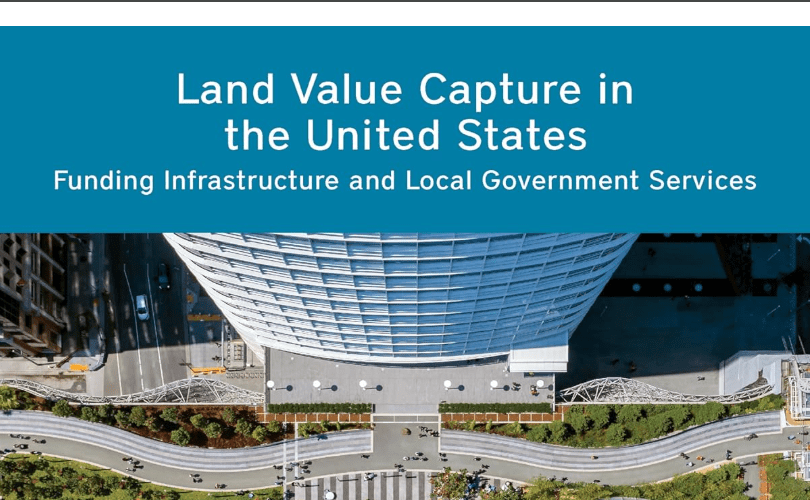
Image: Land Value Capture in the USA – read how they do it
You can read the Government’s One Year Review of the Green Book here
“What is the Green Book?”
“The Green Book is the government’s guidance on appraisal, the process of assessing the costs, benefits and risks of different options for achieving government objectives.”
Above – the Treasury’s Green Book
“Oh – I remember! This is the thing that underpins the debate on the Benefit-Cost-Ratio of the Guided Busways!”
Yes.
“A proposal with a Benefit-Cost-Ratio of less than one may still represent value for money. It may have a low BCR but significant unmonetisable benefits. Proposals with relatively low BCRs should be subject to rigorous scrutiny to ensure that they do indeed represent value for money.”
Above – the Treasury’s Green Book
“Is this why it’s taking the Planning Inspectorate ***ages*** to come to a decision on the Cambourne-Cambridge busway that was first discussed way back in 2014?”
Possibly.
There are still a number of outstanding responses to consultations to come from the Government
For example the New Towns Draft Programme was meant to have more detail on the funding options. The consultation that closed in May 2026 probably won’t report until the Autumn. Which in reality could mean as late as November due to an incoming Prime Minister *and* The Budget for 2026 which is due to be after Party Conference Season – which ends in early October 2026. Major spending announcements or significant policy changes associated with big spending announcements tend not to be made before The Budget.
“Why’s that?”
Because ‘The Budget’ refers to ‘The Budget Speech’ and a package of documents attached to it. The Speech is the tabling and moving of a *major* piece of legislation in the House of Commons: The Finance Bill – which is annual. The Speech is the Second Reading in the Commons of that Bill, where the Chancellor of the Exchequer formally asks MPs to approve the overall proposals within the Bill, with the details to be thrashed out in the committee stage. Following those stages requires a huge amount of patience and a significant level of knowledge – and ***lots*** of time which few people would hand over voluntarily.
“A full Government response to the New Towns Taskforce’s report is planned for Spring 2026 which will contain more information on financing models.”
Above – The Government’s Response to HCLG Committee, 20 March 2026, para 59
The original report stated in its first recommendation the following:
“Recommendation 1: Reforms to land value capture should be iterative, starting with improvements to existing mechanisms. Therefore, the Government must immediately pursue the reforms to Section 106 and CIL outlined in the chapters below.
“The Government must also trial additional mechanisms of land value capture in areas where there are significant uplifts in land value which current mechanisms may not capture effectively.”
Above – the Government’s responses to the above are at Para 24
This is something the Cambridge Growth Company, soon to be Greater Cambridge Development Corporation may want to raise with Whitehall.
UK Big Infrastructure costs lots more than in other countries
Rail and tramway schemes cost on average 99% more according to Britain Remade
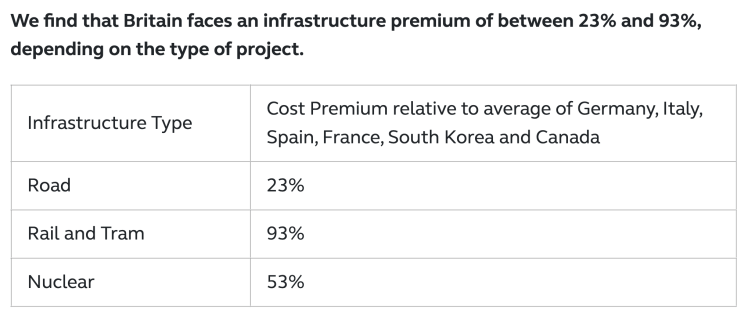
Above – Britain Remade – Build More for Less, Executive Summary
Can you see why the highways engineers prefer roads with signs that say ‘buses only’?
The other thing to be mindful of is comparing what the final built infrastructure looks like and performs like versus what was originally proposed at the very start.
Talking of busways – there’s a new public inquiry for Cambridge transport: The busway (road with signs) heading south-eastwards
Miranda Fyfe of Cambridge and South Cambridgeshire Green Party spotted this – the confirmation of the ministerial instruction to the Planning Inspectorate to open a new public inquiry for the controversial Cambridge South East Busway.
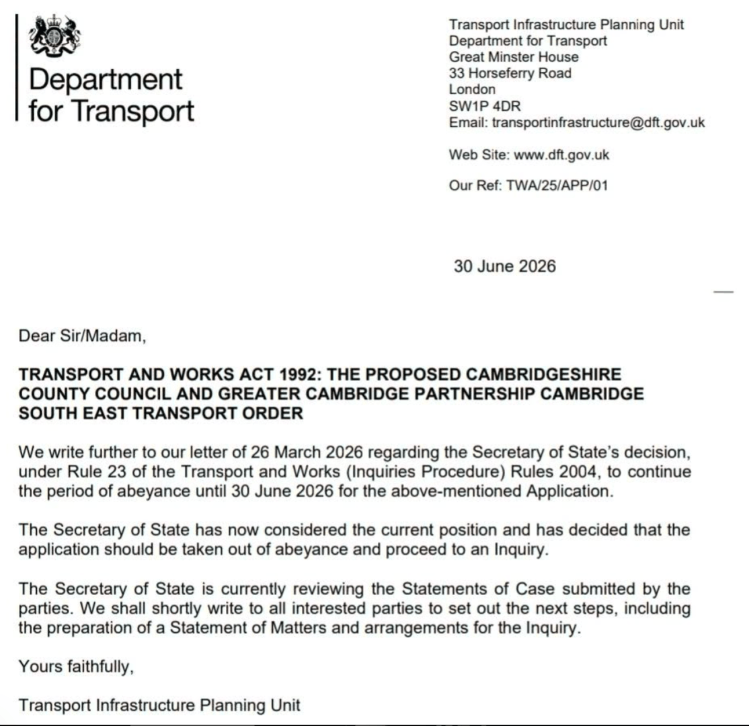
Above – am still waiting for the Department for Transport to publish the above on their website
I think this scheme should be shelved and instead the money put towards a suburban and/or light rail link to Haverhill
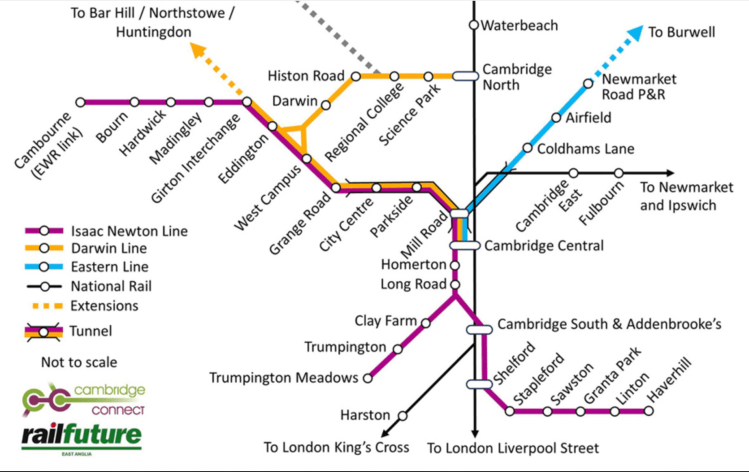
The current southern section of the guided busway could easily be converted into a light rail (in principle) to create new stops at the rear of Homerton College, Cambridge, and the private Abbey Tutorial College (which caters mainly for an international audience), and Long Road Sixth Form College along with the Cambridge Academy for Science and Technology, formerly the University Technical College.
The absence of both land value capture powers and the prohibitively expensive structures (eg land ownership / land speculation), systems and processes (paperwork-heavy. planning), mean that things that are standard in continental Europe (trams and light rail) are prohibitively expensive in the UK.
Which also explains why Cambridge South Station which opened recently, cost £250million
You can go to the station page here – make what you will of the guidance for parking and public transport onward links.
Now compare that with the main railway station with Cambridge’s Hungarian twin city of Szeged in Hungary – which has a tramline stop outside the railway station.
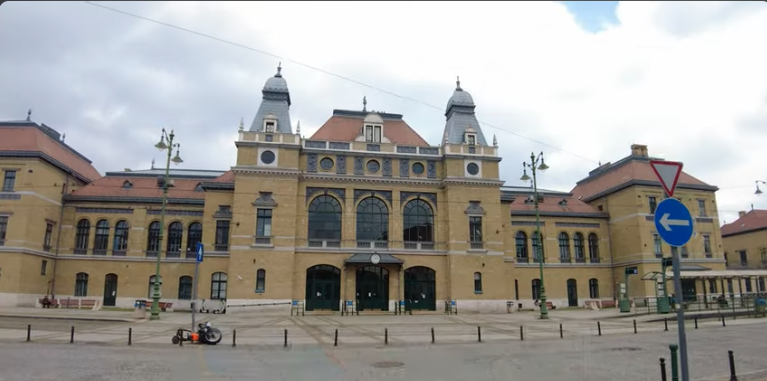
Above – Szeged Railway Station by Railway Networks – with the tram stop to the right of the image
I’d like to think that the new Cambridge East Station could be inspired by architecture like this – not least as a contrast to the designs of Cambridge North, Cambridge South, and Eddington.
If you are interested in the longer term future of Cambridge, and on what happens at the local democracy meetings where decisions are made, feel free to:
- Follow me on BSky
- Spot me on LinkedIn
- Like my Facebook page
- Consider a small donation to help fund my continued research and reporting on local democracy in and around Cambridge.


