
I first wrote about the proposals back in November 2024 here. Since they, the Crown Estate and its agents have done a significant amount of work including on public engagement. They have set a new high bar on youth engagement – something other developers now need to match.
See The list of documents (149 at the last count!) at the planning portal here, typing into the simple search box ref: 26/02567/OUT
The northern part of Milton Road is going through a huge comprehensive redevelopment process that probably won’t be completed for another quarter of a century. The Cambridge Business Park site falls within it and also falls within the North East Cambridge Area Action Plan which is now being incorporated into the next Greater Cambridge Local Plan (as opposed to being carried out separately)
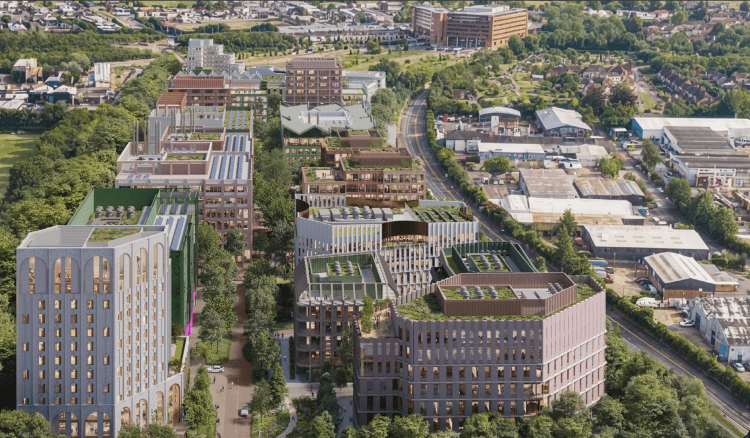
Above – a CGI of what the Cambridge Business Park might look like. (D & A Statement Part 1 of 20, p4)
You can see the location of the site in relation to Cambridge North Station on the image below.
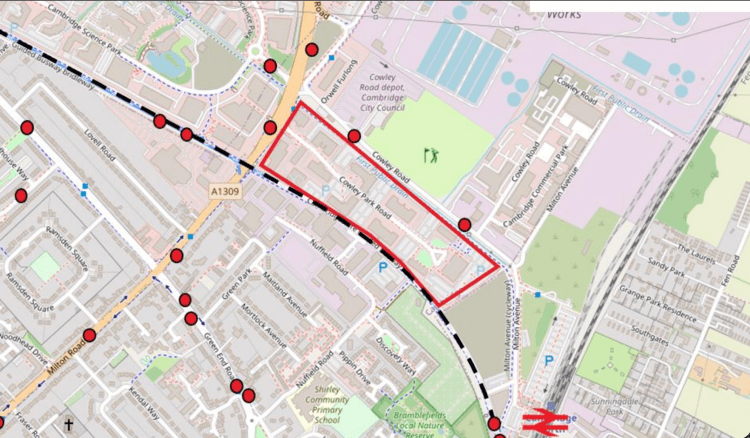
Above – Transport Assessment (Main Report) p41 – map of public transport stops (red dots for bus stops, British Rail logo for Cambridge North
Youth Engagement Report
Just under a decade ago, the Youth Engagement Service was established (see here). It has taken time to get going but the benefits of their work are now being felt as more schools, colleges, and youth organisations become familiar with their work and the processes. And the benefits for the children and young people too.
In a nutshell, my generation of 1990s teenagers did not have anything like this. We were not educated or informed about politics, democracy, the rule of law, responding to town planning, or our rights.
Which is why when David Blunkett became Education Secretary in 1997 he made it the Government’s business to change this. You can see some of the results in the publications by the Citizenship Foundation (which is now known as Young Citizens). Also, second hand copies of the publications can be found here.
“What would an introduction to town planning book for children & young people be like?”
A question I asked in July 2023. I’m still waiting to see/read the answer. All I knew about town planning was that in my late teens I became aware that my older brother wanted to be one. (He was followed by my younger brother, both qualified town planners – which meant that I had to do something else because sibling rivalries and all that)


Above – the Usborne For Beginners series would be a good series to add to

Above – Usborne have even added Geography and Ecology to their series. All four of these books effectively form the allied components for town planning – it just needs that final book to put all of these into a context that children are familiar with
Youth Engagement Reports as a submitted supporting document
This is on top of the required statements of community involvement

What the reports need to demonstrate is not only the processes that developers went through, but also on what impact the involvement of young people directly had.
In this case study, Cambridge Regional College and Bottisham Village College were engaged – small groups of students being invited to the site for a series of activities.
It wasn’t just about the site and what the developer wanted in terms of information
If the public engagement exercises are not giving something back to the people who are giving their time for free, then the developers are effectively getting a subsidy from the communities.
“Once the students had settled down, the facilitators introduced themselves.
Hannah Patrick (The Crown Estate), Lethius Charles (Savills), Olivia Sutcliffe
(Savills), and partners from AECOM and ARUP discussed their career paths and the
job opportunities available in their respective industries.”
Given the chronic skills shortages in town planning and construction, it’s vital that children and young people get to meet face-to-face people not much older than them who have gone on the path to get to somewhere where they are working on improving a local environment. Over the years I’ve asked generations of teenagers and students who are the people who have the most credible voices when it comes to engaging with them, and nearly all of them have said that it’s people who are not much older than them. I.e. not people my age! Additionally, they have to see people like them from similar backgrounds in those fields of work at work. Which is inevitably a challenge given the nature of graduate recruitment into the big corporates where privately educated applicants from affluent backgrounds inevitably have a head start.
“Students were keen to share their ideas with us and have suggested a wide range of sports facilities for the new Business Park, including a squash centre, badminton, Astro turf, basketball court, volleyball court, netball court, tennis court, martial arts, cricket pitch, gazebo, go-karting, running route and golf.”
The report also noted:
“Skate parks [were] one of the most consistently requested features”
Cambridge’s rollerskating history
It goes back a very long way, as I wrote in 2017 in Lost Cambridge here

Above – Cambridge Independent 12 Feb 1876 in the British Newspaper Archive
Sadly none of the rinks exist, and the brilliant CamSkate off Coldham’s Lane is on the other side of town, and as far as I know may not be permanent unless RailPen incorporate the facility permanently into their plans for Cambridge Retail Park between Coldham’s Lane and Newmarket Road.
***Bring back Rollerbury!!!*** (Or at least bring one to Cambridge!)

Above – Rollerbury at Bury St Edmunds via IG here. Today, Curve Motion in Bury St Edmunds is the only place near Cambridge that has an indoor roller rink.
Is the site large enough to accommodate a skate park and a roller rink? Is it something that could be accommodated within the wider North East Cambridge Area Action Plan?
The recommendations from the participants
They are worth reading in detail from Page 17 onwards because many of their suggestions shine a light on the issues they have with the rest of the city and surrounding area.
- The requirement to spend money as being a barrier to entry
- Safe, well-lit, and welcoming environments
- “Avoiding developments that feel exclusive or disconnected from community needs”
That last one is particularly important – and difficult for some firms and institutions in and around Cambridge to deal with. And the city needs to be open and up-front about it. ‘Brand Cambridge’ comes with ‘exclusivity’ built into it – and there is a lot of money to be made from that exclusivity. Furthermore, the University of Cambridge has its own issues even once students have arrived – Varsity the student newspaper regularly discussing class divides and equalities issues.
The Youth Engagement Report is not the end of the process
“Continued engagement as the project progresses will help ensure that the final masterplan remains inclusive, responsive, and aligned with the principles of good youth‑centred placemaking.”
Because the application is for a very large site and is for outline planning permission only, a host of ‘reserved matters’ for individual buildings, facilities on site, landscaping and more will be forthcoming should this application be approved.
It’s essential that this can be part of an ongoing continual process, and that the current participants should they wish, can continue to take part even when they leave school and college.
If you are interested in the longer term future of Cambridge, and on what happens at the local democracy meetings where decisions are made, feel free to:
- Consider a small donation to help fund my continued research and reporting on local democracy in and around Cambridge
- Follow me on BSky
- Spot me on LinkedIn
- Like my Facebook page


