
The old National Institute for Adult and Continuing Education (long since merged with ‘Learning and Work’), and the old Advisory Council for Adult and Continuing Education (abolished by Thatcher’s Government) published a number of reports that still read well today
- You can browse through the digitised NIACE reports in the Internet Archive here
- You can browse through the digitised reports from the old advisory council here
- Have a browse through the badges in the Rebel Badge Club because why should children get all the fun?
The Government’s plan for Music

Above Turn It Up: Our plan for music
It could have: “….for children and young people” following the word ‘Music’ because there’s nothing there for adults interested in getting into music as beginners/returners. That said it also covers issues that professionals in the music industry have had for years.
Anyway, have a browse through it. I get the sense that either it’s a policy oversight or that few have made the case strongly enough to ministers / politicians in the face of inevitable competing interests. And I don’t begrudge the children and young people of what little that has been provided for by ministers. If anything, they deserve far, far more. And if you want to see what one local secondary school in Cambridge has been achieving of late on a shoestring, have a look at Create Coleridge on IG here. It’s so good to see the students turning up the speakers – especially at The Junction. (Again, my generation in South Cambridge didn’t have anything like this, so credit to the people who made this happen).
Learning and Leisure – a survey of adult learners in Inner London in 1991
Learning & Leisure (1991) by Naomi Sargant for NIACE is one of those long-forgotten publications. During my public policy days we did not have access to digitised copies of past policy documents in the way that civil servants do today. That does not automatically mean they have the time or the curiosity to use them – time in Whitehall being in short supply for most policy-makers as I found out the hard way in the late 2000s. Which is why having in-house historians in policy teams and/or policy advisers with historical training is not a bad idea. (See https://historyandpolicy.org/ for more)
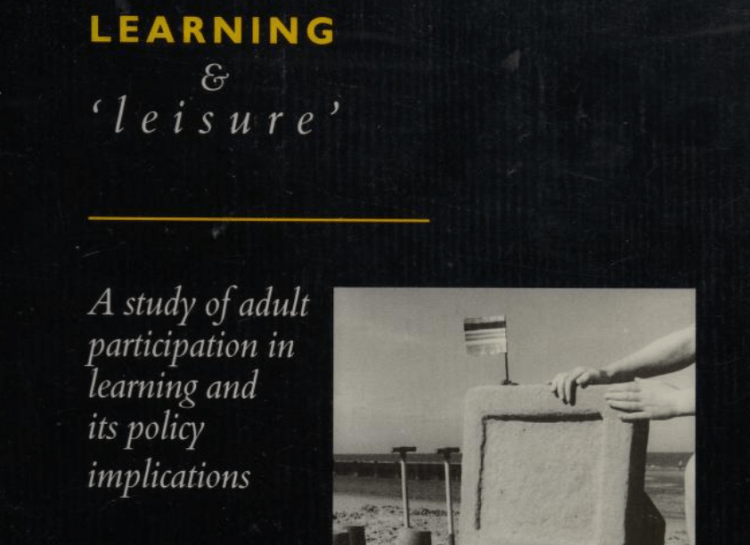
Above – Learning & Leisure (1991) by Naomi Sargant for NIACE, digitised on the Internet Archive here. (You’ll need to sign up to access it)
The foreword by Paul Flather from 35 years ago still reads well today.
Damning on the cuts to adult education funding.
Starting at the end of Mr Flather’s foreword, he was clearly furious about the impact of austerity on provision of lifelong learning in London, for the old Inner London Education Authority (1965-1990) where he was employed until its abolition.
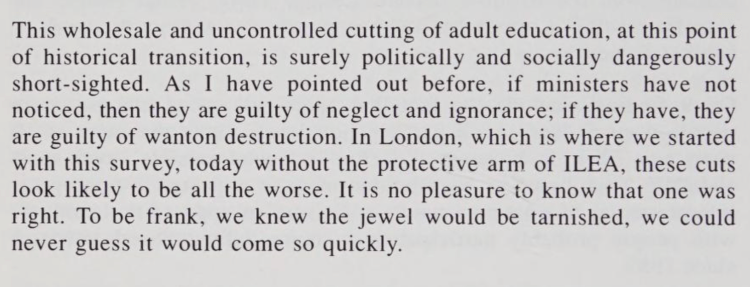
“The wholesale and uncontrolled cutting of adult education, at this point of historical transition, is surely politically and socially dangerously short-sighted. As I have pointed out before, if ministers have not noticed, then they are guilt of neglect and ignorance; if they have, they are guilty of wanton destruction… …It is no pleasure to know that one was right. To be frank, we knew the jewel would be tarnished, we could never guess it would come so quickly’
Above – Flather (1991) in Sargant, p10
One of the issues this publication addresses is the claim that taxpayers should not be subsidising ‘fun’ activities – especially for middle classes

“I recall very well a 1987 survey in Wandsworth which produced a 94% approval rating on the service. But what was staggering was that 10,000 adult learners bothered to take part in the survey at short notice just before the Christmas holidays: that’s real enthusiasm for you.”
“An Inner London survey a few years back showed too that adult learners were not just joining ‘night classes for fun’ as one radio interviewer rather crassly once put it to me. More than one in four were studying to improve work-related skills, and more than one in five were aiming for a specific qualification for vocational reasons.”
Above – Flather (1991) in Sargant, p7
What was also striking was the fears around television dominating leisure time.
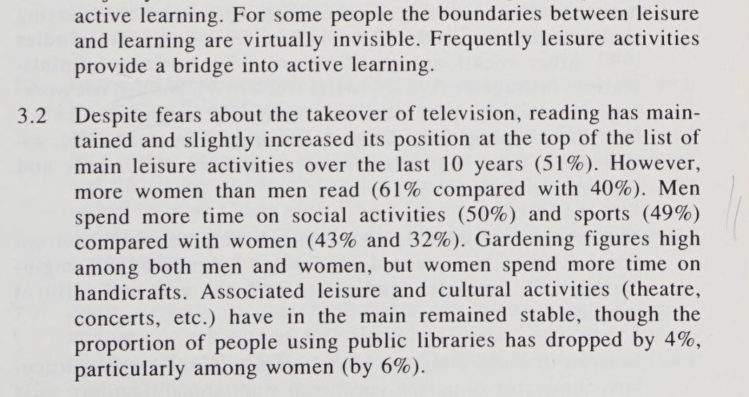
“For some people, the boundaries between leisure and learning are virtually invisible. Frequently leisure activities provide a bridge into active learning”
“Despite fears about the takeover of television, reading has maintained and slightly increased its position at the top of main leisure activities over the last 10 years [1981-1991]
How does that compare with the years since?
- The growth of the number of TV channels, and then subscription services available
- The internet via desktop
- The internet/social media via mobile phones/devices on the move
And are there correlations between spending and consumption on subscription services for things like movies and TV series’ and the decline in social venues?
The cost of loneliness in society
If the alternative to cutting funding for ‘fun’ activities is more loneliness, then how much does that loneliness cost society and the economy?
“Lonely people incur an extra £850 in annual healthcare costs to the NHS, as well as experiencing worse mental and physical health”
Above – Louise Vennells for the University of Exeter, 2025
And the economic costs?
“In 2017, New Economics Foundation produced a report on the Cost of Loneliness to UK Employers. This report, launched jointly by the Co-op and New Economics Foundation and issued in conjunction with the Jo Cox National Commission on Loneliness, put the cost of loneliness to employers at £2.5 billion a year.“
Above – the Campaign to End Loneliness on the cost of loneliness
Breaking the mindset of ‘fun’ and ‘learning’ being completely separate things
Until I left Cambridge to go to university, I grew up with the assumption that ‘fun’ and ‘learning’ were separate things. The same with ‘work’. The culture and the mindset of the 1980s and 1990s looking back on it now, was absolutely toxic.
On a personal level my continued campaigning/lobbying on this reflects what I can only describe as an open emotional wound from a path through education institutions where I had to ‘mask’ (in the neurodiversity sense) to survive. Something that more and more people are speaking up about as society becomes familiar with autism, ADHD, AuDHD, and research discoveries in neuroscience more generally.
And ‘masking’ also meant having to adapt to a system that did not allow for the continuation of anything practical with anything musical, anything artistic, or anything to do with computers (this was the mid-1990s!) for GCSEs because the choices were so limited.
Except for English where we had English Literature and English Language as separate GCSEs. Which in part explains why as an adult with the exception of a couple of years in my 20s (including in London) I never read works of fiction and still don’t now. Yet I still recall from my primary school days of one parent who stopped playing the violin having got to Grade Eight (!!!) because she hated it and only did so because her own parents made her. In a way it’s a bit like compulsory religion in childhood – having to go every week throughout childhood and then having nothing to do with the institution or the concepts as an adult.
Put it this way, you would not have had this in the 1980s and 1990s.
Above – Ibiza Prom Classics | Royal Albert Hall | The Bands of HM Royal Marines, 22 June 2026
The culture change that took place between the time when the first track (Rhythm is a Dancer by Snap! from August 1992 on TOTP here), and June 2026 when the above track was performed at the Royal Albert Hall by the Bands of HM Royal Marines. It reminds me of how ‘repressed’ everything was in the late 20th Century was.
Which makes me wonder what the point of those years at secondary school and college in the 1990s was – and is.
This then provokes something of a challenge to the institutions responsible – what’s the point of forcing people through something that later becomes utterly irrelevant to the lives of so many in adulthood?
It’s perhaps even more disturbing when you look at the question in the context of what generations of children and adults talk about the things they think should have been covered during their school days. Which reminds me of Myleene Klass’s book about what they don’t teach at school – but perhaps should.

Above – They don’t teach this at school (2022) Myleene Klass
I was almost embarrassed by my lack of practical skills when I returned from Brighton having graduated. I’m still embarrassed now – although CFS/ME is the greater and more permanent barrier for me today. I should have been at a music rehearsal earlier but I’m still struggling to recharge after sleepless nights in the recent heatwave that still hasn’t really gone away.
My personal issues aside, we still have huge skills gaps in the sectors that are essential to mitigating the worst of the climate emergency (National Audit Office reported earlier on the state of the construction industry earlier), the lack of anything substantial from successive governments on funding a huge retraining programme for adults remains alarming.
My call for a large lifelong learning college in Cambridge that provides a comprehensive offer to adults is, as I’ve mentioned before, something where adults would ‘choose to be’, so for example they could:
- Undertake the practical training course in the green economy
- Fill out that short survey/consultation response
- Take part in a physical activity – from team sports to dance classes
- Pop in to have the health check up with the nurse, dentist etc.
“So, what are the solutions?”
Here’s one

Above – Makerversity at Somerset House in London
Also, have a browse of their blogposts.
This is something that Cambridge should be looking to create as it grows. Again, the Hobson Street Cinema building would have been a good choice but the building owner has not been interested in civic uses and the site still deteriorates.
“What about Makespace?”
They are brilliant – I went to a couple of events there over a decade ago. So I’m not going to say a bad word about them.
What I’m looking at is something that is much larger in scale and also has significant financial support from the state, from employers, and from charitable foundations and trusts to the extent that, located ideally close to one of the new railway stations it serves not just the city but also surrounding towns and villages too.
What I also like about the Makerversity is its prominent location and grand setting – Somerset House (a 10 min walk from Charing Cross so it has public transport too)

Above – Somerset House with the main courtyard hosting a music event in the background
“Why can’t we have a new Somerset House for Cambridge?”
***Because going by past records, decision-makers and contemporary institutions would insist on B***kgate boxes and minimalist spreadsheet facades, and then commission marketing people to call the result beautiful, elegant, and inspirational.*** (I jest!)
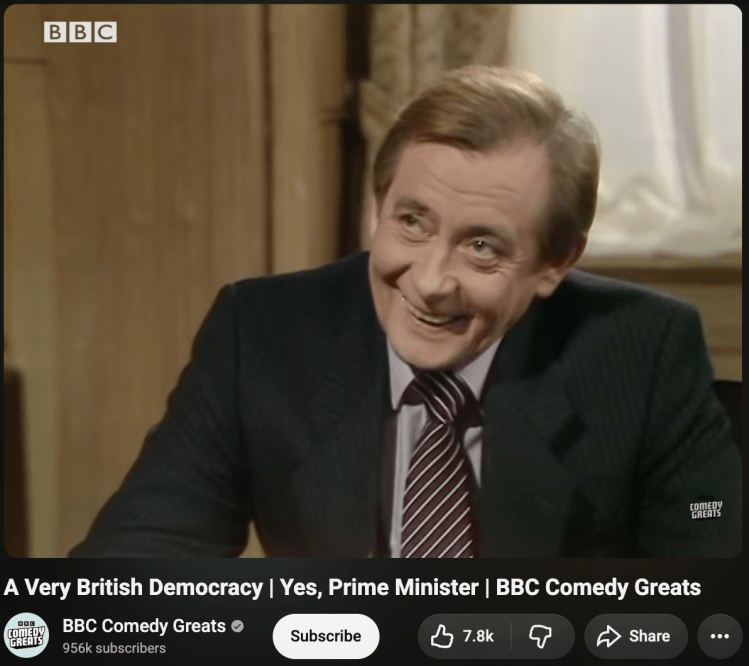
Sir Humphrey: “Bernard do you want to see the National Theatre turned into a carpet sale warehouse?!?”
Sir Bernard [above]: “Well it looks like one actually!”
Sir Humphrey: “We gave the architect a knighthood so nobody would **ever** say that!”
Above – culture wars in Whitehall in the brilliant Yes Minister/Yes Prime Minister series
At the moment I’m not entirely sure who wants to make the case for something as inspiring as what there is at Somerset House as a new building/facility/set of services for Cambridge. Any potential champions out there?
If you are interested in the longer term future of Cambridge, and on what happens at the local democracy meetings where decisions are made, feel free to:
- Consider a small donation to help fund my continued research and reporting on local democracy in and around Cambridge
- Follow me on BSky
- Spot me on LinkedIn
- Like my Facebook page


