
Cambridge City Council confirmed council officers are already gathering the evidence base needed to bring in an ‘Article 4 Direction’ to require anyone changing the use of a property by a single family to less than six tenants
You can have a listen to the response for Cambridge City Council by Cllr Katie Thornburrow (Lab – Petersfield) the Leader of Cambridge City Council – followed by the wider debate from councillors.
Cllr Thornburrow also mentioned the council meeting the previous evening:
“Whilst outside the plan making process, there is a strong case for developing an Article
4 Direction, so that small HMOs would also require planning permission. The policy is
therefore drafted to enable it to be applied to all HMOs that require a planning application
i.e. large HMOs, but also small HMOs if an Article 4 Direction issued.”
Above – Item 5 p9 at Performance, Assets and Strategy Overview and Scrutiny Committee – Wednesday, 15th July, 2026
The other document the petitioners did not have access to at the time of their petition was the commissioned study on HMOs in Greater Cambridge for the draft local plan. That stduy was published earlier this week.
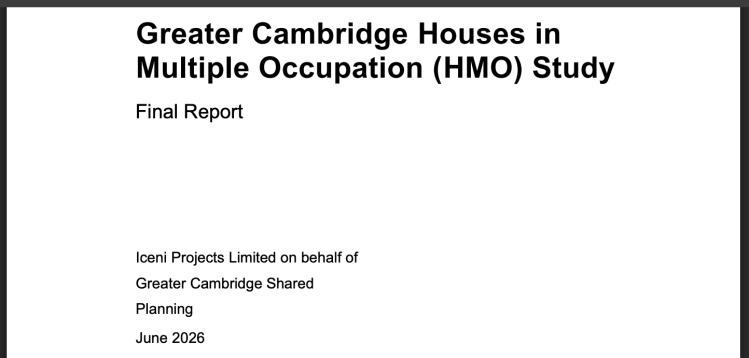
Above – Greater Cambridge Houses in Multiple Occupation, ICENI for GCSPS.
Note the report contains a ***huge omission***
“What’s that?”
“This report does not focus on the impacts of short-term lets and Airbnb.
Above – Iceni (2026) para 1.2
Which is…unfortunate. Because the use of AirBnB and similar platforms also has the same effect of taking out of use homes designed as family houses, and thus removing the ability for a long term occupant to move in and contribute towards the life of the community. Instead what happens is the property is treated as a financial asset to be ‘sweated’ by the asset owner when in the most part the people using such properties should be encouraged to stay in local guesthouses or hotels. Which then provides jobs and tax revenue with a much lower risk of avoidance or evasion. Remember also that the whole premise of Air BnB was to enable existing home owners to let out their homes for a few weeks a year while they were away. Not for already wealthy people to buy up family homes in residential communities and gain the wealth that way.
“Why don’t family homes for HMOs with under 4 people have to have planning permission?”
It was a move brought in by the Coalition Government in October 2010 which removed the requirement for property owners to seek planning permissions for such conversions.
“What did the petition state?”
“We the undersigned petition the council
- Amend the Local Plan to set a clear ‘10% HMO threshold within a radius of 100m’, across Cambridge, to prevent harmful over-concentration. (So if a property owner wants to convert an existing house into a HMO and at least 10% of the properties within a 100m radius of that house are already HMOs, the planning application is likely to be refused.)
- Introduce Article 4 Directions in Cambridge requiring property owners to seek planning permission to convert an existing home into a permanent ‘small’ HMO for three to six people. (At the moment property owners only need to apply for planning permission to convert an existing property into a ‘large’ HMO for seven occupants or more.)
Above – E-Petition from Donna Ferguson
In the explanatory notes, the petition notes that Cambridge is an outlier compared with other university cities, and states:
“This lack of safeguards is allowing family homes to be rapidly converted into HMOs without proper oversight, leading to growing concentrations in some neighbourhoods. National planning guidance and councils across the UK recognise around 10% as the tipping point where too many HMOs begin to harm local communities – affecting parking, waste management, housing quality and neighbourhood stability.”
Media coverage
BBC Cambridgeshire picked up on the petition here
“…to allow the erosion of existing communities, that’s what we’re worried about, because if you have a transient population, then you are going to gradually erode the sense of community and social cohesion in the area,” she adds.”
Above – Tessa Byars to BBC Cambridgeshire 25 June 2026
“How did we get to here?”
This is part of a much wider housing crisis that is now international. Without going into a huge amount of detail, it includes (but is not limited to) things like:
- The sale of council houses by Thatcher’s Government (and not using the receipts to build new ones)
- The restrictions on who had the right to live in council housing – the choice on renting from your local council, a private landlord, or buying your own property
- The removal of state-built homes by councils
- The expansion of university/higher education places *without* requiring institutions to provide accommodation to match the growing numbers (or providing them with the funds)
- “Flexible labour market policies’ (including migration from some parts of the UK to the other, and immigration)
- Growth in some sectors and geographical areas of the UK (think the huge office blocks in central London / The City / Canary Wharf) which could only be sustained by commuters travelling in ever greater distances
- Housing as a financial asset on the international markets
It therefore comes as no surprise that housing issues are a key driver in which political parties people choose to vote for – if they choose to vote at all.
Background reading
Without giving you a big library of things to read, three items that may be of interest include:
- Houses in multiple occupation (HMOs) England and Wales, Commons Library Research Briefing (30 September, 2019)
- Evidence Gathering – Housing in Multiple Occupation and possible planning responses, ECOTEC (September 2008) for the Department for Communities and Local Government:
- National HMO Lobby [who want restrictions on HMOs) submissions to Parliament
In Cambridge, the petitioners highlighted Mill Road as a particular problem
With Cambridge Labour Party having been in control of Cambridge City Council 2014-2026, and before them the Liberal Democrats, perhaps it comes as no surprise that the council wards closes to Mill Road (Petersfield, Romsey, and Coleridge) all returned Green Party Councillors at the 2026 local elections in Cambridge.
“What do The Greens have to say about HMOs?”
Their policies on housing are here. Specifically:
“…tackle rogue landlords by introducing a selective licensing scheme for private rented properties in the city along with an additional licensing scheme for Houses in Multiple Occupation (HMOs).”
Note Cambridge City Council’s licensing pages on HMOs is here.
Additionally, see The Government’s pages on HMO licensing here
Given that the Government’s page also states: “You could get an unlimited fine for renting out an unlicensed HMO.” there should be an incentive on local authorities to put funding into enforcement and prosecution. And if the revenues from fines issued by the courts does not get recycled directly back into local council housing enforcement and investment, maybe it should. That’s not to say it should be a standalone move by central government. Moves to enable landlords to access loans from financial institutions alongside facilities for councils and housing associations to acquire homes and properties that landlords no longer want to upgrade themselves should also be made widely available.
Councillors from the three main parties made clear this was not an anti-HMO campaign – similar to the what the petitioner stated, but rather about improving living conditions for tenants and more balanced communities, including tenants in HMOs
The points made by Cllrs Whitmore (Greens) and Gardner-Smith (Labour) representing Romsey ward highlighted the poor living standards of too many HMOs – especially those on narrow Victorian terraced streets with ‘galley kitchens’ and no living space. They also highlighted the loss of family homes too.
Cambridge’s insatiable housing demand – plus new and improved rail-based transport as one of the solutions
This is something former Queen Edith’s councillor Sam Davies wrote about here in 2022.
The planning permissions have been granted, but for whatever reason the developers are not building out those planning permissions that they already have. (There are multiple reasons for this, not just the financial incentive to keep house prices high by restricting supply of newbuild homes).
The continued failings of the Greater Cambridge Partnership’s larger infrastructure programmes
The Combined Authority Mayor Paul Bristow was in the Cambridge Independent again calling for the abolition of the Greater Cambridge Partnership. Back in May 2023 I was an independent candidate in Queen Edith’s (because Sam Davies and others asked me to stand and I was too weak to say “No!”) and included in my manifesto calls for the abolition of both the Greater Cambridge Partnership and the Combined Authority, and instead have a unitary council matching the Cambridge economic sub-region with new powers to tax the wealth generated here. I’ve also repeatedly called for new, upgraded, and re-opened rail links (such as here in 2021, and again here in March 2026) to connect Cambridge to other towns and villages so as to distribute the demand for housing and to share the wealth much more widely. That it has been over a decade since the first public meetings of the GCP and we’ve still not had spades in the ground for any of the busways speaks volumes about the concept of the partnership as much as anything else.
Anyway, Cambridge’s housing problems have been around for decades and they will probably be around for a few more. Housing policy is complex by its very nature – and also has huge time lags. (I used to work in housing policy in my civil service days). Don’t expect to see huge differences on the ground anytime soon.
If you are interested in the longer term future of Cambridge, and on what happens at the local democracy meetings where decisions are made, feel free to:
- Consider a small donation to help fund my continued research and reporting on local democracy in and around Cambridge
- Follow me on BSky
- Spot me on LinkedIn
- Like my Facebook page


