The book is Cities in Evolution, published in 1915 but written before the outbreak of the First World War, and within it he makes the case for citizens and cities
Image: an old crest of the Royal Institute of British Architecture – RIBA
The crest is from this digitised copy the transactions/report of a major town planning conference in London between 10-15 October 1910. Note that they are going for an even more minimalist branding for their bicentenary here.
Architects visit Cambridge – 15 October 1910
Maurice Webb, the architect of the Guildhall at Kingston-upon-Thames called Cambridge ‘the oldest “Garden City” in England’.
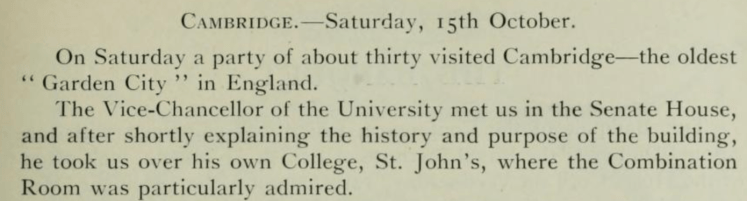
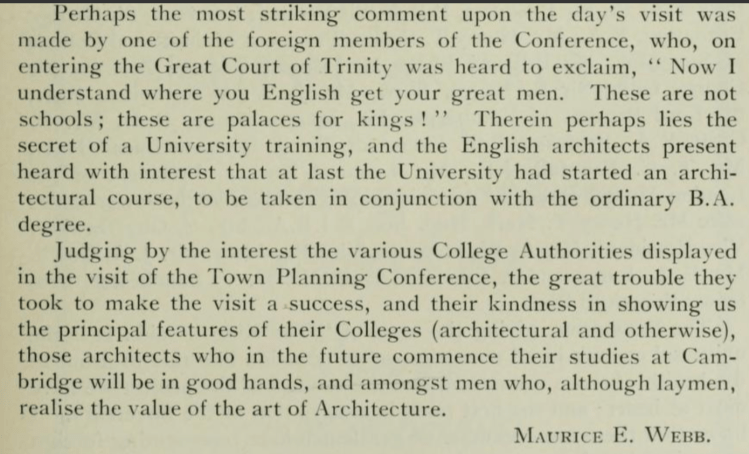
Above – Maurice Webb in RIBA (1910) p91
Not sure what he’d make of the contemporary buildings that have been built in recent times in Cambridge!
The connection between town planning and architecture
The opening preface sets the scene:
“The art of laying-out either the nucleus of a new city or the extension of an existing one to the best advantage of its population, as regards economy, beauty, and health, both now and in time to come, is, for want of a better term, called ” Town Planning.”
Above – RIBA (1910) piii – I fear ‘economy’ is winning!
This is from the preface by John Simpson, the then Secretary General of RIBA (there’s an expensive signed copy here!), in which he goes on to detail how RIBA set up its own town planning committee to explore the issues arising on town planning following the huge developments in Europe and the United States of America. Simpson then quotes Ruskin extensively in what reads like a warning to all of us (especially those involved in the growth of Cambridge) from history.
“It is not possible to have any right morality, happiness, or art, in any country where the cities are thus built, or thus, let me rather say, clotted and coagulated; spots of a dreadful mildew, spreading by patches and blotches over the country they consume.
“You must have lovely cities, crystallised, not coagulated into form; limited in size, and not casting out the scum and scurf of them into an encircling eruption of shame, but girded each with its sacred pomoerium [today it would be open green spaces superbly landscaped] and with garlands of gardens full of blossoming trees and softly guided streams.” The animal man can never be morally sound if he is deprived of those reasonable and healthy pleasures to which he is entitled; and Art aims at giving pleasure in a noble form.”
Above – RIBA (1910) piii – although I’m not clear if that final sentence is Ruskin’s or Simpson’s!
What Patrick Geddes takes on is something that reads as the opposite to Ruskin’s ‘lovely cities’. That concept Geddes criticises heavily is The Paleotechnic City – which covers the worst excesses of 19th Century industrialisation including but not limited to the exploitation of the people, environmental destruction, and the weak checks and balances on the accumulation of huge wealth by the very few. Furthermore, in this piece by Prof Hugh Begg for the Friends of Dundee City Archives we find that Geddes did not consider the case of Dundee – where he was Professor of Botany at University College, Dundee from 1888 to 1919, as a major case study for his work on town planning and civics.
The reason why that resonates is because in my own city of Cambridge, we have this similar issue on an even bigger scale – too few academics at the University of Cambridge undertaking research at scale and in a co-ordinated way so that their impact on solving our city/city region’s chronic problems are greater than the sum of their parts. But given that this involves challenging the very institutions that employ them, that’s easier said than done. Interestingly, Geddes is particularly critical of the university education that the likes of Oxford and Cambridge University of his era provided (See p302 here – unless you are a senior decision-maker within those ancient institutions and are of a sensitive disposition, in which case you may want to look away!)
Geddes on education for town planning, and for civics too
I’ve sort of taken it for granted that Geddes isn’t talking about civics and town planning from an elementary education perspective. At the time compulsory education for primary-school-aged children had been in force for less than fifty years – and it would not be until after the Second World War that a comprehensive programme of secondary school construction supported by central government funding would make this possible for teenagers. So this really is about adults.
The bit I’m particularly interested in is Chapter 13 of his book Cities in evolution : an introduction to the town planning movement and to the study of civics, which starts on page 295.
“We need to establish educational facilities and opportunities in town planning and in civics together, and these as fully as possible for all concerned”
I agree.
Sadly I’ve not been able to persuade any politicians of the merits of a new large lifelong learning college for Cambridge where we could do this – despite the significant expansion of the city in my lifetime (Especially since the late 1990s) and even more so in the future with the current and draft local plan now out for consultation, and the looming proposals from The Greater Cambridge Development Corporation
“A general advance of public opinion on these subjects is in progress; and the technical education of the town planner has correspondingly begun. Schools of town planning are being founded. The recent formation of the Town Planning Institute [today the RTPI], as an organised profession, must tend to further educational advance. Discussion of the nature and scope of education for town planning is thus on all hands beginning.
“If town planning is to meet the needs of the city’s life, to aid its growth, and advance its progress, it must surely know and understand its city. To mitigate its evils, it needs diagnosis before treatment. To express its highest ambitions, it must appreciate and share them. Hence town planning and civics must be advanced together. Arguments against their separation, general and particular, and from cities ancient and modern.”
Above – Geddes (1915) p295
We never got the called for democracy institute – one that is both voter-facing and school/college facing, and also the keeper and upholder of the highest standards of ethics and propriety in the world of civics.
There are a number of caveats/contextual points to raise with Geddes’ publication. The first is the era it is written in – which contains the general potential trigger warning that comes with comparing UK cities and peoples with those of the rest of the world. Additionally – and as he says himself in his preface, he finished working on the text before the outbreak of the First World War but chose not to change it in light of international events.
Talking of international events, today we would consider the Republic of Ireland to be part of international news rather than domestic news. In 1915 the whole of the island of Ireland was incorporated into the United Kingdom – and thus the UK Parliament with a substantial number of pro-Independence MPs representing constituencies that would later form the Republic. It was the consent of those MPs and the Labour MPs that enabled the Liberal Party to stay in Government even though the December 1910 General Election gave them just one more MP than their Conservative opponents – 272 to 271 respectively.
This also explains his praise for Dublin and its civic exhibition as a ‘British’ rather than an international event, grouping the challenges faced by Dublin with those of Edinburgh and Dundee (see p311)
“In Germany and America the same deepening studies [surveys of towns for the purposes of improvement] are pressing; so that if the very words sociology and civics had never been heard of, every serious town planner would soon be inventing them.
“Before long, then, the School of Civics, with its observatory and museum of survey, its drawing offices and business office, must become a familiar institution in every city, with its civic library in rapid growth and widening use, and all as a veritable powerhouse of civic thought and action.
“Since this prediction has been in proof, it has been strengthened by the resolute anticipation of the Dublin Civic Exhibition and of its School of Civics* —with the continued help of the active and public spirited Institute of Civics which has initiated them —to carry on in future years, if possible, a programme substantially of this kind.”
Above – Geddes (1915) pp311-12. Sadly the civic exhibition did not lead to the founding of a new Institute of Civics.
I haven’t thought about whether we need one today, or whether there is an existing institution that already carries out that function but which few have heard of it.
Food for thought?
If you are interested in the longer term future of Cambridge, and on what happens at the local democracy meetings where decisions are made, feel free to:
- Follow me on BSky
- Spot me on LinkedIn
- Like my Facebook page
- Consider a small donation to help fund my continued research and reporting on local democracy in and around Cambridge.


