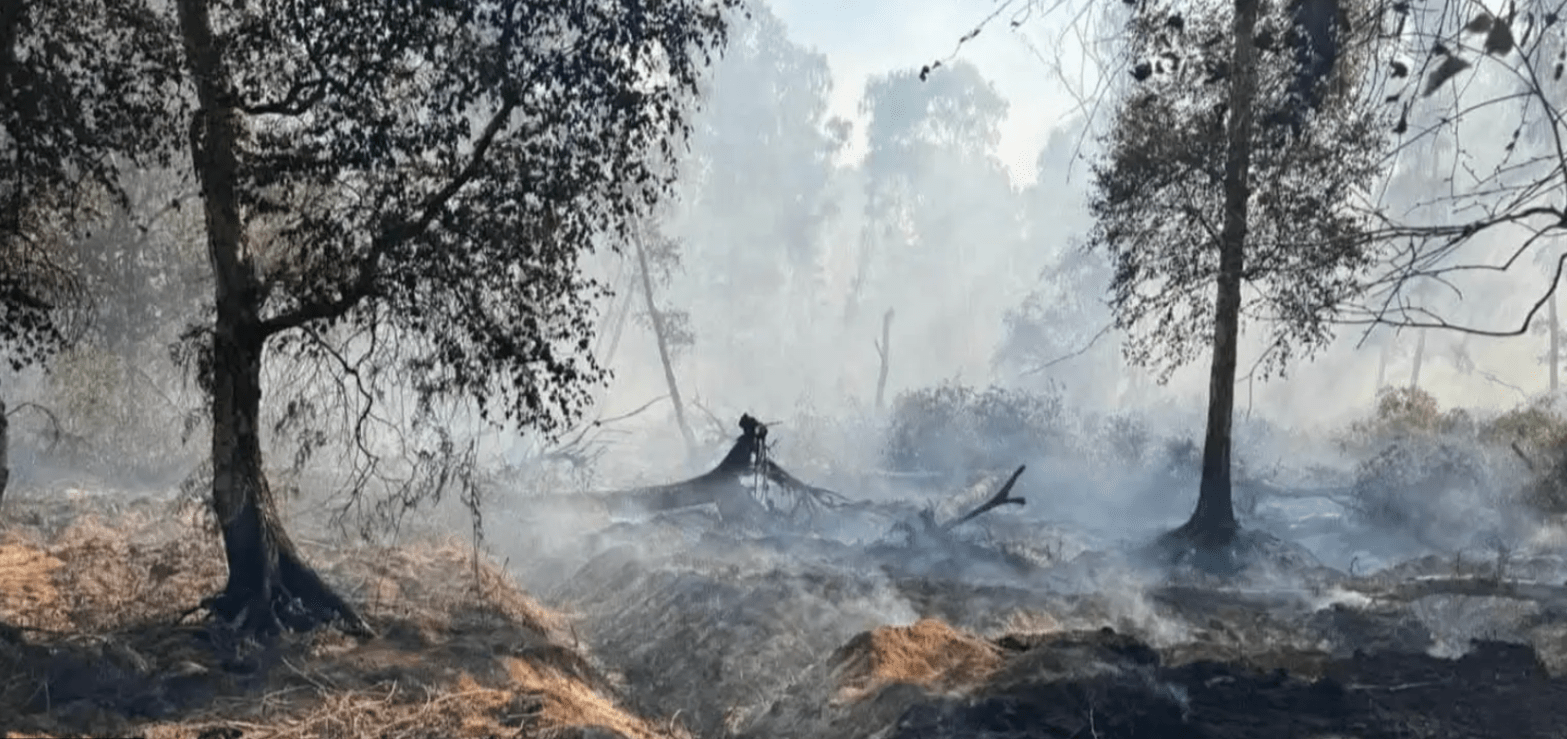
The footage of Holme Fen in northern Cambridgeshire taken by the firefighters of Biggleswade Community Fire Station (down the from Peterborough) is more than a wake-up call informing the public of the age we are now in.
Image – From Biggleswade Community Fire Station via BBC Cambridgeshire
Before I start, just a quick note about the devastating news about Jason Arday earlier – I hope the Coroner not only leaves no stones unturned but also summons senior decision-makers in the major media institutions to appear at any inquest hearing for cross-examination under oath by senior counsel.
Why are people setting off fireworks in Peterborough?
Presumably some people are if the two Labour MPs representing the city’s constituencies (Andrew Pakes MP, and former Cambridge City Councillor Sam Carling MP) have written to their party colleague and Peterborough City Council Leader Dr Shabina Qayyum about it.
Government bans the sale of disposable barbecues with immediate effect
“Retailers have been informed that disposable barbecues must be removed from sale immediately. The temporary measure will remain under review but will stay in place while the heightened wildfire risk continues.”
Above – Press Release from Cabinet Office, 14 Aug 2026
Additionally, we should see further action from local councils following the intervention of Angela Rayner, the Secretary of State for Housing, Communities & Local Government
“The Secretary of State for Housing, Communities and Local Government has also written to local authorities across England reminding them of the powers available to restrict activities that could increase fire risk, including the use of Public Spaces Protection Orders to limit barbecues, campfires and other forms of open fire in vulnerable areas.”
Above – Press Release from Cabinet Office, 14 Aug 2026
The powers seem to come from Section 82 of the Police, Crime, Sentencing and Courts Act 2022. The powers were used the following year in Lancashire where multiple agencies (Police, Fire & Rescue, and local councils) imposed an expedited PSPO to reduce the risk of wildfires on moors within their jurisdiction
Ministers must bring forward substantial proposals now that we have found out the hard way what long droughts combined with extreme heat are like.
By that I mean we’ve now seen the very visual impacts of wildfires spreading to residential areas, with people seeing their homes and livelihoods consumed by flames.
‘Fires prompt national alert as 19 homes destroyed’
The BBC features one image by Alex Dodd for the EPA agency. He took dozens of photographs that tell an even more powerful story.
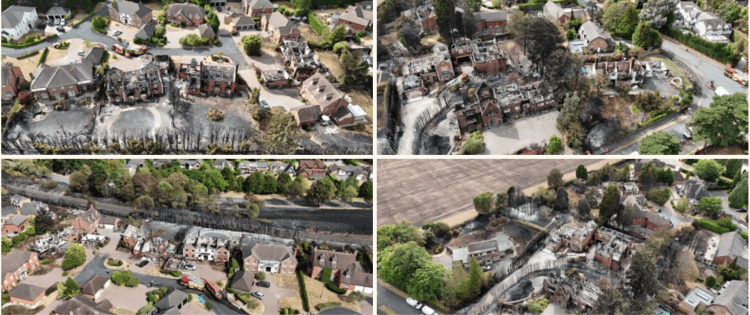
The photographs raise a host of questions about the spread of the fire, including why some properties were entirely consumed by the flames while others appear unharmed.
What makes these images all the more powerful for the public is that these remind us of what many of our residential neighbourhoods are like, and what they could look like if we were to be hit by such catastrophes in our own communities. Which is why I think ministers will come under huge pressure from MPs of all parties to ‘do something about it’.
Short term and long term measures
If you would like your constituency MP to put your questions to ministers, it’s worth emailing them asap (eg via https://www.writetothem.com/ ) and ask them specifically to forward your questions onto the relevant government department ‘for a ministerial response’. This includes short term responses as well as on long term plans.
Town planning – we can’t have healthy cities if people are getting burned out of their homes due to wildfires, the increasing risks of which are a result of climate change
The early pioneers of the town planning movement and profession made healthy cities a core part of their movement.
““The art of laying-out either the nucleus of a new city or the extension of an existing one to the best advantage of its population, as regards economy, beauty, and health, both now and in time to come, is, for want of a better term, called ” Town Planning.”
Above – John Simpson, Secretary General of RIBA (1910) piii
I wrote more about this in my previous blogpost here. The challenge is very much an urban design one as much as it is for architects to design new homes that are less flammable. (As if Grenfell wasn’t a wake-up call on that front with cladding).
“The most pressing long-term risk to humanity’s future is climate change and human alteration of the environment.”
Above – Lord Martin Rees, the Astronomer Royal to Earth.Oeg, 16 Aug 2021,
He is also the co-founder of the Centre for the Study of Existential Risk at the University of Cambridge
“At the beginning of the twenty-first century Professor Lord Martin Rees, the Astronomer Royal and one of Cambridge’s most distinguished scientists, offered humanity an uncomfortable message. Our century is special, because for the first time in 45 million centuries, one species holds the future of the planet in its hands – us.”
Above – Centre for the Study of Existential Risk, University of Cambridge – our story
When activists and politicians say things like ‘Scientists have been warning us about this for decades’, Lord Rees is one of the scientists they are talking about.
Above – Sir Martin Rees as was in 2005 in a TED Talk uploaded in 2008.
2008 was 18 years ago – children born in that year are now at the age of majority. What have the decision-makers in large institutions have to say for themselves? Especially those that were around when Lord Rees was giving this talk?
Lord Rees warned us again in 2013
It was in the 2005 talk that he mentioned something called the Russell-Einstein manifesto.
The Russell-Einstein Manifesto of 1955
“We are speaking on this occasion, not as members of this or that nation, continent or creed, but as human beings, members of the species Man, whose continued existence is in doubt.”
Which sounds like today.
The context of their manifesto was the Cold War, and the titanic struggle as they saw it between Communism and Anti-Communism. And yet there are so many sentences that resonate with today.
“People scarcely realize in imagination that the danger is to themselves and their children and their grandchildren, and not only to a dimly apprehended humanity. They can scarcely bring themselves to grasp that they, individually, and those whom they love are in imminent danger of perishing agonizingly.”
They write in the context of the threat of nuclear war – something we came perilously close to in 1962 during the Cuban Missile Crisis, hence the protest march here in Cambridge.

Above – Veteran campaigner and former city and county councillor Clara Rackham leading a protest march in Cambridge in October 1962 to stop the outbreak of war over Cuba. Looks like she succeeded! (Photo via Mike Petty MBE)
There’s another ‘Lost Cambridge’ connection in the Russell-Einstein manifesto too. The name of the first signatory to the document? Physicist and Nobel Prize winner Max Born.
He arrived in Cambridge in the mid-1930s bringing his wife and children with him – which is where his daughter Irene met a young Welsh student with an incredible singing voice – Brinley Newton-John. (Olivia and sister Rona, sadly now both deceased, explored his Welsh roots for the BBC here).

Above – Irene Born and Brinley Newton-John, Mid 1930s, via Dame Olivia Newton John here.
Coming back to the manifesto, it concludes:
“There lies before us, if we choose, continual progress in happiness, knowledge, and wisdom. Shall we, instead, choose death, because we cannot forget our quarrels? We appeal, as human beings, to human beings: Remember your humanity, and forget the rest. If you can do so, the way lies open to a new Paradise; if you cannot, there lies before you the risk of universal death.”
Above: The Russell-Einstein Manifesto 09 July 1955
Moving from the ‘vague and abstract’ concept of ‘climate change’ to people’s houses being destroyed by wildfires during an expended period of unprecedented drought combined with extreme heat.
The manifesto identifies the barriers created by the ‘vague and abstract’ concept of ‘mankind’ and it being at risk due to the threat of nuclear war. Are we in a similar situation with climate change – and now a climate emergency where we’ve reached a tipping point? A tipping point where the general public can feel the impact of it directly? Where it’s not something that we see on telly as ‘bad stuff happening far away in another country’?
Lord Rees’ most recent thoughts
“I’m Uneasy as to whether we’ll get through the next 20 years”
Above – Dr Philip Davies interviews Prof Lord Martin Rees 24 Jul 2026
Which was a few weeks ago!
I hope they have ideas that can come to the fore on how to get out of this crisis we’re in. But one way or another, we cannot carry on like we are. This autumn could see some very radical changes in policies and principles not just from the UK Government but from governments across the globe – not least because so many of them are dealing with their own wildfire disasters, and not just Europe. Indonesia’s Orang-Utans are threatened, while a State of Emergency in Canada’s British Columbia has been declared in North America – and that’s after the smokey haze drifted over the border to envelop New York just before the World Cup Final last month.
Whatever the policy responses are, this involves everyone. Especially the wealthiest with the biggest environmental footprints
Food for thought?
- Follow me on BSky
- Spot me on LinkedIn
- Like my Facebook page
- Consider a small donation to help fund my continued research and reporting on local democracy in and around Cambridge.


