
The MP-Candidate for Cambridge Liberal Democrats, Cllr Cheney Payne (Castle Ward on Cambridge City Council) on what residents are telling her about our city
You can
- watch her FB Reel here
- take her party’s crime and ASB survey here (noting the data protection notice prior to the survey) or…
- drop her an email (see foot of her campaign page of if Lib-Dem minded, one of her party reps in your area)
- …or alternatively, find out who your local councillors are and contact them via https://www.writetothem.com/
‘Residents are telling me that Cambridge is starting to feel run down’
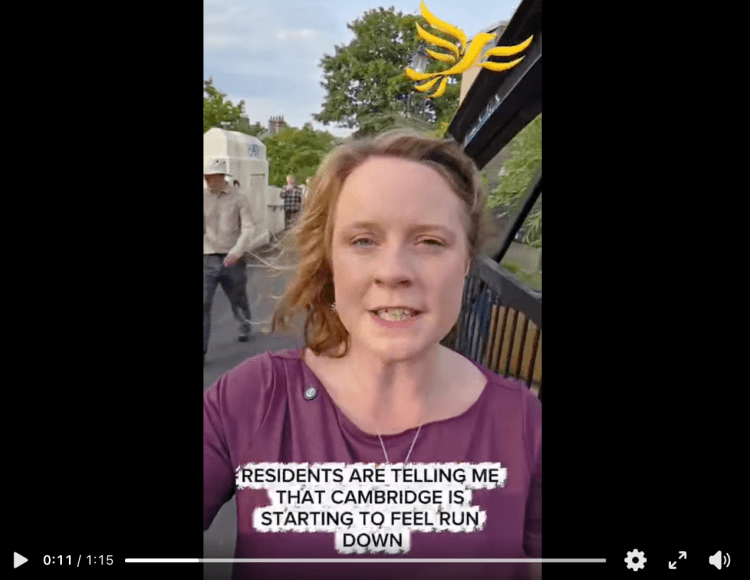
Above – Cllr Cheney Payne (LibDems – Castle) 19 August 2026
“Starting? It already is and has been for ages!”
I think that was more a turn of phrase rather than something to be taken literally. The same goes for instant responses that blame individual local political parties and their records in power, because we all know that politics is not in a good shape. We see the symptoms of it in our towns and cities – especially in former retail centres that were once buzzing with life. We see it on poorly-maintained roads and pavements too.
Below: The Great Buddleia of Cherry Hinton Road in Cambridge – down the road from ARM’s HQ

I took the above photo in early August 2026.
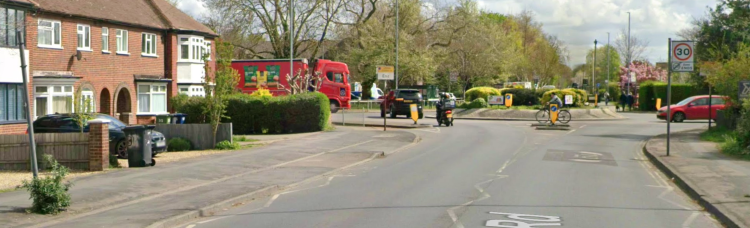
Above – G-Maps says it was this big last April (see bottom-left of the image)
So that’s just over a mile between ARM UK’s Headquarters and the Great Buddleia of Cherry Hinton Road
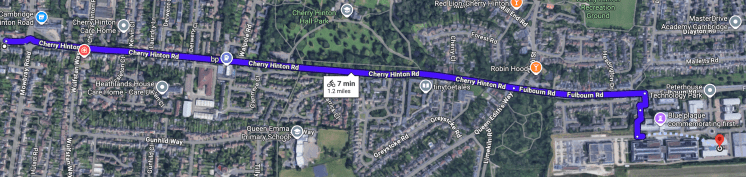
Above – G-Maps from a gleaming sci-tech park owned by Cambridge University’s oldest college (Peterhouse) to a section of pavement where the local (county) council is so cash-strapped that it cannot prioritise removing this butterfly magnet
“Isn’t it the county council’s job to remove such things?”
It is, but at the same time this assumes:
- The county council has the resources to carry out the tasks that the law requires of it (it doesn’t)
- There are enough civic-minded residents who can spot and report such things (eg through the county council’s weblink here)
“So why haven’t you done it?”
Because I liked butterflies when I was about eight years old. (But then had a miserable time on a school trip to a butterfly place not long after and decided I didn’t like them after that!)
This is just one of many symptoms that reflected a broken and dysfunctional political and economic system that goes far beyond what we see in our neighbourhoods.
The sense that Politics as a concept is no longer the means by which people can get local issues resolved is something that was meant to have been resolved by Sir Keir Starmer’s Government. That he was unable to make much of a difference on that front as well as losing the communications war hastened his demise. His successor Andy Burnham has been seen in public policy circles to have made a strong start compared to his predecessor, but there are huge electoral tests in 2027. Furthermore, another test will be when political journalists start contacting regional mayors and local councils in the first instant on geographically localised issues rather than asking ministers for an instant response on which they have no knowledge.
Ministers need to push back collectively and consistently on accredited political reporters (especially BBC News) asking questions on local issues, and point them to local council/mayoral press offices without adding party-political comment to them.
The same goes for questions from MPs even if it feels like an open goal for a minister to criticise a council run by another political party. Which is easier said than done.
The withdrawal of The State as a presence in communities and neighbourhoods
The policies of Margaret Thatcher’s Conservative Government resulted in the fragmentation of civic identities as local public services were cut, centralised, outsourced, privatised, and so on. One very visible indicator of this are the uniforms that leisure centre staff wear – branded with the outsourced contractor company’s branding rather than that of the local council. We see examples of it in health and social care too. (And I loathe it!)
What would it be like if the vast majority of people working in local public services in any town/city wore uniforms or badges/insignia that had consistent civic branding of the local council/authority they worked for? For example the Cambridge BID ‘Ambassadors’ if they had the Cambridge civic coat of arms on their hats alongside the widely-recognised ‘i’ branding for tourist information?
Some examples from history include:
Cambridge Central Library (when the old borough council was responsible for it)

Above – the old Cambridge Central Library’s crest round the back of the Guildhall. From LostCambridge
Cambridge police – this special constable’s badge dates from the 1800s according to the auction site I bought it off ages ago!

Above – a vintage Special Constable’s police badge from the 1800 (own collection)
Should community support officers have similar insignia of their local council’s coat of arms to signify their community support role rather than that of formal law enforcement that accredited Police Officers (i.e. those with full powers of arrest when on duty) have?
Our fragmented governance and institutional structures give the impression that ‘no one is in charge’
Or perhaps that no one can be called upon and relied upon when bad stuff happens. Which reflects longstanding concerns about motor vehicles with unlawfully loud engines and exhausts.

Above – another Cambridge LibDems petition site, this one calling for new noise-detection equipment to help crack down on unlawfully-modified motor vehicles being driven/ridden to the effect of breaching regulations on noise pollution limits
Note Paris has been successful in doing so but still has some way to go before birds can sing at normal pitches. This follows the French Capital’s implementation of noise detection equipment in 2022. But then Paris has far greater powers and is able to raise far more revenue than any UK city could dream of.
Hence the problem of waiting for the benevolent hand of HM Treasury to approve the departmental handout of crumbs to grateful local councils in return for the ministerial photoshoot and positive press release. A familiar Whitehall routine for ministerial visits when it comes to communications planning! The cynical view being that junior ministerial posts and the visits that go with them help keep troublesome and ambitious MPs busy, and thus reduces their ability to plot against the leadership! The result being that Parliament ends up with too few MPs that want to put their constituents first and spend their career scrutinising the government (Eg as a senior select committee chair) and instead get too many MPs aiming for ministerial office too soon, thus spending their time not making life difficult for their own party when it is in government. Pippa Heylings MP’s predecessor as MP for South Cambridge 2019-24 did not vote against the instructions given by his party’s whips for his entire term of office. As things stand, Ms Heylings’ neighbour in Cambridge, Daniel Zeichner MP is heading for a similar record according to TheyWorkForYou.
‘There’s less and less investment in our community’ – Cllr Cheney Payne
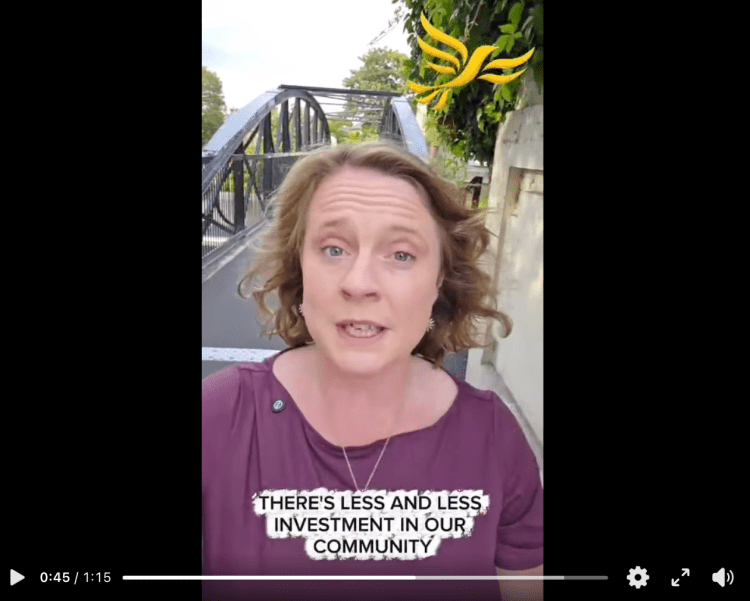
Above – Cllr Cheney Payne, 19 August 2026
I agree.
And so broken are the funding structures in local government that even when new developments make provision for community facilities, there’s no funding left for local councils to pay for the community officers to actually run them. The latest example I heard about was with a new development on the edge of South Cambridge that Cllr Karen Young (LibDems – Queen Edith’s both city and county councils) mentioned to me. And getting community facilities for Queen Edith’s ward for both current and new housing developments is something of a never-ending battle as former councillor Sam Davies MBE wrote about here.
As I’ve mentioned repeatedly over the decade-and-a-half of blogging and social media posting, local councils don’t have the legal powers to tax the excess wealth generated in the city that might pay for such essentials. Furthermore the various schemes advertised in local and social media coming from well-minded individuals in the various business communities can never compensate for services provided for through general taxation where we have a system that does not lead to the gross inequalities we’ve become all too familiar with.
Declining social capital in existing residential communities
In a blogpost from November 2019, Sam Davies wrote about social capital. In it she included the diagram below.

Above – Community Social Capital Model from University of Minnesota via Sam Davies.
I can’t help but think that all of these networks – bridging, bonding, and linking, are all struggling in Cambridge. Some areas inevitably do better than others for a host of reasons including but not limited to:
- Active, long-standing and well-resourced non-state civic institutions that facilitate all of the above
- Active, competent, and passionate individuals who also have the time and commitment to facilitate the above (often within existing civic institutions, sometimes forming new ones)
- Intervention from the state, for example through locally-funded programmes, a successful application for a grant from central government, or developer contributions on the back of housing development
- Intervention from charities or civic-minded business and philanthropists
We’re all too familiar with the things that can undermine those networks – including but not limited to:
- Very high housing costs – house prices that are disproportionately greater than annual salaries for mortgages, rents that are at a level disproportionate to the wages of tenants
- A housing market that incentivises asset-rich individuals and firms to buy up housing designed for long term residents and sub-dividing them for short term/annual renting eg for the student market
- A housing market that incentivises asset-rich individuals and firms to buy up housing designed for long residents and letting them out for very short-term lets eg on Air BnB
- An economy and jobs market that has very low job security – for example with zero hours or routine fix-term contracts ‘renewed’ knowing that a worker can be dismissed with few rights simply on the expiration of the ‘renewed’ contract.
- Neighbourhoods and geographical areas with very high population turnovers
- Areas experiencing poverty and multiple deprivation – and the symptoms that go with it
Why do I know so few people in my neighbourhood? Where did everybody go?
At the moment two of my social media feeds are being bombarded with content from creators trying to figure out different aspects of loneliness in society – mainly UK-based but not entirely. Which tells me that this is not just a ‘Me’ problem but a structural one. (And CFS/ME is a metaphorical millstone around my neck when it comes to any solutions because it’s an impossible one to break).
Walking around Cambridge city centre earlier, it struck me that I didn’t see anyone familiar – and how different this was compared to the mid/late 1990s where I would frequently bump into people not just from school and college. What was also striking was the shell-shocked expressions of one or two of the staff I saw in the closing down sale of the shop formerly known as WHSmith. If you’ve been through a compulsory redundancy programme chances are you’ll be familiar with the facial expressions. When I mentioned it to a visiting in-law it became apparent that there is hardly anything in the city centre that represents ‘essential’ shopping in ways that there might have been a generation ago. Or even leisure-based retail such as music – the concept of which has almost entirely dried up. Or picking up photoprints – also made obsolete by the advance of technology.
The risk of overlooking declining third spaces in historically older neighbourhoods
This is what some parts of Cambridge face because nominally the statistical data shows those neighbourhoods are coping better than those that are and have historically struggled. Hence the targeting of what limited local council resources there are gets focused on those areas in greatest need. In the meantime questions from local residents in other parts of the city who have their own needs start asking why some parts of the city have lots of things put on for them (Especially for younger children) but not in our part. As someone who didn’t grow up in council housing, conversations with a couple of local residents several years ago who live in council housing completely opened my mind as to the different relationships they have with the city council versus more affluent home owners who, other than bin collections could live lives completely separate from local council-provided services. Which also helps make the case for diversity in party politics and in election candidates slates. Lived experience matters.
One of the big social losses to the city was the closure of Cambridge Community Arts in 2025
I wrote about it here. It was something that desperately needed investing in but such are the structures of public finances that councils had no means of raising the revenue from local taxation, and no means of taxing the excess wealth generated in the city. And time and again there was nothing coming from attempts to appeal to the social consciences of the wealthy firms we’re continually told are ‘the jewel in the economic crown of the UK’.
I don’t buy the argument about other parts of the UK saying they would love to have the firms in Cambridge’s sci-tech bubble where they are. All that reflects is how the existing economic, political, and social structures are not working for them or for Cambridge. The same goes for the accumulation of excess wealth alongside the extractive nature of some economic activities. Eg buying up a residential property and turning it into an Air BnB property isn’t ‘investment’ as far as the city is concerned, it’s acquiring and sweating an asset because no new productive capital has been created by the acquisition of the existing property. Furthermore the use deprives local small hotels and guesthouses of custom, and the community loses out on the input that might have come from a new long-term household moving in. Extrapolated that might mean children at local schools have fewer friends living locally, community groups having fewer members or volunteers, and local businesses having fewer regular customers.
The impact of very short-term lettings was also raised in the House of Commons by Rachel Blake MP (Lab – Cities of London and Westminster)
“Chief among the forces hollowing out our communities is the unchecked proliferation of short-term letting hosts on Airbnb, Booking.com and other sites. These individuals turn our homes into hotels, our communities into commodities, and our neighbours into night-time nuisances….”
“Amidst this bad behaviour is the flagrant breach of the London-wide regulation that short lets can operate for no more than 90 nights per year without planning permission. This is operationally impossible to enforce because of how difficult it is to get accurate information on how many nights a short-term let is being used. In some parts of my constituency, as many as 30% of homes are being used as short-term lets…“
Above – Hansard 11 Feb 2026, Short-term Let Accommodation (Data Sharing Requirements)
Volume 780, Col 782
It remains to be seen if the Housing Secretary is prepared to incorporate the key points from Ms Blake into future Government-tabled legislation.
“Are there existing regulatory responses on Air BnB-type lettings elsewhere?”
Some long-overdue research on actions taken by EU nations is now emerging, such as the recently published (i.e. five days ago!) paper by Lukovic, V. (2026). Regulation and Legal Constraints in Response to “Airbnb, Go Home!” Protests in the European Union
“This chapter looks at this issue through the lens of legal constraints of the EU law and examines central and local governments’ policy options with regard to the EU’s Directive (2006/123/EC) on services in the internal market. The research looks at recent measures enforced or announced in Italy, Spain, and Greece, where tourism is a vital part of the economy.”
Above – Lukovic, V. (2026). Regulation and Legal Constraints in Response to “Airbnb, Go Home!” Protests in the European Union. In: Katsoni, V. (eds) Synergizing Management, Culture, and Arts for Tourism Development – Vol. 1. IACuDiT 2025. Springer Proceedings in Business and Economics. Springer, Cham. https://doi.org/10.1007/978-3-032-17545-8_1
Which is a reflection of how international phenomena (such as the emergence of short term letting platforms) can have huge local impacts, while existing political and legal structures prevent any meaningful responses to those local impacts.
Another issue for the ministerial inboxes this autumn.
If you are interested in the longer term future of Cambridge, and on what happens at the local democracy meetings where decisions are made, feel free to:
- Follow me on BSky
- Spot me on LinkedIn
- Like my Facebook page
- Consider a small donation to help fund my continued research and reporting on local democracy in and around Cambridge


