
The embargo on the new policy has just been lifted. This alongside announcements on building on rural land near railway stations linked to key cities, and Mayoral overrides on large development applications inevitably raises concerns about environmental protection.
Image: Spitting Image’s Camberwick Greenbelt from the clip here from 75s in, lampooning arch-Thatcherite Nicholas Ridley MP, Environment Secretary 1986-89
…who according to his Wiki Page coined the term ‘Nimby’ [Not In My Back Yard]


Above – Daily Mirror 14 June 1988 in the British Newspaper Archive
Chances are the term ‘NIMBY’ became even more of a thing when the then Environment Secretary (responsible for housing, planning and local government in those days) was found to have opposed a planning application for the very sort of development he said rural areas would need to accept.
The context is slightly different today because it’s Labour that is in government. Electoral history shows that rural areas tend to return Conservative candidates as MPs. Once large housing developments are built in such areas, that party political control can ease off – as we’ve seen around Cambridge with the astonishing decline of the Conservatives in Cambridgeshire over the past decade. Hence there is a potential electoral incentive for Labour to get new developments approved and started – as well the more important incentive/task of responding to the huge social housing need as demonstrated by the 1.34million households on social housing waiting lists.
“Today (25 August) the Prime Minister and Secretary of State, Angela Rayner, are announcing nearly £10 billion of allocations to build thousands more quality council, social and affordable homes.”
Above – Press Release from GovUK
This is part of the £39billion announced in the Spending Review of June 2025 – see this briefing from the National Housing Federation from February 2026. The NHF is the trade association for social housing providers and housing associations.
“£9.58 billion is being allocated to 33 Strategic Partners outside of London, including housing associations and other providers, to support the delivery of 73,600 new social and affordable homes across England over the next ten years.”
“How does this compare with what Cambridge has been doing?”
“We have built over 1,205 new homes since 2018, including 879 council homes, across 27 sites in Cambridge.”
Above – Cambridge City Council
Cambridge’s council-house-building record (done as part of a partnership with Hill in the Cambridge Investment Partnership) works out at just over 100 per year, although the completion of homes varies significantly year-on-year due to a host of factors that influence the state of the construction industry.
Although only the first part of the announced funding, 73,600 over ten years is approximately 7,300 per year which if councils completed the homes at the rate Cambridge does at 100 or so per year, would sort of cover 70 district council areas. Which is around a quarter of all non-London councils that have housing responsibilities. (I.e. not county councils).
“And what about mayoralties?”
“Over £2 billion of today’s funding is expected to be spent in Mayoral areas outside of London. As part of the government’s wider devolution agenda, Established Mayoral Strategic Authorities are setting the strategic direction for the programme in their areas, helping ensure investment reflects local priorities.”
Above – Press Release from GovUK
Which will be interesting to see how much of an incentive this is.
Proposed new powers for mayors
This applies to large developments and large infrastructure projects – the latter of which may take some of the workload off of the Planning Inspectorate.
“The national thresholds are being set outside of London for the first time: schemes with more than 150 homes, more than 15,000 square metres of commercial space, or any building over 30 metres or taller, roughly ten storeys will be in scope.”
This has inevitably raised concerns a number of rural district council areas – not least given the Government’s confirmation about planning applications for housing developments near railway stations.
Russel Curtis pointed to a tool he created on the back of the announcement which estimates the number of homes that could be built around railway stations served by a sufficient number of train services – the ones that form the top 80 ‘Travel to work areas’
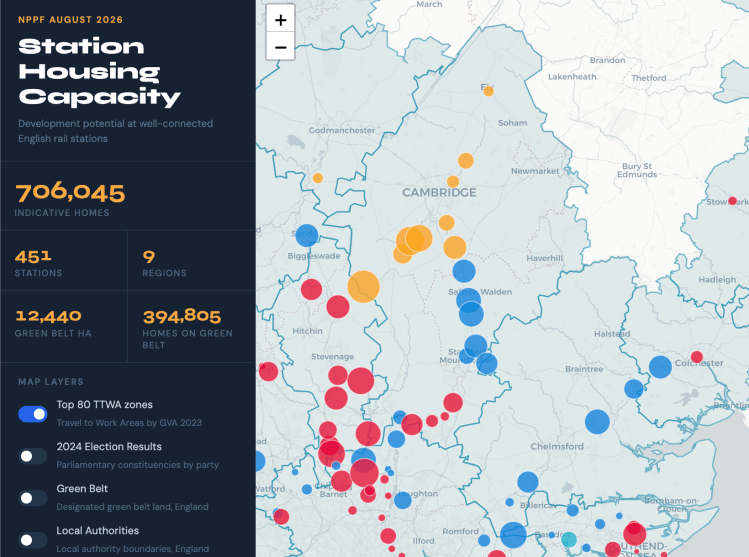
Above – Detail of Cambridge’s travel to work areas and the rural railway stations connected to key cities. By Russell Curtis at https://apps.curtography.uk/nppf2026/ – do have a browse
Foxton and Shepreth along with Ashwell & Morden stand out, but there’s no Dullingham or Kennett – the former identified in the Lichfields study for the Cambridge Biomedical Campus’s housing study of 2024
Given the remit of the Greater Cambridge Development Corporation, I don’t think it will be a free-for-all – not least because of the requirements on infrastructure funding that developers will have to contribute significantly towards. (See my earlier post here)
Mayoralties or Development Corporations – who will decide?
My hunch is that Cambridge is a special case due to ministers deciding on a centrally-led development corporation rather than a mayoral development corporation. It may well be that some of the new ‘combined/strategic authorities choose to establish mayoral development corporations for specific areas of comprehensive redevelopment or regeneration. It remains to be seen what the actual decision-making processes will be when it comes to making recommendations to the mayors. Will it be public hearings followed by written submissions with recommendations to mayors from officers? Or will the mayor decide similar to how planning committee chairs announce their committees’ decisions at public hearings? I imagine it would be the former. \
Growing campaigns against data centres
Given some of the horror stories coming out of the USA following the construction of new data centres, it’s no surprise that there is a growing backlash.
- Consumption of scarce water supplies for cooling data centres
- The urban heat island effect in an era of global warming and a climate emergency
- The massive amounts of electricity needed to power the centres
- The noise emitted from data centres
- Scepticism over whether such costs and damage are outweighed by the benefits of AI (noting AI has got its own huge issues on intellectual property and breach of copyright when it comes to training its systems – along with the controversial book pulping).
Given the amount of investment funds being thrown at what feels like another financial bubble, I’m surprised no one from the sector has made the case for recycling the heat generated from data centres for new district heating systems or for supplying other industries with the heat/hot water they need for their functions.
If data centres are to be built, the losses must be internalised and borne by the investors & developers, and the benefits must be shared much more equitably. And if that means fewer data centres get built, so be it. ‘Give me sparks on my apples, but leave me the birds and the bees’. The environmental and planetary cost isn’t worth it.
On the five points I listed above, ministers need to challenge industry to come up with solid responses and sustainable solutions to all of them. And then hold developers to new higher environmental standards. Because we found out the hard way over the summer what the consequences are when this does not happen.
If you are interested in the longer term future of Cambridge, and on what happens at the local democracy meetings where decisions are made, feel free to:
- Follow me on BSky
- Spot me on LinkedIn
- Like my Facebook page
- Consider a small donation to help fund my continued research and reporting on local democracy in and around Cambridge


