
This follows a consultation from ages ago (December 2025) which set out new standards to enable medium-high density developments to be built in places where sustainable rail transport links already exist
You can:
- Read the press release here
- Read the Government’s official response to the consultation
- Read the new National Planning Policy Framework which effectively sets the rules that developers must meet (alongside anything in local plans approved by ministers) in order to get planning permission
Also, I wrote about it here which listed 12 points in the consultation document
“Under the government’s new National Planning Policy Framework, there will be a default ‘yes’ for homes within reasonable walking distance of well-connected stations, alongside new minimum expectations for how much housing should be built in these areas. It will also prevent excessive gold-plating where there are clear national standards already in place.”
Above – Press Release Gov UK 17 August 2026
There are 155 pages of consultation responses in the official government response
Because longterm development planning is frighteningly complex by its nature. Bits that may interest you
- Chapter 5: Climate change (meeting the challenge of – and includes text on wildfires on pp36-38)
- Chapter 8: Ensuring the vitality of town centres (both old towns and new towns!)
- Chapter 10: Securing clean energy and water <<– This is really important for Cambridge & Cambridgeshire people, see Chapter 10 from p96 in the consultation response, and from p50 here in the new NPPF document.
- Chapter 13: Protecting the Green Belt
- Chapter 14: Achieving well-designed places <<– Will it stop bland box developments?
- Chapter 15: Promoting sustainable transport
- Chapter 16: Promoting healthy communities
- Chapter 17: Crime and pollution
- Chapter 20: The Historic Environment
Green Belt vs Grey Belt
There is a discussion on pp91-92 about the controversial ‘Grey Belt’ designations.
“In response to concerns about exemptions [to Green Belt protections], the government has made targeted amendments to policy GB7. These changes ensure:
- that nature recovery projects are clearly supported,
- clarify that existing allowances for mineral extraction include mineral
processing, and - confirm that necessary infrastructure in the Green Belt includes telecommunications alongside transport, water and electricity infrastructure.”
Which reminds me – have a look at the consultation on minerals and waste for Cambridgeshire and Peterborough.
Travel To Work Areas
Cambridge is long overdue a refresh of its ‘Travel-to-work area’ (unless I’ve missed the update). Cambridge University’s Department of Land Economy published a paper here back in 2016, with the most recent dataset on the Cambridgeshire & Peterborough Insight website dating from 2011, which is ages ago (and when Cambridge’s population was around 123,000, not the 150,000+ it is now. It also predates Cambridge North Station, Cambridge South Station, and the first Guided Busway! Oh – and 15 years of Tory austerity which crushed local bus funding) Cambridge Ahead had a look at mapping the time it takes for commuters using different forms of transport to get into Cambridge in 2024 here.
Rural stations serving the Cambridge Biomedical Campus?
I had a look at this over the past couple of years following the publication of the Lichfields study on housing needs for the CBC in 2024. Within it was a map identifying railway stations that had services into Cambridge – the ones south of the city centre all having services from those stations that stop at the new Cambridge South Station..
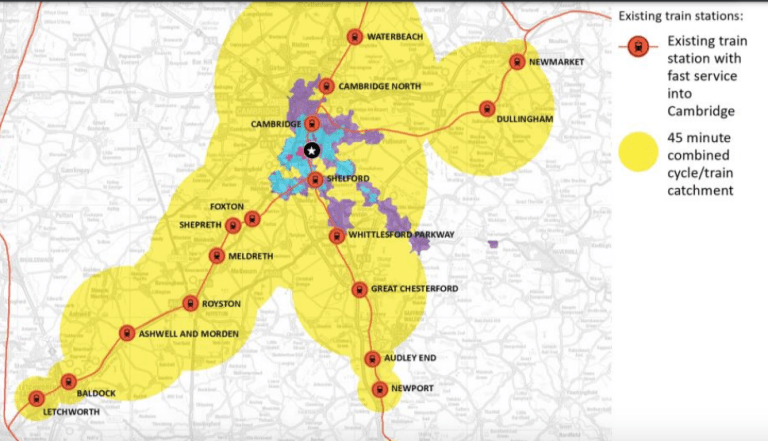
Above – CBC (2024) p26
I also noted the publication by Rail Future East (if you are a regular train passenger, do join them!) of the infrastructure upgrades that need to happen to improve services from north of Cambridge – for example the Newmarket Chord highlighted by the thin red line needs re-instating if services stopping at Soham are to serve Cambride South.

Above – from Rail Future East – noting that the call from Rail Future East for a new station at Cambridge East has since been incorporated into the Government’s plans, although we’re still awaiting news on how much of the Cambridge-Newmarket line will be dualled and upgraded
Local green space
Some of the questions seem loaded – even more so when you look at the responses to the contrary:
“Question 159: Do you agree that Local Green Space should be close to the
community it serves?”
“A total of 761 respondents answered Question 159. Of those, 56% strongly agreed, 24% partly agreed, 13% neither agreed nor disagreed, 4% partly disagreed and 4% strongly disagreed. This indicates strong support for the proposal.”
“I’m sorry but who are these…?!?!”
I have no idea, but 4% of 631 responses is more than 25 people – and those were just the ones motivated to respond to a government consultation!
Public campaign persuades Government to keep Sport England as a statutory consultee
“Having carefully considered the responses received and the strong opposition to removing Sport England’s statutory consultee status, the government has decided to retain Sport England as a statutory consultee.”
Over 34,000 people signed a petition opposing the move.
“Who supported it?”
“Support for removing Sport England’s statutory consultee status came mainly from developers, landowners, and a smaller group of planning professionals and LPAs.”
Which probably comes as a surprise to absolutely no one as these are the groups most likely to benefit financially from the removal of a potential objector to their developments.
Note both Sport England and for that matter Historic England (See Questions 17, 18, and 19) are having their rights to respond narrowed.
This is a really heavy set of documents on a difficult topic.
Furthermore I concur with Sir Patrick Geddes from over a century ago that adult education should incorporate citizenship and town planning to enable a critical mass of local residents in any given area to learn about the essentials of what is being proposed for their area *and the system that the changes will be brought in under* over an extended period of time. i.e. not a one-off workshop. That remains a future task for both the new unitary council and the development corporation.
If you are interested in the longer term future of Cambridge, and on what happens at the local democracy meetings where decisions are made, feel free to:
- Follow me on BSky
- Spot me on LinkedIn
- Like my Facebook page
- Consider a small donation to help fund my continued research and reporting on local democracy in and around Cambridge


