The announcement from the Prime Minister and the Housing Secretary enables the redevelopment of Hanover and Princess Court to go ahead with the new council housing as planned
(It’s worth noting that Cambridge City Council is a net contributor to HM Treasury on business rates to the tune of over £100million per year and the present system doesn’t seem to work for anyone, even the net recipient councils)
You can:
- Read the Government’s press release here (which confirms £96.4m to build 803 homes under their Social and Affordable Homes Programme (SAHP) 2026 to 2036)
- Read the Government’s policy paper here
- Read the quotations following the policy announcement
- Read Cambridge City Council’s announcement
‘Council wins close to £100m to build more than 1,400 council homes and unlocks £600m strategic investment in city housing’
Above – Cambridge City Council’s announcement
“Hang on! The Government says 803 homes, while the city council says more than 1,400 homes – who is right?”
On paper, the Government’s grant pays for 803 new homes. However, because Cambridge did not sell off all of its council housing when others did during Thatcher and Major’s era, the city council still owns a fair amount of land and property – much of which is low-to-medium density. As these homes come to the end of their lifespan and/or cease to meet regulations on housing, they eventually need replacing. Because of the way the state is structured, funding for new council housing is very hard to come by. Which is why the city council refused to sign up to George Osborne’s combined authority policy unless he handed over a big chunk of funding for housing. (I wrote about the mess back in 2016 on my old blog here when the proposal was for an East Anglian Combined Authority). And that wasn’t the only issue – recall this in the run-up to the mayoral elections.
Cambridge City Council negotiated a deal with the developers Hill to form the Cambridge Investment Partnership. In a nutshell the partnership comprehensively redevelops low density council housing sites where retrofitting is poor value for money, and replaces them with flats of medium-to-high densities that have a mix of council housing and private housing for market sale. This is what happened with the Fanshawe Road Redevelopment in Coleridge Ward.
It’s the council’s share of the receipts from the market sales that help finance the redevelopment of what in principle are a net increase in the number of council homes – significant given that the waiting list was just over 3,000 the last time I looked. (The problem is that such has been the state of the economy that completions have not kept up with demand/need which continues to rise).
“Why does wealthy Cambridge get to go first again?”
Cambridge may look wealthy from the tourist brochures and the college publicity, but in reality we are one of the most unequal cities in the country. Furthermore, the long term structures of local government in Cambridge imposed and maintained by successive governments prevents local councils from taxing that excess wealth and using the revenues to deal with poverty and economic deprivation. As a result we have some of the worst externalities associated with over-concentrated wealth. Phil Rodgers posted nearly a decade ago that In late December 2016 the affordability ratio for a lower-quartile house was nearly 20 times that of the lower quartile income figure.
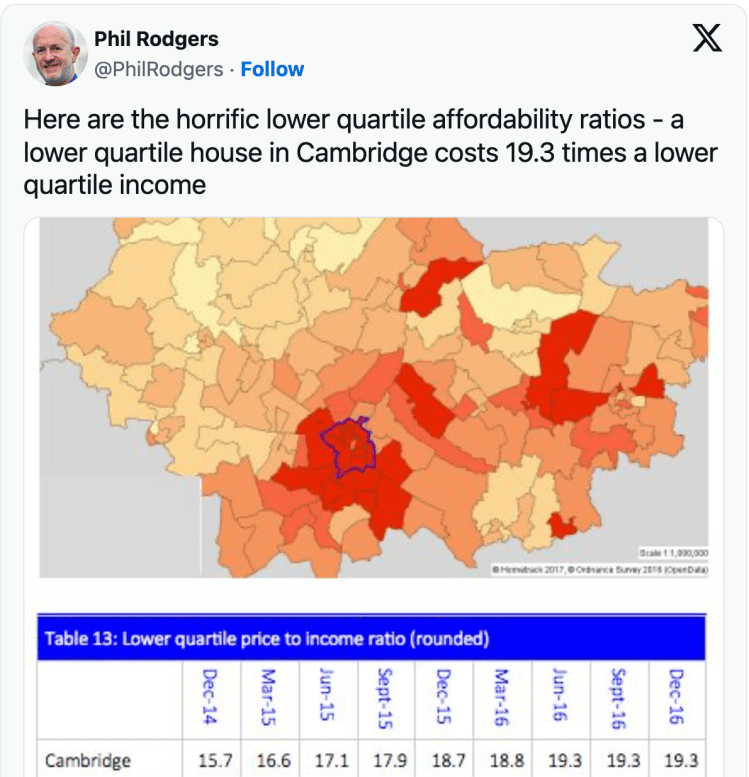
Above – Phil Rodgers in April 2017
Basically if you lined up the value of every single house from most to least expensive and picked out the one after the first 25% of the values starting from the lowest, you get something that is far out of reach of someone earning the 25%ile when incomes are lined up the same way – from lowest to highest. This is a big red flag on inequalities and shows that people who work in functions that are essential for cities to function are not able to live in that same city. Which is why the additional council/social homes are essential.
Hanover and Princess Court redevelopments to go ahead as planned
See https://hanoverandprincess.co.uk/ for the development’s website.
“Oh! This is the one you described as ‘Worse than Communism architecture!’
True dat!

Above – Guilty as charged. 16 June 2026. I’ve been moaning about such things for the best part of a decade – here back in March 2017 is another example with photographs of buildings I loath!


Above left – a propaganda poster from East Germany in the early 1980s, and above-right, a CGI from the developers of one of the proposed blocks
The concern earlier this year was whether the city council could afford to get the site redeveloped. I wrote briefly about the city council’s intent to apply for Homes England funding back in February.
Fast forward to July (last month at the time of posting) and concerns that planning permission had been granted without the guarantee of new social housing became a huge concern (and a party political issue) for local residents.
“Cambridge Investment Partnership (CIP), run by Cambridge City Council and developer the Hill Group, is carrying out the development and is applying for funding to build 72 council homes – but said there is no guarantee of success.”
Above – BBC Cambridgeshire 27 July 2026
Fortunately that success has now been confirmed with the Government’s announcements, and the funding to build those 72 council houses is now available.
Shovel-ready schemes – why Cambridge was selected
“The council has a number of shovel ready schemes, including Hanover and Princess Court which recently secured planning permission for redevelopment. This new funding will enable social and affordable homes to be included in the redevelopment scheme, with work expected to start early next year.”
Above – Cambridge City Council press release 25 August 2026
Ministers past and present have used this phrase when asking for councils and organisations to come forward with proposals that have pretty much everything in place except for the funding. Ministers like this because it increases the chance that some of the work might be completed while they are still in office mindful of the short career-expectancy of politicians in any given ministerial post. Recall Tony Blair used to have an ‘annual reshuffle’ which was great for political reporters but rubbish for almost everyone else due to the time it takes for ministers to become familiar with their portfolio.
With work expected to start in early 2027, expect a ministerial visit to the site not long after – eg when the demolition of the old blocks has been completed. It’s a textbook media photoshoot: Minister in hi-viz and hard hat standing next to a building site being interviewed on regional TV news or on one of the news channels.
The programme of the city council reinvesting rent receipts into new housing
It started off way back in 2012 when the Coalition Government offered councils the chance to become independent of central government. That involved taking on a share of the national housing debt held by central government. According to Cambridge City Council’s HRA Business Plan of 2012, this was around the £230million mark. (See p70 of this document)
Up until then, all the rents were collected and sent to central government for redistribution. Cambridge City Council was a net contributor with an estimated £12.9million shortfall between what it handed over to central government and what it received back to fund housing.
In return for taking on a share of the government’s debt, councils taking up the offer would be able to keep the rental receipts and use them to reinvest in their housing stock. At the time Cambridge City Council (then run by the LibDems).
The latest figures on all things housing revenue are from p187 of the Public Reports Pack for the council’s meeting on 26 February 2026 here. Note you’ll need to know the basics of accountancy to make sense of some of the figures.
Some of you may find the report from the previous year (February 2025) for the Housing Scrutiny Committee a little easier – have a look from p29 here. The background information from p15 is very useful and I might pick out a few things for a future blogpost.
The bit that I’m trying to work out is the connection to the following in the council’s press release:
“Winning the bid also unlocks a £584m funding package previously committed by the council to deliver a bigger programme of nearly 3,000 new homes by 2036, 1,400 of which will be new council homes with at least 60% of these at social rent”
That funding package would have been approved at the Budget earlier this year – see the minutes of the meeting of 26 February 2026 here.
If you are interested in the longer term future of Cambridge, and on what happens at the local democracy meetings where decisions are made, feel free to:
- Consider a small donation to help fund my continued research and reporting on local democracy in and around Cambridge
- Follow me on BSky
- Spot me on LinkedIn
- Like my Facebook page


