What national and local public policies miss on community development and tackling loneliness in society
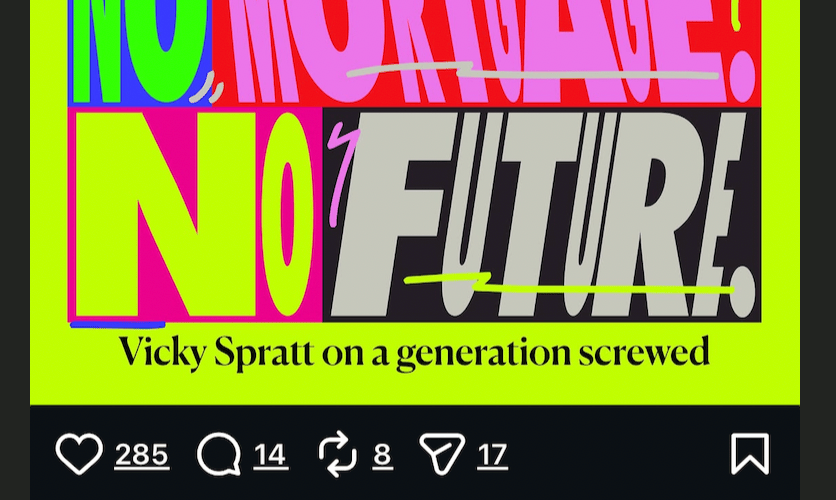
Image: Front page of The New Statesman by Kris Andrew Small for housing policy reporter Vicky Spratt in September’s edition – £read the latter’s article here.
The following sounds painfully familiar
“Go to university, get a job, buy a house, have a family – that was the New Labour teleology of higher education. But today, many young people are stuck partway through that progression. No longer pays what it once did, and – despite the rising price of obtaining one – neither does a degree”
The above was also similar in John Major’s Government as I remember it in South Cambridge in the mid-late 1990s.
One of the reasons why I keep coming back to the issue of loneliness in society is the number of people in my social media feeds of a similar age to me that are having similar experiences irrespective of income. Anecdotally neurodiversity is something that seems to be a common factor between us. In one sense it’s reassuring that it’s not an ‘only me’ problem. On the other hand, very few people go further and explore local social and political contexts.
Loneliness as a public health issue
“For example, social isolation is associated with increased risk of coronary heart disease, in part, because social isolation and feelings of loneliness can be a physical or psychosocial stressor resulting in behaviour that is damaging to health, such as smoking.”
Above – UKHSA 2015
While correlation isn’t causation, having a stent put into one of your arteries means you have coronary heart disease. Or rather that’s what one of the staff at Royal Papworth Hospital explained to me.
Stephen Fry on Loneliness – 2013
“And perhaps I am writing this for any of you out there who are lonely too. There’s not much we can do about it. I am luckier than many of you because I am lonely in a crowd of people who are mostly very nice to me and appear to be pleased to meet me. But I want you to know that you are not alone in your being alone.”
The first blogpost I wrote on loneliness was in response to Mr Fry’s post. It was just over a year after a mental health crisis that left me with CFS/ME, although it would be nearly a decade later before I got medically diagnosed at Addenbrooke’s. This was also a time when far less was known about neurodiversity than today – especially on ADHD in adults, or whatever you want to call AuDHD. What I find reading the blogpost over 13 years later is how little I knew about the underlying causes & roots of what I was describing. It shows how fast research in health – and neuroscience has been advancing.
“Social-policy-wise, I look at the rabbit hutches and the bland boxes going up all over Cambridge…and wonder how such communities living in some of them can ever be sustainable. How do you build a community…that can combat loneliness while allowing for a reasonable level of privacy?”
Several of the more recent articles on the theme of loneliness identified a number of themes which I narrowed down into the title of this blogpost:
- Proximity (geographical)
- Regularity (frequency)
- Affinity (things you have in common with another person/other people)
With the exception of the decade between when I left Cambridge in 1999 for university through to my final couple of years in the civil service, the house I live in today is the same one that I spent the first 20 years of my life in. 30-40 years ago, the number of people I was acquainted with within say a 15 minute walking distance (given the cities of that time frame!) was very large. Understandably so as I was a child who for primary school could walk to school, and in the late 20th Century the housing market was much more settled and localised. Today I hardly know anyone.
Proximity: I knew lots of people in a local geographical area. Regularity: I would see many of them every weekday at school. Affinity: Many of us were sharing the same life experiences (eg in the same institution – even the same classroom) at a similar age, doing similar activities and talking about them.
‘Why making friends as an adult is objectively harder’
“The difficulty you’re experiencing is not a character flaw. It’s an architectural problem. Adult life systematically removes the conditions that friendship requires and replaces them with competing demands”
“You’re not less likable or less interesting than you were at 16. The scaffolding that once held your social life together has been dismantled.”
Above – from a US-based article on ReachLink 02 June 2026
One of the things my generation never got to talk about was ‘The Great Scattering’
This was the then growing phenomenon of teenagers (in particular those that did well in their academic exams at school/college) leaving their home town and going off to university far away – removing the day-to-day contact they had with each other. With the rapid growth of domestic student numbers from the 1990s reflecting Government policy of the era, more people became familiar with the challenges of big life transitions that happened collectively in a very short period of time. What happens to your social life when it feels like you have lost ***everyone***? Hence this interesting piece by Dr Gillian Sandstrom of the University of Sussex from March 2026 that came a quarter of a century too late for me at the same institution!
“…loneliness signals that we’re hungry for social connection. If we find a way to fill that need, then loneliness will soon pass. However, if we don’t find a way to fill that need, then we can get sucked into a negative spiral and end up stuck in a vortex of chronic loneliness, which has serious consequences for not only our emotional well-being, but also our physical health.”
What Dr Sandstrom doesn’t address in her blogpost (but may well have done in other publications) is the impact that institutions can have – especially universities when it comes to loneliness. In particular the difficult issue of student accommodation which in the grand scheme of things has been exacerbated by broken higher education policies of successive governments.
The decision by the Coalition and Conservatives to remove the limits on university expansion created a double-crisis with universities in less affluent towns/cities facing a drop in demand and risking financial implosion, while the ones at the opposite end, the Russell Group, Oxford and Cambridge, expanded at a rate that made existing housing crises even worse. Brighton was another such place where students and people on very low incomes compete for poor quality housing in the face of a lack of purpose-built student accommodation near places of study and the chronic lack of council houses.
Inevitably some places end up in situations where they have very high levels of population turnover.
When I look around I see so many symptoms of inequalities in our city, one that reflects a very extractive nature of property ownership as well. Homes where childhood friends of siblings once resided are now AirBnB properties or cheap conversions for student accommodation – whether university students or targeting international students or migrant workers. The latter are inevitably more vulnerable to exploitation in an era where local government has neither the powers nor resources to carry out enforcement functions, and the courts system does not have the capacity to process the cases in sufficient time.
While I don’t agree with those that turn towards the likes of TeamNigel and beyond at election time in the hope that things might change, I can understand why someone not obsessed with politics but who has found their home for many decades has changed with few familiar faces around. And what they get from both local and national politicians are explanations rather than specific solutions to their issues – such as not being able to get a doctor’s appointment or not being able to register with an NHS dentist. (All the while seeing more and more new homes being built without the infrastructure needed to support them). This was picked up by Darren Rodwell, former leader of Barking and Dagenham in London.
“They may see millions being spent on regeneration while the local high street, GP surgery or community centre still feels forgotten.”
Above – Darren Rodwell, former leader of Barking and Dagenham in London
Add to that ever-declining mobility because for example cuts to bus routes, withdrawal of specialist bus services and the closure of day centres in the face of 15 years of austerity in local government and the picture for older people feels even worse.
“Age UK reminds us that one million older people in the UK can go for a whole month without speaking to a friend, neighbour or family member.”
Above – UKHSA 08 December 2015
So where do politicians, policy makers and, well anyone who wants to make a difference, begin?
Rebuilding Trust
“…after many years working in regeneration, local government and communities, I have become increasingly convinced there is another piece of infrastructure we urgently need to rebuild alongside them, and that infrastructure is ***trust***.
Above – Darren Rodwell, former leader of Barking and Dagenham in London
How do you rebuild trust in local communities when you have such broken patterns of housing ownership that generate high population turnover? (Eg absentee landlords, rents out of proportion to wages, housing supply reduced due to the AirBnB/short-term-let phenomenon to name but a few).
Housing policy is one of the most difficult of public policy areas – as I found out the hard way in my civil service days. Not least because Margaret Thatcher’s Government effectively removed the ability of the state to build homes without being dependent on the private sector. Hence successive governments have been at the mercy of the oligopoly as TV’s Kevin McCloud explained in this piece. With a small number of volume builders building identikit developments at scale, their choice on when and where to build and at what rates ultimately will decide whether the Government meets its housing targets. And they have a huge financial incentive to slow-drip release new homes in order to keep prices artificially high. The barriers to entry into the industry are huge making it hard for new entrants to come in.
A growing Cambridge – who benefits?
What Mr Rodwell stated in his post quoted below in part explains why I have spent almost a decade calling for new large sub-regional-size facilities and amenities that Cambridge does not have but will almost certainly need given the ambitions of governments past and present over the past decade.
“You should be able to take a major regeneration scheme, an inward investment opportunity or a new development and follow a thread all the way back to the resident.
- What does this mean for them?
- What opportunity does it create?
- How does their family benefit?
“If we cannot answer those questions, then we should not be surprised when people become disconnected from regeneration.”
Above – Darren Rodwell, former leader of Barking and Dagenham in London
Cambridge University’s community outreach
Keep an eye on this workstream from the University of Cambridge which I’m a paid participant in. With the University being in the national news on a number of issues, the next couple of months will be an acid test (or a series of) for the institution and in particular its leadership.
What I want to see the University of Cambridge doing as far as the growth of the city is concerned, is to address the issues Mr Rodwell raised in his post given his experience as a former council leader in one of the most challenging local council areas in the country (in 2025 it had the fifth highest level of income deprivation for local authorities in England). What positive direct impacts will the developments and continued growth have on the challenges and issues that local residents face? Because if the negative impacts outweigh the positives, you can understand why they might be hostile.
If you are interested in the longer term future of Cambridge, and on what happens at the local democracy meetings where decisions are made, feel free to:
- Follow me on BSky
- Spot me on LinkedIn
- Like my Facebook page
- Consider a small donation to help fund my continued research and reporting on local democracy in and around Cambridge


