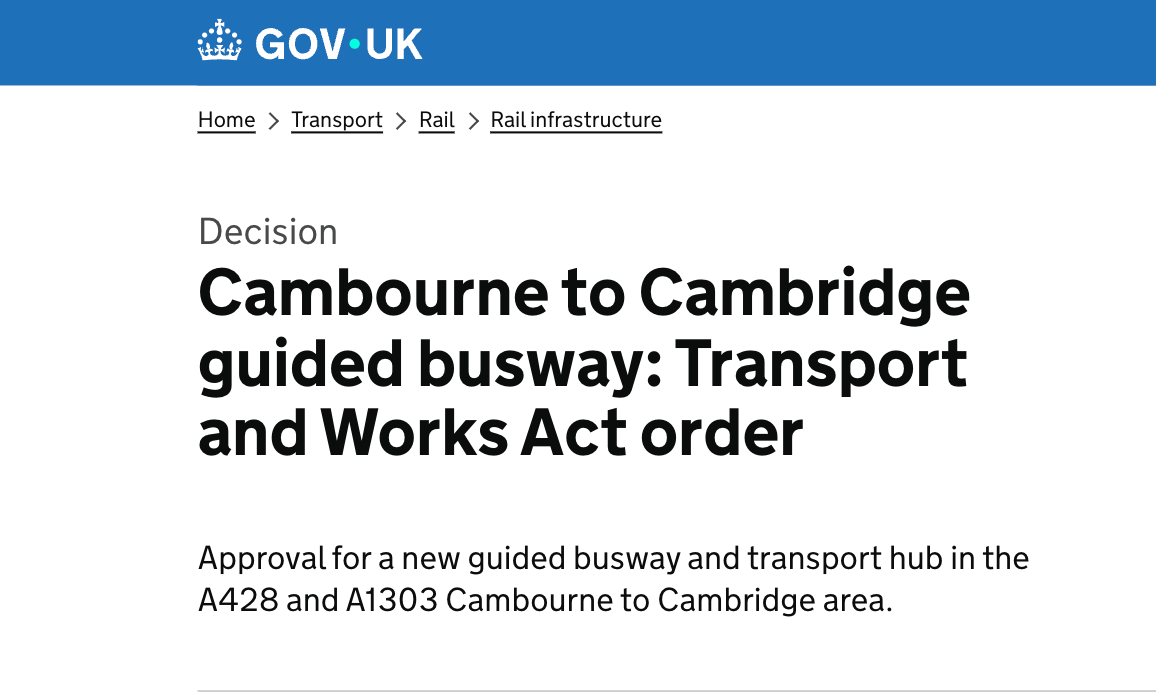
Yet even if Lord Hendy had declined the advice from the two transport inspectors and refused the application, I would have come to the same conclusion
The systems of public consultation are broken – Cabinet Office
It comes as no surprised that the First Secretary of State at the Cabinet Office, Louise Haigh has come to the conclusion that too much public consultation is just box-ticking. Hence the press release from Cabinet Office here.
It should not have taken over ten years to get from the early public meetings of ‘The City Deal Board’ to submitting an application for ministerial approval of the main transport infrastructure project.
But it did. And that alone reflects the complete failure of the Greater Cambridge Partnership *as a concept*. And the responsibility for that ultimately rests with ministers in the Coalition – primarily the Conservatives because they refused to accept the proposals for a Cambridge Unitary Council from the Liberal Democrats (who until 2014 were in political control of Cambridge City Council) that might have been able to have decided things locally.
“What was the benefit for the Liberal Democrats in getting the City Deal signed off in 2014?”
You can read the press releases of the era here. Ultimately there was a lot of party politics in the decision – not least the impact of TeamNigel under the U K I P brand that won 12 seats on Cambridgeshire County Council back in the 2013 county council elections.

Above – BBC Look East of 21 May 2013, and a much-younger-looking me appears on the telly with Castle Mound on Castle Hill in the background
I wrote about the county elections that year – one which saw the Conservatives lead a minority council with control and supply votes from UKIP conditional on minimal council tax rises.
The lack of a clear, high profile party political champion for the busway made it harder for the public to identify who was responsible for what.
The intellectual champion was transport engineer Bob Menzies, who was one of the senior transport officers at Cambridgeshire County Council. Note this article is not going to be a hatchet job on individual officers or politicians. This was a structural failure with its roots in Whitehall.
““This is twice as long and half the cost of the Nottingham tramway and gives a flexibility you can’t get with trams” Bob Menzies, Head of Delivery, Cambridgeshire County Council”
Above – Bob Menzies quoted circa 2010 in an article by Mark Mulian for an unnamed trade mazagine commenting on the first busway between Cambridge-St Ives
The first guided busway was consistently opposed by the CAST IRON group which favoured a rail-based option. Their website is still up at https://www.castiron.org.uk/
I cannot recall at any point over the past decade-and-a-half any senior local politician on a public platform declaring their rock-solid support for the Cambourne-to-Cambridge busway
And ditto that of their political party. As a result there was never any sense that anyone had an election-winning mandate for it.
The first clear objections to the busway proposals were heard at one of the earliest City Deal Board Meetings on 03 November 2015
Such was the interest that it took Cllr Lewis Herbert an hour to get through the public questions tabled for that meeting. I turned up and filmed the meeting for reasons that probably need a separate blog entirely! You can watch the full video of the public questions here.
My point here is that residents in West Cambridge and Coton spent ***nearly twelve years*** engaging with the processes to make their opposition clear – as well as pointing to possible alternatives. That point alone deserves a post-closure evaluation and an explanation from the Ministry of Housing, Communities and Local Government / Department for Transport as to why this happened. And if central government won’t do that, then the relevant select committees of Parliament should do it for them and summon the relevant individuals and come to their own conclusions.
What concerns me is that as far as the residents are concerned, democratic processes failed.
Here’s where the party politics are very messy – and no one benefited from this
At the ballot box the voters ejected the Conservatives who held the majority of board seats on the City Deal, then GCP Board between 2014-2018. My point is that the progress of the Cambourne-to-Cambridge busway could not have progressed *without* the votes of the Conservative Party representatives on the GCP Board. In 2018, to the surprise of many outside the Liberal Democrats, South Cambridgeshire District Council elected the Liberal Democrats with a landslide in 2018, and followed that up with even greater majorities in 2022 and in 2026 – leaving the Conservatives with just two councillors.
By 2021 the Conservatives had lost Political control of both South Cambridgeshire District Council *and* Cambridgeshire County Council. Furthermore, and to some surprise they also lost control of the new Combined Authority mayoralty to Dr Nik Johnson of Labour. But when it appeared that Labour were supportive of the busway the electorate switched back to a Conservative candidate, backing Paul Bristow with his manifesto pledge for a light rail for Cambridge. Yet despite his best efforts, the Planning Inspectors dismissed his arguments and recommended approval.
“Did anyone tell the City Deal / GCP that the structures were not working?”
Yes – me! And Heidi Allen MP who had recently been elected in the general election six months earlier in the General Election of 2015. Here’s my public question at the City Deal Board of 03 December 2015 at The Guildhall in Cambridge to one of my then local councillors, Cllr Lewis Herbert (Labour – Coleridge), who at the time was also the leader of Cambridge City Council. He had been elected chair of the board by his Conservative counterparts. I was followed by Edward Leigh here.
A year later, Heidi Allen MP turned up to a City Deal Board Meeting on 13 October 2016 at the now Old Shire Hall on Castle Hill, which at the time was the HQ of Cambridgeshire County Council. Again, I filmed it.
Above – Heidi Allen MP (2015-19) – speech to the Cambridge City Deal Board, 16 October 2016 at Shire Hall, Cambridge. Filmed by Antony Carpen for the Federation of Cambridge Residents Associations
By that time as mentioned above, I received sponsorship from the Federation of Cambridge Residents Associations to film the City Deal/GCP meetings and publish them online to enable local residents unable to get to the meetings to scrutinise who said what. This was in the days before councils installed professional AV/live streaming equipment due to the impact of the lockdowns and restrictions of the pandemic. (Which reminds me – need to get vaccinated again).
There were public protests in the mid-2010s and cross-party opposition to the busway proposals as I filmed here in December 2016
Above – Julius Carrington (then a Conservative campaigner), Cllr Bridget Smith (then Leader of the opposition on South Cambridgeshire District Council for the LibDems), and Stuart Tuckwood, (then a campaigner for the Green Party)
I see the above as an important piece of contemporary history for future generations to look at. I don’t know what Messrs Carrington and Tuckwood are doing now – they may have long-since left political campaigning.
While Cllr Bridget Smith is still a councillor and from 2018 has been the leader of South Cambridgeshire District Council, the progress or otherwise of the Cambourne-to-Cambridge busway did not rest on her shoulders. That said, it’s a perfectly valid question to ask why she changed her mind, and what evidence did she have to justify her change (and her party’s change) in policy? Anyone who wants to do this can table public questions to South Cambridgeshire District Council at their future meetings (see their calendar here) either for the Cabinet on 29 September or 08 October 2026. (A similar question can be put to Conservative councillors as to why they went from supporting the busways project and voting for them between 2014-21, to opposing it. Note it could be as simple as realising the voters had voted them out and they had to change policies if they wanted to get elected again!) Around the same time I also asked the then Leader of the Opposition at Shire Hall, Cllr Lucy Nethsingha about the busways at another protest march.
Above – the same question can be put to Cllr Lucy Nethsingha, (then Leader of the Opposition on Cambridgeshire County Council in 2016 who then became leader of the county council from 2021), as to Cllr Bridget Smith. Why did her party change policies and what evidence does she have to explain the change of policy towards the busway?
(The prominent Cambridge Liberal John Maynard Keynes is often attributed with the quotation: “‘When the facts change, I change my mind. What do you do, sir?’“)
Note that between 2021-25, the Joint Administration that governed Cambridgeshire County Council which kept the Conservatives out of office since the late 1990s, elected Cllr Elisa Meschini as the County Council’s GCP Board Representative. In that period that gave a nominal Labour Majority of 2-1 to the LibDems, but GCP Board decisions in the 2020s were almost always unanimous.
Public opposition to the busway

I even filmed a couple of time-lapses, such as the one below in September 2017.
Above – Save the Westfields protest 2017
There were multiple alternatives put forward by grassroots activists…
These included but were not limited to:
- Cambridge Connect Light Rail which became prominent locally following Dr Colin Harris’s presentation to the Rebooting the City Deal event at Lee Hall, Wolfson College, Cambridge in October 2016 (you can watch the presentation here)
- Smarter Cambridge Transport which between the mid-2010s to early 2020s put in a huge amount of work and research including from people qualified in a number of fields, only to be ignored by the GCP. Hence their final blogpost in December 2021 here.
- Rail Haverhill – which commissioned a consultant to write a report making the case for re-opening the line, only to see it dismissed out of hand by the GCP. (The GCP were rightly slammed by Rail Future East on this).
The challenge that they all faced was that The State imposed too great barriers for ideas on busway alternatives from grassroots campaigners to be adopted.
The problem was that The State said that alternatives needed to have feasibility studies undertaken before they could be properly examined by public bodies. Yet when we asked on multiple occasions for assistance in those feasibility studies, or campaigned to have the feasibility studies undertaken by the GCP, we were thrown back – and on multiple occasions. Such as in the final case on Cambridge Haverhill vs CSET when I tabled a question on behalf of Rail Future. At which point I stopped taking notice of the GCP.
“Didn’t CamCycle have some successes with the Chisholm Trail?”
While CamCycle was broadly successful in what it lobbied for – and actually provided the Greater Cambridge Partnership with some of its successes such as the Abbey-Chesterton bridge for the Chisholm Trail, and a number of their greenway cycleways, CamCycle were able to provide the sort of expertise and analysis that the GCP and county council did not have enough of in-house. In that regard, the work that CamCycle did on smaller / less expensive infrastructure improvements was a bonus to the GCP members.
That said, it should not have needed the existence of the GCP to have gotten the cycleways built in the first place. The reasons behind it were in part ideological and in part electoral. One persistent complaint from Cambridge politicians on transport infrastructure was that Conservative councillors on the county council never prioritised road repairs and transport infrastructure works in Cambridge – just ask Cherry Hinton residents about the ‘Church End’ rat run. It was ever so frustrating for ward councillors who found themselves facing angry residents at local area committee meetings with no powers to deal with the problems. The county council elections of 2021 showed how extreme the polarisation was between the county divisions in and around Cambridge, and those to the north and west of the county.
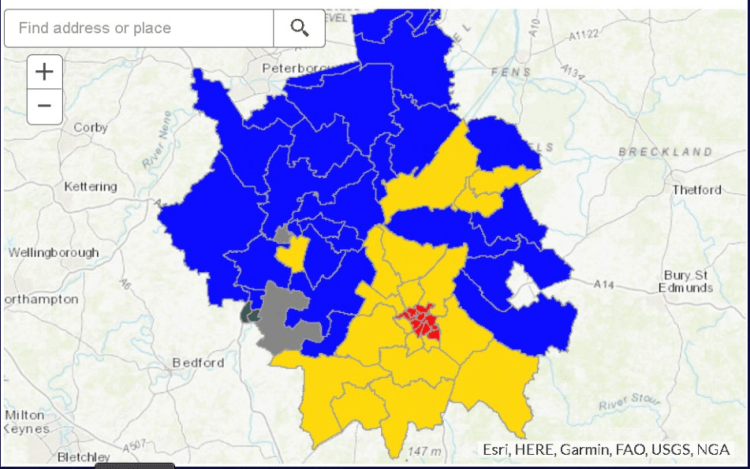
Above – the Cambridgeshire County Council election results of May 2021 which caused a political earthquake in Cambridgeshire, and paved the way for the implosion of the county party at the general election in 2024 where it collapsed from seven MPs to two.
Had the Greater Cambridge Partnership done even the most cursory of desktop historical studies they might have avoided the debacle of the congestion charge revolt
But again they doubled down – first here in September 2016 when I asked them about whether they had been through the archives that at the time were on the floor below the meeting room we were in, and then in further public questions where the then Director of Public Transport confirmed they had done no historical analysis.
It later turned out that the county council had commissioned a very expensive survey to find out the public’s disposition towards traffic congestion and congestion charging in the late 2000s. (See the second half of my blogpost here). A generation before, the Cambridge Evening News had done a similar survey about traffic and light rail published in 1990.

The following year the County Council’s own attitude survey showed support for light rail.

Above – from Cambridge Weekly News 07 Feb 1991 in the British Newspaper Archive
One big structural problem has been the inability for local and regional tiers of government to raise revenues independently of central government to pay for mode-shiftinga municipal public transport infrastructure
Ironically the changes that Prime Minister Andy Burnham is bringing in for what are effectively ‘sub-regional mayors’ – too small for regions, too large for counties, does not apply to Cambridge in the context of the Greater Cambridge Development Corporation. One of the consistent themes from all the local political parties at The Guildhall is the removal of significant planning powers from councils and concentrating them in a centrally-led development corporation. At the same time, neither Labour nor Liberal Democrats would have been content with a Mayoral-led development corporation under a Conservative Mayor. Which is another reflection of the broken institutional governance structures.
“So…what are we left with?”
A sense that the institutions were on a sort of ‘autopilot’ to get the busways done. While it might be convenient to blame individual transport officers (and that temptation is very strong on my part), there were too many individuals and institutions in the mix for any one person in any one role to have had that much power or influence to impose their will. Certainly there was not enough for any of the elected politicians to stand up and take ownership of it in the longer term – although I can understand the pressure faced by the more recent GCP Board Members just to get the damn thing done, saying that it’s either the busway or nothing.
Cambourne to Cambridge busway and the large Bourn Airfield development
One thing that may have concentrated minds was the planning condition on Bourn Airfield which was approved in July 2024 – 3,500 homes and then some. As reported by BBC Cambridgeshire, one of the planning conditions was that they could only build up to 500 homes on the site until the busway or equivalent was completed. Not approving the busway under the 2018 plan would immediately have triggered developers’ challenges to the existing local plan on a lack of housing supply which they probably would have won, and it would have resulted in a bonanza of unsustainable planning applications being rubber-stamped by planning inspectors.
The Greater Cambridge Development Corporation’s inheritance
Mindful that there’s another busway public inquiry coming up – this time on my side of the city!
Above – CSET linking Addenbrooke’s to the A11 which I wrote about the document release here
Having been through the experiences of the last 10-15 years, I can more than understand why residents might be reluctant to engage with any future consultations. It is much, much harder to re-engage the general public after they have had a negative experience over such an extensive period of time. And if trust is to be regained, it won’t be overnight – and the process will be hard going for all. Even more so given the climate emergency that is very much here.
One of the things that local public service institutions would do well to get a grip of are those issues that are regularly brought up by the general public in opposition to new housing developments which are outside of the planning remit, and take them head on.
- New GP surgeries and health clinics
- New dental clinics
- The existing shortage of secondary school places and underfunding of schools
- Potholes
- Water – supplies and sewage capacity
On community engagement I would recommend all those involved have comprehensive and meaningful responses prepared for each issue including:
- Who makes the decisions on locating new GP surgeries, health clinics, and dental clinics
- Who makes the decisions on employing GPs, dentists, and healthcare professions
- Where the funding is coming from and who signs it off
- Information and diagrams showing that decision-making is co-ordinated and connected and that procedures are in place for escalation when things go wrong (because they will) – all the way up to ministerial level if necessary
- Suggested actions that the public can undertake to get any additional funding needed – including passing on the office contact details of Members of Parliament
- The ministers/department of state where the buck stops
On water – one place to start looking is…
Over to you.
If you are interested in the longer term future of Cambridge, and on what happens at the local democracy meetings where decisions are made, feel free to:
- Follow me on BSky
- Spot me on LinkedIn
- Like my Facebook page
- Consider a small donation to help fund my continued research and reporting on local democracy in and around Cambridge


