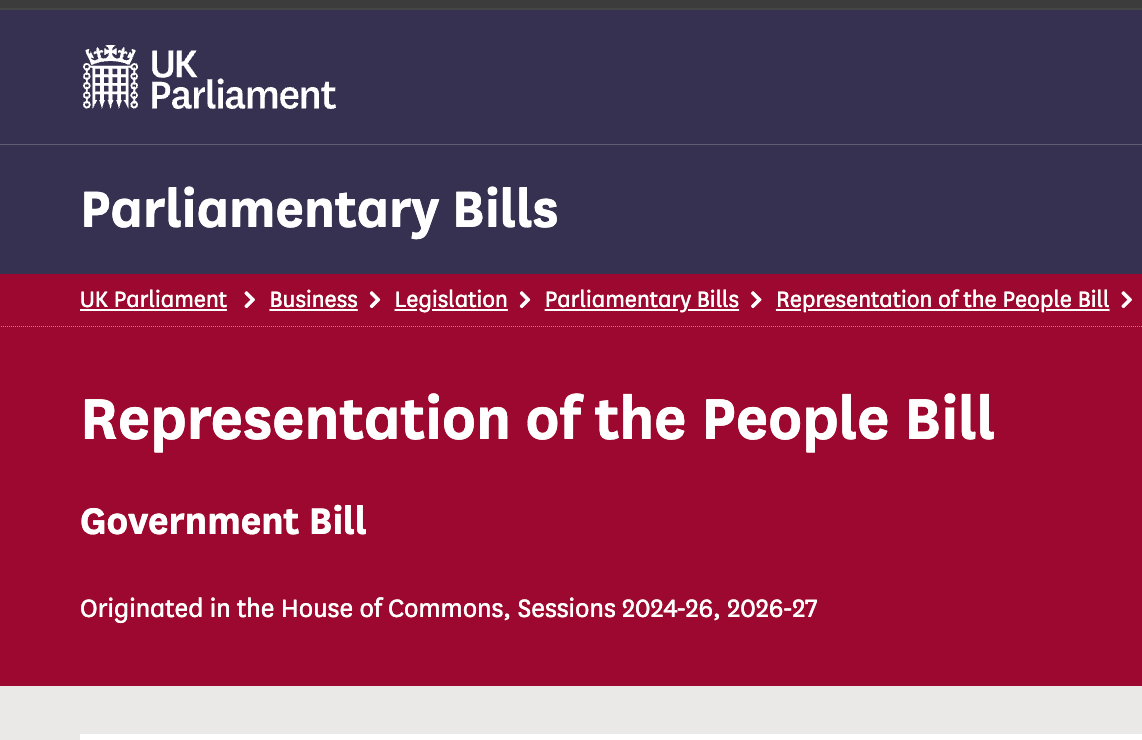
Peers spent several hours debating the legislation that had passed its Commons stages before voting it through to the next stage
You can:
- Watch the debates here
- Browse through the (uncorrected) transcript here
- Browse through the draft legislation, explanatory notes and bill documents here
- Browse through the Rycroft Review which several peers mentioned in their speeches
There’s ***lots*** I could say about this but instead I’ll highlight some of the speeches I picked out.
Ones that stood out included:
- Former PM Theresa May, followed by Margaret Hodge, the former Chair of the Public Accounts Committee – both now baronesses in the Lords. (The latter mentioned the concept of ‘access capitalism’ (AKA corruption)).
- Lord (Jeffrey) Rooker supporting Votes at 16 and the improvements in political awareness of teenagers today vs my generation in the 1990s.
- Natalie Bennett – former leader of the Green Party on the steer the country is now giving on capping donations
- Carmen Smith – the youngest life peer representing Plaid Cymru on Votes at 16 and on online abuse, with women disproportionately affected.
- Lord (Simon) Russell – Great Grandson of Stanley Baldwin, and historian – pulling up several Conservative peers over their recollections of historical events(!)
- Viscount Stansgate (Stephen, eldest son of the late Tony Benn) on the ‘race to the [ethical] bottom with financial donations
- Mark Pack – President of the Liberal Democrats (and one of the slightly younger peers)
- Baroness Nicky Morgan – former Conservative Cabinet Minister now non-affiliated (due to her appointment as chair of the ASA – a regulator) speaking on online abuse, crypto-donations, and votes at 16.
“”We as adults have made such a mess of the world they will inherit that the sooner [teenagers] have skin in the game, the better. Especially on Climate Change.”
Lord Russell (Cross Bencher)”
He also mentioned the concept of ‘power without responsibility’ when Stanley Baldwin had to face down two Tory-supporting press barons (of the Daily Mail and Daily Express newspapers in the 1930s), who but for their huge influence would have gotten thrown out of their party for supporting an opposition candidate (their own!) in a by-election in order to change government policy.
“The newspapers attacking me are not newspapers in the ordinary sense. They are engines of propaganda for the constantly changing policies, desires, personal vices, personal likes and dislikes of the two men. What are their methods? Their methods are direct false- hoods misrepresentation, half-truths, the alteration of the speaker’s meaning by publishing a sentence apart from the context…What the proprietorship of these papers is aiming at is power, and power without responsibility – the prerogative of the harlot throughout the ages.“
Above – Stanley Baldwin’s speech of 17 March 1931 quoted here
On democracy education – civics and citizenship studies
I’ve written ***lots*** about this and there’s a gap on what was said on applying the welcome improvements for schools to lifelong learning. Several referred to the Schools APPG Report titled:
See also the summary by the Association for Citizenship Teaching here.
The minister said as follows on democracy education
“We want to break down barriers and drive participation. We know that education and engagement are a crucial part of implementing this policy. It is vital that young people understand and value democratic processes and feel they are relevant to them. We want to ensure that democracy education reinforces the importance and value of participating and inspires greater democratic engagement, and we want that to start at 16 and continue into adulthood.
“We are working with the Electoral Commission, the devolved Governments and civil society to consider what additional measures we can take to support schools, colleges and youth groups to roll out practical voter and civic education, and our colleagues in the Department for Education are looking at this in terms of curriculum.”
Above – Baroness Taylor of Stevenage, Lords Minister at the Ministry of Housing, Communities & Local Government
What are the proposals to continue this into adulthood?
Moving from mass membership subscriptions funding political parties to large donations from a very small number of people
“We are moving rapidly from a broad-based, democratic system of financing parties to one of unprecedented sums coming from a tiny number of people.”
Above – Mark Pack to House of Lords, 14 Sept 2026
Questions from the former Culture Secretary Baroness Nicky Morgan
You can listen to her questions here:
- Developing and testing future regulatory systems on crypto and similar
- Resources to the Electoral Commission
- Requirements for both Houses of Parliament to vote on any future actions on lifting prohibitions re donations
Her wider remarks are also worth listening to.
Baroness Carmen Smith asks why there’s nothing in the bill to deal with online abuse
“Can the minister explain why no provisions have been included to respond to online abuse?”
This was followed up by Baroness Leaman for the Liberal Democrats. She’s a former chief of staff to both Jo Swinson and Sir Ed Davey.
“The scale of the barriers facing disabled candidates was underlined again this morning when the Electoral Commission published its review of May’s mayoral and local elections and found abuse of candidates rising sharply. Some 40% of those who stood reported harassment, intimidation or threats—up from 34% last year—while disabled candidates were hit hardest of all, with almost half reporting personal abuse. A third of all candidates said it made them consider not standing again. The barrier to standing is not only financial; a second, uglier obstacle sits behind it, falling disproportionately on the people an access to elected office fund would bring in.”
Above – Baroness Leaman to the House of Lords 14 Sept 2026
“As the Electoral Commission’s recent report states, the rising abuse and intimidation of electoral candidates is changing politics. This must not be normalised and requires a change of culture.”
Above – Baroness Royall, former Leader of the Lords for Labour
“What did the minister say?”
Have a listen here or have a browse of the final long speech in the Hansard transcript.
That said…
“I will seek to respond to the main points raised in the debate. Where I am not able to cover every contribution in detail, I will of course write to noble Lords. It has been a long debate and I am pretty sure I will not get to everything.”
Above – Baroness Taylor of Stevenage, Lords Minister at the Ministry of Housing, Communities & Local Government
The acid test will be the group of amendments that the Government will table at the next stage – Committee Stage (and report stage after it!)
I’ve pulled out a few quotations from the uncorrected transcript of the Minister’s winding up speech
“What is a ‘Task and Finish’ team?”
Looks like we’re getting one for democracy.
“We are establishing a cross-government task and finish team to consider threats to UK democracy, including political funding, illegitimate influence and broader threats to political equality. I have heard all the points raised in the Chamber, and I will take those back for consideration.”
On spending limits, July 2027 seems like ages away
“The Secretary of State and the First Secretary State have asked the Electoral Commission to undertake a review on lowering registered political-party, third-party campaigner and candidate limits to ensure the entire electoral spending framework is scrutinised and fit for purpose. In terms of timing for that, the commission has been asked to provide recommendations no later than July 2027.”
“Anything on disinformation?”
“There were some questions around AI-generated misinformation and disinformation. Illegal AI-generated content is already regulated under the Online Safety Act, as I said. A range of legislative offences apply to deepfakes and misinformation and disinformation in this context, including the false communications offence, which makes it illegal to knowingly spread false information with intent to cause non-trivial psychological or physical harm.”
I wouldn’t be surprised if something more substantial came up.
No change in the voting system in this legislation
“The last thing I will have time to cover is the national commission on electoral reform, which a number of noble Lords asked about. I understand the push for that. The Government’s priority is a politics that works for all people. The Prime Minister has been clear on his commitment to bring about a new voting system and he welcomes a national debate about this. But this Bill is not the place to legislate for that debate.”
Committee stage in the Lords for the legislation will commence after party conference season – starting with the LibDems on 19 September and finishing on 07 October with the Conservatives.
If you are interested in the longer term future of Cambridge, and on what happens at the local democracy meetings where decisions are made, feel free to:
- Follow me on BSky
- Spot me on LinkedIn
- Like my Facebook page
- Consider a small donation to help fund my continued research and reporting on local democracy in and around Cambridge

