Isn’t that marvellous!?!
“What is cultural infrastructure? Sounds very woke to me! Could be suspicious!”
It isn’t. The strategy itself is in the documents library for the current consultation – scroll down to the Wellbeing and Social Inclusion sub-heading which also contains a number of reports you may have missed.
At the end of the document is an appendix (section 8) which separates and summarises things nicely:
- Cultural Performance – think concert hall
- Cultural Presentation – think art gallery
- Cultural Production, Learning & Community Creativity – think maker spaces or workshops with manual tools [as opposed to office-based online ‘toolkits’] and things, where people make stuff
- Placemaking – think parks and green spaces where outdoor events can be organised
- Positioning Across the Cultural Ecosystem – this can include supply chains that go towards supporting (and being supported by) an anchor institution, through to genuine arts/cultural quarters.
On those last two, these are ***very difficult to create top-down***
Not least because all too often they become the victims of their own success, with the very people who both created and are needed to sustain them being priced out by wealthier people moving into the ‘fashionable area’. Social history is littered with examples, and so long as local government has no power to safeguard cheap and affordable spaces both for production and for people to live in, we’ll go on repeating ourselves.
The big asks – or rather ‘requirements’
Given the inability and/or reluctance of the private sector and the University of Cambridge to build the cultural, arts, sports and leisure infrastructure in previous rounds of otherwise lucrative development (See the conclusion of former Astra Zeneca executive Dr Andy Williams several years ago to a community forum meeting in Queen Edith’s ward), we are now at the stage where these are now required before the new housing is complete.
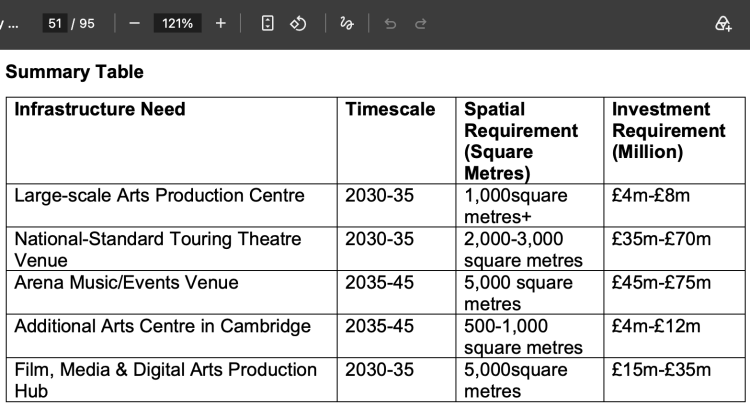
Above – GCCIS-2 p51 – which summarises the big stuff that we need given the proposed growth in the draft Greater Cambridge Local Plan 2024-45
We have got to get the urban design right on this – because we haven’t done so for places like North West Cambridge or the new towns such as Northstowe and Cambourne.
The report states:
“[Cambridge needs] A large-scale arena capable of hosting major music, events and
conferences…. The Cultural Infrastructure Strategy identifies a regional gap in arena-scale provision, particularly following the closure of the East of England Arena. The nearest comparable facility is Marshall Arena. [in Milton Keynes]”
Above – GCCIS-2 p48
“What does the Marshall Arena look like in terms of urban design?”
Built for the last millennium – but that’s not the fault of the local residents who in the grand scheme of things deserve so much better. But remember this was designed and built in and for a previous age.
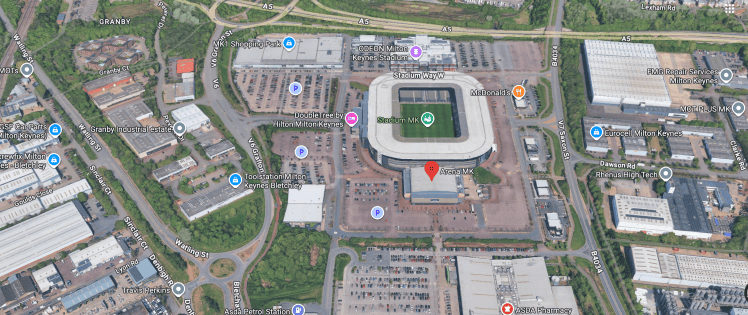
Above – Arena MK built next to the home ground of MKDons in the middle of an industrial estate with swathes of car park and no nearby railway station or light rail stops
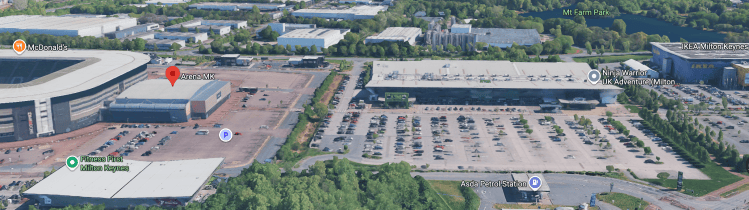
Above – All I can hear is comedian Tom Allen’s voice saying ***Oh it’s horrible! Take it away! Get it out of my sight!*** Or words to similar effect.
“From the first days of Milton Keynes as a new town, designated in 1967, the Milton Keynes Development Corporation (1967–1992) envisaged a stadium capable of accommodating a top-flight football team”
Above – from Stadium MK’s wiki page
This cited the original plan for Milton Keynes:
“Proposals for sport and physical recreation include… …iv) A major indoor recreation centre at the new city centre possibly klinked to a stadium for football and other major sports.”
Above – The Plan for Milton Keynes (the 1970 version in Routledge’s version 2014) p103 / p115
Being designed for the motor car in an oil age, the access to the A5 and other major roads contrasts with the nearest railway station along a single track at Fenny Stratford, or failing that, Bletchley.
Which is why a growing Cambridge has to do better – and which is also why a light rail-based metro is ever so important as part of the wider transport network solution.
Now, which of these hangars could be turned into a massive indoor arena?
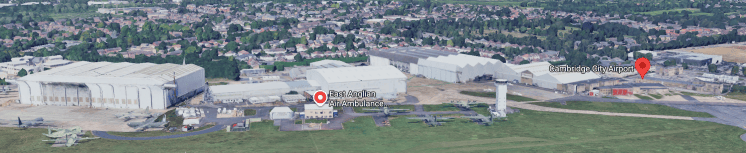
Note a concert hall has been included in the draft local plan already. And given that we didn’t get the one we were promised in the 1960s, this is long overdue! Which is why it’s also good that such a facility is in the CPCA Mayor’s plans. The 1960s proposals by Gordon Logie never came to fruition due to ministers not providing the funding and also the declining health of Mr Logie and his ally the Vice Chancellor Sir Ivor Jennings who offered to go 50-50 with the city council for a joint town-gown public hall in 1962.

Above – from the Cambridgeshire Collection, Cambridge Hall proposals

Above – From Gordon Logie’s masterplan in 1965
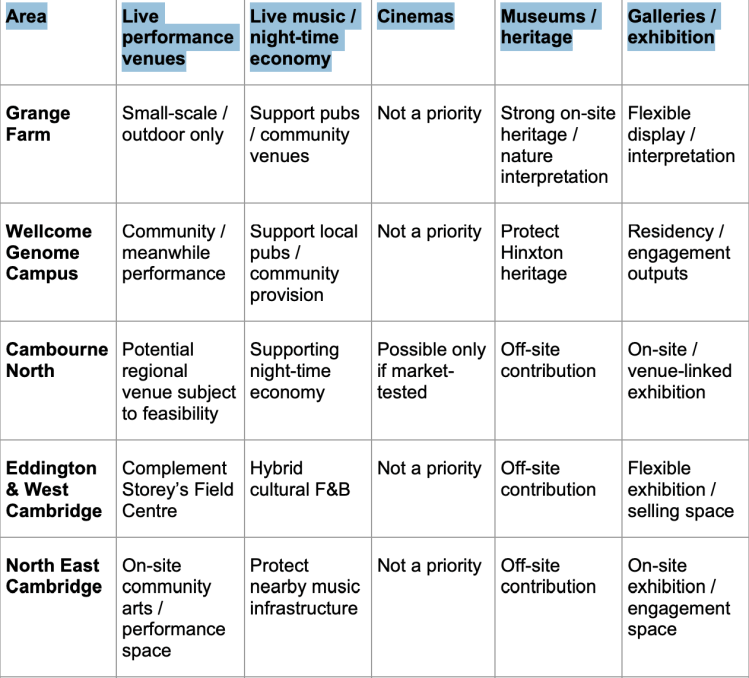
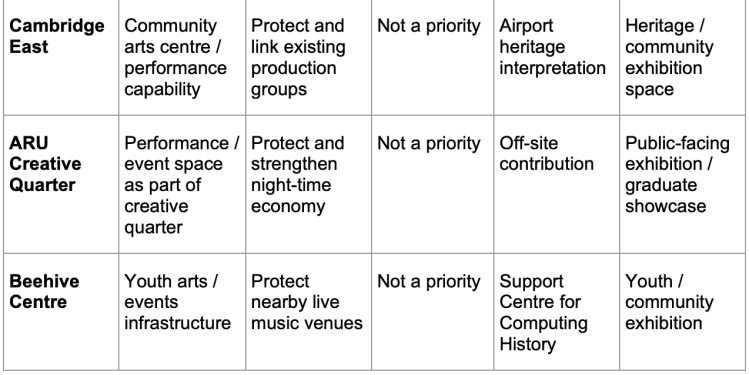
Tables of what is recommended for where
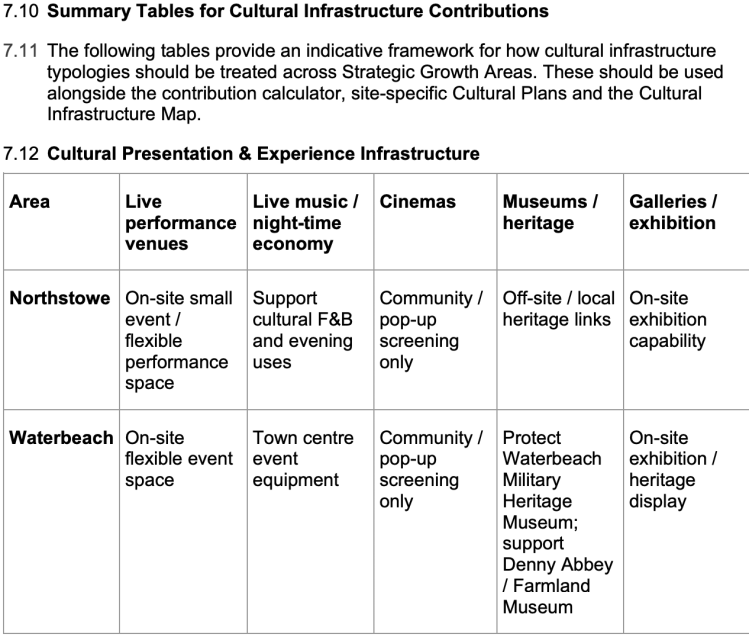
Above – GCCIS-2 p87 ono, for two of the new towns
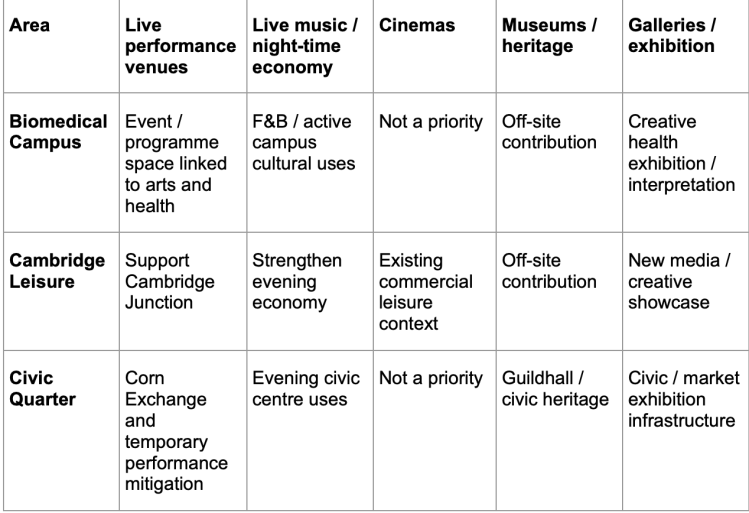
Building a city greater than the sum of our parts
“The Strategic Growth Areas should not be expected to deliver identical cultural
infrastructure in isolation. Instead, each area should contribute to a balanced Greater
Cambridge cultural infrastructure network.”
Above – GCCIS-2 p91
Some of you may be old enough to remember the concept of making Cambridge greater than the sum of its parts – it was in Puffles’ election campaign of 2014.
The Cultural Infrastructure Network can only be as strong as its weakest link (just like everything else. Some of Cambridge’s weakest links for me are:
- The public transport network – the proposals for new active travel routes and any mass transit systems need to connect the venues and the places they are located in, to each other
- Private schools vs the rest – both a cause of and a symptom of inequalities in our city, and one that is also not going to go away because the financial and institutional interests are far too strong. It is also a Political problem with all of the baggage that brings with it. So the challenge in the short-medium term is trying to work around this – mindful of the consultants that called out the unequal access to cricket pitches through to the inaccessibility of facilities at Eddington to residents in Abbey ward etc.
- Cost of living – you only have to look at how ticket prices have risen in the face of subsidy cuts and production/running costs rising – especially on energy bills.
- Social culture barriers where even things like cutting ticket prices are not enough to persuade people to turn up to your classical music event even though football match tickets your target group purchase regularly, might be significantly higher. (The case study of Royal Opera House access schemes vs the prices of Premier League tickets being a familiar one!)
Many of those barriers will be outside of the local development planning system. Rather than leaving it for someone else to pick up, there’s a moral responsibility for those in the planning system to ensure they know who is responsible for the allied issues that fall outside of their remit, and making sure/assuring themselves that someone is on it. Otherwise we end up with the Nightingale Pavilion scenario all over again.
“What happened there?”
This.
“Although a new pavilion is being built on Nightingale Rec to replace the old one, the city council informed the Queen Edith’s Community Forum AGM that it could not afford to staff it – asking if any volunteers or voluntary organisations could do it instead.”
It still does not have a permanent council-funded/employed member of staff running it. So succession planning is essential.
If you are interested in the longer term future of Cambridge, and on what happens at the local democracy meetings where decisions are made, feel free to:
- Follow me on BSky
- Spot me on LinkedIn
- Like my Facebook page
- Consider a small donation to help fund my continued research and reporting on local democracy in and around Cambridge


