
I disagree with the report’s statement about using the creation of more jobs to stimulate developers to build out the large number of planning permissions they already have.
Also, ‘Oxford-Cambridge-Growth-Corridor’ is too inconvenient a phrase, so am sticking with the Arc. But before we start…
Greater Cambridge Development Corporation published its response to the Greater Cambridge Draft Local Plan (reg 19) consultation. (See here, scroll down to ‘Development Corporation Representations‘)

Above – from the CamDevCo’s news and library page tucked away in a dropdown menu – am tempted to ask them to put this out as a high profile news item if only to remind developers that the CamDevCo strongly supports the draft local plan, and that developers won’t be able to use the former to get round requirements in that plan.
Furthermore, the response signed off by Anthony Hollingsworth, the CamDevCo’s Director of Planning & Place goes further:
“[The CamDevCo recommends]…that a Statement of Common Ground is prepared to help explain our relationship with the Development Corporation, GCSP, and CPCA, and how we intend to work together in addition to addressing any relevant specific matters in the representations.”
Public First’s OxCamArC growth report
My general point with any public policy report is to check the assumptions they are using. Because all too often they contain ***very strong assumptions*** that when tested in real life are found to be wanting.
On the relationship between job creation and the number of planning permissions that developers build out
It was former Queen Edith’s councillor Sam Davies MBE who pointed this out to me, mindful that she did an MSc in Sustainable Urbanism at University College London fairly recently, hence the depth her blogposts went into on the link between jobs, growth, and environmental sustainability in the context of Cambridge.
She wrote:
“Over recent years, jobs have been created faster than new homes have been built and this has contributed to higher house prices”. The proposal is therefore that, in recognition of “the continuing strength of the Greater Cambridge economy and its national importance”, we should now base our Local Plan on an employment-led approach to quantifying housing need”
Above – Sam Davies MBE, 28 September 2021
This contrasts with the Public First paper by Jack Airey that has been in the media lately.
“Supply-side factors are not the only constraint to housing delivery in OxCam. A large stock of consented homes is not being built out, in part because demand has been subdued for some time. Job creation drives housing demand, so a stronger local economy is itself one of the most effective routes to faster housing delivery. Planning reforms will help in high-pressure areas, but viability, infrastructure constraints and weak effective demand together keep delivery well below what long-term economic growth requires.”
Above – Scaling OxCam (2026) Public First, p41/p43pdf
“What’s the point of increasing job vacancies when employers in and around Cambridge are struggling to fill so many existing vacancies – citing skills shortages as a major factor?
Here’s the Cambridgeshire Chamber for Commerce from their 2026 skills survey
- 60 per cent said applicants were missing technical skills related to the job role, making this the most significant skills gap identified.
- 52 per cent of employers said recruitment had been difficult or very difficult over the past year.
Above Cambridgeshire Chambers of Commerce 2026.
“Why are the consented planning permissions not being built out?”
This is something the Government consulted on recently – have a look here
‘Job creation creates housing demand’ says Public First – but is that the only factor that creates demand?
It’s not the only thing that creates housing demand. Other things can also create housing demand:
- International investment – especially offsite purchases for yet-to-be-built properties
- Immigration in the context of international crises combined with government policies to accept and integrate specific cohorts on specific programmes – eg in/around Cambridge we have, through government-backed schemes & appeals to local councils, accepted people from Syria, Afghanistan, Ukraine, and Hong Kong.
- Speculative bubbles – why else would US investors buy up an old quarry and capped historical landfill off Coldham’s Lane in Cambridge and try to turn it into a science park? This came up at Cambridge City Council’s full council on 01 October 2026 where residents acquired data from the Environment Agency via Cambridge Friends of the Earth and found that the developers might not be complying with the very strict planning permission pollution control requirements.
- Financial windfalls – in the mid-2000s I recall the business media asking what impact bankers’ bonuses would have on the high-end property market
- Growth of industries (Especially in education) that automatically result in increased demand for properties – because the customers have to live somewhere while accessing in-person courses.
- Language schools
- University/higher education expansion
- Executive learning/provision
- The ease at which residential properties can be converted for other uses via Change of use of buildings – with hugely profitable returns. (Note such things also reduce supply – eg turning homes designed as long term residential accommodation into very short-term-lets/holiday accommodation/second homes
- Lower prices – price goes down, demand goes up? But then remember Theresa May’s Government published a Housing White Paper titled ‘Fixing the broken housing market’ in February 2017. Chronically high house prices have not stimulated new entrants into the construction industry in the way the basic economics textbooks tell people they should. (Fixed supply of land, very high barriers to entry for new firms wanting to become developers, builders, limited access to finance, and so on).
What we don’t know is what percentage of the new housing being built in and around Cambridge is the result of job creation
Not only that, by its very nature working out what the figures are is extremely difficult – and would not hold still for long given how volatile all of the other factors can be. Especially in these uncertain times.
When it comes to purchasing of new properties by people/firms domiciled abroad, Cambridge has inevitably been incorporated into the international property market to the extent that it’s not clear how changes in job creation might affect build-out rates when you consider how high the sales of new build homes to international buyers has been.
“According to Savills dealbook data, the proportion of non UK buyers in Cambridge has fallen from 38% in 2015 to 28% in 2017.”
During & just after the financial crash of 2008 that figure was even higher.
“Investor activity, from domestic and overseas buyers, returned in force to the Cambridge market in 2010, with 58% of new home sales to investor purchasers. Cambridge saw levels of overseas investor activity second only to London in 2010.”
Above – Savills Spring 2011 newsletter
“Are there any restrictions on foreign buyers regarding domestic housing in the UK?”
Not that I’m aware of – see the research paper Foreign Investment in UK Residential Property from 2017 by the House of Commons Library (which prepares politically impartial briefings for MPs)
“Should there be restrictions?”
I think there’s a case for it so long as it is part of a wide range of other polices – with those policies being co-ordinated and their positive impact being greater than the sum of their parts. At the same time given that the challenge is international, the solutions require international co-ordination as well. Most recently according to the FT Labour has pulled back from its proposals on bringing in such restrictions.
“How much does it cost to build a new house in/around Cambridge?”
***That is commercially-sensitive information and not for public consumption!!!***
Actually it’s not easy to pin down because there are so many variables. Also, when I first looked at what seemed a very extensive and reference blogpost I thought that must be good to quote, but there were too many red flags which made me think it was AI-generated. (No name of author, no institutional contact address…and unfamiliar font)
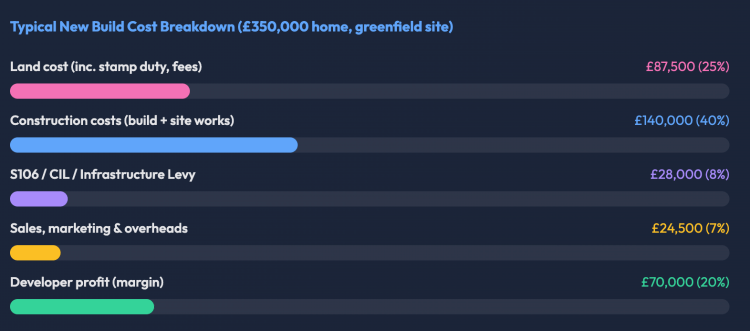
Above – I have no idea where the figures originated from or how they were arrived at
As percentages, how do they look?
- Land cost -> 25 percent
- Construction costs -> 40 percent
- Section 106 / Community Infrastructure Levy costs -> 8 percent
- Sales and marketing -> 7 percent
- Developer profit margin -> 20 percent
And yet in this submission to the London Assembly in 2017, Savills stated that the profit margins may not be high enough given the lack of new entrants into the market.
“With no new entrants of scale into the housing market over the last 10 years, and SME’s in perpetual decline, the evidence would suggest that current returns are not adequate for the risks involved.”
Above – Residential development margin (2017) Savills, p3
Again, this makes similar errors as in the Public First paper, assuming that there’s only one cause for the lack of new entrants. Another could be oligopolistic behaviour by the largest developers. Eg acquiring large land banks means that with a fixed supply of land, there’s little opportunity for new developers to enter the market where housing need is high, because land acquisition is prohibitively expensive.
“What about council housing and affordable housing?”
The provision of affordable housing has long been an issue here, with developers commissioning ‘independent’ viability assessments to get out of providing social and affordable housing time and again. Here’s Ms Davies again back in 2023.
“Sam Davies, an independent city councillor, says it is “absolutely incredible” that “prime property in this location” did not generate enough profit for developers to provide affordable housing.”
Above – BBC Cambridgeshire, 09 June 2023
This was at Cambridge Station featuring a development which I loathe because the developers did not rebuild the lovely old Mill silo building down the the last moss-covered roof-tile. But then this is Brookgate we’re talking about. What really infuriated residents was how so many properties were sold to overseas buyers, and some ending up on short-term rental sites.
“At least a fifth of the 89 flats were sold to overseas buyers. Some apartments have appeared on short-term rental websites.”
Above – BBC Cambridgeshire, 09 June 2023
The repeated inaction by successive governments to rein in the exploitation of cities by the already wealthy is a global issue – it’s not just a Cambridge thing. It is also a highly Political issue. Some take the view that it’s no business of the state what an individual chooses to do with their property. Others at the opposite end take the view that land and property belongs to the commonwealth/collective and that its distribution and use should be done in the interests of the many, not the few.
What view you take will depend on your values and your interpretation of the evidence through them. (This is something I learnt from former Cambridge MP Dr Julian Huppert (LibDems – 2010-25) when asked about a niche issue in an emerging field that he was not familiar with).
It remains to be seen what impact the Greater Cambridge Development Corporation makes on both designated ‘affordable housing’ and also the affordability of housing – in particular those very high land costs.
If you are interested in the longer term future of Cambridge, and on what happens at the local democracy meetings where decisions are made, feel free to:
- Follow me on BSky
- Spot me on LinkedIn
- Like my Facebook page
- Consider a small donation to help fund my continued research and reporting on local democracy in and around Cambridge


