North Hertfordshire District Council has opened a public consultation to update its local plan. One of its main towns, Royston, is on the Hertfordshire/Cambridgeshire border and is less than 15 miles from Cambridge. How will it manage the growth pressures from Cambridge spilling over the county boundary?
You can:
- see the North Herts new local planning pages here. Consultation closing date 24 November 2026.
- See the content of the draft plan here – along with the public exhibitions with the closest one to Cambridge being the one at Royston Town Hall on 20 October 2026 3.30 – 6.30pm. It’s a 10-15 minute walk from Royston Railway Station.
- See also East Hertfordshire District Council which is also working on a similar future local plan
- See the Hertfordshire County Council transport plan pages here. Consultation closing date: 9 November 2026 (11.45pm)
Below – the shapes in red are the submitted sites from which councillors and council planners will have to decide which to add to the current development sites (in blue)
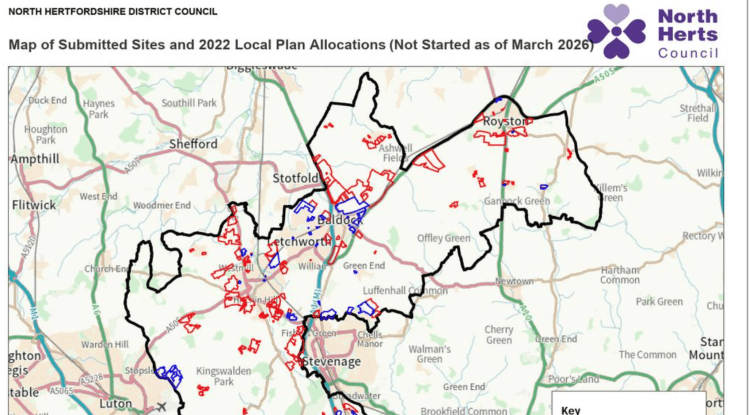
Above – Detail of call for sites submissions, North Herts DC
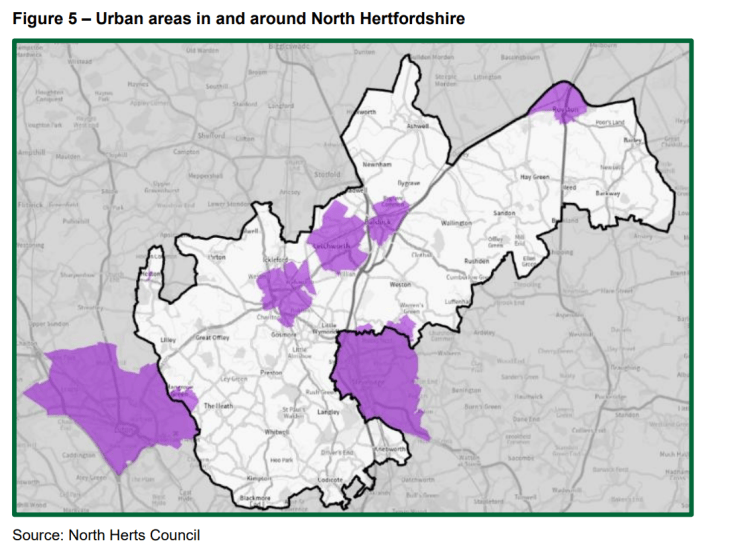
Above – Urban areas in North Herts District: The two largest are Luton and Stevenage – both outside of the district but which heavily influence it.
The trio of towns strung out in a line are (left to right) Hitchin, Letchworth, and Baldock. At the top-right on the Herts/Cambs border is Royston. I’ve lost count how many times I’ve travelled through that quartet on a train during my commuting days!
How should North Hertfordshire respond to the Government’s plans for fast growth for Cambridge, less than 15 miles away from Royston?
And to a lesser extent, how should it respond to the pressures for commuter housing in the face of London’s chronic housing issues? As the document states
“Our District has a greater proportion of residents employed in higher-skilled occupations
than the number of higher-skilled jobs available locally. As a result, many residents currently commute to employment centres outside our area, particularly London, Cambridge, Stevenage and Luton”
Above – NHDC Content and Evidence (2026) p74
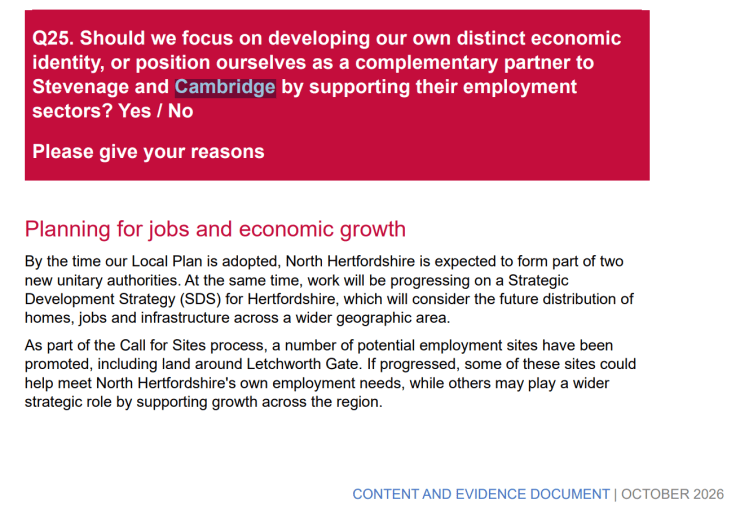
Above – “Should we focus on developing our own distinct economic identity, or position ourselves as a complementary partner to Stevenage and Cambridge by supporting their employment sectors?”
It may well be that it’s simply not possible to develop such an economic identity given the growth figures ministers past and present, and pro-growth sectors have repeatedly spoken about.
In which case what’s the worst case scenario? And how can North Herts avoid it?
One big risk is the Hertfordshire towns becoming dormitory communities. Something that would drain the life out of the towns because few people are around during the day.
“The Greater Cambridge Development Corporation will focus on the delivery of strategic, nationally significant growth within its boundary. It will work collaboratively with local authorities both within and bordering its development area, as well as with transport bodies and utility providers, to unlock development opportunities and boost economic growth.”
Above – Matthew Pennycook MP, Minister for Housing and Planning, to Ninth Delegated Legislation Committee, Parliament 08 July 2026
Given the clear statement of intent to Parliament when seeking the Committee’s approval for the Order to create the Development Corporation, North Hertfordshire District Council will find it has to work with the Greater Cambridge Development Corporation one way or another.
The other challenge they have is the one Cambridge and South Cambridgeshire found out the hard way in 2014 when developers lobbied heavily to get the original draft plan declared lacking a sufficient supply of housing, which is why it took another four years to get it finally signed off by ministers in 2018 – the current plan. How do Herts councillors intend to manage that risk? Especially in the fields around Royston.
Note Royston is identified as a location for housing in the Lichfields study for the Cambridge Biomedical Campus
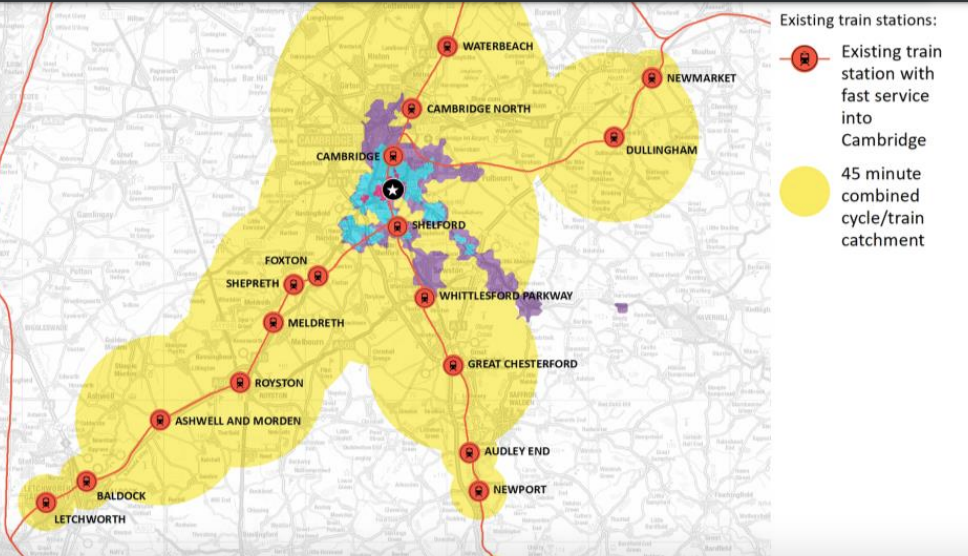
Above – Lichfields for CBC (2024) p26
Has the Cambridge Biomedical Campus been in touch with local government in Hertfordshire?
The four options identified by North Herts District Council planners
- Infill of existing sites
- Urban expansion
- Dispersed village growth
- New settlement
Above – NHDC Content and Evidence – Spatial Development Options (2026) p40-47
The document recommends choosing 1-3, and not recommending any new settlements.
North Hertfordshire District Council has commissioned an extensive evidence base
You can browse through the documents here
The one major omission so far is transport – because Hertfordshire County Council has just launched a consultation to replace the existing one.
The current one for which Hertfordshire County Council is responsible for expires in 2031.
Consultation for Hertfordshire County Council’s new transport plan from 2027-50
You can browse through their proposals here. The closing date: 9 November 2026 (11.45pm)
In 2021 New Civil Engineer featured a HERT rapid transit scheme.

Above: New Civil Engineer 22 November 2021 – a magazine that’s an interesting read if you like public transport infrastructure and things.
Above – is it a levitating vehicle or is this the sales pitch to hide the bog-standard buses hiding in the paperwork that hasn’t been seen yet? Only here in Cambridgeshire we’ve got form when it comes to being disappointed by big public transport schemes whose buses get stuck in traffic
Just ask the teenagers who rely on them to get to school and college.
“So, what’s the proposed route for HERT?”
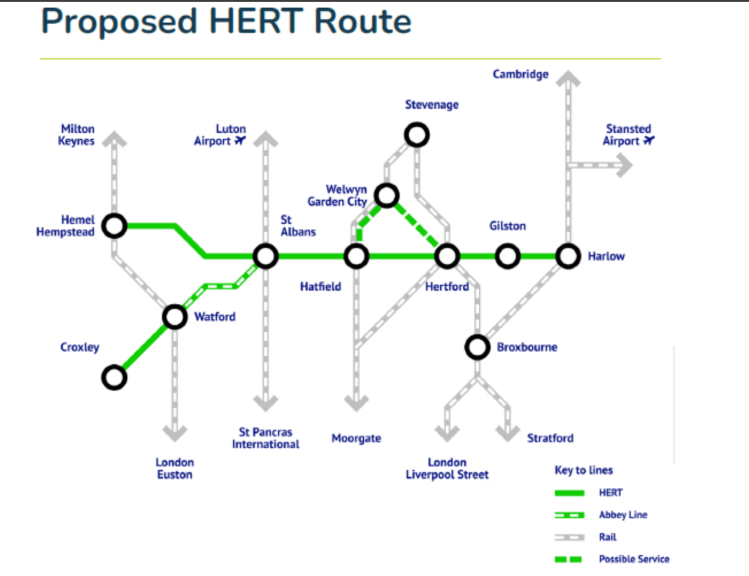
Above – the proposed HERT Route
It was featured by the BBC in May 2026 here, but I imagine local government reform has gotten in the way of further work.
If they went with a rail-based system in the longer run, then a suburban rail loop link could join up from Harlow to Cambridge (via Bishops Stortford and the Cambridge Biomedical Campus. With one of the Cambridge stations as a terminus, it could head down to Stevenage on the existing railway line (which at some stage will need increasing from 2 to 4 tracks) then onto Luton and Hemel Hempstead.
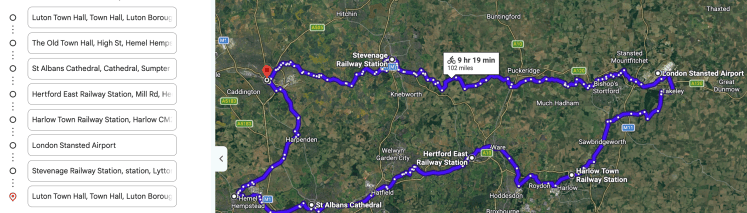
Initial thoughts on the North Hertfordshire Local Plan and Hertfordshire County Transport Plan
Hertfordshire County Council has inevitably focused on the south of the county where it has greater population density to the extent that parts of it are effectively part of Greater London. There’s very little on or for Royston and North Hertfordshire in comparison.
Is the lack of proposals tenable in the face of a fast-growing Cambridge that is less than 15 miles from Royston?
Hertfordshire transport planners should be meeting up with their counterparts in the Cambridgeshire and Peterborough Combined Authority (responsible for transport planning) and the Greater Cambridge Development Corporation. Not least because both may be able to support infrastructure planning in that part of their county.
For North Hertfordshire, is there a case for lobbying Great British Rail to build a new parkway railway station to free up car parking space by existing town-based railway stations for future development, such as at Royston? With Baldock and Royston having had larger plots of land submitted for consideration as urban extensions, there will be further pressure to provide sufficient community facilities for the new residents. To avoid the risk of dormitory towns, are there attractions that could be built close to existing or new railway stations that might attract residents from Cambridge and Stevenage to visit? Are there also facilities needed and investments that could be made to reduce the number of children and teenagers that travel from Hertfordshire to Cambridge for school and further education? For example what might a state-of-the-art further education college or sixth form college of the calibre of Hills Road and Long Road SFCs in Cambridge do for teenagers in Hertfordshire along the Cambridge-Hitchin railway line?
It’s more than homes and roads
“‘By 2040, North Hertfordshire will strengthen its identity as the District shaped by the world’s first Garden City, Letchworth, whose pioneering principles of planned growth, green space, and community wellbeing will continue to influence high-quality design and placemaking across the area.”
Above – NHDC Content and Evidence (2026) p23
How does that vision for North Hertfordshire District read in the context of a fast-growing Cambridge?
Don’t tell me – respond to their consultation
If you are interested in the longer term future of Cambridge, and on what happens at the local democracy meetings where decisions are made, feel free to:
- Follow me on BSky
- Spot me on LinkedIn
- Like my Facebook page
- Consider a small donation to help fund my continued research and reporting on local democracy in and around Cambridge


