When I looked at the jam-packed notice boards, I wondered why we didn’t have similar in Queen Edith’s ward and in South East Cambridge more generally
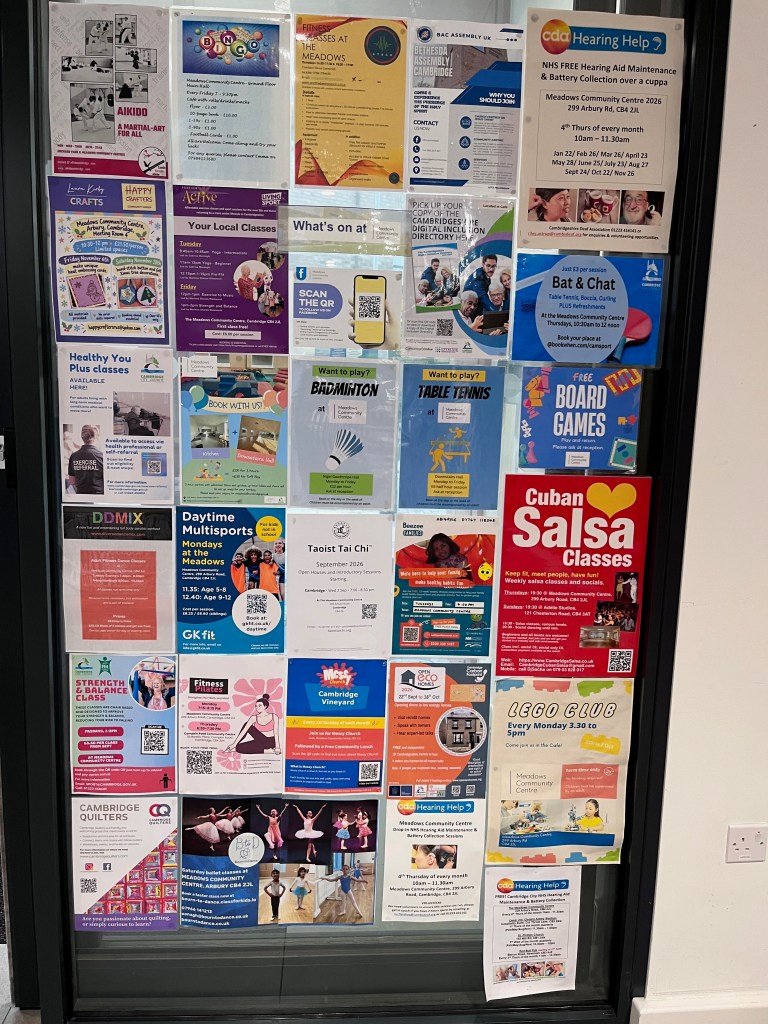
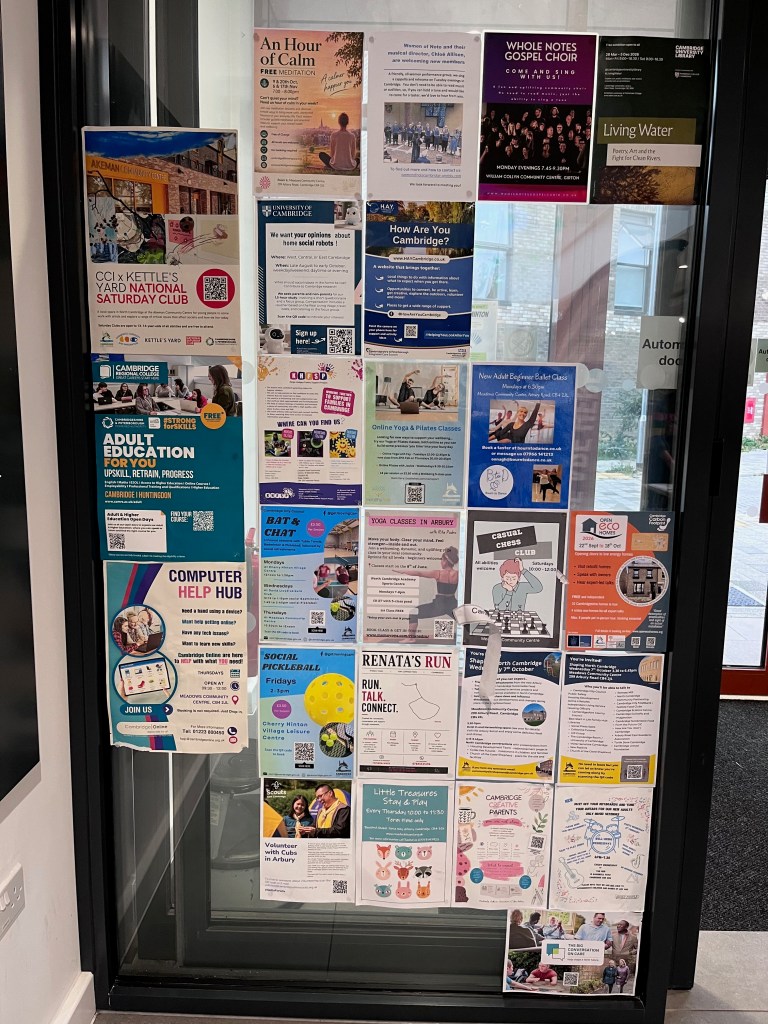
Above – the noticeboards at The Meadows in early October 2026
This was something that a local resident had raised with me just over two years ago:
“The lack of provision of community events was also raised by one of the younger parents who came to one of the events in Queen Edith’s that volunteers had put on. She asked why there were lots of things in Arbury & King’s Hedges, but not here.”
Above – CTO 10 June 2024
But then when I heard from some of the community workers at the sharp end, I can understand why councils across the country focus what limited resources they have on the areas that the data tells them are the places with the most need. It’s not about two parts of the city with needs fighting each other for limited resources given the huge wealth generated in the city that is not shared with the rest of the city without whom the wealth would not be generated.
What do you do when so many people cannot afford to participate?
“…conversations with several parents really emphasised how mounting financial pressures now exclude them from activities that others would regard as pretty standard Cambridge half-term pursuits: trips to the pool, Clip ‘n Climb, the ice rink, the Botanic Gardens, or a National Trust site. They are conscious of – and understandably upset by – the thought of their children missing out on these experiences.”
Above – Sam Davies MBE 30 October 2022
“We don’t have the community and social infrastructure in many of our residential communities because there are few people with the capacity to volunteer, and even fewer suitable facilities to function as exciting and vibrant community hubs.”
Above – A Tale of Two Cambridges, CTO 10 June 2024
The context of the above was the run up to the 2024 General Election. Since then, Cambridge City Council has spent a small fortune commissioning independent reports for the draft local plan that has quantified what that shortfall is and what the city will need on community, social, leisure, and sporting facilities to support the growth that ministers want. (See the links in my Future Cambridge page here)
Developers building financially unsustainable facilities
I wrote about what one volunteer at one venue had told me after he had done a ring-round of other volunteers at community venues across the city.
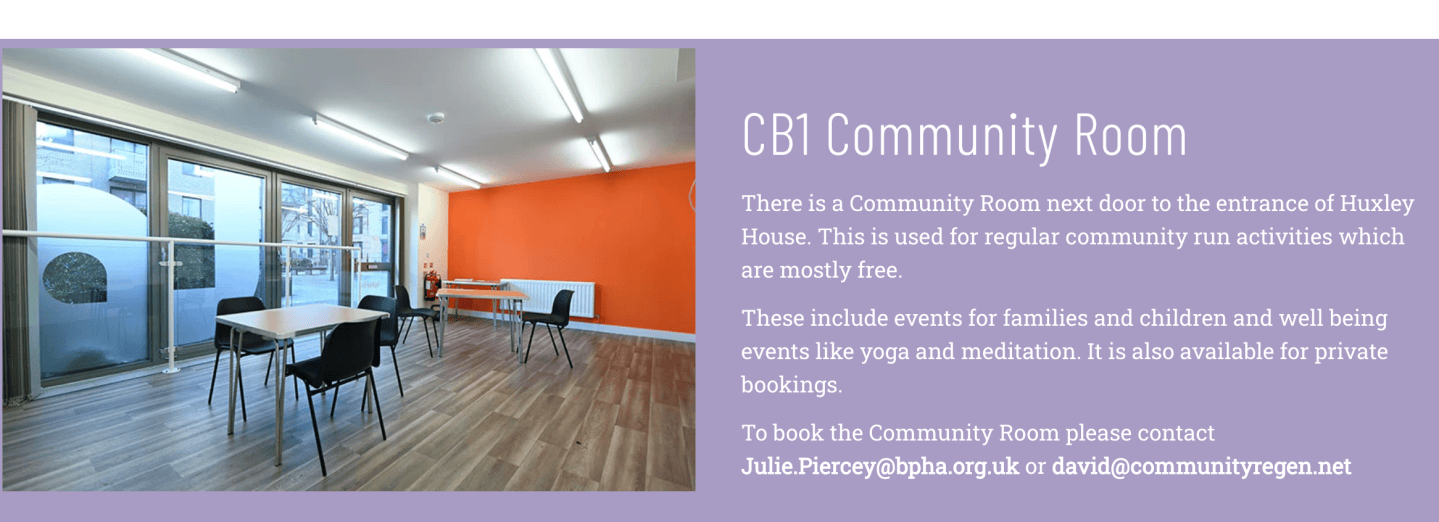
Above – another pokey community room – the CB1 estate by the railway station. A far cry from the original local history and archives hub that was originally promised.
“We shouldn’t be designing cultural buildings. We should be designing cultural economies.”
…says Tim Jones FRSA on his Li Page. Or has his TL/DR summary says:
- “Theme: most cultural infrastructure briefs still ask for a map and a wish list. They should ask for a decision system.
- “Insight: the binding constraint is revenue, not capital. The cheapest square metre is the one you don’t lose.
- “Action: write the brief so the answer comes back priced: a revenue line beside every square metre, and a register of what is at risk before a list of what to build.“
Above – Tim Jones on Li, 08 October 2026
It’s a really interesting piece let down only by one thing: Using Eddington in Cambridge as a case study.
“What did it say?”
“3. Eddington, Cambridge: the trust came before the building
“The University of Cambridge and Cambridge City Council set up Storey’s Field Community Trust in 2014, with three trustees each. The £8.28m Storey’s Field Centre opened four years later, as the first residents moved in: a RIBA Stirling Prize nominated 180-seat hall built for concerts and theatre, a studio and a 100-place nursery.”
“Lesson: create the body that will hold the building before you design it. A building with no operator is a liability on day one.”
Above – Tim Jones on Li, 08 October 2026
Apart from utterly despising the architectural design style as I wrote here, and not liking how having no bus services from other major residential areas of Cambridge (esp where social housing is), the ownership of the land on which Eddington was built, combined with the support from that same landowner (the University of Cambridge) meant that the community was not burdened by the financially-extractive practices that other development sites are afflicted by – ones that mean developers try to get out of provision of community facilities. Recall the tale of the Cambridge Railway Station area.
“Still, Storey’s Field was nominated for a Stirling!”
My general view of architectural awards is similar to Sir Humphrey Appleby’s explanation: They are handed out so that the public are not allowed to criticise them!
The landing page of RIBA’s Stirling Prize has three cases studies, the images of which leave me feeling cold and empty inside.
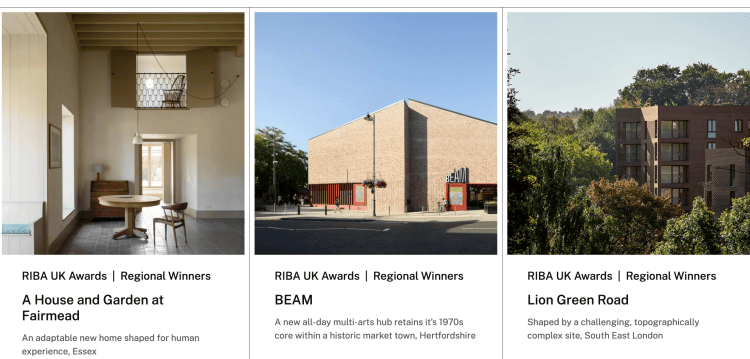
Above – RIBA Stirling Prize landing page as of 08 Oct 2026
The BEAM arts centre in the middle, is in Hertford. It replaced a 1970s-era centre. The history of the site is in the planning documents at East Herts District Council, ref 3/20/2285/FUL. The cinema that was there before it
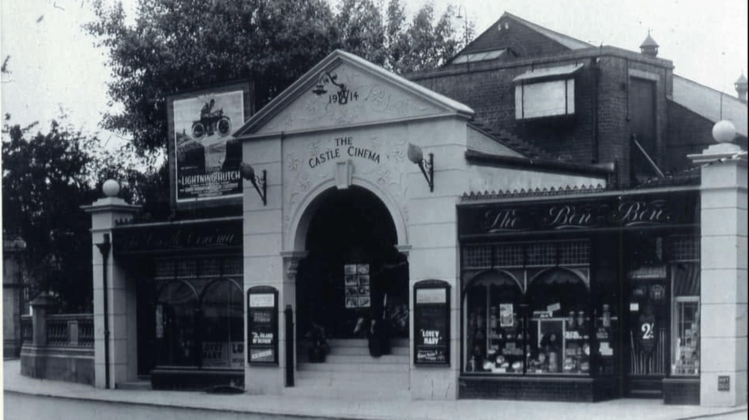
Above – The old Castle Cinema, Hertford, Herts – from the ILoveHertford FB Group 25 Jan 2026.
What a shame the architects didn’t take inspiration from this design. Then again, the architects were Bennetts Associates so that doesn’t surprise me given their past form in Cambridge.
“What are the criteria that the judges assess entries against?”
Good question. Further down the landing page RIBA explain:
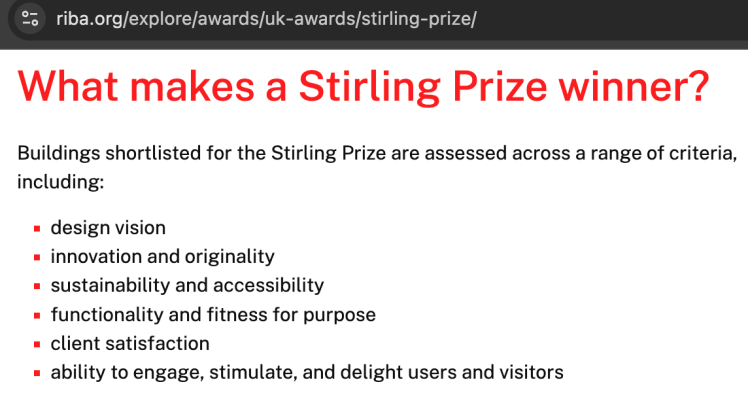
“Buildings shortlisted for the Stirling Prize are assessed across a range of criteria, including:
- design vision
- innovation and originality
- sustainability and accessibility
- functionality and fitness for purpose
- client satisfaction
- ability to engage, stimulate, and delight users and visitors
Above – RIBA Stirling Prize landing page
There’s a random controlled trial waiting for someone to commission to compare and contrast how different groups of people – each group coming from a similar background bar a ‘general public one, assesses the same long list of entries to come up with their shortlist. Furthermore it could be done for groups of buildings grouped into different historical eras and/or different parts of the world
And yet I find Mr Jones’ provocations section compelling
He states:
- Stop commissioning theatres. Start counting hours.
- The cheapest square metre is the one you don’t lose.
- Your city’s cultural shortage is backstage.
- A plan that dies with its sponsor was a brochure.
Above – Tim Jones on Li, 08 October 2026
In Cambridge’s case with a rapidly-growing city and population, the top two are slightly less relevant in that the evidence bases that the multiple groups of consultants have prepared for the local councils for the local plans tell us that we have a chronic shortage: previous rounds of developments built by developers *under-provided* for community facilities, and the next local plan will have to address this. Hence also why we have a new development corporation for Cambridge. It will have greater legal powers to deal with this.
For other towns and cities, the challenge is how best to re-use and repurpose existing buildings in the face of a building industry that is both one of the most wasteful in terms of raw materials used, and one of the most carbon-intensive.
“Each year, poor design and site management leads to approx 13% of all solid materials delivered to sites, some 10 million tonnes, going unused. This makes the construction industry the largest generator of controlled waste going to landfill (NCE, 2007; WRAP, 2007).”
Above – C. Udeaja, D. Ekundayo, L. Zhou, and S. Perera – Material waste in the construction industry: a review of the legislative and supply chain issues (2013) Northumbria University, Newcastle upon Tyne, NE1 8ST, United Kingdom
That unused materials landfilled issue which I became familiar with during my civil service days is one that has a very long half-life, with BBC News quoting it in 2021
The Junction in Cambridge in its earlier redevelopment plans wanted to build in far more rehearsal space
Talk to any performing arts group in/around Cambridge and they will tell you about how hard it is to find suitable, affordable, and accessible rehearsal space. With the redevelopment of so many schools and the dissolution of old religious institutions that previously provided cheap rehearsal space, that supply has fallen. Repurposed spaces have to recoup the expenditure – including for schools.
5th Studio came up with some initial designs which I included in this blogpost – you can see the proposed densification of the site below.
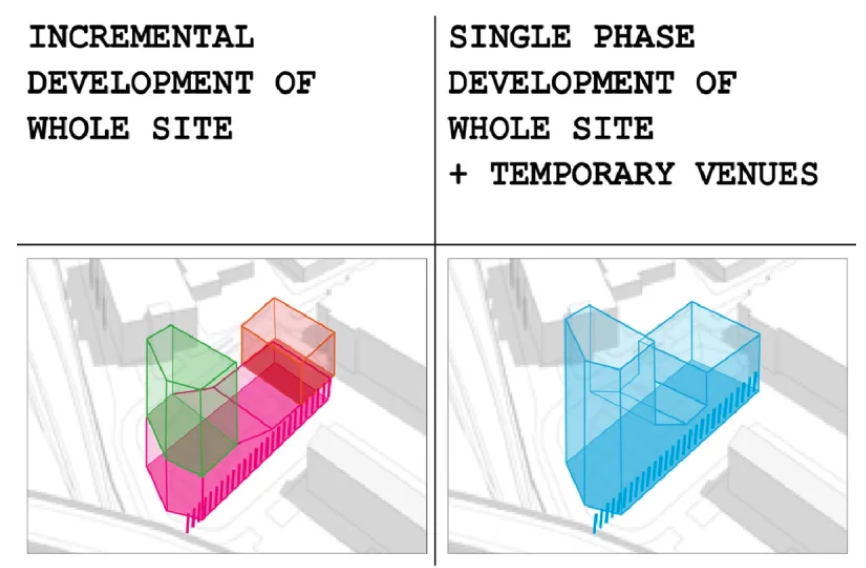
Above – concepts from 5th Studio from ***ages ago***
That now is all being swallowed up in the proposed sale and comprehensive redevelopment of the entire Cambridge Leisure Park site – now incorporated into the draft local plan.
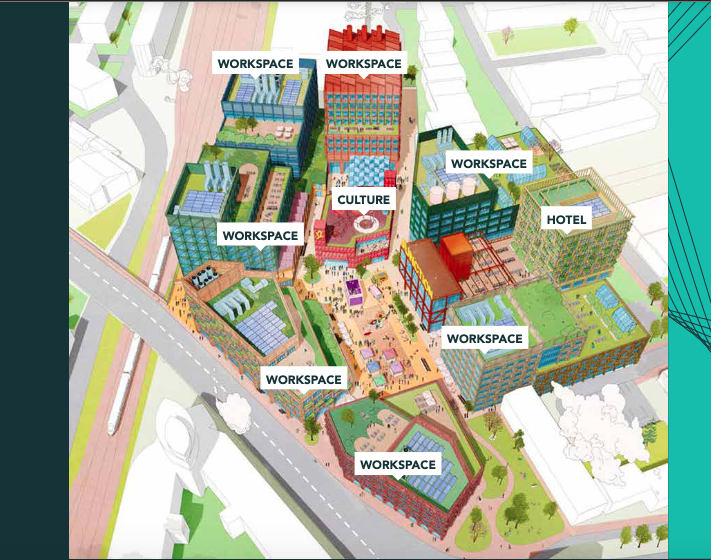
Above – a concept plan from an investors’ brochure which I wrote about here
Over-reliance on short-lived government-created institutions that have a habit of being abolished when there’s a change of government
Anyone remember Cambridgeshire Horizons and their grand plans?

Above – you see those priorities from the mid-2000s?
I wrote about Cambridgeshire Horizons and their archived publications which I managed to rescue earlier this year here. Count the things we are still waiting for.
I quite like what Mr Jones has done with estimating current demand.
- “The benchmark. Apply a recognised ratio, such as the Arts Council figure, or seats and studios per 1,000 people in comparable places.
- “The bottom-up count. Start from the people who live there and what they do. For example: how many residents sing in a choir or act in amateur theatre, how often they rehearse, and so how many hours of rehearsal room that adds up to each week.
- “The evidence on the ground. Waiting lists for studios, bookings that venues turn away, groups rehearsing in a car park because nowhere is free.“
Above – Tim Jones on Li, 08 October 2026
What makes things ***really challenging*** for Cambridge is:
- Significant population turnover
- Weak community and civic institutions in the face of very powerful and wealthy interests that put financial returns ahead of social need
…Which explains why Cambridge is one of the most unequal cities in the country
Cambridge’s chronic transport problems as a barrier
In the olden days, Cambridgeshire County Council was responsible for buses and for lifelong learning. Which meant that in its publicity there was someone to connect the two together and ensure that adverts also included public transport information – including maps!
Private sector efficiencies and minister-invented institutions since then have meant that there’s no co-ordination so we can’t have nice things.
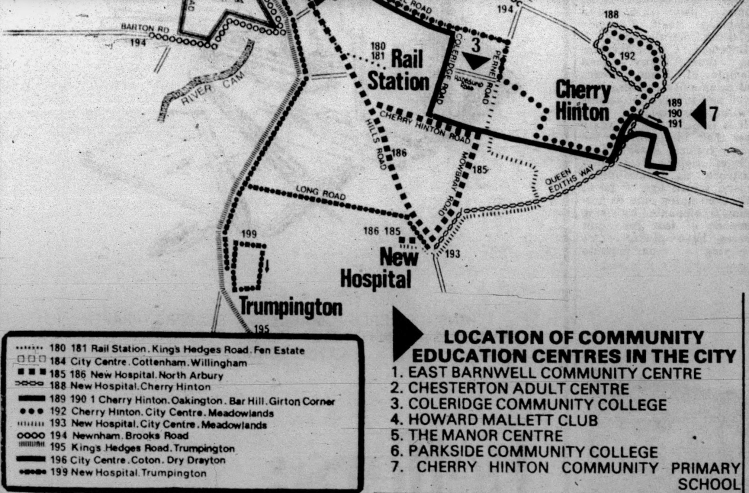
Above – Cambridge Evening News 02 September 1980, Detail of Cambridge Community Centres feature, p14
“So who is the big hunk of a man to provide strong leadership and get things done for businessmen and splendid chaps in the property industry?”
I jest because the ministers past and present who have made the case for ‘strong leadership models’ have also been in the governments that fragmented public sector institutions making it all but impossible to know where power and accountability reside. And that same old message of ‘Who is in charge of Cambridge?’ was one that came up at the Bidwells event on Good Growth in the OxCamArc earlier in the week.
In the case of The Meadows Centre and all of the fun stuff happening there, a host of things lined up:
- The large area of land for redevelopment was available, along with the social need to provide more social housing and the regulatory demand to improve housing standards
- The political will was there – both from the deal former Cllrs Lewis Herbert and Kevin Price negotiated with ministers to fund a significant level of new council housing in the mid-2010s, to their successors to put things into practice later on
- The growing support from private sector started to emerge, especially with key charitable organisations as the publicity of inequalities in Cambridge started undermining the legitimacy of their growth plans
- The desire from a critical mass of local residents to make a positive difference – some of the things they have achieved have been incredible.
The bit the transport chiefs got wrong was locating the bus stops
Both the busway and the Citi network really should be stopping outside the entrance to one of the largest council community centres in the city.
Let’s hope future decision-makers don’t make the same mistakes for the next generation of community buildings that will be built for an ever-expanding city.
If you are interested in the longer term future of Cambridge, and on what happens at the local democracy meetings where decisions are made, feel free to:
- Follow me on BSky
- Spot me on LinkedIn
- Like my Facebook page
- Consider a small donation to help fund my continued research and reporting on local democracy in and around Cambridge


