One of the volunteers at a community centre in South Cambridge told me he and his colleagues had been in touch with a number of similar centres across the city and said a very large hall is essential to bring in significant lettings’ revenues
Image: Greater Cambridge Community Infrastructure Study 2026
Which made me wonder whether any detailed study had been done of all of the small community venues built in recent years for the draft local plan. Maybe we should have one done. Because…
We’ve been here before:
“My take remains that the developers did not plan for nearly enough community facilities to serve the new residents – The Clay Farm Centre is far, far too small. Developers should have planned for a much larger and much more magnificent premises. But they have no financial incentive to do so. In fact they have the opposite.”
Above – CTO 21 September 2020 on well-connected community centres
“How does the above read six years later?”
That’s for the local residents to cast their judgement on based on their experience of using it. The full Clay Farm timetable that is updated every month by Cambridge City Council shows that it is being used – a sign of success in itself. But what we don’t know is whether the building and facilities are at capacity. Furthermore, it’s hard to get a sense of what the ‘capacity’ is given that demand can change in the face of changing rental fees or changes in the ranges of activities put on for people to participate in.
Of the developments in the past 20 years in Cambridge…
The Signal Box off Brooklands Avenue
The local residents deserve far, far better than this pokey little community room allocated by the developers.
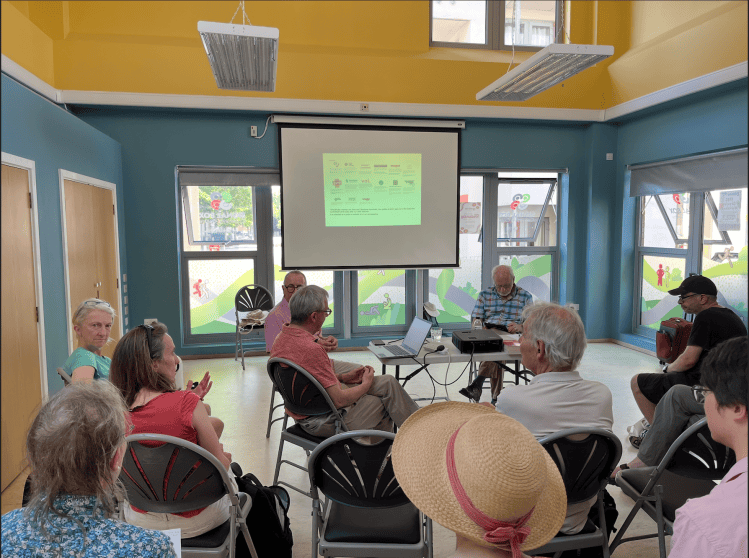
Above – Cambridge Bus Users AGM from July 2026 – this is about two thirds of the main room taken up from where I took this snap. I’ve been to other meetings at this venue including the annual Cambridge meetings of Rail Future East which sadly always clash with the Mill Road Winter Fair!
CB1 Estate by the Railway Station – Brookgate
I’ve been to public consultation events in this room and it suffers from the same lack of space that the Signal Box does. The achievements by the volunteers on the CB1 residential areas are inspite of, rather than because of the facilities provided for them.
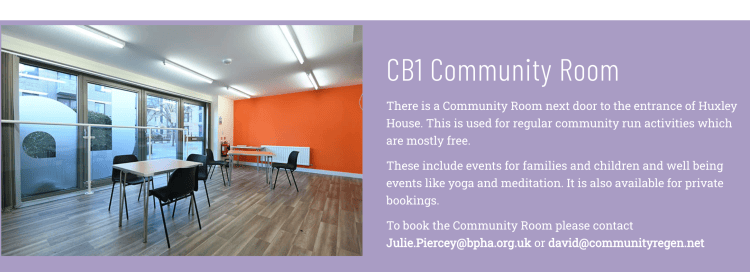
Above – another pokey community room – the CB1 estate by the railway station. A far cry from the original local history and archives hub that was originally promised.
The Springstead Community Living Room
I remember having a look around this but can’t pinpoint exactly when it was – other than it was rainy outside! The difference between this room which is the smallest of the bunch, and the other two is that the housing development is still work in progress – and some much more substantial community facilities are due to be built in future rounds, some of which already have planning permission. The room is also next to the airport and as Peter Freeman told South Cambridgeshire District Council’s Overview and Scrutiny Committee last week, the CamDevCo takes possession of the airport site in three years time and will be hitting the ground running from that point. Which means that possibly within a decade there will be sufficient new community facilities superseding the room.
Effectively a revamped branch library – and opened as such with council housing above it. Behind the library is the Cherry Hinton Village Centre opened by Princess Diana in the late 1980s which does have a very large sports hall. The Village Centre is run by a separate contractor for the city council, while the library is a county council service, so it will be interesting to see how the two end up being managed following unitarisation. Any urban designers and architects out there might be looking at the sites of the Village Centre and Library and wondering whether a more effective use of the land footprint could be designed for any future overhaul. Not only because of the age of the buildings, but also because of the densification of the housing that replaced the smaller council houses.
As well as being too small for anything larger than a beginners or improvers ballroom dance class (James and Trevor are running a new term of classes here, with the soon-to-be-returning Cambridge Dancers’ Club also struggling with the Gibson Hall as one of their venues of a similar size (hence if you go, pick classes at one of the other venues!), the problem the pavilion has is that Cambridge City Council never had enough money to pay for anyone to staff the venue. Call me old-fashioned but I quite like the idea of such venues having live-in or next-door-resident caretakers. i.e. someone who everyone in the area knows is ‘in charge’ if anything goes wrong. For people of a nervous disposition (i.e. Me) we sometimes won’t book a venue for whatever it is we might want to put on if no one else is on site or is responsible for locking and securing buildings at the end of events. It may be a neurodiversity thing but in the grand scheme of things I prefer rocking up to a place, running whatever workshop I have to run, then heading back home to crash out and recharge.
“The problem nobody owns: cumulative impact”
So wrote Joe Reeve of the Forest City consortium on 20 September 2026 (today!)
He continues:
“Every piecemeal option shares one flaw. Each application is judged on its own, so nobody is responsible for the total.”
And I agree with that point. The tension is that there is no clear method of charging existing residents or firms to support the construction of new facilities that they might benefit from – especially the firms and their financial bottom line. Instead, it’s the new residents moving in that ultimately stump up the costs. Developers simply pass the costs on, or not go ahead with the plans at all because they’ll say it won’t be profitable.
On community venues in residential areas
I wrote about progress made in the previous decade back in 2023 here. There is so much more that we could do – if only local government/local public services had the resources and the organisational structures to go with it. One of the data collection exercises the CamDevCo could support as part of their community engagement and research is getting a picture of what residents saw as amenities.
For those of you historically-minded…
…you can compare them to community centres built by previous generations – mindful of the huge desire to build a better society after WWII, hampered primarily through a huge shortage of building materials needed to build them. One such community centre was in Cherry Hinton – for the Royal British Legion, which included some of the survivors of the Cambridgeshire Regiment that endured the hell of Imperial Japanese prison camps as Winston Churchill diverted their unit – part of the East Anglian 18th Infantry Division en route to the Middle East and trained for desert warfare, to Singapore in a forlorn attempt to save the doomed fortress that never was.
The old Nissen Hut from Maeve Williams’ memories, in Michelle Bullivant’s wonderful histories of Cherry Hinton
You can see the distinct shape of the hut – named after its designer Peter Norman Nissen, a Major in WWI.
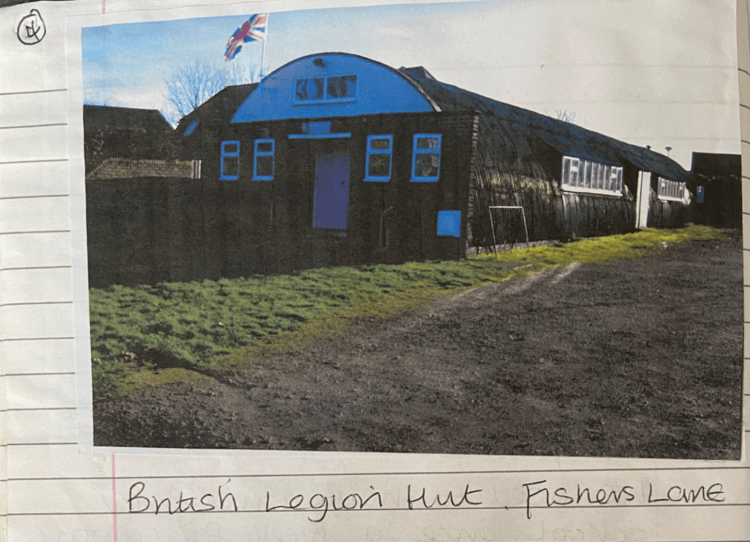
“During the war there was dances every Saturday in the Legion hut on the Rec, you could hardly move let alone dance it was so crowded, especially when the pubs closed.”
Above – Bett Dawson (nee Stevens) Cherry Hinton Memories in “Cherry Hinton Memories Book Three” by Cherry Hinton and Cambridge local historian and archaeologies Michelle Bullivant. (Her local history FB page is here – do have a look)
Ms Bullivant has also uploaded an extensive photograph collection of the Royal British Legion in Cherry Hinton, which you can browse through here.
The testimony in the Cherry Hinton Memories collection show how important it is for today’s generations of politicians and developers to ensure there are sufficient community facilities in the new developments – not just for today but for future generations too.
Place-Check by Rob Cowan. Applied citizen town planning
I looked at this in the context of his excellent book on urban design which is a very useful book for residents wanting to suggest improvements to developers when they bring in their applications.
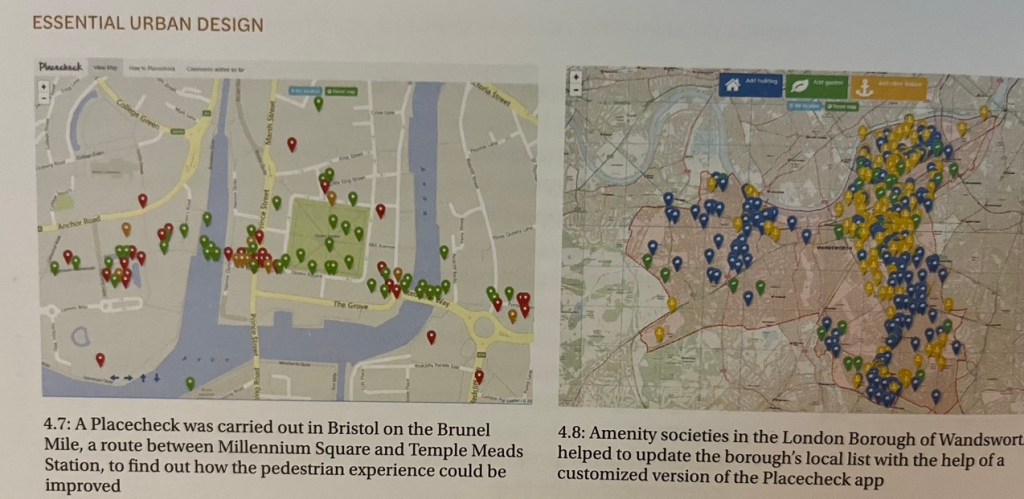
Above – could Cambridge commission a customized version of the app for schools, colleges, and community groups to use, in order to populate a wider city map?
Such an app should be looked at in the context of the Community Infrastructure Report for the draft local plan which I wrote about here. This is because…
Not all community assets are the same
And furthermore, they also don’t have the same level of accessibility. To be fair to the consultants
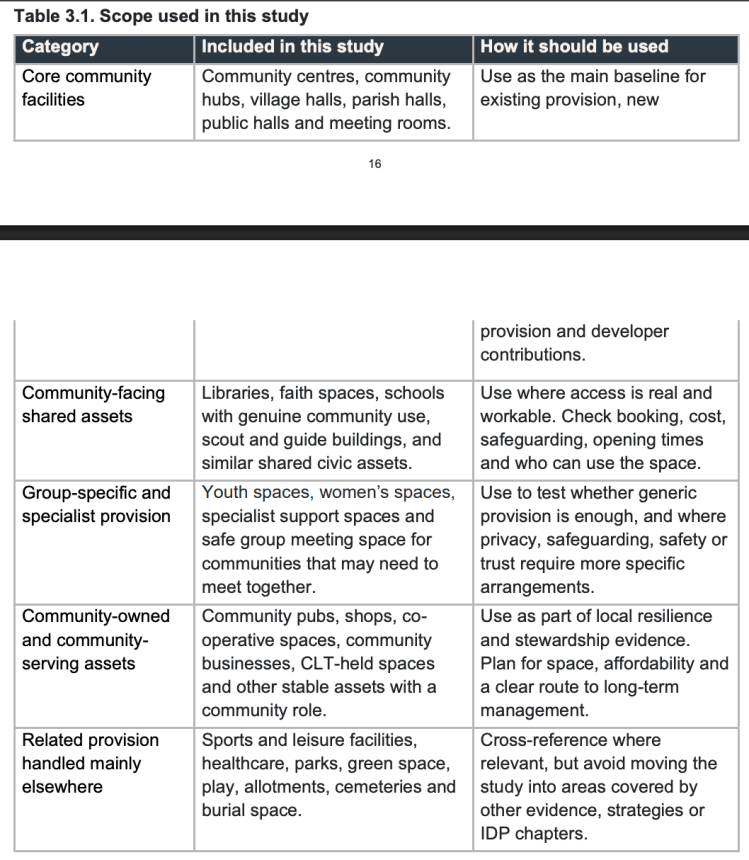
Above – Community Infrastructure Report (2026) p17/p18pdf
One key category that is missing in the above are privately-owned assets with limited community access. Take the public swimming times at the recently-opened Perse swimming pool.
Term time lane swimming is limited to:
- Monday – 90mins
- Tuesday – 120mins
- Wednesday – 90mins
- Thursday – 60mins
- Friday – 90mins
- Saturday – 55mins
- Sunday – 55mins
But then it is a private school and in the grand scheme of things it can do what it likes with its facilities – give or take what governments of the day require for ‘provision of social benefits in return for whatever tax breaks they might get’. (Note The Leys which has a much older pool has even very few slots for public swimming, although like its competitors it hires out its performing arts facilities including its highly-rated theatre)
Anyone who wants to open the can of worms that is the debate on whether to abolish private schools altogether should read the Government-commissioned Public Schools Commission of 1968 Vol 1 Report, and the Vol 2 Report here – mindful that had Clement Attlee won the 1951 snap general election or had Harold Wilson won the 1970 general election, the incorporation of many private schools into the state system might have happened.
This is why it’s ever so important for the University of Cambridge to get on with building their long-delayed West Cambridge swimming pool. The risk is that the already significant wealth divide in and around Cambridge gets even greater.
Food for thought?
If you are interested in the longer term future of Cambridge, and on what happens at the local democracy meetings where decisions are made, feel free to:
- Follow me on BSky
- Spot me on LinkedIn
- Like my Facebook page
- Consider a small donation to help fund my continued research and reporting on local democracy in and around Cambridge


