This follow from my previous blogpost on the updated Cambridge Science Park intensification proposals
One of the documents I cannot find but am very interested in is CSP’s Employment and Skills Plan which is as good as mandatory for a planning application as large as this. I’m assuming it will be forthcoming, mindful it’s website says:
“Opportunities for skills and employment are embedded within the masterplan for Cambridge Science Park.”
Above – https://futurecambridgesciencepark.co.uk/
Furthermore, this was also included in their Statement of Community Engagement. The executive summary stated that there was:
“Support for creating training, apprenticeship and local employment opportunities, with respondents keen for the Site to help boost local skills and provide accessible pathways into high-quality jobs.”
It goes on further:
“…the Applicant is actively pursuing opportunities to support training, apprenticeships and local employment linked to future phases of construction and occupation. This includes collaboration with construction partners, future tenants and organisations such as Constructed Pathways.”
“The proposals also create opportunities for partnerships with schools, colleges, community groups and charitable organisations through the delivery of new buildings, landscape spaces and learning environments. These spaces will enable outdoor learning, STEM engagement and skills development, helping to widen participation in Cambridge’s innovation economy. The Applicant will continue working with education providers and third sector partners to co-develop initiatives that respond to community priorities and support long-term participation.”
Is the Combined Authority keeping records on developer contributions towards skills and training programmes?
Given the scale, this should involve conversations with the Cambridgeshire and Peterborough Combined Authority which leads on employment and skills – one for November’s Skills Committee meeting to ask for a progress update?
It’s not just the science park that has employment and skills obligations. Other large developments will have similar. Something as simple as a table with each large development listed alongside the financial value of its contributions along with the actual nature of the contributions they are making would help local residents and local councillors get a sense of how the city and county is benefiting from this growth. Furthermore it could be used to send signals to careers advisers, schools, and teenagers of the future training and job opportunities likely to come up – important given the challenge of youth unemployment.
It’s one thing to provide the opportunities, but they are useless if people cannot get there because of lack of transport provision
The headline figure that the Cambridge Science Park is working with for this expansion is this:
***By the year 2047, the Cambridge Science Park expects the densified site to employ an additional 23,360 workers***
Which has huge implications for both the existing population of Greater Cambridge, the future population that will move into the newly-built homes proposed, and beyond that the counties that will find commuters to the site living in their areas due to the public transport links – eg the existing guided busway and the train services to Cambridge North Station.
I referred to the Transport Assessment in Part 1, but not the workforce accessibility
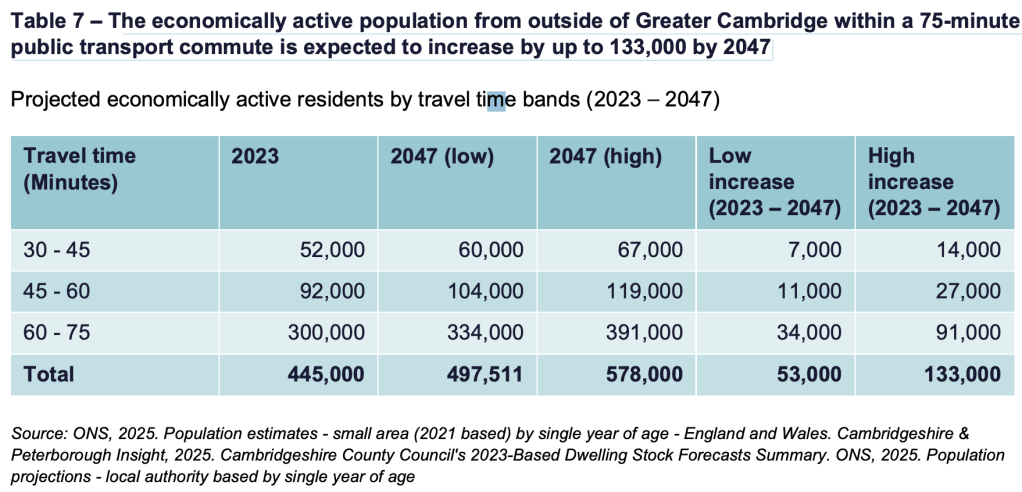
Above – Transport Assessment p12/p13pdf. I hope someone has had a more detailed look at this mindful of the existing and potential future transport network (and also how the climate emergency will affect commuting patterns!)
Of those active workers,
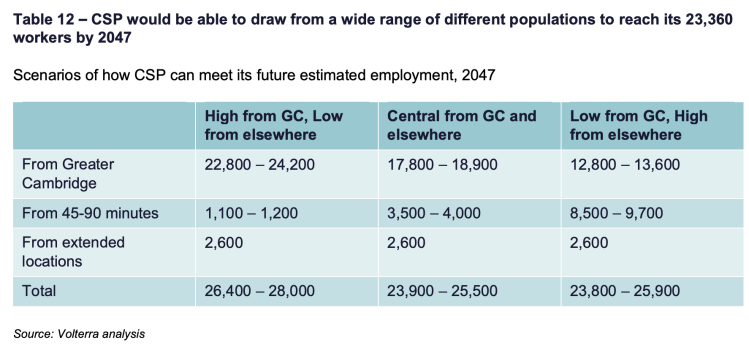
Above – Transport Assessment p18/p19pdf
Is the Combined Authority keeping records on the committed travel plans, and on the data coming from the monitoring they have committed to?
The assessment by Tam Parry of Cambridgeshire County Councils Transport Assessment Team in a separate document highlights what the county council thinks the developers should be required to sign up to.
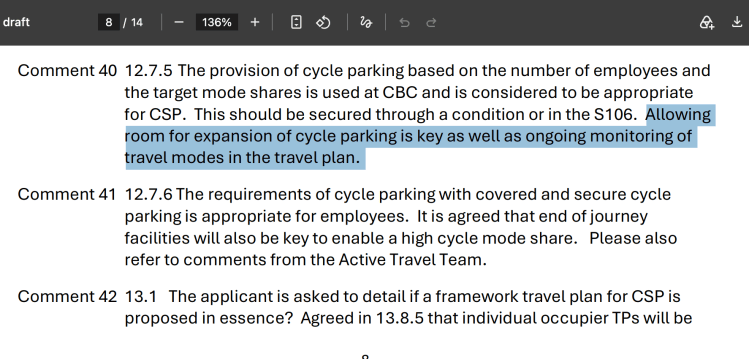
Above – CSP – CCC Comments Travel Assessment p8
The same questions on data collection and monitoring apply: Who is monitoring the monitors? Who is collating the data coming in from the monitoring? Who is analysing the data and reporting them to the committees of democratically-elected councillors?
“Is this something that the Greater Cambridge Development Corporation officers might be interested in?”
I hope so!
This stems from the cross-examination of Peter Freeman and CamDevCo Officers last week at South Cambridgeshire Hall by the District Council’s Overview and Scrutiny Committee (See my blogpost here). With the Government having set out the powers it plans on giving the CamDevCo and the floor above which the latter will take responsibility for, I think there’s a case for their officers to get hold of all of the transport assessments for all of the large applications of the last 5-10 years that would fall within the CamDevCo’s remit had it been established back then.
This also relates to my public question to the Combined Authority’s Transport Committee of 09 September 2026 when I asked for a progress update on research undertaken by the CPCA on assessing the level of private commuter buses in/around Cambridge and the options of integrating at least some of these into the Mayor’s new bus franchising plans. The meeting papers are here (including the text of my question at No.4) and the response from Cllr Chris Boden (Cons – Fenland District Council) is in the video from 17m in.
Cllr Boden confirmed that the CPCA is recruiting for an Integrated Transport Officer to lead on this work – which also reminds me of what Mr Freeman said about the recruitment of transport expert Richard di Cani to the Board of the CamDevCo. At some stage the two sides will need to sit down and work out how to avoid duplicating each other’s work – and also share data sets. Given the responses from the two meetings, it sounds like this is something we’ll have to come back to in a year’s time. (Note you cannot ask the same question within 12 months to the same committee).
The Workforce Accessibility Study compares the Cambridge Science Park with the Cambridge Biomedical Campus
This should be publicised to any geography students looking for Cambridge employment-based case studies!
“By expanding from roughly 12,000 employees in 2017 to over 22,000 by 2025, CBC demonstrates that concerted masterplanning, large-scale clinical/pharma anchors (e.g. AstraZeneca) and dedicated transport investments can nearly double the employment at a major site in under a decade. Its success shows [Cambridge Science Park] could similarly leverage flagship tenants and rail links (e.g. Cambridge North) to attract a far higher volume of local STEM talent.”
Above – CSP Workforce Accessibility (2026), p7
What the above report does not consider is what the local impact of that substantial population rise is.
Which reminds me – the next Cambridge Biomedical Campus Open Forum is on Monday 21 September so I might ask them what assessment they have made of the impact of such a huge rise in employment numbers on the surrounding neighbourhoods, and if they have any advice for the Cambridge Science Park!
The Cambridge Science Park is looking to increase the percentage of workers it draws from within Cambridge City and South Cambridgeshire District over time
The result of this is that it aims to employ a higher percentage of the total actively working/seeking work population of Greater Cambridge over the next quarter of a century as it grows.
That creates public policy issues – both costs and benefits
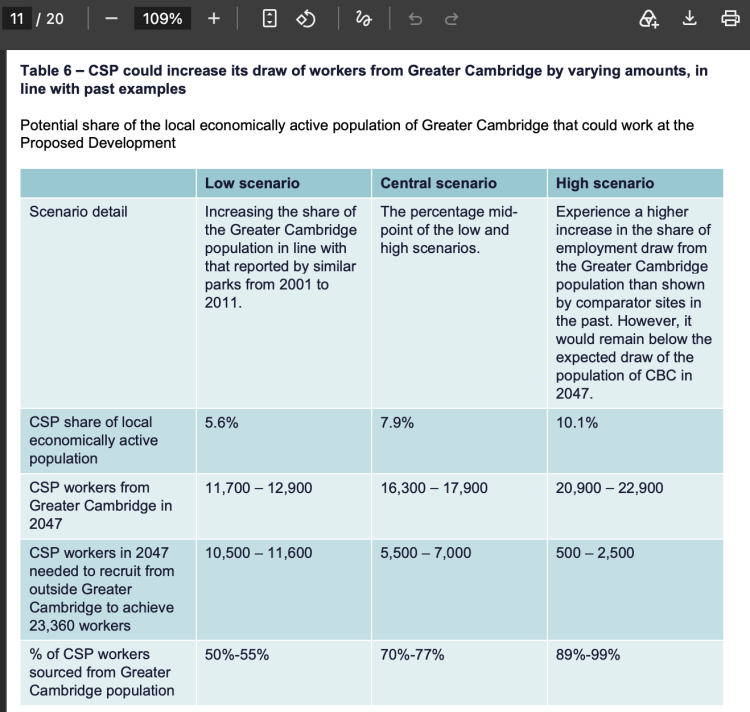
Above – CSP Workforce Accessibility (2026), p11
A host of questions arise from this objective of the Cambridge Science Park. My questions include:
*If the Cambridge Science Park aims to employ a higher percentage of the working population of Greater Cambridge…*
- …which of the existing employers or industries does it expect to reduce its share of the working population, and what evidence does it have to show this?
- …what arrangements does it have in place to retrain those workers made redundant / looking to career-switch to work for CSP employers, mindful that Cambridge still does not have a large adult education/lifelong learning college? (How much would Trinity College, Cambridge, the CSP’s owners, be willing to contribute financially to this?)
- …are its figures based on a static population eg the populations of the Census 2021, or do the projections move with the projected population? (In which case a higher percentage of a higher base number means much more people than if the analysis assumes a population fixed at the 2021 levels)
- …does it assume that CSP firms/employers will be competing with the Cambridge Biomedical Campus and also RailPen’s Beehive Centre on salaries and other benefits – and where does it expect to see ‘cost push inflation’? (i.e. which job types?)
- …what proportion of the population will be people who already live in Greater Cambridge and what proportion will be people who move to Greater Cambridge from outside? (Irrespective of whether that’s next door over the county boundary in say Hertfordshire, or from the other side of the world). What programmes for population integration are you exploring? (This question could easily be put to other big developers including the Cambridge Biomedical Campus, RailPen, and Brookgate – and additionally to what will become the Greater Cambridge Unitary Council)
- …what public transport infrastructure would you be willing to contribute towards? (The context here is I opposed RailPen’s planning application for The Beehive Centre on the grounds they showed no interest in building a new railway/light rail station over Coldham’s Lane Bridge – but the minister ignored me and everyone else, and approved the application following a controversial last minute call-in).
- …that still leaves large numbers of people commuting in from outside Greater Cambridgeshire – especially those you highlighted who are in ‘well-connected areas’. the Workforce Assessment in a scenario with a low percentage of additional staff coming from within Greater Cambridge assumes up to 11,600 workers coming in from outside Greater Cambridgeshire by 2047. Have you informed local councils along:
- the King’s Lynn-Cambridge-Hitchin railway line
- the Norwich-Ely-Cambridge line
- the Peterborough-Ely-Cambridge line
- The existing guided busway from St Ives? (i.e. Huntingdonshire District – mindful they have a substantial local plan they’ve just voted to submit to ministers)
Just a quick thing on integrating new arrivals in new build estates with existing communities – some research
This comes from Humanise.org’s community engagement case studies. Their third case study looks at urban extensions. How do you make residents of an urban extension feel part of the existing town/city? Additionally, there is the risk that in investing in community development resources for those new developments, how do you ensure existing communities don’t come to resent the new ones? This is particularly an issue where large developments of new social housing are undertaken in places where existing social housing communities are on a much smaller scale. (This was something that was put to me a few years ago, a young mother asking me at a community event why north Cambridge got all of the fun things and in the smaller council estates in the south we got hardly anything).

Above – Case Study 3: Soft Edges, by Humanise (2025)
If you are interested in the longer term future of Cambridge, and on what happens at the local democracy meetings where decisions are made, feel free to:
- Follow me on BSky
- Spot me on LinkedIn
- Like my Facebook page
- Consider a small donation to help fund my continued research and reporting on local democracy in and around Cambridge


