Peter Freeman confirmed this in his opening remarks to South Cambridgeshire District Council’s Overview and Scrutiny Committee of 18 Sept 2026. The Committee Chair Cllr Dr Richard Williams said that he wanted to see more detail and clarity on the plans following the Q&A session, and asked that this be put to ministers and senior civil servants.
The slide show also featured a proposed new green loop around the expanded city, which would connect all of the greenways (the cyclepaths, bridleways, and footpaths that are A-to-B routes from the villages into Cambridge, the new ones being funded by the GCP)
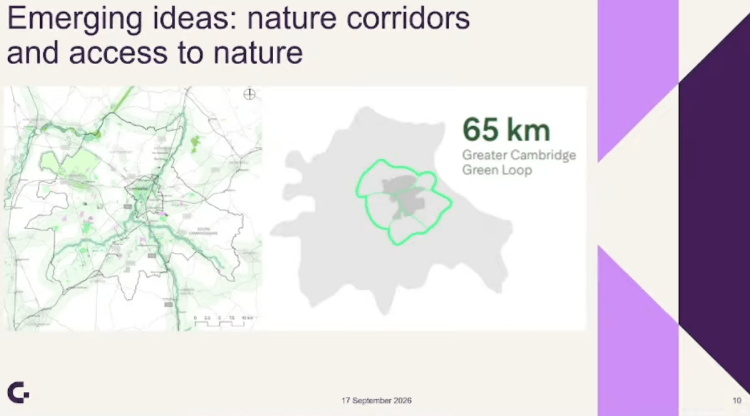
Above – the proposed Green Loop, one of the proposed ideas to connect up the Greenways and nature corridors
The airport announcement was made earlier this year (I wrote about it here) only at the time I wasn’t sure what the percentage stake Homes England – effectively the Government, had in the joint agreement with Hill the developers.
“Homes England [on behalf of the GCDC] has a 40% stake of the airfield …we get vacant possession in 3 years time and will hit the ground running with planning & designs up and away”
‘We have one of Britain’s leading transport strategists on the GCDC / CamDevCo Board’
Mr Freeman highlighted the appointment of Richard de Cani from Arup, previously of the Department for Transport and the Mayoralty of London. Back in 2022 Mr de Cani took part in this conversation about the future of cities – you can watch the video by Arup here.
This was part of his summary of the new board members, which are listed here. Mr Freeman also stated:
“Over the next 12-18 months we have a series of emerging milestones”
- Integrated transport
- Water
- Creating a focus group who have an horizon that is at least 25 years, but also that can ‘hit the ground running’, that can also solve the chronic problems that have been affecting Cambridge for years
He finished his opening statement with a commitment that Cambridge must become a wonderful place to live – for both existing and future residents. So whatever plans the CamDevCo comes up with will have to work for existing as well as new residents.
This was followed by a series of short slides led by Beth Dugdale (Deputy Chief Executive) and colleagues covering progress since they last addressed local councillors. This starts from around 30m here.
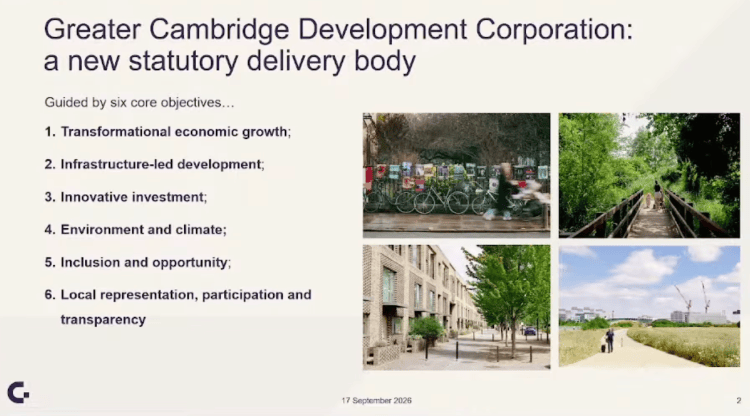
Above – the six core objectives of the Greater Cambridge Development Corporation set by central government (The Minister for Housing and Planning being the accountable minister)
- Transformational economic growth
- Infrastructure-led development
- Innovative investment
- Environment and climate
- Inclusion and opportunity
- Local representation, participation, and transparency
Questions from councillors: “Where is the money coming from – the very large sums needed?”
The Chair Dr Richard Williams (Cons) questioned Ms Dugdale, saying councillors are concerned that ministers have not committed the money that ‘s needed for transformational growth. Have a listen to his question here.
Ms Dugdale responded saying that the CamDevCo will have substantial borrowing powers – with discussions on how to make that happen with HM Treasury. She also said that while £500million committed is a good start, there’s no point in making a pitch for a huge sum *now* without substantially prepared plans on what it is going to be spent on.
This for me highlights one of the key faults with the GCP/City Deal: The total amounts were announced but the projects as far as the public were concerned, were not. And the most important aspect for the public was the mode of transport – something that board members and senior officers refused to provide sufficient clarity on which is a reason why the question never went away. As the election of the CPCA Mayor Paul Bristow with his manifesto commitment for a light rail for Cambridge demonstrated.
“The backbone of the proposed strategy is a transport network to link areas of population and employment within the City Deal area. There will be new orbital bus routes around Cambridge and new high quality public transport links into Cambridge on key corridors, connecting with major employment centres”
Above – Cambridge City Deal Agreement, 20 June 2014, p3/4
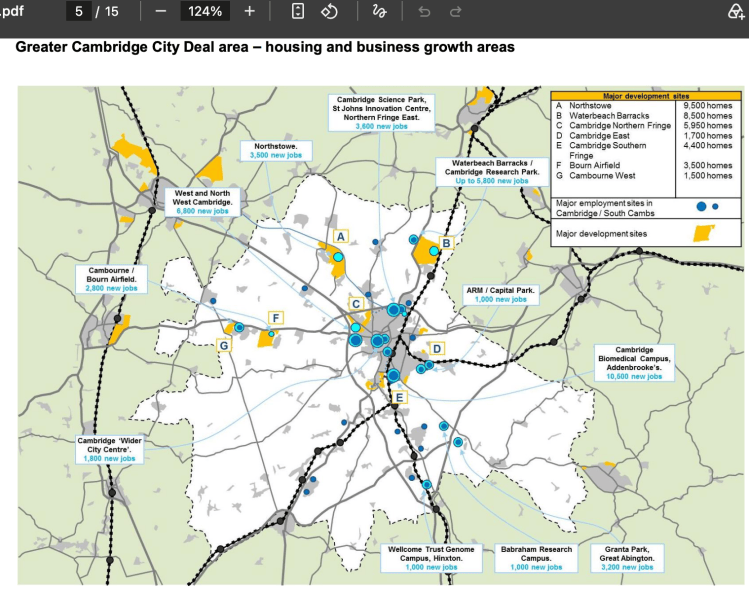
Above – the map from the City Deal agreement of June 2014 on p5 of the agreement – 12 years later now hopelessly obsolete and no building work on any of the ‘high quality public transport corridors’ has actually taken place.
Questions from councillors: “What will happen to the highly-rated Greater Cambridge Shared Planning Service?”
This was tabled by Cllr Anna Bradnam, which Ms Dugdale replied to here.
“We are absolutely clear we are following on from the local plan – we are very supportive of the sites being brought forward.”
Above – Beth Dugdale responding to Cllr Anna Bradnam’s questions on the status of both the shared planning service and the development plan powers. Ms Dugdale also confirmed that the CamDevCo would only seek to acquire the development planning powers *after* the draft local plan had been through the Examination in Public processes and signed off by the Secretary of State for Housing, Communities and Local Government. [Personally I think that department could be renamed ‘The Department for England” given its geographical remit and policy remit]. Ms Dugdale also mentioned that this process would require further approvals from Parliament – which would involve ministers having to appear before a committee of MPs as happened with the hearing to establish the new development corporation.
Developers and planning applicants should engage with the Greater Cambridge Shared Planning Service in the first instance for new planning applications – i.e. business as usual
Cllr Bradnam’s planning question was followed up – have a listen here.
Question: “What do you mean by transformational economic growth?”
Ms Dugdale’s response was to ‘watch this space’ for the new KPIs (Key Performance Indicators) which will have to be signed off by ministers.
Question: “Mass rapid transport”
This was picked up by Eoin McCaul, the LDR for Greater Cambridge here – have a read.
“There have been many proposals in the past for metro services, tunnels under the Cam…none of which have come to fruition. There is a degree of cynicism – where are we on the mass transit network? Will it stop at the boundaries or extend to Newmarket, Ely, and Haverhill?”
Have a listen to the question in full here from Cllr Mark Lunn
“We are undertaking a strategic business case so that is demonstrating the need/case for change rather than the solution… That [mode of transport] won’t be defined until the next stage”
Above – Response from CamDevCo officers.
Which basically means that The Government needs to make a more detailed case demonstrating that their growth ambitions cannot happen *without* something that involves not the private motor car. Or standard bus services.
Timescales?
First phase aligns with the CPCA Mayor’s transport strategy which should be done by November 2026. Very early January 2027 looks like when the CamDevCo will publish its outline strategy.
Cllr Dr Richard Williams said he was not satisfied with the vagueness of the responses coming from CamDevCo officers.
Have a listen to his questions here
There was a bit of a gap before Peter Freeman stepped in – Dr Williams recognising that his question needed to be put towards the Minister for Housing and Planning, Matthew Pennycook MP.
“You are, I’m afraid, the only way we have got of communicating with the Minister.’
Above Cllr Dr Richard Williams to Peter Freeman and officers.
“I sympathise with your point of view’ – Mr Freeman’s response. He then gave a summary of the processes involved and the detailed work involved in coming up with future transport infrastructure solutions – which if anyone has had the misfortune to read through Greater Cambridge Partnership meeting papers knows is ***substantial***.
Mr Freeman also said that until Parliament had approved the creation of the CamDevCo, and until Richard Di Cani had joined the Board, there was actually very little of substance that Mr Freeman and his team could actually do beyond establishing the structures, systems, and processes of the institution.
As is always the case, local institutions on the ground have to work with whatever central government imposes on it. The CamDevCo is the third major institution that has had powers and/or a very strong influence on transport infrastructure (the GCP/City Deal, and the Combined Authority being the other two) which would not be needed for similar programmes in other countries. All of that is tied up in the question of how to finance local government. In the UK’s constitutional set up with a Sovereign Parliament, local government does not have constitutionally protected powers – including on taxation, that other countries have. Which is why governance-wise making comparisons between UK cities and cities in other countries is ***really problematic***. Ben Schofield tried for BBC Look East comparing Cambridge with Gothenburg in Sweden, and ended up missing the big picture because the news cycle focus was on congestion charging only. Comparative local government is not something for a short regional news item!
“My criticism of the [Cambridge-Gothenburg] comparisons – then as now with any UK-continental European comparison is that the UK has a much more centralised system of government – local councils have far fewer, much more narrower revenue-raising bases.”
Above – my response in a blogpost from September 2024
Question: “How will the CamDevCo work with NHS organisations to ensure doctors surgeries and dental clinics are staffed, and not just empty buildings?”
This question from Cllr Sunita Hansraj which you can listen to here is another critical issue that is persistently raised by residents and one that successive governments have not had a sufficient answer to.
Ms Dugdale said that the new community facilities have to be able to deliver the new NHS community delivery model that the Government is bringing in. By the sounds of things Ms Dugdale has escalated that issue to ministers and senior civil servants (which is a good thing) because while it is technically outside of the powers of the development corporation, the latter will fail in its objectives if the NHS institutions do not co-operate. And that co-operation ultimately comes from the top.
Question: “The CamDevCo is taking planning powers but the area that’s failing is with transport… …what are your plans to transform the [failing] bus network?”
Councillor James Hasbro focused his questions on past failures and specifically on buses
Ms Dugdale reminded councillors that they had to stay within their legal remit and were focusing on co-operating with the statutory arrangements that the Combined/Strategic Authority has on transport.
Philip Harker for the CamDevCo also said they were working with the Combined Authority on delivering its transport strategy which I wrote about recently here.
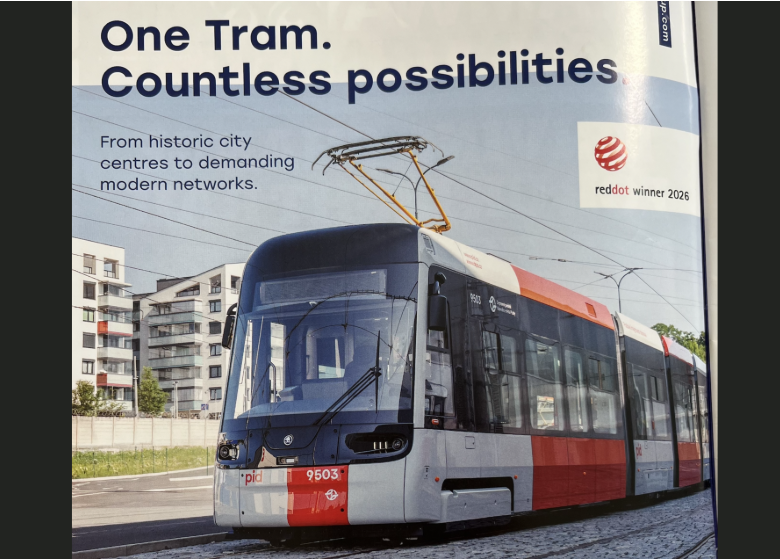
Above – don’t expect a decision on trams and light rail until early 2027 at the earliest. CamDevCo officers confirmed that the high level strategic /outline planning they are working on is about making a case for public transport investment as a principle to support growth, not on which transport system.
Ms Dugdale confirmed that this was part of the standard processes they had to go through as set out by the Department for Transport.
“It’s very early days” on the ‘how to finance’ all of this work, Ms Dugdale said, but she confirmed that land value capture was one of the options on the table.
Question: “What’s happening with the water?”
His concerns included
- Water credit system
- Options beyond the Chatteris reservoir to increase water supply
- Timelines – delivery has not sped up despite ministerial statements
Philip Harker responded for the CamDevCo – and he confirmed that the water credit system ‘has not been actively progressed.’ This is something that local MPs need to raise with ministers as it’s beyond the control of the development corporation officers. Furthermore, the Cambridge Water Scarcity Group should be asked for a statement.
Question: How will the DevCo seek to bring nature to communities? We don’t just want pocket parks in urban areas
Pocket parks are one of my pet hates and have been for years.
“The new developments we build need to have large open green spaces in them – not ‘pocket parks’ or concrete squares.”
Anyone remember Cambridge Great Park?
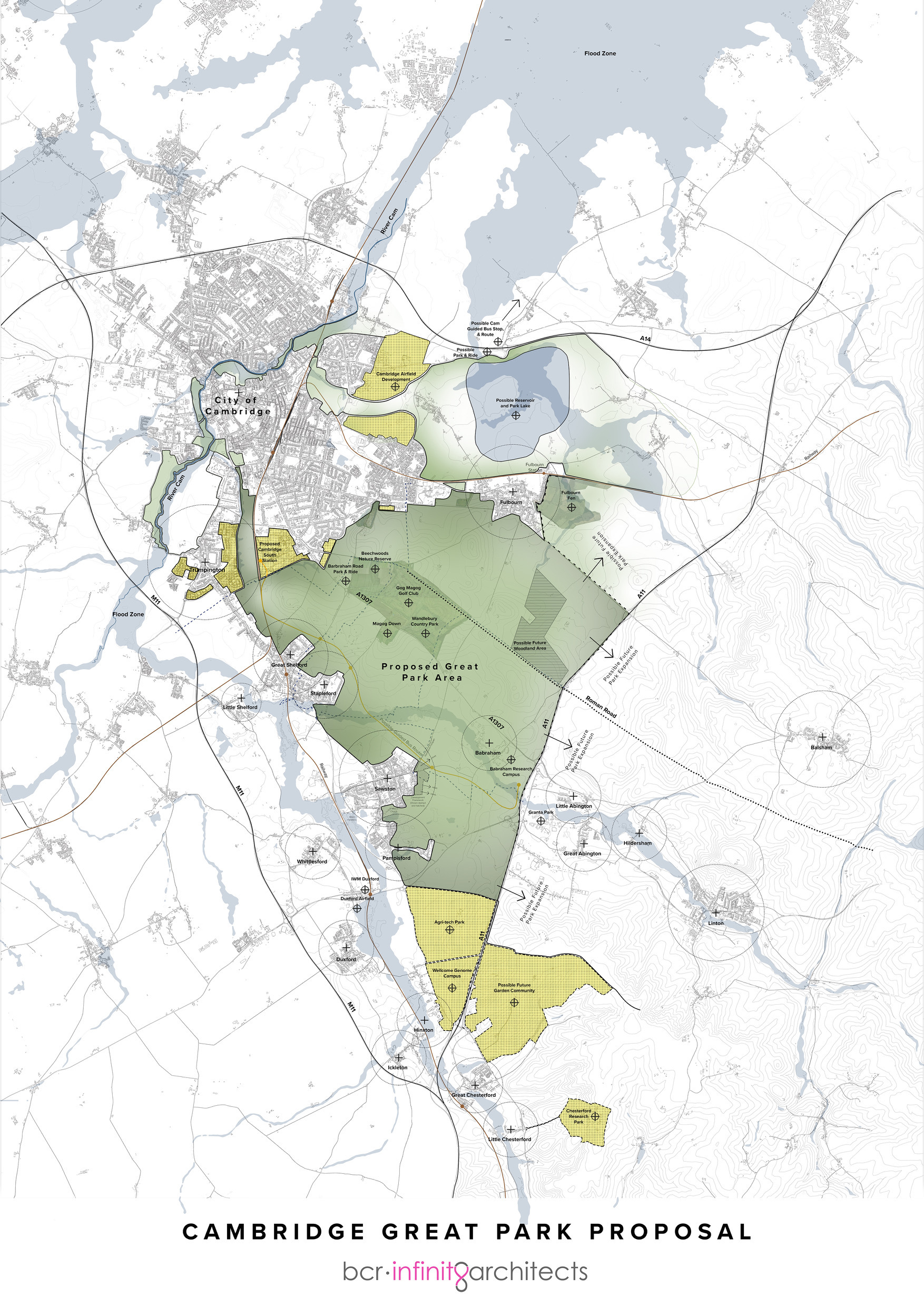
I also think that this should also incorporate some new woodland cemeteries/burial grounds. The burial study is included in the draft local plan wellbeing evidence reports which I wrote about here.
Combined Authority Board meets next week
Meeting papers are here if you want to browse through them. They include a new tourism brand.
Above – Wonder (and wander?) Further
If you are interested in the longer term future of Cambridge, and on what happens at the local democracy meetings where decisions are made, feel free to:
- Follow me on BSky
- Spot me on LinkedIn
- Like my Facebook page
- Consider a small donation to help fund my continued research and reporting on local democracy in and around Cambridge


