The House of Lords gave its approval on 22nd July 2026, while the House of Commons gave its approval a couple of weeks earlier
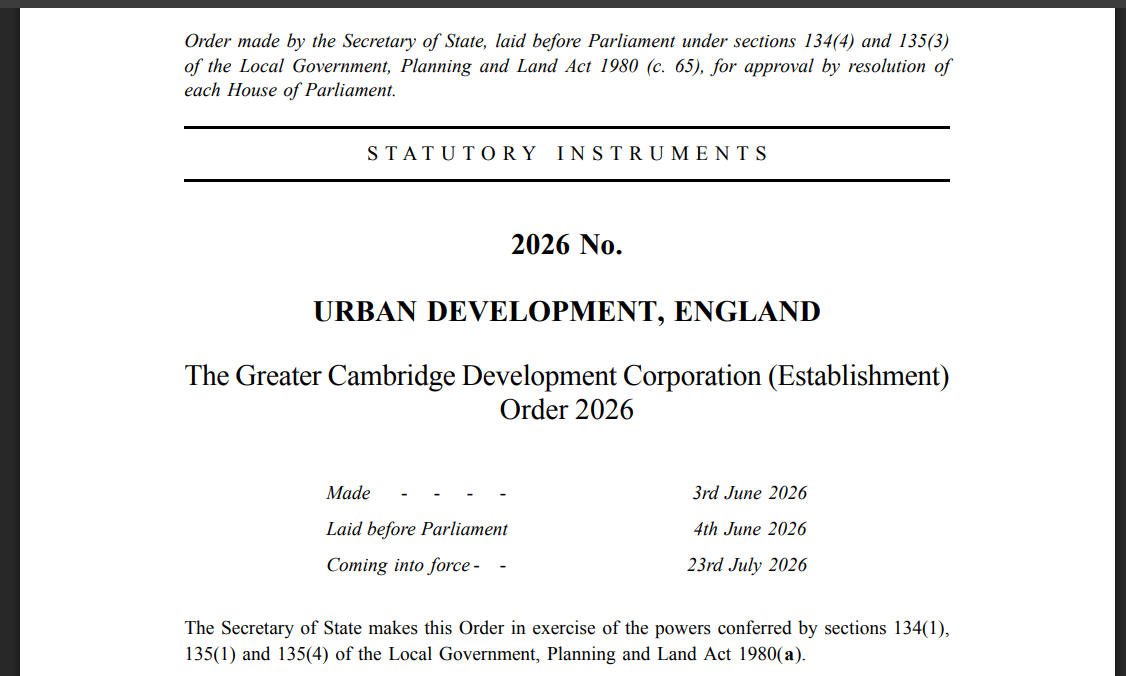
Image – detail of the Order creating the development corporation. Read the full Order here.
You can read the transcripts of the debates:
- House of Commons 08 July 2026 – and also see the video of the debate on ParliamentTV. Of the 18 members attending, 11 voted for the motion creating the CamDevCo, and one voted against. The rest abstained.
- House of Lords 22 July 2026 – and also see the video of the debate on ParliamentTV
House of Commons debate – the Minister’s case
The Minister Matthew Pennycook MP highlighted the high level shortcomings and failures by existing institutions, concluding that they did not have the legal powers to deliver what was required for them.
This was the more significant exchange for me because Mr Pennycook is the minister with policy responsibility for Cambridge, and is well-read-up on the issues. His counterpart in the Lords, Baroness Sharon Taylor, the former council leader at Stevenage, has to cover the entire policy portfolio for her department – which is not an easy task at the best of times because the more difficult and challenging questions tend to come from the Lords, not the Commons.
“The prevailing theme among responses was that infrastructure delivery in greater Cambridge has been slow and piecemeal, or has failed to keep pace with historical population and employment growth, and that that was having a detrimental impact on residents’ quality of life, constraining the region’s ability to scale its globally significant innovation economy, and reducing business and investor confidence.”
“Individuals and organisations widely reported that greater Cambridge has lacked a strategic, co-ordinated and long-term approach to the rapid delivery of primary infrastructure. Complex governance, fragmented decision making and uncertain long-term funding were identified as obstacles to delivering at the scale and pace required.”
“While fully acknowledging the strong local efforts that have been made and the excellent performance of the greater Cambridge shared planning service, the consultation confirmed the Government’s belief that the scale and complexity of the development challenges faced by greater Cambridge required a bold and long-term approach, and a genuine step change in how infrastructure is planned, co-ordinated and delivered; and that the establishment of a centrally led development corporation, combining responsiveness to local priorities with national leadership and influence, would be the most effective way to unlock nationally significant growth at the pace and scale required.”
Above – Matthew Pennycook MP, Minister for Housing and Planning, 08 July 2026
The Minister confirmed the development corporation boundaries are not set in stone
“The Government would, of course, consider, through due process, any changes to the development area that are deemed necessary as a result of any local government reorganisation”.
Above – Minister Pennycook in response to Lewis Cocking MP (Cons – Broxbourne)
The Minister also acknowledged the shortcomings with previous generations of public consultation and engagement.
“[The Development Corporation] will be asked to create exemplary engagement structures to enable broader community participation, including from residents, community representatives, and town and parish councillors.”
Above – Minister Pennycook.
The Minister confirmed that sites of 1,000 units (of accommodation, eg flats in tower blocks) would fall into what would be considered as strategic developments by the Development Corporation, and will be for it to determine rather than local government planning committees.
“The development corporation will also be granted development management powers for strategic sites within its boundary. Only applications for sites of strategic importance will be determined by the development corporation. The vast majority of planning applications will continue to be determined by the greater Cambridge shared planning service. The Government recognise and accept that almost all strategic residential developments will be of over 1,000 houses, flats, or houses and flats.”
Above – Minister Pennycook.
“Does this mean big developers and developments will bypass everything?”
Not at all – the Minister confirmed that ***the existing and later on the draft Greater Cambridge Local Plans will continue to apply***. That means developers can’t make their developments extra dense in the hope that the development corporation will give them an easier ride. They won’t.
“Any application that is determined by the development corporation will still be considered against national and local policy, and subject to public consultation as normal.“
Above – Minister Pennycook.
“The problem is that public consultation functions have been failing for over a decade”
Back in early 2016 I wrote a blogpost following a Birdsite exchange with Roger Mosey, then the Master of Selwyn College, Cambridge and before that a BBC News Executive (his book on how to make the News better is worth reading) about how Cambridge should communicate with its residents.
“As well as meetings of Cambridge City Council, South Cambridgeshire District Council and Cambridgeshire County Council, single local government reporters also have to cover the Greater Cambridge City Deal and any community actions that are vaguely political. That is a massive remit even with the support of a friendly team of community activists/reporters to source news stories from.”
Above – ADBF [My old blog], 29 March 2016
News reporters no longer have the benefit of that friendly team of community activists and reporters. One way or another, most people either moved away, lost interest, moved onto other interests, or passed away – the latter being inevitable when the people who are most engaged decision-making processes are of advanced years. As a city – and as a country we are appalling poor at educating and informing younger generations on how politics works, and how to influence decisions that are being made about where they live and work. Remember my generation in South Cambridge in the 1990s had a 15 minute talk from a county councillor just before our GCSEs. And that was it. No, I haven’t forgiven John Major’s government for that appalling piece of national civic vandalism. [It’s a personal neurodiversity thing – I can hold a grudge against institutions from the last millennium for a stupendously long time with an utterly irrational intensity!]
So for those of us approaching or in middle age, we’re starting from ground zero unless we’ve got professional or voluntary interests in government and politics
Working with neighbouring countiesa
“The Greater Cambridge Development Corporation will focus on the delivery of strategic, nationally significant growth within its boundary. It will work collaboratively with local authorities both within and bordering its development area, as well as with transport bodies and utility providers, to unlock development opportunities and boost economic growth.”
Above – Minister Pennycook.
This will be significant for rail-based transport links to places like:
- Haverhill
- Royston
- Saffron Walden
- Cambourne and St Neots
- Peterborough & Wisbech
- Chatteris & Huntingdon
“What did opposition MPs say?”
The main substantive issue from the Conservatives was that of the Combined Authority Mayor.
” One issue is that the English Devolution and Community Empowerment Act 2026 envisages that new mayors will take on many of these development powers. Given that a decision on local government reorganisation structures in greater Cambridge and many other areas is likely to be imminent, what thinking has there been about how the powers of the corporation will be transferred to the new mayoral or combined authority once it comes into being, if at all?”
Above – David Simmonds (Cons – Ruislip, Northwood and Pinner)
Mr Pennycook responded:
“The order establishes, as a corporate body, a centrally led urban development corporation, not a mayoral development corporation. The sitting Mayor of Cambridgeshire and Peterborough will have representation, with a seat on the board, but the mayor and his area will not be controlling this development corporation; it is very different from the mayoral development corporation model.”
If looking through a party-political lens, basically ministers refused to hand over control of Cambridge to an opposition Mayor – just as the Conservatives refused to create a unitary council for Cambridge that the LibDems asked for in the early 2010s, resulting in the creation of the much-maligned Greater Cambridge Partnership that was negotiated involving a Conservative-led county and South Cambs District, and a Lib-Dem-run city council, only for the latter to lose political control to Labour in 2014 when the negotiated deal was signed off.
Local MP Dr Ian Sollom (LibDems – St Neots and Mid Cambridgeshire) Speaks up
Dr Sollom was a former local councillor before being elected MP for the newly-created St Neots and Mid Cambs, a constituency formed out of the rump of the old South Cambridgeshire constituency which was effectively reoriented to cover the southern end of the county plus an additional Cambridge City ward, won by his party colleague Pippa Heylings MP.
Dr Sollom agreed with the analysis of the problems, but not the solution proposed by the Minister.
“I would like to be clear at the outset that the diagnosis behind the idea of the corporation is one that I and many in the area broadly share. Cambridge’s growth is constrained by water supply, wastewater capacity, and transport and energy infrastructure…Nobody disputes that.“
Dr Ian Sollom MP (LibDems – St Neots and Mid Cambridgeshire)
He called out the lack of information about the functions and powers of the proposed development corporation:
“However, the Lib Dems cannot support establishing a corporation whose purpose remains undefined at the point at which we are being asked to approve it. This order does one thing: it creates the Greater Cambridge Development Corporation in name…. …We are being asked to vote on an institution before we know what it will be for. That is not just a procedural quibble; it goes to the heart of whether development corporations actually work.“
Dr Ian Sollom MP (LibDems – St Neots and Mid Cambridgeshire) to Minister Pennycook
Dr Sollom also had concerns about geographical scale (“We are establishing what will be the largest urban development corporation of its type, covering an area almost double that of all 17 previous urban development corporations combined…”), and whether planning permissions was the problem.
“The greater Cambridge area already has planning permission for 37,000 homes that have not yet been built. The evidence is clear that planning is not the barrier at that level. Water, sewerage and transport—those are the barriers”
#IAgreeWithPuffles
Remember the March 2020 Budget just before the first lockdown? I do!
“The government is also going to examine and develop the case for up to four new Development Corporations in the OxCam Arc at Bedford, St Neots/Sandy, Cambourne and Cambridge, which includes plans to explore the case for a New Town at Cambridge, to accelerate new housing and infrastructure development.”
Above – Budget 2020, Section 2.20, OxCam Arc
I wrote about the above in my old blog here, where I complained about our city and county’s broken governance structures.
“I’ve stated my views repeatedly – we are long overdue a national restructure of local government – powers, funding, boundaries, the lot. Even the meeting formats.”
I also referred to a blogpost from 2017:
I pointed out in the 2020 article the proposals from 1945 which highlighted the old county-district structure – what was Cambridgeshire County Council being the shaded area in pink until the 1960s.
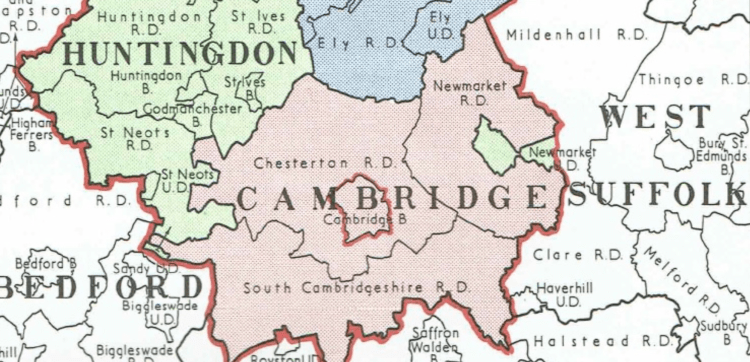
Above – from A history of local government in Cambridgeshire 1835-1958
This was before I found out about the proposals from Nathaniel Lichfield and Lord Redcliffe Maud in the 1960s which is featured halfway down in this blogpost.
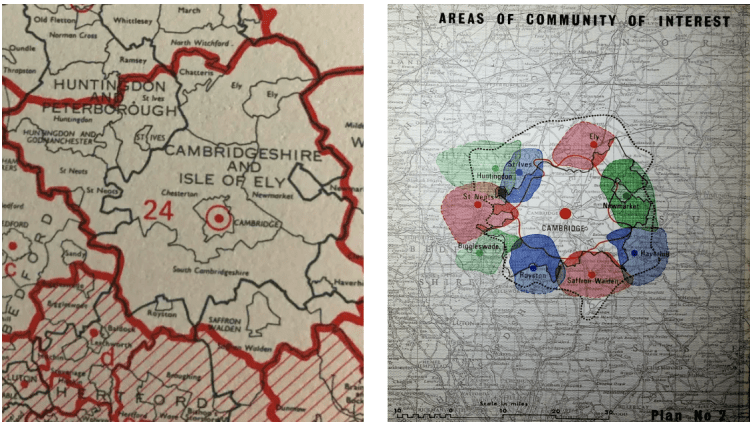
Above – left: Detail of Redcliffe-Maud (1969), and above-right, detail of the Cambridge Sub-region, Lichfield (1965). A circular suburban or light rail line and network sells itself
Dr Sollom referred to concerns from his predecessor–but-2, the former Health Secretary who now chairs the CamDevForum who raised the same issues over boundaries that were the ones I had been going on about for years! (Hence #IAgreeWithPuffles which became a mini-meme in the early 2010s)

Above – Puffles the Dragon Fairy who spent much of the 2010s at local council, GCP, and CPCA meetings as a sort of mascot for everyone else trying to scrutinise what decisions were being made about our local area.
“What did their Lordships say about the CamDevCo?”
What was interesting was how the former MP for South Cambridgeshire (it’s a decade+long personal style-guide thing for my blogs) stated so many things that I had written in these blogposts. (He can’t have read them – surely?!?!)
“We need to look at this development corporation and ask: how does it add value? The Minister was absolutely right: it is by building out the infrastructure. I will give just one example: the mass rapid transit requirements around Cambridge. Cambridge Ahead has said recently, on where the Cambridge cluster really extends to, that in the years ahead we are looking at what is, in effect, a polycentric system of Cambridge and related large settlements which will form part of a functional economic geography. If you look at a map, a 20-mile radius around Cambridge includes Ely, Newmarket, Haverhill, Royston, St Neots and Huntingdon.”
Above – the Former MP for South Cambridgeshire (Cons 1997-2015), House of Lords 24 July 2026
Re that final paragraph, that’s exactly what Lichfield produced for us in the 1960s. Only the Conservative Government that followed under Sir Edward Heath did not take the chance to create a new unitary or even a two-tier council to join up all of those market towns within Cambridge’s economic sub-region to ensure co-ordination of policies.

Above – see Lichfield (1966) p7 here for an explanation
The call to reconnect Huntingdon to Cambridge by rail
“Huntingdon is an excellent example. We need mass rapid transit to Huntingdon, in addition to the A14 and the Cambridgeshire Guided Busway.”
Let’s look at the old railway map to see what happened
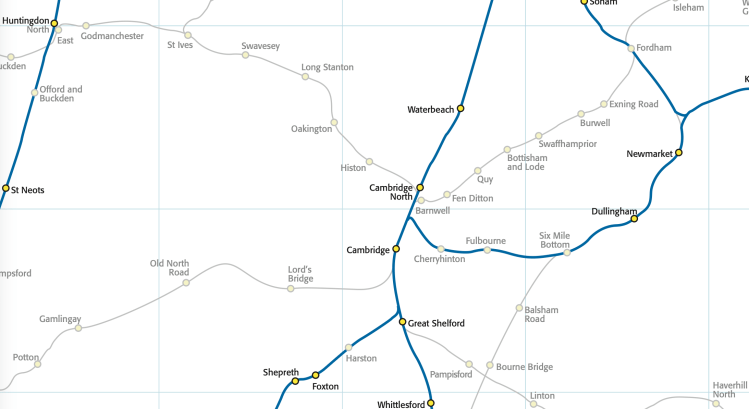
Above – detail from the New Adlestrop Railway Map, what we used to have
The old Huntingdon East Station was closed to passengers in 1959 – which would have been Harold MacMillan’s Conservative Government, but just before the corrupt scoundrel that was Ernest Marples, the Minister for Transport, appointed Dr Beeching to wield the axe on the railways. As Christian Wolmar stated in a biography on the former:
“…What the book makes clear is that [Marples‘] views which enabled this disdain of the railways together with the belief that the car was king were very much the result of heavy lobbying by vested interests such as the Road Haulage Association. Indeed, Marples himself who, when appointed as Minister of Transport had large shareholding in the roadbuilding company Marples Ridgway and which he then passed on to his wife. The Beeching axe fell while simultaneously motorways and ring roads were being constructed around the country”
Above – Christian Wolmar, review of The Shadow behind Beeching, 25 June 2022 .
Which reminds me, have a look at Mr Wolmar’s book about Trams from 2016. Have things got better since re trams and light railways?

Above – Are Trams Socialist? (2016) Wolmar, London Publishing
Natalie Bennett speaks for The Greens on the future of Cambridge
The former Leader of the Green Party was a regular visitor to Cambridge in the mid-2010s, and was the spark behind the revival of the party in that era. You can watch her responding to Qs on housing, greenbelt, and lack of public transport from just before the 2015 general election here.
In the debate in the Lords, she raised many of the points that local councillors of the three main parties on Cambridge City Council had raised – in particular democratic control of local planning, and the water crisis that still is not resolved. She also noted the loss of party political control by Cambridge Labour of Cambridge City Council following the elections a couple of months ago – one which the Green Party leapfrogged over the Liberal Democrats to become the official opposition party at the Guildhall.
“The corporation model is designed to accelerate growth far beyond what local infrastructure, water supplies and fragile ecosystems can sustain, while stripping democratic control from Cambridge and Cambridgeshire residents.”
Above – Natalie Bennett (Green Party – House of Lords) 24 July 2026
‘Fix the existing infrastructure first’ says Natalie Bennett
This is the importance of having local links to members of the House of Lords.
“The inadequacy of the infrastructure there has been demonstrated by the conditions in Addenbrooke’s Hospital during the recent heatwave. Media reports indicated that four staff members went home ill and two more collapsed at work—and that is the staff. There is a clear need for significant investment there, as well as in the more than 60 schools that either closed early or indicated that pupils could leave because they were too hot.”
Above – Natalie Bennett (Green Party – House of Lords) 24 July 2026
For those of you who know me, you’ll be aware of my stays in hospital where on every occasion staff were overstretched.

Above – a depressingly frequent sign from when I was admitted in summer 2025 when the hospital ran out of specialist beds. I blogged about it here.
“That question of how does hospital capacity relate to that growth in population [the A&E unit having last expanded in 2001, since when the population of our city has grown by over 30,000, and that of surrounding districts in the catchment area by even more] was his central question. And we indicated that there is no correlative funding that follows the growth in population, but the concerns on the pressure on our infrastructure and that of the patient experience is centre to our debate with Government…. ….We had extensive discussions with him and his team over the summer on that particular point.”
Above – Dr Mike More, 29 Sept 2023, quoted in CTO 11 Oct 2023
To be fair to Dr More and to Peter Freeman, chair of the Cambridge Growth Company, now the development corporation, they made the case for bringing forward the work for a ‘New, New Addenbrookes’ (the current Addenbrooke’s being the ‘New Addenbrooke’s’ and the Judge Institute being the building/site of the ‘Old Addenbrooke’s.
Hence Addenbrooke’s 3 here
The Cross-Bencher Lord Best welcomed the new development corporation:
“Development corporations can do so much better. By capturing the land value, now without the necessity of incorporating hope value, with the possibility of using compulsory purchase powers as a last resort, a development corporation can deliver a high-quality master plan to include much-needed affordable homes and social and community benefits.”
Land value capture was one of the powers the first CPCA Mayor James Palmer said he needed to pay for the proposed CAM Metro – but ministers did not prioritise this.
Lord Smith of Cambridge University and Finsbury
The new Chancellor of Cambridge University spoke in that capacity, and spoke in support.
” I welcome the establishment of the Greater Cambridge Development Corporation. It will, quite simply, speed things up and cut through bureaucratic delays.”
His three issues/concerns were:
- We’ve heard it all before about infrastructure, citing the delays with East West Rail
- Water scarcity, referring to Natalie Bennett’s speech
- Public consultation – I think he should have said more about how the University wants to work with town communities given the new workstreams here.
Both Baroness Pinnock (LibDems) and Lord Jamieson (Cons) raised issues about the powers of the Development Corporation over utility companies and national state agencies.
“What powers will this DCO have over things such as Great British Railways, Anglian Water, highways and the electrical and power companies, not to mention east-west rail?”
Above – Lord Jamieson (Cons) 24 July 2026
It sounds like there is much more to be published by ministers on the powers, scope, and functions of the newly-established Greater Cambridge Development Corporation.
Parliament is now in recess and returns on 01 September 2026
Enjoy!
If you are interested in the longer term future of Cambridge, and on what happens at the local democracy meetings where decisions are made, feel free to:
- Follow me on BSky
- Spot me on LinkedIn
- Like my Facebook page
- Consider a small donation to help fund my continued research and reporting on local democracy in and around Cambridge


