
This is a repeat submission from the promoters and so far, it all looks so bland. Furthermore, it is outside the draft local plan proposals so expect heavy lobbying and expensive barristers at the Local Plan Examination in Public
TL/DR? Go and meet them in Shelford on:
- Mon 05 Oct 2026, and
- Sat 10 Oct 2026
Details at the bottom of https://cambridgesouth.co.uk/
Remember that ***this development is not in the draft local plan 2024-45*** so it’s worth asking what the developers propose doing in order to get around that.
Some of that might involve sending Access to Information Requests to central government and its agencies of state to see what lobbying the developers are doing. The same goes for any other developer or land owner continuing to promote sites that are outside the local plan.
Some of the essentials:
- Land owners – A mix of Jesus College, St John’s College, and by the looks of it Pemberton Estates and possibly one of the local councils
- Promoters – Pigeon, and Lands Improvement – feel free to browse their senior executive teams.
- PR Firewall from angry local residents: Kanda Consulting – local residents and ward councillors may want to contact them to confirm their representatives attending the events are people who are familiar with the locality. You don’t want what RailPen did with one of their PR consultants who rocked up to Cambridge and did not know where Parker’s Piece was. The onus is on the developers to commission local firms or individuals who have the skills, competencies, and local knowledge for public engagement functions. Leaving it to London-based PR firms is lazy commissioning
- Architects – JTP, who are currently working on Howes Close (and in the more distant past did the Brunswick Riverside on the old Brunswick School site)
- Transport – KMC, who at least have a Cambridge office on Gwydir Street, so have to live with the same fun and games of traffic congestion as the rest of us!
Where are they proposing to build?
In the fields around Shelford Rugby Club
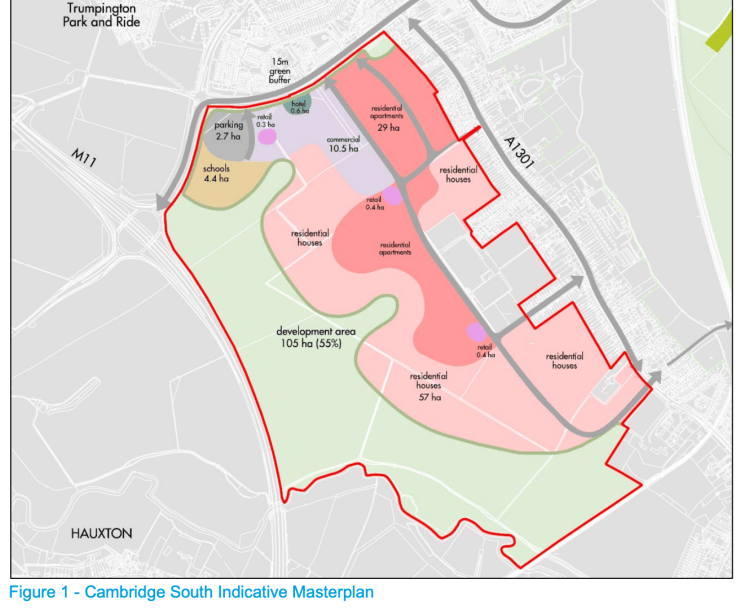
Above – Cambridge South Vision Document (Part 1) p5
You can browse through the catalogue of submitted public documents to the GCSPS here
Above – the 2021 iteration of the Cambridge South vision with the three main institutional land owners – mindful that the vast majority is owned by JCC.
“Anything to say about this one?”
I’ve been aware of this old chestnut of a proposal for a number of years but I haven’t written much about it beyond mentioning its existence because council planners turned them down in favour of other sites – similar to the successive attempts by Commercial Estates Group and their advisers, with the fields heading out of south east Cambridge, which so far have managed to avoid the worst of the Barratt-Box-Dystopia. It remains to be seen whether recent research in neuroarchitecture along with the change of government and changes to the Government’s planning policies following the recent Acts of Parliament will result in substantive improvements to the sorts of schemes put forward in recent years.
Put simply, if everything was working splendidly the new government would not needed to have legislated or changed the planning policies.


Above – does Cambridge risk a Blandemic as feared by the Humanise campaign against boring buildings?
Neuroarchitecture – Financiers need to be aware of it, developers need to read up on it, and architectures need to refresh their ideas because of it
Feel free to look at the research of Dr Cleo Valentine who was awarded her Ph.D from the University of Cambridge for her pioneering research in this emerging field. Also have a watch of this interview with her on Architectural Neuroimmunology and how the Built Environment Shapes Stress
In a nutshell. Dr Valentine and colleagues have been able to quantify the increase in the mental stress generated in the human brain due to the different environments people find themselves in. (See also one of her research papers here) With many contemporary building designs (interior as well as exteriors) the risk of higher levels of mental stress is increased. Which is not good if you are pitching your case in/around the Cambridge Biomedical Campus where the hospitals are meant to be helping people get better.
Developers: Don’t use AI-slop for your proposals. Commission an artist who is local to where you want to build
Your industry extracts enough wealth from local communities as it already is. At least try to reinvest something back into them.
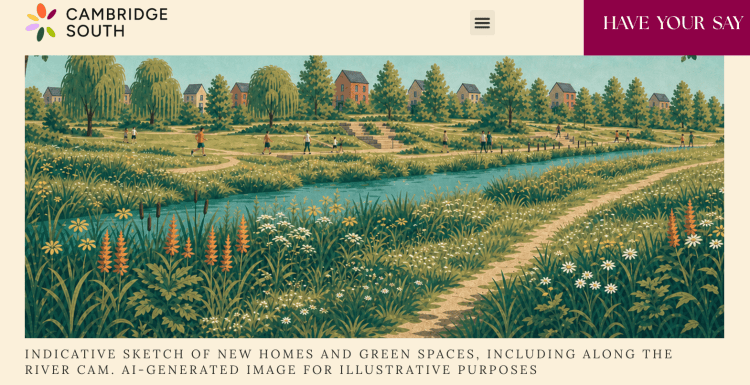
Above – this is AI-Slop. It’s not a sketch because no one has sketched it. https://cambridgesouth.co.uk/ Don’t do this.
“What should people ask at the public events?”
Although this guide is for Wales, the questions included in the latter stages of the pamphlet are relevant for public consultation events
The Planning portal lists the material considerations here.
- Overlooking/loss of privacy
- Loss of light or overshadowing
- Parking
- Highway safety
- Traffic
- Noise
- Effect on listed building and conservation area
- Layout and density of building
- Design, appearance and materials (thinking the blandemic?)
- Government policy
- Disabled persons’ access
- Proposals in the Development Plan
- Previous planning decisions (including appeal decisions)
- Nature conservation
I think with all of them it’s worth finding out if in principle they are prepared to go beyond the bare minimum that the law requires, or if they are prepared to go for a ‘better than best in class’ development.
It’ll be interesting to see what the feedback from residents shows.
If you are interested in the longer term future of Cambridge, and on what happens at the local democracy meetings where decisions are made, feel free to:
- Follow me on BSky
- Spot me on LinkedIn
- Like my Facebook page
- Consider a small donation to help fund my continued research and reporting on local democracy in and around Cambridge


