It’s just over three miles between the two venues for the events yesterday and today. Beyond that, they could have been on different countries
I was going to say ‘planets’ or ‘solar systems’ or ‘galaxies’ but that would be a bit over-the-top. But my point remains: The challenges that the two events were discussing included the same city, but it felt like the one with the money and the power was completely oblivious to the challenges faced by the other with a community having been crushed by austerity.
Image: North Cambridge – Framework for Change 2025
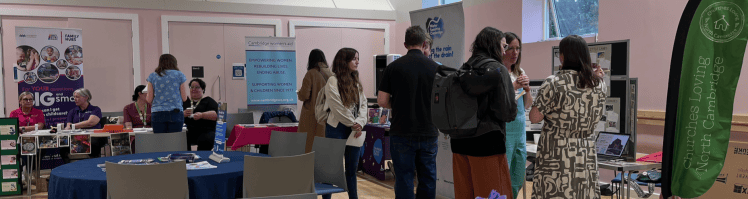
Above – the opening 90mins functioned as a sort of mini societies fair for North Cambridge but with the focus on established providers rather than grass-roots community groups
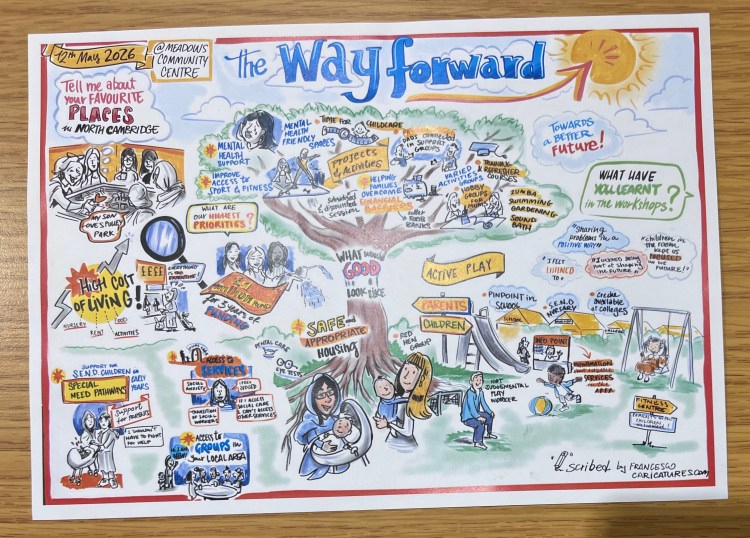
Above – the illustrated result of work carried out by Collective Futures as part of an ongoing project with families with very young children in North Cambridge, funded by philanthropists from the venture capital sector
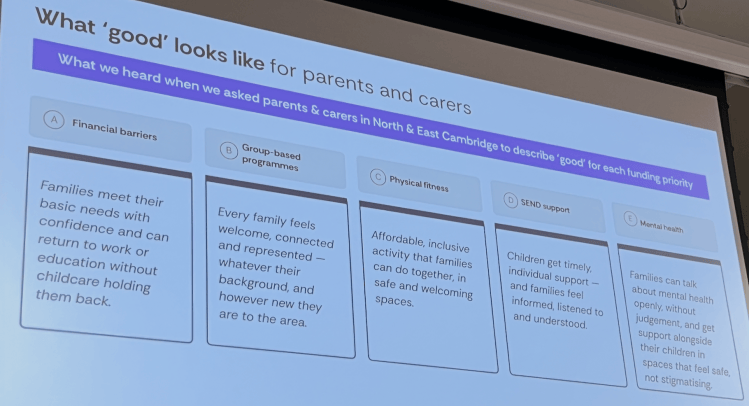
Above – from Collective Futures: What the participating parents and carers of young children in North Cambridge said what ‘good’ looks like
Are developers aware of things like this? Are they challenging their design professionals to ensure these are designed into new developments?
What would continuous programme over an extended period of time (mindful of
One of the first conversations I had was with a frontline community worker who told me how the neighbourhood had declined significantly over the past decade.
The most consistent issue that came up was lack of safety as a result of crime and anti-social behaviour. When I got back earlier this evening I found former city councillor Sam Davies picking up on this.
Above – Sam Davies on Birdsite
“If we can’t get the basics right, what hope do we have with the rest?”
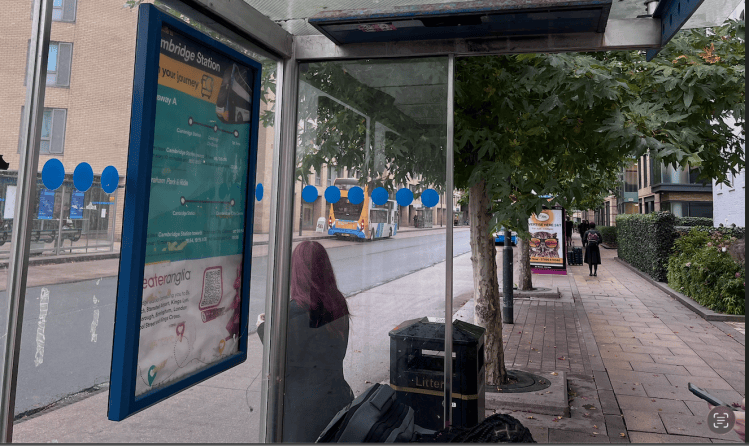
Above – Cambridge Station bus stop for the Busway A service looking in a sorry state from earlier today (07 October 2026).
Brookgate’s controversial showcase development that I love to despise and moan about showing symptoms of a broken city:
- The live electronic bus times panel has been removed
- There are no replacement paper posters with the timetables
- There is a very poor phone signal – the sorry site of a huddle of us passengers trying to get a signal was almost comical…
- …and then became comical when the busway bus rocked up absolutely jam-packed so that only a couple of people could get on.
That bus was packed full of teenagers at the further education colleges in South Cambridge, with more teenagers waiting to get on at Cambridge Station
The full-to-capacity buses and lack of extra provision wasn’t mentioned at the Bidwells event that I was at the previous day (see my blogpost here). But the very poor mobile phone signals both on the trains and in various parts of the city (such as in the Corridor of Doom at the Cambridge Station bus stops around the corner from Station Road) were. I overheard a couple of businessmen saying it was embarrassing hosting events in Cambridge with people from tech powerhouses hearing them complaining about how awful the mobile signals or the wifi signals were.
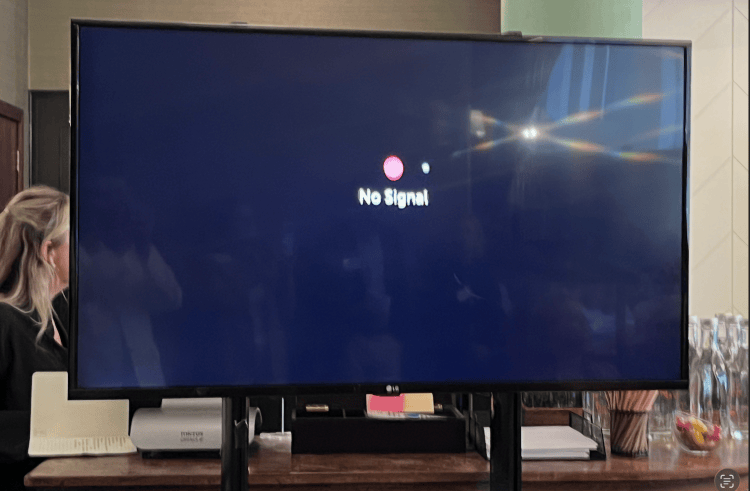
Above – the screen at the Clayton hotel that was meant to synchronise with the main on-screen presentation. It was working at the start but broke off after the first five minutes
The expressions on the faces of the people around me showed that this is still a normal experience in the business world. Which is one of the reasons why I’ve switched back to paper hand outs for the workshops I do. (I’ve also found that large print outs help facilitate conversations between people who might otherwise not talk to each other).
Two very different cohorts dealing with the same problems of connectivity
Given that the provision of all of these is the responsibility of private firms, I’ve often wondered why business leaders and business lobby groups have not appeared on high profile platforms criticising the failures of their fellow business chiefs in the provision of services that impact the lives of so many of us – inevitably having an indirect impact on the success or otherwise of so many firms. Why do we not hear about business figures grilling the board members of Stagecoach about their woeful performance?
‘Business people won’t travel by bus, but they will travel by tram, light rail, and underground’
…is a quotation I’ve had said to me on more than one occasion over the years when trying to make the case for light rail. Before that I’ve often used the words of the former Mayor of Bogota in Colombia.
“A developed country is not a place where the poor have cars. It’s where the rich use public transportation“
Above – a quotation often attributed to Gustavo Pedro as Mayor of Bogota
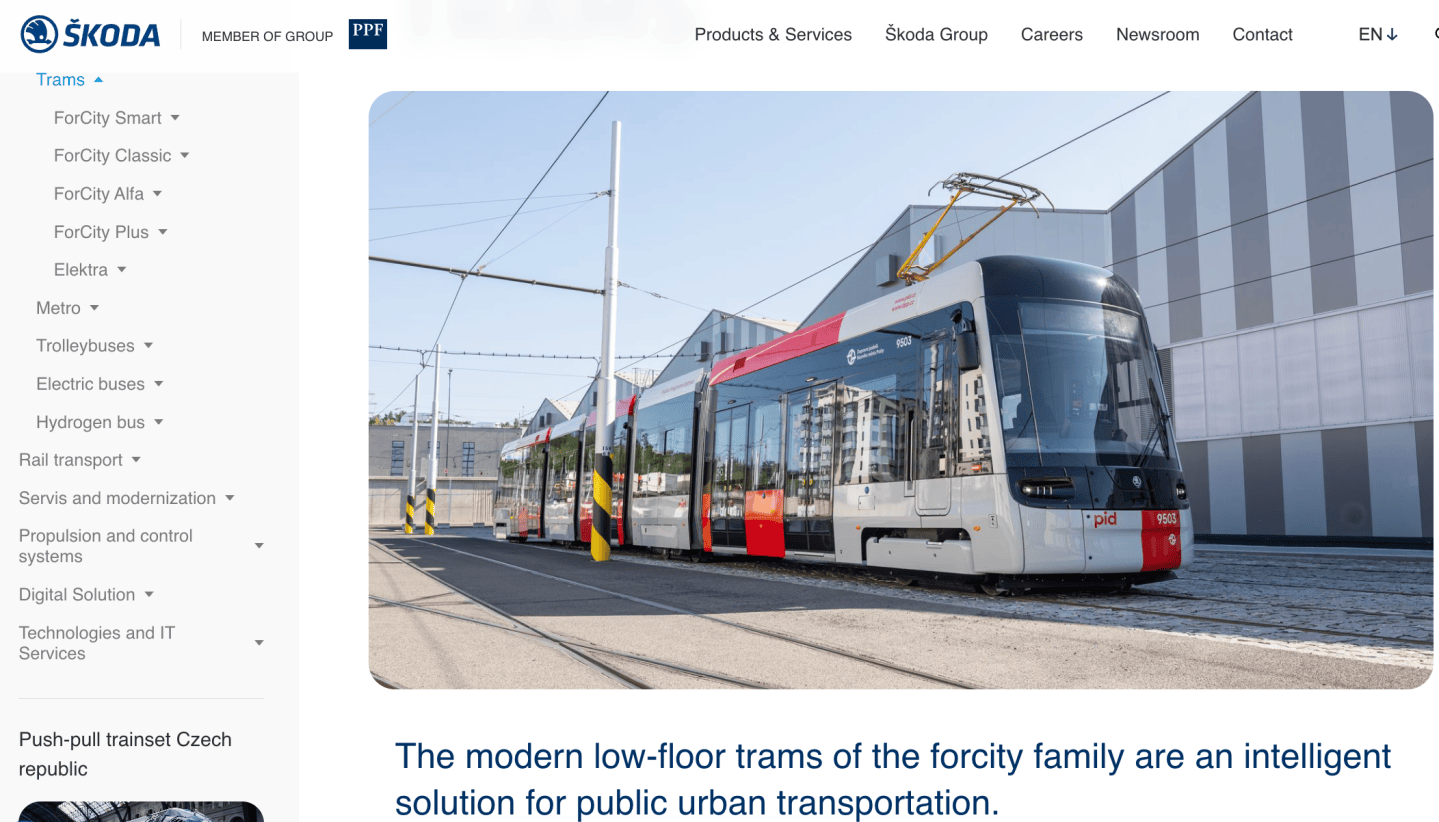
Above – we’re still not having meaningful conversations in Cambridge about stepping up the type of public transport systems – and the routes they should take in an ever-growing Cambridge
I completely understand why some people say Cambridge’s historic centre is not suitable for electric trams, or that the existing city is too small for rail-based public transport. If Cambridge wasn’t growing its current housing stock of around 60,000 dwellings, I’d agree. The problem is the discussion yesterday involved the opening presenters from Bidwells talking about *how* to build 150,000 new homes by 2045. Hence as ministers have stated that this is their target, they need to plan and fund the construction of a public transport / mass transit system for a city that has over 200,000 dwellings which means a population of around half a million.
“Well if you can’t stop them boys throwing things off of the Guildhall roof, you’re not gonna be much good at building a light rail system or all them ‘ouses, are ya?”
Above – paraphrasing an anecdote from the late Frank Dobson recalling a tale told to him as a young campaigner by a veteran of interwar campaigning who was brought back down to earth over local anti-social behaviour, after telling a resident how voting Labour would stop fascism in Europe.
The frequency of interactions matter
Especially those that bring together people who otherwise don’t get to talk to each other in their day-to-day lives as equals. This is one of the principles behind Mixed Communities as a planning policy objective. One local historical example of trying to build in diversity in residential areas is Hartington Grove in Cambridge, built in the late 1800s/early 1900s. (In my childhood I had family friends who lived down that road). As you can see in the link above, the homes on the left are notably grander than those on the opposite side of the road, the former with larger front gardens with off-street parking and an additional storey. That also reflected what I remember of primary school not far away, where children living in council homes were in the same classes as those who were the children of senior university academics – until the lure of the local private schools in the later years changed that balance.
The crossover between public policy on tackling loneliness in society, and polarisation in our city
“The solution lies beyond simply asking people to be better neighbours. We need to look at the structural drivers that make our cities such lonely places.”
“The fact is that traditional ‘third spaces,’ which have historically nurtured community, have dwindled across the UK. The cafés, pubs, places of worship, libraries and hair salons that were once the lynchpins of community interaction no longer play the role or even have the very presence they once did.”
Above: Greg Moss in AJ 30 July 2025
Mr Moss then goes onto mention both Eddington and Marmalade Lane in Cambridge
The problem with both case studies is that their circumstances do not apply to the standard large developments. All too often we see £value extracted by land speculators, creating financial pressures to reduce the size, scope, and quality of those important third spaces and larger open green spaces. My hope is that the Greater Cambridge Development Corporation will be able to deal with that problem with its greater powers on land acquisition, assembly, and wider borrowing powers.
My anecdotal standard for large open green spaces is somewhere that is large enough for teenagers to play team games. And for indoor community spaces, as one of the volunteers at the new Cherry Hinton Hub told me, a large hall needs to be much larger than what was provided for there. Again, my anecdotal minimum standard is a hall large enough to fit two badminton courts in.
If we take the words of the former Mayor of Bogota and apply it to community and social spaces…
*A successfully integrated city at ease with itself is not one where each group chooses to live within their own gated communities with residents’-only facilities, but one where people from all incomes and backgrounds choose to pool their resources, share the space, and create much larger, shared facilities that are greater than the sum of their parts.”
One of the best examples I experienced during my London years was when I lived around the corner from Russell Square. No front gardens or back gardens because of the medium-high density of the accommodation, but instead a medium-sized tree-covered park in a city that gets very hot in the summer.
Those two contrast with the ghastly Marque and Belvedere developments at the junction of Hills Road and Cherry Hinton Road, with their towers glowering menacingly over Cherry Hinton Road – the benefits privatised and the losses socialised.
Ten years ago I included both in an article where I described the two plus three other developments as ‘a toxic quintet’. That was just over a decade after the opening of the Cambridge Leisure Park which happened in 2004 – one where as local residents we had such high hopes, especially for the long-awaited bowling alley.

Above “The Belvedere, The Leisure Park, The Marque, Grand Central and CB1 – a toxic quintet of controversial developments in my neighbourhood” ADBF: 28 October 2016
That was in a blogpost I titled: ‘How developers game the planning system – a Cambridge case study’
That the Leisure Park is now being sold off by LandSec (I wrote about it here) and included as a site of major change in the local plan so soon after it was completed tells its own story.
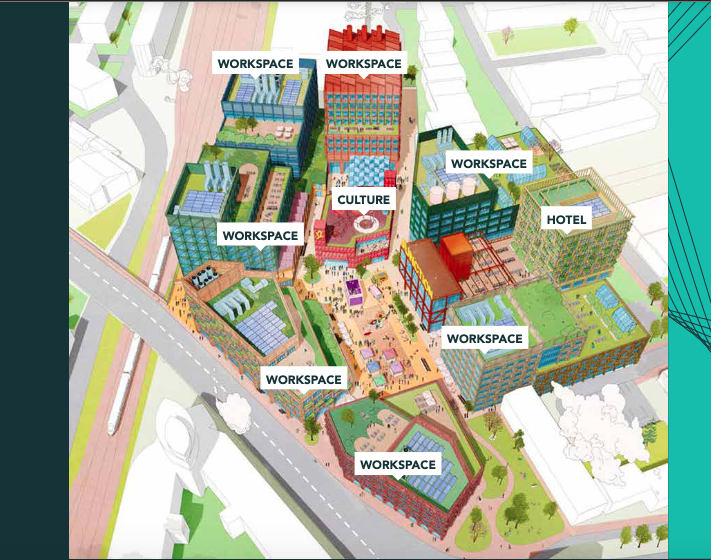
Above – from the sales brochure for Cambridge Leisure Park. (It’s unlikely the final site will look like this!)
This isn’t just about events and workshops that bring people together for an hour or two before never seeing each other again
In 2017 Michael Sheen set out that challenge when he gave that year’s annual Raymond Williams lecture.
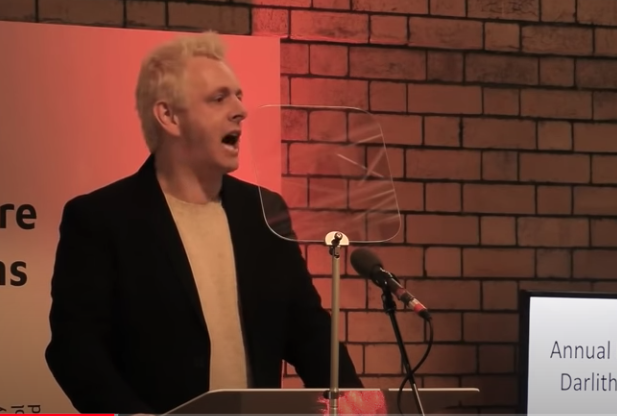
“If we are to have any kind of a future, then we must face the reality of our present – and that means a reckoning with the legacy of our past.”
When you hear Michael Sheen say it, it’s far, far more powerful. Have a listen here.
And the legacy of our recent past is one that led to Cambridge becoming the most unequal city in the UK, as journalist and local resident Donna Ferguson highlighted in The Guardian back in 2020 here. In it she mentioned the establishment of https://cambridge2030.org/ – we are now six years down the line. (People can apply for grant funding for up to £5,000 here)
And that’s the hard ask if we are to break the negative cycles and the structural barriers. It involves:
- a time commitment
- a social commitment with people and in places you might not choose to be with
- knowing that the process will at times make you feel uncomfortable – and challenge you in a way that you may never have been challenged before
- has no guarantee of success
- won’t result in an end-of-year corporate financial bonus (that one specific to private sector property industry people!)
One thing it will do if such a long term programme is designed and implemented is that it will:
- change you as a person as a result of having participated (more than likely for the better)
In one sense the early work on Shaping North Cambridge is already doing all of the above.
Which is one of the reasons why I went to the event on 07 October 2026 at The Meadows Centre. I wanted to get an idea of what they were doing to see how much of it is applicable to those of us south of the river other than Abbey ward, which design-wise is very similar to the north Cambridge post-war council estates. Because the poverty and multiple deprivation we have is in micropockets compared with Arbury and King’s Hedges. This means that those smaller developments of interwar and post-war council housing fall through the statistical tiers that central government uses. So when things are averaged out, the poverty is hidden on paper. Interestingly, this is one of the issues that Collective Futures wanted to take on.
A programme of term-time weekly sessions over an extended period of time
This reminds me of blogposts I wrote three years ago here, and here which were focused on democracy and civics for resident adults rather than about improving our city. The reason being that the government at the time was not interested in the sorts of programmes and policies that we are now seeing coming from central government.
The final words are from actor Michael Sheen
“You have to learn how to listen.
It’s not just a question of standing there with a clipboard and asking questions with the right look on your face.
You have to show up.
And stay around.
You have to let go of your assumptions and your biases and your agendas and your prejudices.
It’s really hard.
Speak to the people who are on the frontline of working in communities.
The ones doing the really tough work of giving support where it is desperately needed.
Where their resources are getting smaller all the time but the need for what they’re doing is getting greater every day.
Ask them about listening.
Because they’re really good at it.
But they’re also the ones who’ll say that they’re not being listened to.
He concludes:
“We must affirm each other.
That is where our future lies.
That is where we build from – each other.
Use what voice we have in the service of each other.
Whenever we can, join our voices together to help create a Wales that is our ‘own world’, as Williams described it.
A world that can argue, and challenge, and question, and explore.
A world that can encompass multiple histories, and diverse experiences.
A world that does not avoid its past or ignore its divisions.
A world where our difference can become the source of our strength.
Confident enough to take control of our own energies and our own resources.
Connected to each other and taking responsibility for ourselves.
That is how we build our dragon.
Put real flesh on its bones.
And hope that, one day, it will fly.
Thank you“
Above – The 90 minute speech Michael Sheen gave for the Raymond Williams Annual Lecture in 2017
Replace the words “Wales with “Cambridge” , “Welsh” with “local”, and “World” with “a city” and you could say the above could apply to a future Cambridge.
If you are interested in the longer term future of Cambridge, and on what happens at the local democracy meetings where decisions are made, feel free to:
- Follow me on BSky
- Spot me on LinkedIn
- Like my Facebook page
- Consider a small donation to help fund my continued research and reporting on local democracy in and around Cambridge


