
But before I start…
The joys of longterm chronic illnesses means I will probably spend the next couple of days tucked up in bed because of the post-exertional malaise that goes with CFS/ME. Hence why I blog lots because I don’t get out of the city unless someone takes me, and also because undiagnosed AuDHD (waiting lists!) means my mind does not stop so I try to put it to good civic use!
Supporting my blogging
For those of you find what I post useful/interesting, and are willing and able to contribute to my costs (which also includes sourcing long lost reports that still read well today – I’m a historian!) please see my Ko-Fi page at https://ko-fi.com/antonycarpen

I posted a few updates on Bluesky on the #OxCamArc hashtag, but it will never make up for the old Birdsite hashtags from events over a decade ago where participants exchanged comments and hyperlinks with ease.
Which is a shame – because under past owners it was possible for participants unable to be in the room to take part and submit questions remotely that hosts could then read out for panellists and the room to discuss.
Perspectives from Oxford and Milton Keynes. It’s not all about Cambridge
Oxford is going through something similar to Cambridge, with one of the most recent statements to Parliament from the Minister for Housing Matthew Pennycook MP from March 2026 here.
Milton Keynes on the other hand has got its draft local plan for 2050 ready for its examination in public – a few steps ahead of Cambridge
“Which of the three cities is the largest?”
Turns out it’s Milton Keynes with over 250,000 people within its boundaries – the city having become a unitary council back in 1997.
Oxford’s population at the 2021 census was 162,000 – hence why Oxford City Council like Cambridge remains a lower tier borough/district level council
Cambridge’s population at the 2021 census was just over 145,000 and as I’ve spent the past decade complaining about on this and my previous blog, has spent the past half-century constrained by the politics of the county council who, since the late 1990s until 2021 seldom shared the party political leadership of the mainly rural county.
“What does good growth look like for the Oxford-Cambridge Growth Corridor?”
A couple of people at the event pointed out to me that no one had defined what ‘good growth’ meant. This was further highlighted by a couple of the speakers who said that one big thing missing was ‘a national plan’.
“Local plan, regional plan, national plan…isn’t the risk you get swamped in paperwork?”
George Dibb for Labour List back in October 2023 wrote a prophetic piece on what Sir Keir Starmer needed to learn from with Harold Wilson’s failed National Plan of the 1960s when he led Labour’s government. What the speakers said was that they wanted was to know where the proposals for growth in the OxCamArc fitted within a wider national plan. The closest we’ve got was Sir Keir Starmer’s 10 year infrastructure plan here. Another participant mentioned to me that a number of areas east of Cambridge wanted to latch onto the eastern end of East West Rail and similar so they did not miss out on the benefits of growth.
Trying to achieve highly Political objectives without getting involved in Politics
You’re probably familiar with the phrase ‘Let’s take the politics out of it’. But then politics is the means by which we resolve our differences in order to live together without resorting to war and violence. The provision of health, education, housing, and public health are some of the most important political issues around for the general public. The proposals to change the places where people live is also falls within that. The inevitable challenge is how to share out very limited resources (including land) in a manner that at least does not incite mass disorder and public rebellion. (Ideally informed public consent to a system that results in equitable distribution but then I’m living in one of the most unequal cities in the country…)
The ongoing problem is with Politics – Party Politics more generally which has dangerously low levels of trust so as to be compromising how the state functions and the provision of public services. But this isn’t the blogpost for that. It’s just to acknowledge that this is the context we’re in. And developers like the general public cannot and should not ignore the most local tier of politics, that of local government.
Like so many other sectors of the economy I’ve stumbled across in life, the property and construction sector ***really does not like talking about Politics***. I watched Cambridge’s Sci-Tech sector channel many of its problems through Dr Julian Huppert in the early 2010s (even though some of them could easily have chosen the former Health Secretary of that era who was also the MP for South Cambridgeshire), while staying out of the Political fray. Even over a decade later I still think the sci-tech community in Cambridge should have provided more campaigning support for Dr Huppert in the 2015 general election campaign. The history of the Liberal Democrats turned on that sixpence as he lost his seat to Labour’s Daniel Zeichner, who has held onto it in subsequent general elections by sizeable majorities.
The Green Party as the official opposition on the city councils of Oxford and Cambridge
In Oxford, The Green Party have 13 councillors to Labour’s 20
In Cambridge, The Green Party have 12 councillors to Labour’s 17
Both councils are under no overall control. Oxford isn’t due to have local elections in 2027, but Cambridge is. What are the Government’s contingency plans should The Greens become the largest party in Cambridge following the 2027 elections in May? Other parts of the country face challenges from other parts of the political matrix – in particular North Cambridgeshire (Fenland voted 75% leave in 2016). Which brings its own challenges.
We know our political system is broken – but we can’t sit and wait for Westminster to sort things out while there are so many urgent issues to deal with, from the climate emergency to disinformation in the media.
At the moment the informal structures are not functioning properly – it’s not just the formal mechanisms that are struggling
One thing that the current processes are lacking is a ‘Political release valve’ for local residents – one that enables councillors to act as community champions with local mandates, and one were developers and their consultants can be challenged to improve their proposals.
At the moment the structures are both confrontational and lacking in transparency
Before a crayon has been sketched, developers should be doing a meaningful set of workshops similar to what Marshalls did for their airport site over three years ago. I went along to that consultation (which should have been in a much more accessible venue!) and they told me to my relief that all of the old proposals for grey concrete blocks had been scrapped and that they were starting again. (See my blogpost here). Some of the more socially-responsible developers have made the effort to find out from local residents – in particular children and teenagers, what their needs, hopes, and opinions are. This is something that South Cambridgeshire District pioneered and formalised to take the organisational pressure off of schools. The revamped Citizenship curriculum for schools coming in in the next few years should provide further opportunities to commission standardised materials for most if not all of the state schools to participate. (See the Association for Citizenship Teaching – would be good to get a cohort of new teachers in Cambridge qualified in citizenship teaching who are also knowledgeable of the housing and transport planning essentials as well).
Communications between developers and local residents, and from central-government-sponsored institutions and local government has lots of room for improvement
It’s one of the reasons why I didn’t feel the upbeat vibes that some in the room did at the end with the call to action. In particular I did not get any sense on what developers were prepared to forego in terms of profits to pay for amenities and facilities beyond the bare minimum – mindful of what both Peter Freeman (Greater Cambridge Development Corporation) and several years earlier, Dr Andy Williams before his Ox-Cam-Supercluster days had said.
“What did they say?”
That previous generations of housing growth had not provided enough of the infrastructure (transport, amenities, facilities, large enough open green spaces) that were needed to sustain the communities that now lived there. As Mr Freeman repeated, that infrastructure must be in place, and in place much earlier in the system. Otherwise we risk another Northstowe with the grim headlines of 2023.
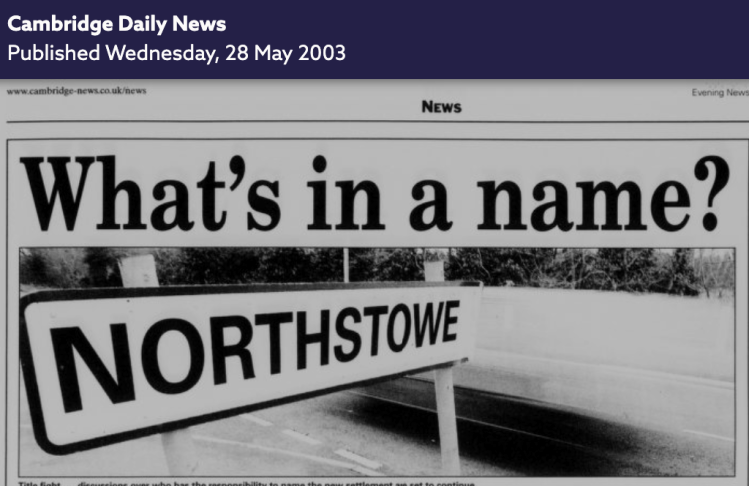
Above – over 20 years of failures of both government and the construction industry? The Cambridge Evening News of 28 May 2003 reporting on the selection of the name of Northstowe for the development.
If there are any university students looking for a research topic, everything that led to the headlines of July 2023 on Northstowe – starting from the late 1990s would make for a challenging but timely topic!
Providing residents with the knowledge tucked away in the in-depth local plan evidence reports
On my Future Cambridge page I’ve managed to pick out a host of topic papers, highlighting what I see as important evidence bases on issues that are important to the wellbeing of people and environment.
What would it be like if workshops involving developers and local communities involved having summaries of those reports and summaries of the requirements/restrictions of national and local planning policies at the very start of the design process?
“What would that do?”
Rather than having opinionated so-and-sos like…me turning up to public consultation events with a list of demands (“Be realistic: Demand the impossible!” says one of the fly-posted stickers in my neighbourhood!) we’d get a better shared understanding of what the evidence informing the local plan said was needed. And the evidence bases for the current draft local plan (which I included in Future Cambridge here) have some splendidly large requirements – such as a new large indoor music venue in the Cultural Infrastructure Strategy Interim Report of July 2026.
Corporate documents produced by private sector institutions not getting the critical scrutiny they need.
Scaling OxCam (2026) Public First is one such example – a report ‘accepted as given’ in the opening remarks. Which surprised me because I picked more than a few holes in it. (See my blogposts on 02 Oct 2026 here, and 03 Oct 2026 here). Which is why I think it is dangerous for the local government sector to rely on policy reports by external institutions that are not bound to the same codes that the civil service and local government officers are bound by. And interesting as I find the Cambridge Ahead reports – especially from their young advisers’ committee, local government needs a sound policy-making function that has the capacity to match the demands placed on it. Cambridge has not had this for nearly two decades. It has a fascinating statistical function in Cambs and Peterborough Insight which is great if you like playing with numbers and throwing them at graphs to see what you get. But not everyone is comfortable with knowing where to look and knowing how to process and analyse data. And we don’t have the adult education colleges to enable the upskilling of cohorts of people together in a social environment.
While the University of Cambridge has established the Bennett School of Public Policy, there is not what I would consider a ‘technical level’ tier that would enable school leavers to upskill in the equivalent of affordable evening classes or day classes. The fees at Cambridge Regional College for the BTEC Level 4 (so beyond A-level, first year undergraduate equivalent) at over £5,000 are far out of reach of most adults who might otherwise be interested in enrolling. Furthermore, there are a host of additional modules that if I were a large public sector employer I would want to see on the syllabus – not least something on data analysis, AI in the public sector (including ethics), and something central and local government.
Comparing clusters in England with any clusters in other countries *must* incorporate proper analysis of the different structures of their nation states
I tried to ask that point when the city of Austin, Texas, in the USA was mentioned but no one picked up on it. So I’ll repeat the points from my earlier posts:
Austin, Texas, USA: There are only 11 councillors on Austin City Council, which sits within Travis County – that has its own functions. These all of which sit within Texas State (with its own governor, house of representatives and state senate). The component states then sit within the Federal Government.
“Most Americans have more daily contact with their state and local governments than with the federal government. Police departments, libraries, and schools — not to mention driver’s licenses and parking tickets — usually fall under the oversight of state and local governments. Each state has its own written constitution, and these documents are often far more elaborate than their federal counterpart. The Alabama Constitution, for example, contains 310,296 words — more than 40 times as many as the U.S. Constitution.”
Above – the archives of the Whitehouse under President Obama
In the USA the federal tier of government cannot intervene in issues of local government unless the US Constitution empowers it to do so. This is not the case in the UK where we have a Sovereign Parliament that can legislate however it pleases on local government. As it did when the Minister for Housing and Planning, Matthew Pennycook MP formally asked MPs to approve the legislation needed to create the Greater Cambridge Development Corporation in a debate in Parliament – one repeated with Baroness Taylor for the Government in the House of Lords. (You can watch the video of the former here).
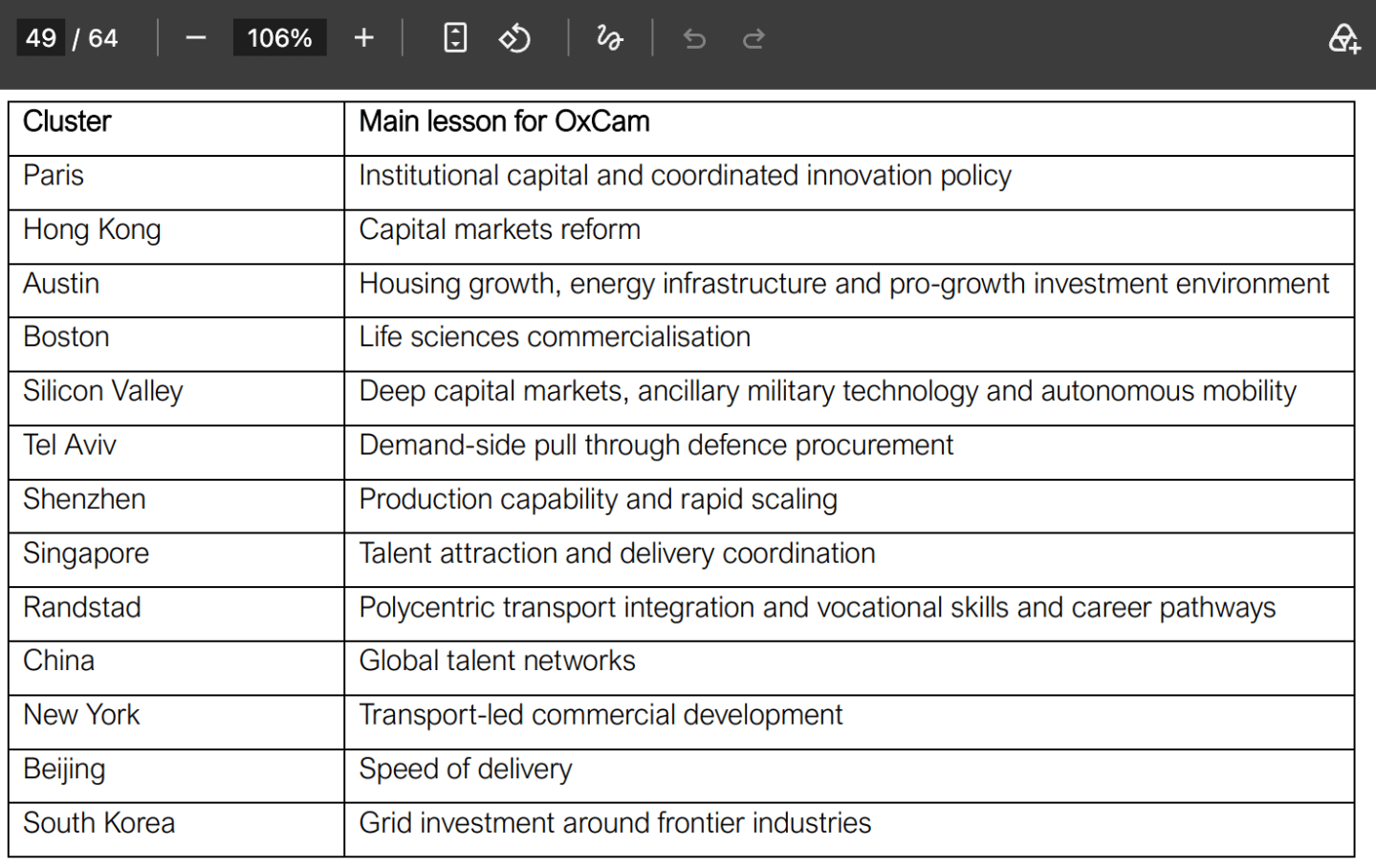
Above – Scaling OxCam (2026) Public First, p47/p49pdf
On the table above:
- Which of those main lessons are the responsibilities of which tiers of government or which institutions?
- Which of those benefits would involve compromises that the general public and elected politicians would be unwilling to compromise on? Such as giving up democratic freedoms in favour of ‘getting stuff done fast’?
- Which of those benefits cannot be gained because of deep-seated barriers – such as geographical ones such as a fixed land supply with multiple competing needs including agriculture for food security? Or cities surrounded by flood-prone land?
- Which of those main lessons would developers be willing to compromise some of their financial gains in order to get public support? Such as contributing much more than present towards upskilling and reskilling the workforce? (Economist Frances Coppola wrote a superb piece on how firms were externalising the costs of training their staff in The Bifurcation of the Labour Market back in 2013.)
“It’s like a city in a developing country: there is a “core” of highly-skilled, highly paid and largely protected people for whom businesses compete internationally, surrounded by a growing “shanty town” of low-skilled, poorly paid and increasingly insecure workers.”
Above – Frances Coppola (2013)
Which developers would be willing to contribute more financially for the education and training facilities for adults as well as teenagers to fill those chronic skills gaps? Or does this require further state intervention and compulsion?
If you are interested in the longer term future of Cambridge, and on what happens at the local democracy meetings where decisions are made, feel free to:
- Follow me on BSky
- Spot me on LinkedIn
- Like my Facebook page
- Consider a small donation to help fund my continued research and reporting on local democracy in and around Cambridge

